Chapter 1

Two streams

One god, two traditions — a northern war-god, and the most beloved deity in the south, who is older still

The red god of the hills

Tamil's oldest poetry — from the Sangam age, two thousand years old — knows a god: Murugan.

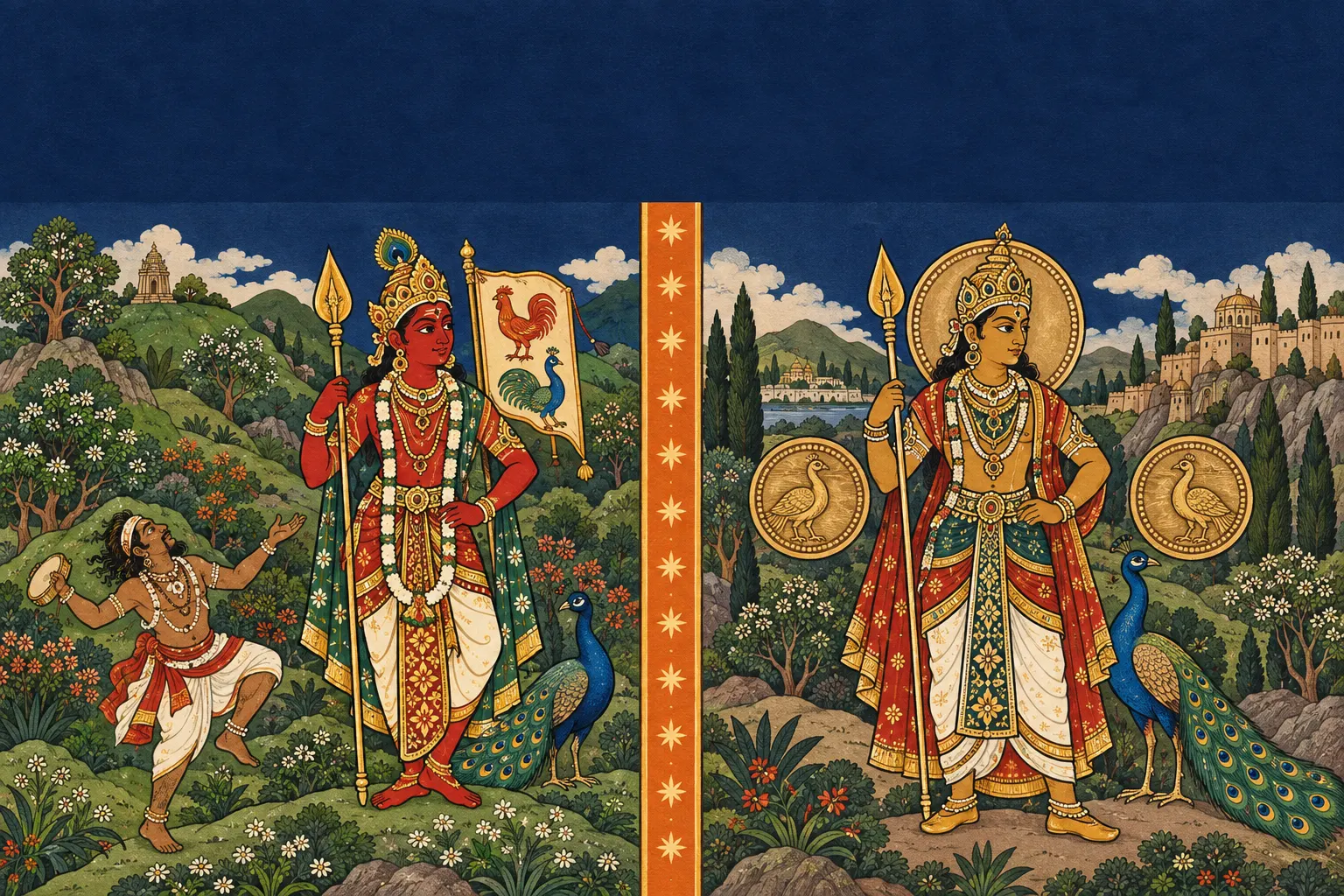
There he is the god of the hills, of the "kurinji" land. Youth, war and love are his. His colour is red. His mark is a lance — the vel. A rooster and a peacock ride his banner.

He is worshipped by a priest called a "velan", who dances himself into the god's possession.

Nakkirar's Tirumurukarruppatai — "the guide to Lord Murugan" — is one of the oldest sustained hymns to any Hindu deity. It also names his six shrines.

The general of the north

Away in the north, around the same time, there is a different god: Skanda.

On the coins of the Yaudheya republic he stands with a spear and a peacock — a state deity. On the coins of the Kushan king Huvishka his names appear — Skanda, Kumara, Mahasena, Vishakha.

The Gupta kings named themselves for him — Kumaragupta, Skandagupta — and Kumaragupta I's coins show Kartikeya seated on a peacock.

Here he is a warrior, the general of the gods.

An older layer still

But in the oldest layer Skanda is not so gentle.

In the Mahabharata's own Skanda passage, and in medical texts like the Sushruta, "Skanda", "Vishakha" and "Kumara" are counted among the spirits that seize and afflict small children — spirits you performed a rite to keep away.

The gentle general is a later resolution. It is the same with Ganesha, who began as a troublesome power.

Two rivers met

By the Gupta period the two gods are taken as one.

Birth from the Krittikas, the Taraka war, being the son of Shiva and Parvati — that is the northern frame. Tamil tradition takes it on, but keeps the vel, the peacock, the rooster, Valli and the six shrines as its own.

It would be wrong to say "he was always one god". It would also be wrong to say "the north stole a Tamil god". Both streams are old, and they met here.

Note: Murugan is an established deity in the Tamil Sangam literature (roughly 3rd century BCE to 3rd century CE) — god of the kurinji (hill) land, with the vel, the peacock and the rooster; Nakkirar's Tirumurukarruppatai is his oldest sustained hymn and names six shrines. In the north Skanda is a war-god on Yaudheya coins of the early centuries CE and on Kushan coins under Huvishka in the 2nd century CE; northern images of Karttikeya-Skanda are independently attested by about the 1st century BCE. The Gupta kings Kumaragupta and Skandagupta are named for him. In the Mahabharata's Skanda passage and early medical texts, "Skanda / Vishakha / Kumara" are also child-afflicting grahas — the benign-general form is later (as with Ganesha). By the Gupta age the Tamil Murugan and the northern Skanda are being identified. Murugan has in modern times been claimed both as a symbol of Tamil-Dravidian identity and as fully a pan-Hindu deity; the antiquity of his Tamil worship is not in dispute, and this epic takes no side in that politics.

Source: from several texts and traditions, Two streams

Now — how much stayed with you?

Fact

In the Sangam-age Tamil poems, Murugan is the god of which landscape?

  • The seashore
  • The hills
  • Farmland
  • The desert
Read the whole story — The red god of the hills

Sangam poetry divides the Tamil land into five "tinai", each with its own god.

Murugan is the god of the kurinji — the hill land. His colour is red, his mark a lance.

This is an ancient Tamil layer, older than the later Sanskrit synthesis with the northern Skanda tradition.

Fact

One mark is attached to Murugan in both north and south — which?

  • The discus
  • The trident
  • The lance
  • The mace
Read the whole story — The vel

In Tamil tradition the vel is given by Parvati / Shakti — the spear of wisdom.

In the northern texts it is a shakti, sometimes from Agni, sometimes from Indra.

In both streams, the lance is his true weapon.

Who am I?

In the oldest Tamil poems I am the red god of the hills, with a rooster and a peacock on my banner. In the north I am the general of the gods. Who am I?

  • Murugan / Skanda
  • Indra
  • Agni
  • Hanuman
Read the whole story — One god, two names

In the south he is Murugan — the Tamil god.

In the north he is Skanda, Kartikeya, Kumara — the god of war.

By the Gupta period the two are taken as one.

Later tradition

Nakkirar's Tirumurukarruppatai is one of the oldest sustained ___ to any Hindu deity.

  • temples
  • images
  • inscriptions
  • hymns
Read the whole story — The oldest devotion

"Tirumurukarruppatai" means "the poem that guides you to Lord Murugan".

It celebrates six sacred places of Murugan.

A long, sustained hymn this old is rare for any Hindu deity.

Fact

Which Gupta kings named themselves for this god?

  • Chandragupta and Samudragupta
  • Kumaragupta and Skandagupta
  • Harshagupta and Devagupta
  • Ghatotkacha and Sri Gupta
Read the whole story — A god of kings

By the 5th century Kartikeya is a royal, martial god.

Kumaragupta I's coins show him seated on a peacock.

Skandagupta's very name carries the god's name.

What happened?

In the oldest layer — the Mahabharata's own passage, medical texts like the Sushruta — what kind of powers are "Skanda", "Vishakha" and "Kumara"?

  • Spirits that seize and afflict small children (grahas)
  • Charioteers of the gods
  • Guardians of rivers
  • Sages of the Vedas
Read the whole story — The one who used to frighten

The gentle-general form is a later resolution.

Early on, Skanda is counted among the child-afflicting grahas.

It is the same with Ganesha, who began as a troublesome Vinayaka.

Why is that?

Why does this chapter open with "two streams" rather than one continuous story?

  • Because the story is very long
  • Because the texts are lost
  • Because this god really is a fusion of two old traditions
  • Because there are two separate gods people wrongly take as one
Read the whole story — Two rivers met

The Tamil Murugan is an established god from the Sangam age.

The northern Skanda is a war-god on Yaudheya and Kushan coins.

It is wrong to say "he was always one", and wrong to say "the north stole a Tamil god".

Fact

On which coins does Skanda appear as a state deity with a spear and a peacock?

  • Chola coins
  • Yaudheya coins
  • Maurya coins
  • Satavahana coins
Read the whole story — A republic's god

The Yaudheyas were a military republic and took Skanda as their state deity.

Their coins show Skanda with a spear and a peacock.

These Kartikeya coins are of the early centuries CE.

What happened?

Taking on the Sanskrit frame (Krittika birth, the Taraka war, son of Shiva–Parvati), which things did Tamil tradition keep as its own?

  • Only the name "Murugan"
  • Only the six abodes
  • Nothing; Tamil tradition took everything from the north
  • The vel, the peacock, the rooster, Valli and the six abodes
Read the whole story — What stayed Tamil

The birth story and the Taraka war are the northern frame.

But the vel, the peacock-and-rooster banner, the marriage to Valli, and the six abodes are the Tamil layer.

This is why the one god is worshipped in two very different ways.

Who am I?

Today I am a friendly general of the gods. But in the oldest texts I was the power people did a rite to protect their children from. Who am I?

  • Yama
  • Rahu
  • Vritra
  • Skanda
Read the whole story — The opposite direction

Like Ganesha, Skanda begins as an ambivalent, sometimes frightening power.

The Mahabharata itself counts him among the child-afflicting grahas.

By the early centuries CE the martial, victorious Skanda is already firmly established, and that form remains prominent through the Gupta age.