Chapter 3

Kama and the wedding

The gods needed a son, so they sent Kama to break Shiva's trance — and Kama was burnt to ash

The one who came with a flower-arrow

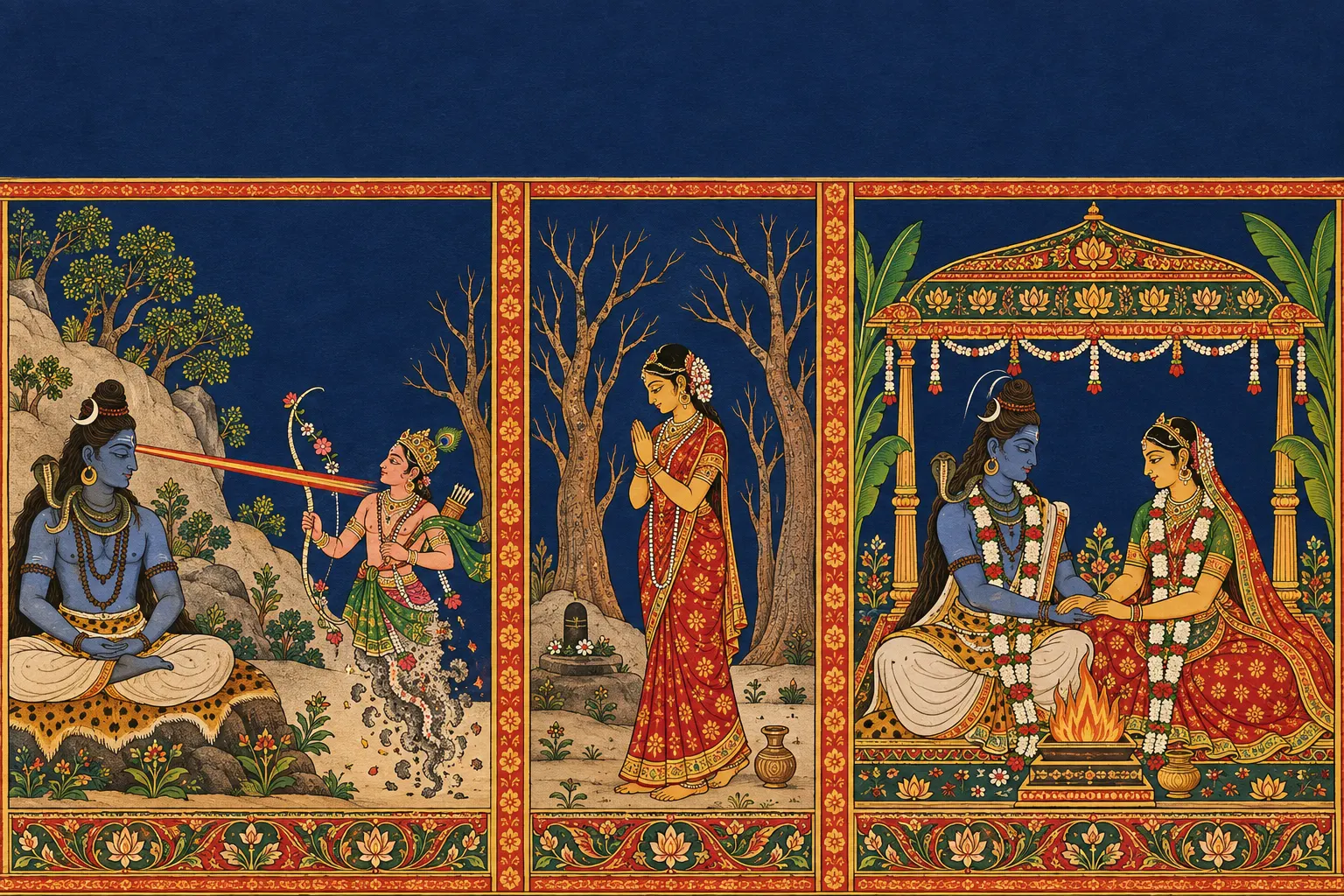
Parvati was born as the daughter of Himavan, king of the Himalaya, and Mena — Sati reborn — and was set to serve Shiva where he sat in penance.

The gods sent Kama — Kamadeva, with Rati and Vasanta, spring — to wake desire in Shiva's mind.

Kama drew his arrow of flowers.

Shiva opened his eye — the third eye — and the fire from it burnt Kama to ash on the spot.

Rati wept. Later Shiva revived Kama, but without a body — "Ananga", the one who has no form. Desire survived without a body.

Aparna

Parvati felt that beauty had lost.

So she began her own penance — so severe she gave up food, then even leaves. From this came the name Aparna — "leafless".

One day an old brahmin came and began to abuse Shiva — to test her. Parvati defended Shiva. Then the brahmin showed his true form. It was Shiva.

The wedding

All three worlds came to the wedding.

Kalidasa wrote the Kumarasambhava — "the birth of the war-god" — on this story. But a strange thing: the genuine poem is eight cantos and ends with the union of Shiva and Parvati. The birth of Kumara never comes into it, despite the name.

Note: This chapter connects to Shiv-Mahima chapters 5 (the burning of Kama) and 6 (Parvati's penance); this site's policy is that such an episode is told standalone, without hedging, in every epic. Kama becoming bodiless "Ananga" is in the Puranas; some traditions give him a full rebirth in Krishna's time as Pradyumna (a link to Krishna-Leela). Kalidasa's Kumarasambhava is held to be genuine only through eight cantos (ending at the union of Shiva and Parvati); the later cantos — up to seventeen in some manuscripts — are considered a sequel by a later imitator. Read it as a poem, not as history.

Source: from several texts and traditions, Kama and the wedding

Now — how much stayed with you?

Fact

Who were Parvati's parents?

  • Himavan and Mena
  • Daksha and Prasuti
  • Janaka and Sunayana
  • Kashyapa and Aditi
Read the whole story — The mountain's daughter

Parvati is Sati reborn, in the house of Himavan, king of the Himalaya.

The name "Parvati" itself means "of the mountain".

She was set to serve Shiva where he sat in penance.

What happened?

When Kama loosed the flower-arrow, what did Shiva do?

  • Gave him a boon
  • Laughed
  • Stayed in meditation
  • Opened the third eye, and its fire burnt Kama to ash on the spot
Read the whole story — The price of a flower-arrow

The gods had sent Kama to break Shiva's trance.

Kama came with Rati and Vasanta and drew his arrow.

The fire from Shiva's third eye reduced him to ash.

Fact

Kama, revived without a body, is known by which name?

  • Manmatha
  • Ananga
  • Kandarpa
  • Rati-pati
Read the whole story — Desire without a body

At Rati's grief Shiva did revive Kama.

But without a body — Ananga.

Desire survived even without a form.

Why is that?

Why did Parvati then begin her own penance?

  • Because she felt beauty had lost, and would now win Shiva by penance
  • To take revenge on Shiva
  • To revive Kama
  • To leave the Himalaya
Read the whole story — Beyond beauty

Kama's job was to wake desire, and he failed.

Parvati decided she would reach Shiva not by looks but by tapas.

She gave up food, then even leaves.

Fact

What name did Parvati earn by giving up even leaves?

  • Gauri
  • Uma
  • Aparna
  • Ambika
Read the whole story — Leafless

Parvati's penance was so severe she stopped eating even fallen leaves.

From this came the name Aparna.

Kalidasa turns this into the most famous poetry in the Kumarasambhava.

Who said it?

An old brahmin came and began to abuse Shiva — to test Parvati. Who was the brahmin really?

  • Narada
  • Shiva himself, in disguise
  • Brahma
  • Himavan
Read the whole story — Abusing himself

Shiva came as an old brahmin and began speaking ill of himself.

Parvati defended Shiva and scolded the brahmin.

Then Shiva showed his true form.

Later tradition

How many cantos is the genuine part of Kalidasa's Kumarasambhava, and where does it end?

  • Eighteen cantos, at the killing of Taraka
  • Seven cantos, at the wedding
  • Seventeen cantos, at Skanda's coronation
  • Eight cantos, at the union of Shiva and Parvati
Read the whole story — The birth in the name, not the poem

"Kumarasambhava" means "the birth of the war-god".

But scholars hold the genuine poem to be eight cantos, stopping at the union of Shiva and Parvati.

The later cantos — up to seventeen in some manuscripts — are a sequel by a later imitator.

Whose son?

In some later traditions, as whom is Kama given a full rebirth in Krishna's time?

  • Balarama
  • Abhimanyu
  • Samba
  • Pradyumna
Read the whole story — Desire returns

As Ananga, Kama's desire survived without a body.

Some traditions give him a full body again in Krishna's time, as Pradyumna.

This links to this site's Krishna-Leela.

Why is that?

This chapter overlaps episodes in Shiv-Mahima (the burning of Kama, Parvati's penance). How does the site handle it?

  • By removing it entirely
  • By telling it standalone, without hedging, in every epic
  • Only in passing
  • By sending the reader to Shiv-Mahima
Read the whole story — Deliberate repetition

The burning of Kama and Parvati's penance are a necessary part of Kartikeya's story.

It is also in Shiv-Mahima, and the site accepts the overlap.

The same call was made for Ganesha and Bhagavata Devotees.

Riddle

A poem named for my birth ends before I am born. Whose poem is it?

  • Valmiki's
  • Vyasa's
  • Kalidasa's
  • Bharavi's
Read the whole story — Unfinished mastery

The genuine part of the Kumarasambhava is eight cantos.

It stops at the union of Shiva and Parvati — Kumara is never born.

Even so it is among the most admired poems in Sanskrit.