
Chapter 8
The peacock and the rooster
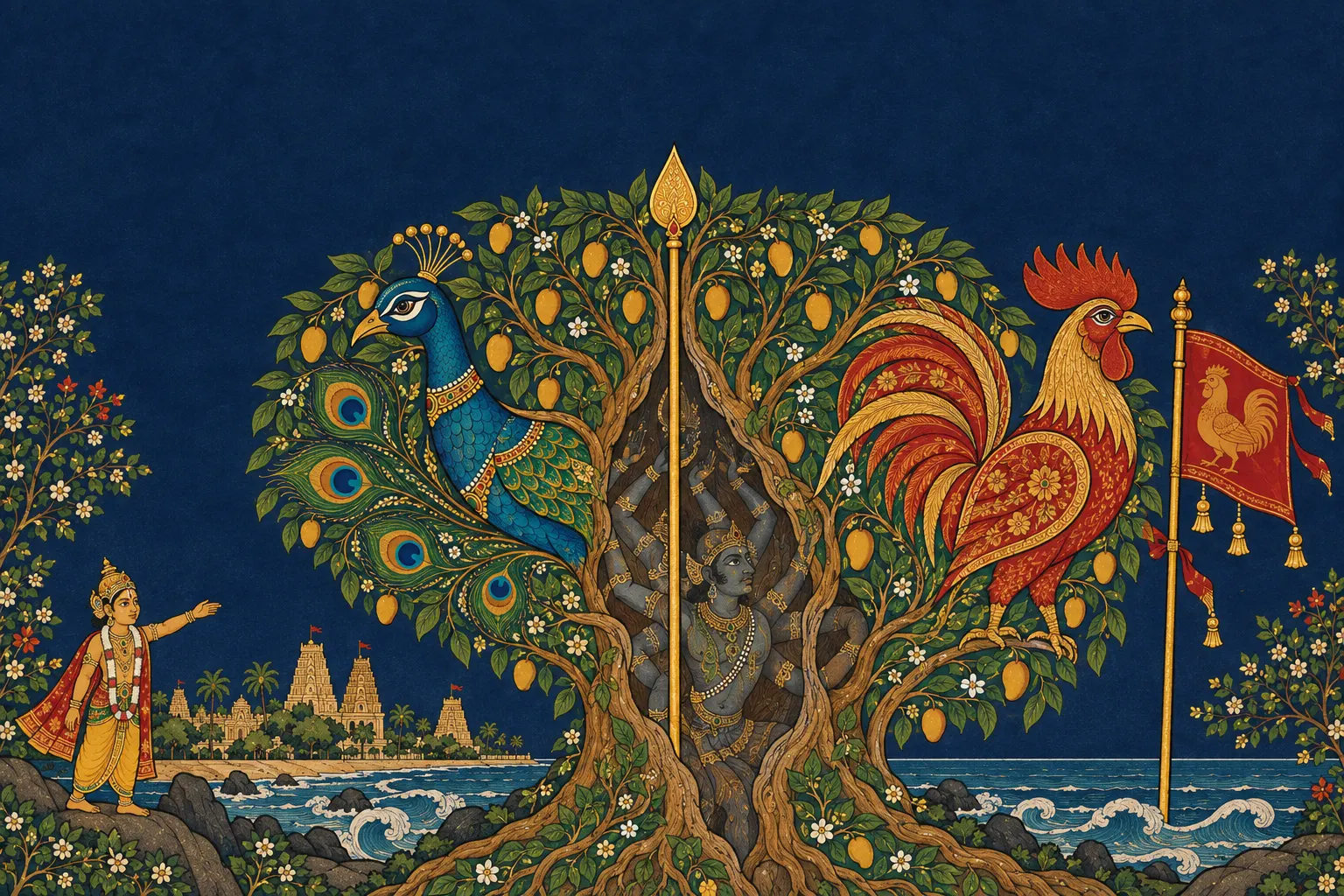
The vel split Surapadman in two — one half became the peacock he rides, the other the rooster on his banner
The Kanda Puranam
Kacchiyappa Sivachariyar of Kanchipuram wrote the Kanda Puranam in medieval Tamil — commonly dated around the fourteenth century, though its exact date is disputed — based on the Shankara Samhita of the Sanskrit Skanda Purana.
It is the fullest Tamil telling of Murugan, and the source of the imagery Tamil Nadu actually uses today.
Surapadman
Surapadman rules from an island fortress, Viramahendrapuram. His brothers have fallen. Now Skanda faces him at the seashore at Tiruchendur — the seaside temple there marks the spot.
Surapadman shifts shape again and again, and finally becomes a giant mango tree.
Skanda hurls the vel. The vel splits the tree — the demon — in two.
The enemy as mount, the enemy as flag
From the two halves emerge a peacock and a rooster. Skanda subdues them and takes both into his service.
One becomes a peacock — Paravani — which Skanda rides.
The other becomes the rooster that sits on his banner — the seval kodi.
The one he fought became his mount and his flag. That is the image of this chapter.
Kavadi
An asura named Idumban, who becomes Skanda's devotee, carries two hills — Shivagiri and Shaktigiri — on a shoulder-pole to Palani.
That is the origin of the kavadi — the burden on the shoulder that millions of devotees carry on Thaipusam today.
Note: Kanda Puranam (Tamil), by Kacchiyappa Sivachariyar of Kanchipuram — commonly placed around the 14th century, though its precise date is disputed — is based on the Shankara Samhita of the Sanskrit Skanda Purana. Surapadman's island fortress is Viramahendrapuram; the final battle is at Tiruchendur; Surapadman takes the form of a mango tree and is split by the vel, the two halves becoming the peacock (Paravani, the mount) and the rooster (seval kodi, the banner). Simhamukha's end is told differently from text to text. Skanda Shashthi (Aippasi month) reads the whole Surapadman war over six days, ending with a mass enactment of the "Sura Samharam". The story of Idumban and the kavadi belongs to Palani.
Source: from several texts and traditions, The peacock and the rooster