
Chapter 10
Tamil Kadavul
In the north Kartikeya's solo worship shrank hard; in the Tamil south Murugan is one of the great living gods
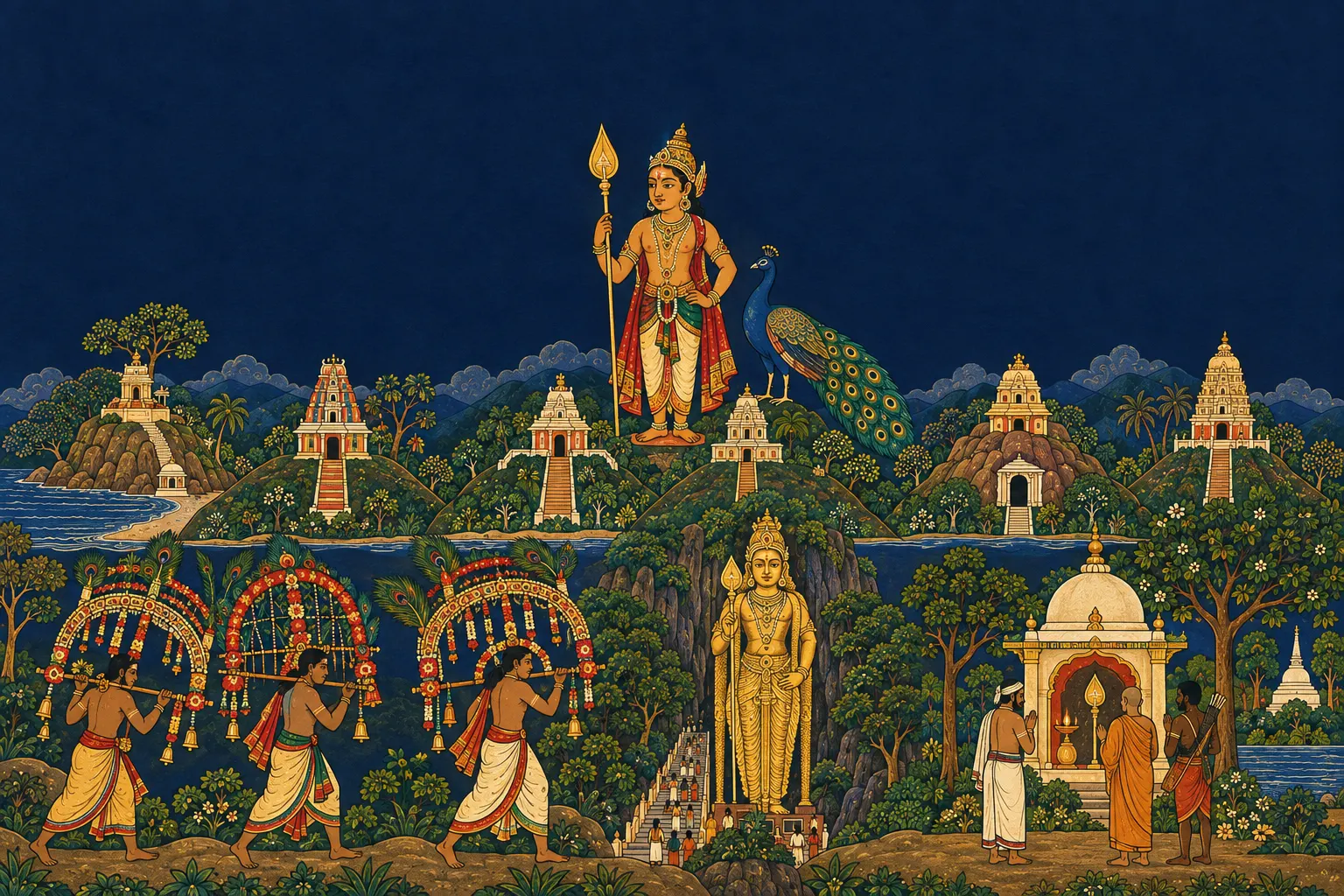
The six shrines
The Tirumurukarruppatai celebrates six sacred Murugan places. Later tradition fixed these as the Arupadai Veedu — Murugan's six abodes visited today:
Thiruparankundram (near Madurai — where he married Deivanai), Tiruchendur (the seashore — where Surapadman was killed), Palani (the hill — where he is Dandayudhapani, the ascetic), Swamimalai (where the boy Murugan taught his own father Shiva the meaning of "Om", and was called Swaminatha), Thiruthani, and Pazhamudircholai.
Thaipusam
Thaipusam — in the Tamil month Thai, under the star Pusam — is celebrated in Tamil tradition as the occasion when Parvati gave Skanda the vel.
Devotees carry the kavadi — the same shoulder-pole as Idumban's — and many have their bodies pierced with spears and hooks, through the cheeks and tongue, as a vow.
It is huge at Palani and at Batu Caves in Malaysia — where a 42.7-metre gold-painted statue of Murugan stands and crowds can exceed a million — and in Singapore, Mauritius, Réunion, South Africa and Fiji, wherever Tamil labour went.
Kataragama
At Kataragama in Sri Lanka there is a very old Skanda / Murugan shrine — worshipped by Hindus, Buddhists and the Vedda people alike. Valli is a local figure there.
"The Tamil god"
Murugan is called "Tamil Kadavul" — the Tamil god. The name is both old and modern.
He is the god most bound to the Tamil language and land, and his Tamil worship is among the oldest unbroken devotional traditions in India.
And the north
Across much of North India his independent cult declined after its early-medieval high point, but it did not vanish. Pehowa in Haryana is an important surviving northern shrine.
Kartik worship is alive in Bengal — both in the Durga family and as an independent Kartik Puja — and Kartikeya or Kumara traditions also survive in parts of the Himalaya and Nepal.
Note: The Tirumurukarruppatai celebrates six sacred Murugan places; later tradition fixed the modern Arupadai Veedu circuit as Thiruparankundram, Tiruchendur, Palani, Swamimalai, Thiruthani and Pazhamudircholai. The identification of every ancient place-name with a modern shrine is not equally certain. Swamimalai's name Swaminatha is from the story of the boy teaching his father the meaning of "Om". In living Tamil festival tradition, Thaipusam — Thai month under the Pusam/Pushya star — commemorates Parvati giving Murugan the vel; Skanda Shashthi in Aippasi is the festival cycle that culminates in the Surapadman war and Sura Samharam. The kavadi is from the Idumban story; the body-piercing is a form of vow. Batu Caves (Malaysia) has a 42-metre gold statue and draws over a million; with Tamil migration the festival spread to Mauritius, Singapore, Réunion, South Africa and Fiji. Kataragama (Sri Lanka) is a shared pilgrimage site — Hindu, Buddhist and Vedda. Kartikeya's independent cult became much less prominent across much of North India after its early-medieval high point, but it did not vanish. Pehowa in Haryana is an important surviving northern shrine; Bengal maintains both Kartik in the Durga family and independent Kartik Puja; and Kartikeya / Kumara traditions also survive in parts of the Himalayan region and Nepal.
Source: from several texts and traditions, Tamil Kadavul