
Chapter 2
Taraka's boon
A demon asked for a death that could never come — at the hands of a seven-day-old son of Shiva, when Shiva had neither wife nor son
What will never happen
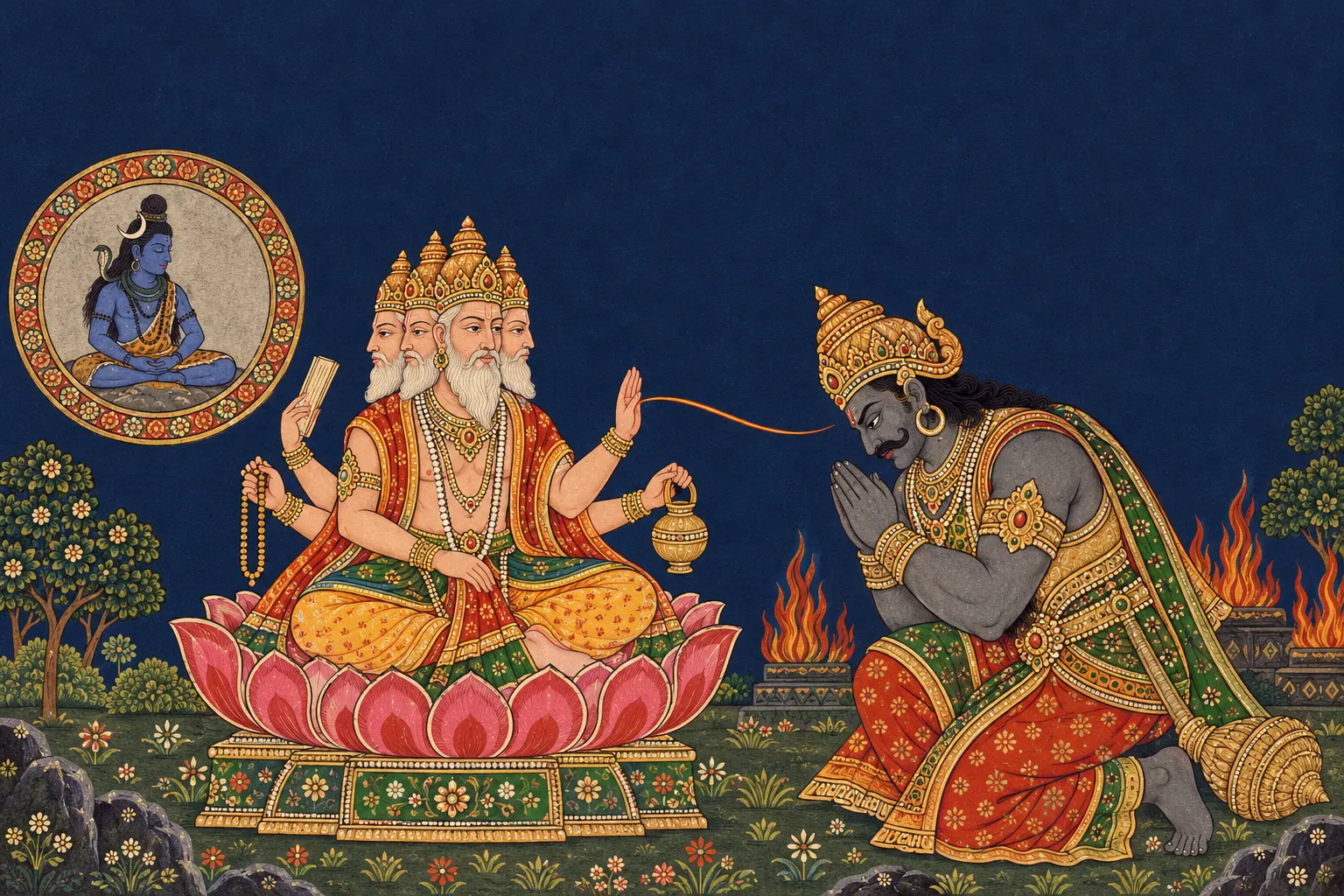
Tarakasura did fierce penance, and Brahma appeared.
He did not ask for immortality — he asked for a clever condition.
"If I must die," he said, "let it be only at the hands of a son of Shiva — and then, when that son is seven days old. Let no one older than that be able to kill me." (Some texts say six days.)
He thought it was impossible. Shiva at that time had no wife and no son. Sati had walked into Daksha's sacrifice, and Shiva was in mourning, in meditation, withdrawn from the world.
Brahma granted it.
Lord of the three worlds
On the strength of the boon Taraka conquered the three worlds.
He drove the gods out of heaven. He made the sun, the moon and the wind his servants. The sages' sacrifices stopped.
The gods went to Brahma.
The only way
Brahma said — there is one answer. A son of Shiva.
But that son will only come if Shiva returns to the world and marries.
So the real task was not to kill Taraka. The real task was to bring Shiva out of his meditation.
Note: Tarakasura is the son of an asura named Vajranga and of Varangi. The core idea — that Taraka can be killed only by Shiva's son — appears across several Sanskrit traditions. The explicit "few-days-old child" form, including the seven-day version used here, belongs especially to later Puranic tellings such as the Matsya Purana. The Shiva Purana gives a different formulation: Shiva's son is to become commander and defeat Taraka, without specifying six or seven days. The Mahabharata's Vana-Parva Skanda account is a different birth cycle and should not be cited as the source of this exact day-count. Sati's death and Shiva's withdrawal are told in full in this site's Shiv-Mahima, chapter 2.
Source: from several texts and traditions, Taraka's boon