Chapter 9

Valli and Devasena

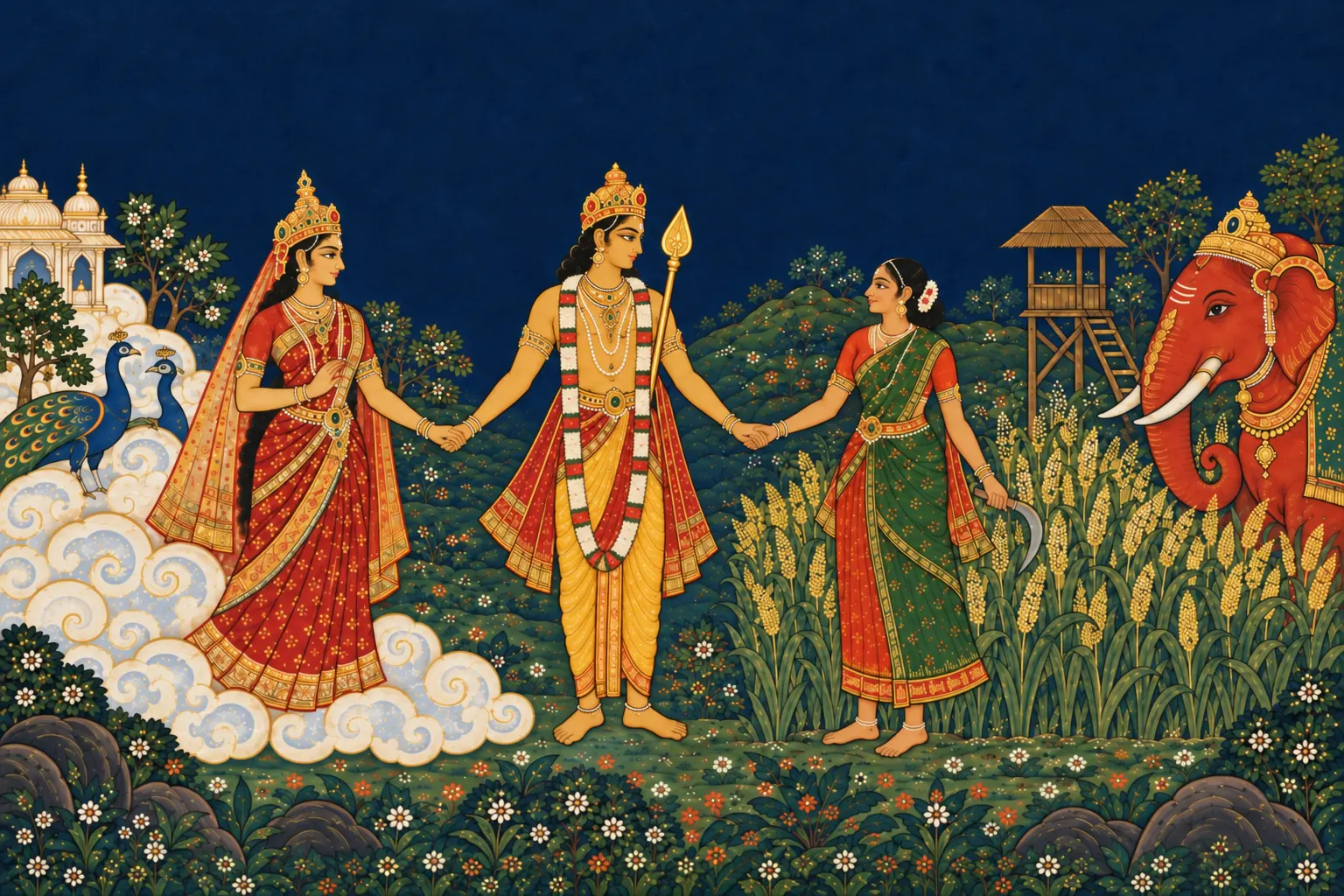
One wife was the daughter of the king of the gods, the other of a hill hunter

Two marriages

Devasena — Deivanai. In the Tamil Kanda Puranam tradition she is Indra's daughter; the Mahabharata instead calls Devasena a daughter of Prajapati and a relative of Indra. The celestial marriage follows the war. In Tamil metaphysics she is kriya-shakti, the power of action.

Valli — the foster-daughter of a Kuravar hill chief (in the story born of a sage and a doe, raised among hunters). She guards a field of millet. She is iccha-shakti, the power of desire.

In the field

Murugan goes to Valli in disguise — first as a young hunter, then as an old man.

Valli will not have him. Then Ganesha comes as a wild elephant and frightens her into Murugan's arms.

Brother helped brother. (A link to this site's Ganesh-Vrittanta.)

The northern ascetic, the southern householder

Here the two traditions part.

In the south Murugan is a married householder god — Deivanai and Valli at his sides, home and prosperity.

In many northern and eastern traditions Kartikeya is remembered as a celibate warrior — "the bachelor god". Separately, Tamil Palani tradition tells how Murugan, angered after losing the fruit-race to Ganesha, withdrew to Palani as the ascetic Dandayudhapani.

In some northern traditions his solo worship is even held inauspicious for householders, and in some temples women traditionally do not go.

Note: Murugan's two wives are Devasena / Deivanai and Valli. The Mahabharata calls Devasena a daughter of Prajapati and a relative of Indra; the Tamil Kanda-Puranam stream makes Deivanai Indra's daughter. Married after the war (Valli's foster-family is of the Kuravar hill community). Scholars (Zvelebil and others) read the Valli story as the older, indigenous Tamil love-myth onto which the Devasena marriage was added when the Tamil god was fitted into the Sanskrit frame. Valli is of a hill / hunter community — this is recorded as the texts have it; such "the god married a tribal woman" stories have been read both as inclusion and as condescension, and this epic does not adjudicate and repeats no list of peoples. The disguised courtship and the elephant are a Tamil folk layer, not in the Sanskrit sources. This north/south split mirrors Ganesh-Vrittanta chapter 4. The northern custom of women not entering, or worship being "inauspicious for householders", belongs to some traditions only, not a universal rule.

Source: from several texts and traditions, Valli and Devasena

Now — how much stayed with you?

Fact

Who are Murugan's two wives?

  • Radha and Rukmini
  • Sita and Urmila
  • Ganga and Parvati
  • Devasena (Deivanai) and Valli
Read the whole story — Two wives, two powers

Devasena — of Indra's family, married after the war.

Valli — the foster-daughter of a hill hunter.

In Tamil metaphysics one is kriya-shakti, the other iccha-shakti.

Fact

Valli is the foster-daughter of a hill chief of which community?

  • Yadava
  • Naga
  • Gandharva
  • Kuravar
Read the whole story — The hill's daughter

Valli, in the story, is born of a sage and a doe and raised among hunters.

She is the foster-daughter of a Kuravar hill chief.

She guards a field of millet.

What happened?

How does Ganesha help Murugan court Valli?

  • By giving her a boon
  • He comes as a wild elephant and frightens her into Murugan's arms
  • By persuading her father
  • By singing a song
Read the whole story — Brother helped brother

Murugan goes to Valli in disguise — first a young hunter, then an old man.

Valli will not have him.

Then Ganesha comes as a wild elephant. This links to this site's Ganesh-Vrittanta.

The texts disagree

According to scholars such as Zvelebil, which marriage represents the older Tamil layer?

  • Devasena's
  • Both are the same age
  • Valli's
  • Neither can be dated
Read the whole story — Old and new

Scholars such as Zvelebil read the Valli-Murugan story as an older kurinji love-myth.

In that reconstruction, the Devasena marriage is a later Sanskrit-facing layer.

Scholars read this as an example of "Sanskritization".

Why is that?

How is this god's family form different in the south and the north?

  • In the south he is a married householder god (with Deivanai and Valli); in many northern and eastern traditions he is a celibate warrior
  • He is an ascetic in both
  • He is a householder in both
  • He is married in the north and a bachelor in the south
Read the whole story — Householder or ascetic

In the south Murugan is a god of home, prosperity and family.

In many northern and eastern traditions Kartikeya is remembered as a celibate or "bachelor" god.

This split is also in Ganesh-Vrittanta chapter 4.

The texts disagree

Losing the fruit-race to Ganesha and withdrawing to Palani as Dandayudhapani — whose tradition is this?

  • It is the northern tradition's explanation
  • It is in the Mahabharata
  • It is in the Vedas
  • It is specifically the Tamil Palani tradition
Read the whole story — Two separate layers

"In the north and east Kartikeya is celibate" — that is one tradition.

"He lost the fruit-race and went to Palani and became an ascetic" — that is separately the Tamil Palani story.

Merging the two into one is wrong.

What happened?

In some northern traditions, how is the solo worship of Kartikeya regarded?

  • As the most auspicious
  • As inauspicious for householders, and in some temples women traditionally do not go
  • As compulsory
  • With no special rule
Read the whole story — The ascetic's temple

In some northern traditions Kartikeya is held to be a strict celibate.

So in some places his solo worship is held inauspicious for householders.

This belongs to some traditions only, not a universal rule.

Fact

In Tamil metaphysics, what do Valli and Devasena represent?

  • Iccha-shakti (desire) and kriya-shakti (action)
  • Past and future
  • Sun and moon
  • Wealth and learning
Read the whole story — Two powers

Valli is iccha-shakti — the power of desire.

Devasena is kriya-shakti — the power of action.

And Murugan is jnana-shakti — the power of wisdom.

Why is that?

Where do the disguised courtship and the elephant come from?

  • From the Sanskrit Skanda Purana
  • From the Mahabharata
  • From a Tamil folk layer
  • From Kalidasa
Read the whole story — The folk layer

Valli's whole courtship — the disguises, the old-man form, the elephant — is Tamil folk tradition.

It is not in the Sanskrit Skanda story.

It is a sign of Murugan's Tamil, hill origin.

Who am I?

One of my wives is of the family of the king of the gods; the other guards a field of millet. Who am I?

  • Krishna
  • Murugan
  • Rama
  • Shiva
Read the whole story — Wives of two worlds

Deivanai is from heaven — of Indra's family.

Valli is from the hills — raised among Kuravar hunters.

Murugan joins the two worlds.