
Chapter 6
Jimutavahana
The prince who gave away the wishing-tree to everyone, and then put himself in a naga's place before Garuda
Jimutavahana is chapter 6 of Kathasaritsagara. Source: Kathasaritsagara, Book 4 (Naravahanadattajanana), Chapter 22 (Tale 27). It is told in 6 scenes — Vasavadatta's wish; The wishing-tree; Leaving the kingdom; On the Malaya mountain; Shankhachuda's turn; On the killing-rock — followed by 10 quiz questions.
Vasavadatta's wish
Vasavadatta was with child. In those days a wish rose in her heart to hear the great tales of the vidyadharas, tales of great beings with mantras and magic powers. To fulfil the queen's wish, Yaugandharayana told this tale before them all.
The wishing-tree
On the Himalaya mountain stood the home of Jimutaketu, king of the vidyadharas. He had a wishing-tree, handed down from his forefathers, named after its nature: 'the giver of wishes'. The king had no child. One day he went to the garden and prayed to that divine tree: 'We have always had everything from you. O god, give me a virtuous son.' The tree said, 'O king, you shall have a son who will remember his former birth, a hero in giving, and compassionate to all beings.' The king told the queen the news, and in a short time a son was born. He was named Jimutavahana.
As Jimutavahana grew, so did his compassion. When he became crown prince, he said to his father in private, 'Father, I know that in this world everything is destroyed in a moment. Only the spotless fame of great men lasts to the end of the kalpa. If it is earned by helping others, high-minded people count even their lives as nothing beside it. And riches, if they are of no use to others, are like lightning, which dazzles the eyes for a moment and vanishes somewhere. So if this wishing-tree that we have is given for the good of others, we will have gained its whole fruit. I will so act that by its wealth all the needy are freed from poverty.'
With his father's permission he went to the wishing-tree and said, 'O god, you always give us the fruit we desire. Today grant us this one wish. My friend, free this whole world from poverty. May you prosper. You are given to a world that wants wealth.' At the word of that generous prince the wishing-tree rained gold on the earth and everyone was glad. No one but one as compassionate as Jimutavahana, like an incarnation of a bodhisattva, could have dared such a gift. Because of it all the quarters became his devotees and his spotless fame spread far above.
Leaving the kingdom
When Jimutaketu's kinsmen saw that his son's renown had made his kingdom strong, they burned with envy and became his enemies. They thought that the kingdom with the wishing-tree, now given to charity, would be easy to conquer, and gathered for war. Then Jimutavahana said to his father, 'This body is like a bubble on water. Why should we long for wealth that is like the flame of a lamp trembling in the wind? And what wise person would want to gain wealth by killing others? Father, I must not fight my own relatives. I will give up the kingdom and go to some forest. Let these unhappy people stay; we will not kill our own family.'
His father Jimutaketu also resolved, 'Son, I too will go. What does an old man want with a kingdom, when you, young as you are, are leaving it like a straw out of compassion?' With his father and mother he went to the Malaya mountain, where there was a hermitage of siddhas and waterfalls hid behind sandalwood trees. There he went on serving his father.
On the Malaya mountain
There he became friends with Mitravasu, the generous son of Vishvavasu, chief prince of the siddhas. One day, in a lonely place, Jimutavahana saw Mitravasu's unmarried sister, who in a former birth had been his beloved. Their eyes met. Then one day Mitravasu, pleased, said to him, 'My younger sister is named Malayavati. I want to give her to you; please fulfil this wish of mine.'
Jimutavahana replied, 'Prince, in my last birth she was my wife, and in that birth you were my friend, like a second heart. I remember my former birth.' Mitravasu asked him to tell the story of that earlier birth.
Then Jimutavahana told it. 'Once I was a vidyadhara roaming the sky. Once I was flying over a peak of the Himalaya. Below, Shiva, sporting with Gauri, was angered at my passing above him and cursed me: "Enter a human womb. When you have gained a vidyadhari wife and set your son in your place, you will remember your former birth and then be born again as a vidyadhara." Saying this, Shiva vanished. I was born on earth in the city of Vallabhi, in a merchant's house, with the name Vasudatta.
'When I grew up, at my father's word I went to another country to trade. There in a forest bandits robbed me and, binding me, took me to the Durga temple in their village, where I was to be offered in sacrifice. Their chief, Pulindaka, a Shabara, as soon as he saw me was moved by compassion and saved me from the sacrifice. A kindly feeling without cause is the mark of a friendship from a former birth. When he went to offer himself before the goddess, a voice came from the sky: "Do not do it. I am pleased with you; ask a boon." He asked, "May my friendship with this merchant's son last into the next birth too." The goddess said, "So be it." The Shabara gave me much wealth and sent me home.
'Later the king had that same Shabara arrested for the crime of plundering a caravan. I freed him from the death sentence by paying a hundred thousand gold coins and kept him in my house with honour. On returning, he began to think of a gift for me equal to my kindness. Pearls and musk seemed too little to him. He took his bow and went to the Himalaya to have a necklace made for me from the pearls in elephants' heads. There on the shore of a great lake he saw a woman of marvellous beauty coming riding on a lion to a temple of Shiva. He thought to himself, "If I can unite her with my friend, I will have repaid his kindness in a unique way." He praised me to her. The beauty told him to bring me. He carried me off at night itself and took me to the Himalaya. The next day that girl came there, and that very girl, named Manovati, became my wife. A son, Hiranyadatta, was born to us. After my father passed away I looked after the family, and when old age prodded me — "how long will you stay in the house?" — I handed everything to my son and went with my wife and my Shabara friend to the Kalinjara mountain. There I remembered that I had been a vidyadhara and the curse was over. I prayed in my mind, "In the next birth too may I have this same wife and this same friend, and remember this birth," and, meditating on Shiva, the three of us leapt from the mountain and gave up our bodies. Thus I am now born as Jimutavahana. That Shabara prince is you, born as Mitravasu. And my wife Manovati in this birth is your sister Malayavati. So my marriage to her is fitting. First speak to my parents.'
Hearing this, Mitravasu carried the word to the parents. Both sides were pleased. Jimutavahana took Malayavati's hand amid the honours of the king of the siddhas. Gandharvas and vidyadharas danced at the festival. He lived happily with his wife on the Malaya mountain.
Shankhachuda's turn
One day he went with Mitravasu to see the forest by the seashore. There he saw a frightened young man coming, his mother following him crying 'Alas, my son!', and being sent along by him. A man like a soldier led him to a tall, broad rock and left him there. Jimutavahana asked, 'Who are you? What are you about to do? Why is your mother weeping for you?'
The young man told his story. 'Long ago Kashyapa had two wives, Kadru and Vinata. Once they made a bet whether the Sun's horses were black or white. Kadru said black, Vinata said white, and it was agreed that the loser would become the other's slave. Kadru told her serpent sons to spit poison on the horses and, showing them black to Vinata, won by trickery. Vinata became her slave. When Vinata's son Garuda learned of this and came and asked Kadru to free his mother, the serpents said, "The gods are churning the ocean of milk. Bring nectar from there and give it to us, and take your mother." Garuda went to Vishnu; pleased with his strength, Vishnu told him to ask a boon. Furious at his mother's slavery, Garuda asked, "May the serpents become my food." Vishnu agreed. Indra too told Garuda to stop the serpents from drinking the nectar and bring it back. Garuda went to the serpents with the pot of nectar and said, "I have brought you this nectar; release my mother and take it. If you like, I will set it on a bed of kusha grass." The serpents released his mother, and Garuda put the pot on the kusha grass and left. As the serpents moved towards the nectar, Indra swooped down and flew off with the pot. The serpents licked that bed of kusha in case a drop had fallen, and their tongues were split in two.
'Now by the strength of Vishnu's boon Garuda began to eat serpents again and again. In the underworld serpents began to die of fear, pregnant serpent women began to miscarry, and the whole serpent race began to be almost destroyed. Then King Vasuki made a treaty with Garuda: "I will send you one serpent every day for your food, on a hill raised from the sea sand. You must not enter the underworld, for the destruction of the whole serpent race would spoil your own purpose." Garuda agreed. Since then one serpent is sent here every day. I am the serpent named Shankhachuda, and today is my turn. So by Vasuki's order I have come to this killing-rock to be Garuda's meal, and my mother is weeping for me.'
On the killing-rock
Hearing this, Jimutavahana was deeply pained. He said, 'Alas! How cowardly a use Vasuki makes of his royal power, to send his own subjects himself as food for the enemy. Why did he not give himself to Garuda first? How unmanly is one who watches his own family be destroyed! And Garuda too, a son of Kashyapa — what a great sin he is committing! Even great ones commit such folly for the sake of the body! Today I will give my body and save you from Garuda. Do not despair, my friend.'
Shankhachuda said firmly, 'Sir, do not say so. It is never right to destroy a jewel for the sake of a piece of glass. And I will not let a stain fall on my line.' Telling him this, he thought that only a moment remained before Garuda would come, and went to worship Shiva named Gokarna, on the seashore, in his last hour.
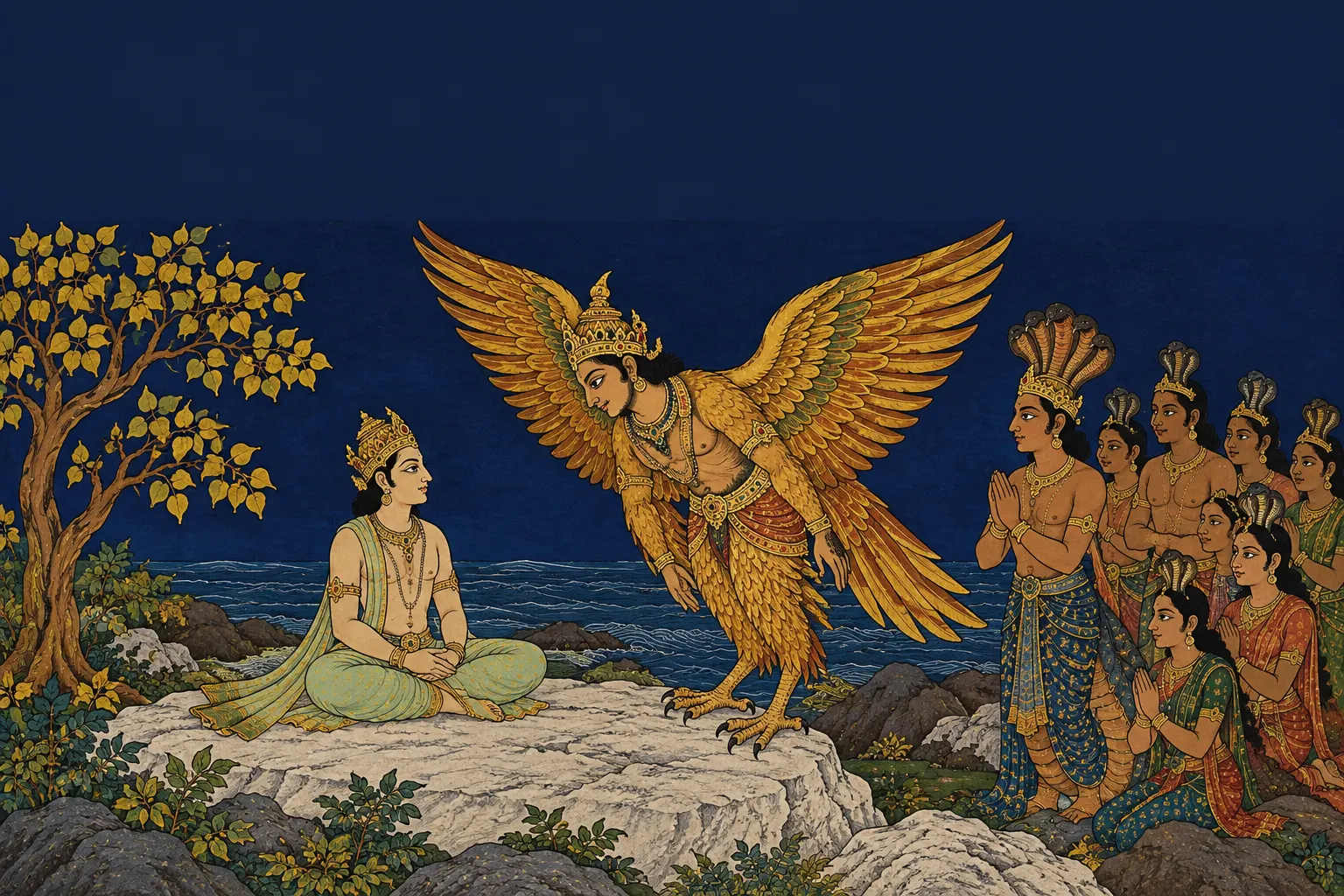
The moment he left, Jimutavahana got his chance to offer himself. Cleverly, pretending he had forgotten something important, he sent Mitravasu home. At once the earth shook with the wind of Garuda's wings, as if astonished at his might. Jimutavahana understood that the enemy of serpents was coming, and, full of compassion for others, he climbed on to the killing-rock.
In a moment Garuda, covering the sky with his shadow, swooped down and, striking with his beak, carried off that great soul. Drops of blood fell, and Garuda stole the jewel from his crest. He took him to a mountain peak and began to eat him. At that moment flowers rained from the sky. Garuda was astonished and thought, 'What is going on?'
Meanwhile Shankhachuda came back from worshipping Gokarna. He saw drops of blood on the killing-rock and thought, 'Alas! Surely that great soul has sacrificed himself for me. Where has Garuda taken him in all this time? I will look for him, perhaps I will find him.' He followed the trail of blood.
Here Garuda saw that Jimutavahana was cheerful even while being eaten. He stopped and began to think, 'This is someone else, whom I ought not to have taken. I am eating him, but he is not in the least sad; on the contrary he is steadily glad.' To achieve his purpose Jimutavahana said, 'King of birds, there is flesh and blood in my body too. Your belly is not yet full — why are you stopping eating?' Garuda said, amazed, 'Sir, you are not a serpent. Tell me, who are you?' Jimutavahana was just about to say, 'I am a serpent; eat me, finish what you began, for the resolute do not leave a task half done,' when Shankhachuda arrived from afar shouting, 'Stop, stop, Garuda! This is not a serpent. I am the serpent who came for you. Let him go! Alas, how did you suddenly make this mistake?'
Hearing this, Garuda was deeply alarmed, and Jimutavahana grieved that his purpose was left unfinished. In the conversation, when Garuda learned that by mistake he had been eating the king of the vidyadharas, he was very sorrowful. He thought, 'Alas! In cruelty I have committed a sin. Those who walk the wrong road easily earn sin. But this great soul gave his life for another and, counting this world, so full of illusion, as nothing, came before me. That deserves praise.' In remorse Garuda went to enter the fire to purify his sin, and Jimutavahana stopped him: 'King of birds, why are you despairing? If you are afraid of sin, then resolve that from now on you will never eat serpents, and repent for those you ate before. That is the only remedy.'
So, full of compassion, Jimutavahana instructed Garuda, and Garuda accepted his advice, regarding him as a teacher. He set off to bring nectar from heaven to revive the wounded prince and the serpents of whom only bones remained. Just then the goddess Gauri, pleased with the devotion of Jimutavahana's wife, came herself and rained nectar upon him. His limbs grew back more beautiful than before and the gods' drums sounded. When he rose, restored, Garuda brought nectar from heaven and sprinkled it along the whole seashore. All the serpents came alive. The shore, full of serpents, looked as if the underworld had come to see Jimutavahana, forgetting its fear of Garuda.
Jimutavahana's relatives, seeing him safe and with deathless fame, congratulated him. His wife and parents too were very glad. Shankhachuda, with his permission, returned to the netherworld, and Jimutavahana's fame spread of itself, without permission, through the three worlds. His old enemies, Matanga and other relatives, who had been changed by Gauri's grace, came to Garuda and bowed at his feet. At their entreaty Jimutavahana returned from the Malaya mountain to his home on the slope of the Himalaya. With his parents, Mitravasu and Malayavati he remained emperor of the vidyadharas for a long time.
Vasavadatta heard this tale from Yaugandharayana's mouth and was pleased, for she was eager to hear of her unborn son's glory. That day she talked with her husband of her future son, the vidyadhara emperor. She had full faith in the gods' word.
Note: This chapter is written directly from C. H. Tawney's English translation (Book 4, Chapter 22). Jimutavahana's tale of his former birth (Vasudatta, the Shabara Pulindaka, Manovati) and the tale of Kadru and Vinata are tales within the tale in the text; both are given briefly here and many details are left out. The same tale is found in the Sanskrit play *Nagananda*, which is much earlier than Somadeva; only the Kathasaritsagara's text is given here. The names are as in the text: Jimutaketu, Jimutavahana, Mitravasu, Malayavati, Shankhachuda, Vasuki, Garuda, Manovati.
Source: Somadeva Bhatta — the Kathasaritsagara (Kashmir, eleventh century), an abridgement of Gunadhya's lost Brihatkatha, Jimutavahana