
Chapter 10
Crows, Owls and Policy
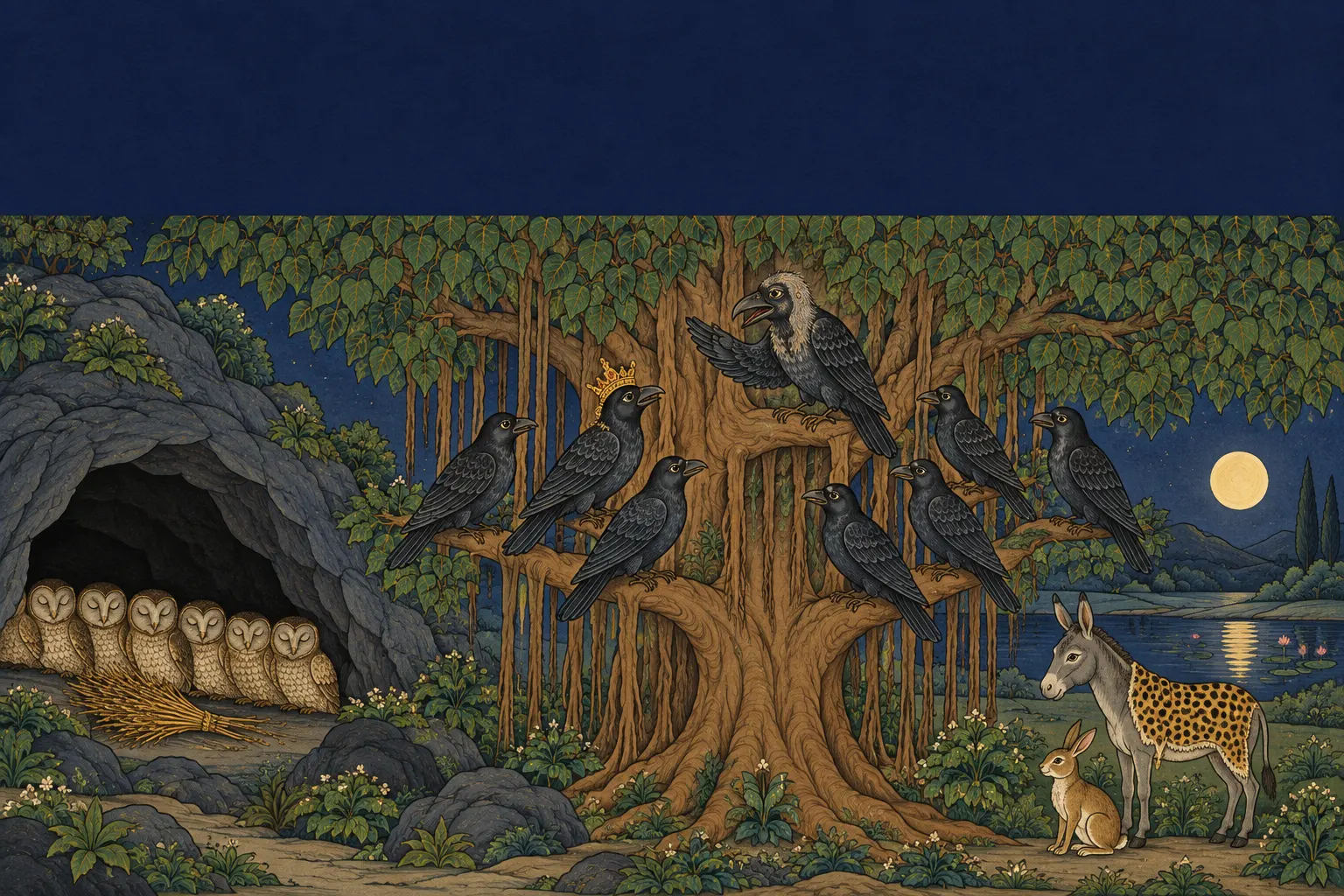
The old crow had his own feathers plucked, sat down among his enemies the owls — and had them shut into their own cave
Crows, Owls and Policy is chapter 10 of Kathasaritsagara. Source: Kathasaritsagara, Book 10 (Shaktiyashas), Chapter 62 (Tales 121–131). It is told in 5 scenes — Gomukha's night story; The donkey in the leopard's skin; Who is to be king of the birds; Meghavarna's stake; Small tales of fools — followed by 10 quiz questions.
Gomukha's night story
Prince Naravahanadatta was sad, parted from his beloved Shaktiyasha. His minister Gomukha, who had grown up with him, started a tale that night to amuse him. This tale is like the third book of the Panchatantra. (In Somadeva's time the tales of the Panchatantra were already in circulation, and he retells them in his own way.)
In one place there was a thick banyan tree, on whose branches the voices of the birds rang as if it were calling weary travellers into its shade. There lived Meghavarna, king of the crows. His old enemy was Avamarda, king of the owls. One night Avamarda suddenly came and killed many crows, defeated Meghavarna and went away. In the morning Meghavarna called his ministers and said, 'That powerful enemy may gather hundreds of soldiers and come again. Think of some remedy.'
The five ministers said five things. One said that instead of fighting the strong, one should leave the country or make peace. One said that the danger was not yet in front of them, so first weigh the enemy's strength and your own. One said that death was better than bowing, so let us go and fight. One said to make peace and watch for a chance. The oldest minister, Chirajivin, said, 'Peace with whom? Who will go as envoy? The enmity of crows and owls is old. This work will be done by policy, for it is said that policy is the root of empires.'
The king said, 'You are old; first tell me how this enmity began. Tell your policy afterwards.' Chirajivin said, 'It began from something said without thought. Hear the tale of the donkey.'
The donkey in the leopard's skin
A washerman's donkey was thin. To fatten it, the washerman would put a leopard's skin on it and let it graze in a neighbour's field. People, thinking it a leopard, were afraid to drive it off. One day a farmer with a bow saw it. He thought, 'A leopard.' Frightened, he bent his back, wrapped himself in a blanket and began to creep away. The donkey saw him bent over and thought he was another donkey, and, high on grain, brayed loudly. The farmer understood it was a donkey. He came back and killed it with an arrow. That fool was killed by its own voice.
Chirajivin said, 'Our enmity with the owls too came from a careless remark.'
Who is to be king of the birds
Once the birds had no king. All gathered and, bringing parasol and chowrie, set out to crown the owl. A crow flying above saw it and said, 'You fools, are there no other birds, like the cuckoo? Will you make king this cruel-eyed, ill-faced, wicked bird of ill omen? Make him king whose name brings welfare. Let me tell you a tale.'
The elephants and the hares. There was a great lake named Chandrasaras, on whose shore lived the king of the hares, Shilimukha. In a time of drought a chief of elephants named Chaturdanta came with his herd to drink water, and many hares were trampled by the herd as it went down into the lake. Shilimukha sent a clever hare named Vijaya: 'Go, meet the elephant and find some remedy.'
Following the elephant, Vijaya climbed on to a rock and said, 'I am the envoy of the moon. The god has sent word: I dwell in Chandrasaras, and the hares there are dear to me (that is why people call me Shashanka, the hare-marked). You fouled that lake and killed my hares. If you do so again you will bear the consequence.' The elephant was frightened and said, 'I will never do so again. I must honour the moon-god.' Vijaya took him to the lake and showed the reflection of the moon in the water. The elephant bowed to it from afar in fear and never went there again.
The bird, the hare and the cat. The crow went on, 'One must not trust the base. I used to live in a tree, and below in the same tree was the nest of a bird named Kapinjala. He went away for many days and a hare came and settled in his nest. On his return the two began to quarrel, "It is mine!" "No, mine!" They set out to find a knowledgeable arbiter. Out of curiosity I followed hidden behind. At the lake shore was a cat, who pretended to have renounced violence and sat with eyes closed in meditation. The two said, "Holy one, judge our case." The cat said in a low voice, "I am weak from austerity; come close and speak into my ear. A wrong judgement ruins both this world and the next." The moment they came before her, that base creature killed both with a single pounce.' Hearing this the birds gave up the idea of making the owl king and all flew away. The owl said to the crow, 'From today you and I are enemies.' What the crow had said was right, but he was left thinking that by one remark he had taken on a dangerous quarrel.
Meghavarna's stake
Chirajivin said to the king, 'The owls are many and strong. When numbers are heavy, what can one do alone? Hear a tale.'
The Brahman, the goat and the rogues. A Brahman had bought a goat and was returning from the village with it on his shoulder. Some rogues saw him and wanted to get the goat. One rogue came before him and said, 'Revered Brahman, why are you carrying a dog on your shoulder? Put it down.' The Brahman paid no attention. Then two more said the same. He began to doubt. Three more rogues came and said, 'You wear the sacred thread and carry a dog too? You seem to be a hunter.' The Brahman said, 'Perhaps some ghost is casting a veil on my eyes, so that I see everything wrong.' He threw the goat down and went off to bathe. The rogues took the goat and had a feast.
Chirajivin said, 'Maharaj, now follow my advice. Pluck some of my feathers and throw me under this tree and go to the mountain until I return having done my work.' The king, pretending anger, plucked his feathers, threw him under the tree and went to the mountain with his flock.
At night Avamarda, king of the owls, came with his band. There was not a crow on the tree. Just then Chirajivin cawed feebly from below. Avamarda came down, looked at him and asked who he was and why he was in this state. Chirajivin said, 'I am Chirajivin, the minister of the king of the crows. The king wanted to attack you. I forbade it, saying make peace with the powerful king of the owls. In anger he said, "This one is a partisan of the enemy," and he and his band pecked me and left me in this state.' Saying this he sighed and turned his face to the ground.
Avamarda asked his ministers what should be done with him. The first minister, Diptanayana, said, 'Good people spare even a thief if he turns out to be a benefactor.' And he told the tale of an old merchant whose young wife was averse to him. At night a thief entered the house, and in fear she clung to her husband, and the merchant, taking this as his good fortune, forgave the thief and let him go. The second minister, Vakranasa, said, 'Let him stay. He knows the enemy's secrets, and the quarrel between the enemy's king and minister is to our advantage.' And he told the tale of the Brahman whose two cows a thief wished to steal and whom a rakshasa wished to eat. The two met on the way and began to quarrel over who should go first. At the quarrel the Brahman woke, took up his sword and recited a mantra, and both fled. The third and fourth ministers, Prakarakarna and Kruralochana, also said that one should help those who come for refuge, as in olden days King Shibi gave his flesh to one who sought refuge.
The fifth minister, Raktaksha, objected. 'O king, these ministers are bent on ruining you by giving unwise advice. Those who know policy do not trust a born enemy.' He warned that a fool is carried away by sweet words. 'It is true that even when a crime is before his eyes, one who is lulled by flattery becomes an object of laughter.' But Avamarda did not heed his advice.
Chirajivin said to the king, 'What is my life now? Have wood brought for me, I will jump into the fire and ask the fire for a boon that in my next birth I may be an owl and take revenge on the king of the crows.' Raktaksha laughed, 'What need have you of fire? And as long as your nature is a crow's, you will not become an owl. Every creature remains as the Creator made it.' And he told the tale of the mouse.
The maiden made from a mouse. A sage found a tiny mouse that had escaped from a kite's claws. Out of pity he turned it by the power of his austerity into a maiden and brought her up in his hermitage. When she grew up, wishing to marry her to some mighty husband, he summoned the Sun. The Sun said, 'The cloud is stronger than I; he covers me in a moment.' The cloud said, 'The wind is stronger than I; it drives me in any direction.' The wind said, 'The mountain is stronger than I; I cannot move it.' The Himalaya said, 'Mice are stronger than I; they dig holes in me.' Then the sage called a wild mouse and said, 'Marry her.' The mouse said, 'First tell me how she will get into my hole.' The sage said, 'Then it is best to make her a mouse again,' and having made her a mouse, gave her to the mouse. Raktaksha said, 'Every creature returns to its nature after a long wandering. So Chirajivin will never become an owl.'
Hearing this Chirajivin thought to himself, 'The king did not follow the advice of this policy-wise minister. All the rest are fools; my purpose is gained.'
Avamarda, setting Raktaksha's advice aside, took Chirajivin to the cave of his fortress. There, feeding him pieces of meat and all kinds of morsels, he soon made him glossy-winged like a peacock.
One day Chirajivin said to the king of the owls, 'Maharaj, I will go and give courage to the king of the crows and bring him here, so that you may attack him tonight and kill him and I may repay your kindness. All of you stay in the cave, and close the door and approaches with grass and leaves, so that by day they cannot attack your nests.' The owls did so and went into the cave. Chirajivin went back to Meghavarna, and now the whole flock of crows came. In Chirajivin's beak was a burning ember taken from a pyre, and in the beak of every crow a burning stick. They threw fire on the door covered with grass and leaves. The owls, blind by day, burned in the cave, king and all. After the victory Meghavarna returned to his banyan and honoured Chirajivin greatly.
Chirajivin taught the king, 'That is why, Maharaj, the enemy's king did not follow the advice of the one good minister, Raktaksha, and in the intoxication of trust he was killed.' He also told the tale of the snake and the frogs: an old snake, unable to catch frogs at a pond, sat quietly. When the frogs asked, he said that by mistake he had bitten a Brahman's son, whose father cursed him that he should now carry frogs and not eat them. The king of the frogs grew fond of riding on his back. Then the snake pretended to be tired: 'I cannot go a step without food.' The frog king said, 'Then eat two or three of my people.' The snake ate them one by one, until all were gone, and the frog king, blind with pride, watched.
Chirajivin said, 'In this way a clever one wins a fool's trust and ruins him. For a king who knows policy and is self-controlled, Lakshmi clings as if tied with a rope; to the rest she is a deceit like gambling.' Meghavarna took his advice and ruled without thorns.
Small tales of fools
When the tale was done Gomukha said to the prince, 'See, even animals rule with discernment, and those without discernment are always objects of laughter. Like these fools.' And he began some short tales.
The two brothers who divided everything. In the land of Malava two Brahman brothers were dividing their father's property and quarrelled that I got less and he got more. They made a Veda-learned teacher the arbiter. The teacher said, 'Divide each thing into two equal parts.' The two fools cut and divided house, beds, everything in two, even cows and oxen. The king heard and had all their property confiscated. (The text also speaks of a maidservant being cut; that is left out here.)
The lesson of contentment. Some wandering mendicants had grown fat on being content with whatever they got as alms. A man bet his friends that he would make them thin even though they would eat what they ate before. He invited them all one day and fed them a fine meal with all six tastes. After that, remembering the taste, the mendicants did not find plain alms-food pleasing, and they grew thin. That man said to his friends that whoever wants happiness should settle his mind in contentment, because discontent brings sorrow in both worlds.
Gold in the water. A young man went to a pond to drink water and saw in the water the reflection of a golden-crested bird sitting on a tree. Thinking it gold, he jumped into the water again and again, but nothing came to hand. His father came and drove away the bird, the reflection vanished, and he explained to him and took him home.
The leather of the trunks. A merchant's camel sat down under its load. He went to get another camel, and told his servants to keep the leather of the trunks from getting wet if it rained, since they were full of clothes. When the cloud rained, the foolish servants took the clothes out of the trunks and wrapped them round the leather. The clothes were ruined. The merchant came back and said, 'I told you for the sake of the clothes, not the leather.' He took all the servants' wealth as a fine.
The seventh cake. A traveller bought eight cakes for a pana. After eating six he was still not satisfied, but the seventh satisfied his hunger. He began to cry, 'Why did I not eat the seventh first? The other six were wasted!' People laughed at his foolishness.
Guarding the door. A merchant said to a servant, 'Take care of the door of the shop; I will be back in a moment.' The servant lifted the door on his shoulder and went off to watch a play. When his master scolded him he said, 'You told me to look after the door and I looked after it.'
The villagers who ate the buffalo. Some villagers killed a man's buffalo under a banyan and ate it. The owner complained to the king: on the east of the village, by the pond, under the banyan, on the eighth day, before my eyes my buffalo was eaten. An old fool said, 'In our village there is no pond, no banyan, no east, no eighth day.' The king laughed and said, 'You are a truthful man. Tell me, did you eat the buffalo or not?' He said, 'I was born three years after my father's death, and he taught me to speak. I do not tell lies, Maharaj. We ate the buffalo; all the rest is false.' The king and the courtiers could not hold back their laughter. The king had the price of the buffalo paid to the owner and fined the villagers.
The physician and the hunchback. A Brahman asked a clumsy physician to cure his son's hump. The physician made a wager: give me ten panas, and if I fail I will pay a hundred. He tortured the hunchback with fomentations, but the hump did not go, and he had to pay the hundred panas.
Hearing these tales until morning, Naravahanadatta was very pleased with Gomukha. He was sad at the memory of Shaktiyasha, but in the pleasure of the tales he fell asleep, and slept surrounded by the ministers who had grown up with him.
Note: This chapter is written directly from C. H. Tawney's English translation (Book 10, Chapter 62, Tales 121–131). The war of the crows and the owls also comes in the third book of the Panchatantra (Kakolukiya); the Kathasaritsagara is later than the Panchatantra, so Somadeva has retold it in his own way, not the other way round. An inset tale in Tale 121 about a carpenter and his wife, and the detail of cutting a maidservant in the tale of the two brothers, are deliberately left out. The burning of the owls is a tale about animals, not about any caste or community. Words like 'hypocritical cat', 'rogues' and 'fool' are for characters, not for any community.
Source: Somadeva Bhatta — the Kathasaritsagara (Kashmir, eleventh century), an abridgement of Gunadhya's lost Brihatkatha, Crows, Owls and Policy