
Chapter 11
Mrigankadatta's Quest
A prince who set out in search of a princess seen in a dream, ten ministers scattered by a serpent's curse — and one night in a temple at Ujjayini
Mrigankadatta's Quest is chapter 11 of Kathasaritsagara. Source: Kathasaritsagara, Book 12 (Shashankavati), Chapters 69–74, 100–103 (Tale 163). It is told in 8 scenes — Two dreams; A tale of policy, and a tale of fortune; When the son was banished; The dry tree and the serpent's curse; The lost found one by one; The offer of peace, and the war; The night in Gauri's temple; The father-in-law's message, and the wedding — followed by 10 quiz questions.
Two dreams
In the earlier chapters the tales of the vetala were told inside the story of Mrigankadatta; now comes his own tale. In Ayodhya there were King Amaradatta and Queen Surataprabha, and they had a son, Mrigankadatta, whose virtues everyone praised. He had ten ministers, all of his own age, brave and wise: Prachandashakti, Sthulabahu, Vikramakesarin, Dridhamushti, Meghabala, Bhimaparakrama, Vimalabuddhi, Vyaghrasena, Gunakara and, the tenth, Vichitrakatha. He lived happily with them, but he had not found a wife fit for him.
One day Bhimaparakrama told him privately, 'Last night, sleeping on the palace roof, I dreamed that a lion was springing at me. I got up with my sword and it fled. I chased it. Crossing a river it stuck out its long tongue at me to mock me, and I cut off the tongue with my sword. That tongue became a bridge and I crossed the river by it. Then the lion turned into a hideous demon. He said, "I am a vetala, and I am pleased with your bravery." I asked, "Who will be the wife of my master Mrigankadatta?" The vetala said, "In Ujjayini there is a daughter of King Karmasena, Shashankavati, whose beauty surpasses even the apsarases. She will be his wife, and by getting her he will become king of the whole earth."'
Mrigankadatta called all the ministers, had them told this, and said, 'I too had a dream. We all went into a forest, wandering thirsty, and came to some water, when five armed men rose up to keep us from drinking. We killed them, but then there were neither men nor water. We were very unhappy when suddenly Shiva came, mounted on Nandi, with the moon on his forehead. We bowed to him and he dropped a tear from his right eye. It became a sea. I drew from it a necklace of pearls and put it round my neck, and I drank that sea, filling a blood-stained skull. Then I woke.' Vimalabuddhi said, 'Shiva has shown you favour. Getting the necklace and drinking the sea means you will win Shashankavati and rule the earth. The rest of the dream says there will be some trouble on the way.'
A tale of policy, and a tale of fortune
Mrigankadatta said, 'The dream is one thing, but Karmasena relies on his army and fortresses. I must win Shashankavati by policy. Policy is the greatest instrument.' And he told the tale of the minister Mantragupta.
King Bhadrabahu of Magadha wanted to marry Anangalila, daughter of King Dharmagopa of Varanasi, but Dharmagopa, out of enmity, would not agree, and he had a powerful elephant named Bhadradanta. The minister Mantragupta said, 'Success comes not by valour but by policy.' Disguised as a Pashupata ascetic, he went to Varanasi with a few companions and spread word of his powers. By telling, as a mystery, of the elephant-keeper's runaway wife and stolen wealth, and getting them back for him, he won his trust. Then at a feast the keeper gave, he stayed in the elephant stables and at night let into Bhadradanta's ear a snake brought hidden in a bamboo tube. The elephant died. With his greatest support gone, Dharmagopa gave Anangalila to Bhadrabahu. Mrigankadatta said, 'In the same way I too will win Shashankavati by wisdom.'
Vichitrakatha replied, 'By Shiva's grace your dreams will come true. By the favour of the gods even hard tasks are done.' And he told the tale of King Pushkaraksha of Takshashila, who by the merit of a former birth got as his wife the princess Vinayavati, born of a she-swan. Mrigankadatta took heart from it, and prepared with his ministers to go to Ujjayini.
When the son was banished
They were planning to slip out quietly in the disguise of Pashupata ascetics. Bhimaparakrama gathered the staffs, skulls and other things in his house. The king's chief minister learned this through a spy. At that very moment a small thing happened. Walking on the palace roof, Mrigankadatta spat betel juice, which fell on the head of that minister walking below. The prince had not seen him, but the minister understood everything and kept the insult in his heart as a grudge.
The next day the king fell ill with cholera. Seeing his chance, the minister, after obtaining a promise of safety, said to the king, 'Maharaj, the prince is performing magic rites against you in Bhimaparakrama's house; that is why you are ill. Banish him; only then will the sickness go.' The king sent the commander. In Bhimaparakrama's house the commander found skulls and other things. In anger the king ordered that his son be expelled from the kingdom at once, with his ministers. A trusting king does not see the tricks of wicked ministers. Mrigankadatta worshipped Ganesha, bowed mentally to his parents, and set off with his ten ministers. He felt glad at being expelled, for now he could go in search of Shashankavati.
The dry tree and the serpent's curse
They came to a waterless forest. After much searching they found a pond, with a dry tree standing on its bank. They spent the night under it. At midnight, in the moonlight, Mrigankadatta woke and saw the dry tree first put out green leaves, then flowers, then fruit. He woke the ministers. Hungry, they all ate the sweet fruit, and as soon as they did the tree became a young Brahman.
He said, 'I am Shrutadhi, son of Damadhi, a Brahman of Ayodhya. In a famine my father wandered with me and reached this place half dead, hungry. Someone gave him five fruits. He gave three to me and kept two for himself, and went to bathe. In my hunger I ate all five, and lay down pretending to sleep. Returning, my father saw me lying motionless and cursed me: "Become a dry tree. On moonlit nights flowers and fruit will come on you, and when you have fed guests with fruit you will be freed from the curse." You ate my fruit, so I am freed.' Shrutadhi had no one left. He was versed in the science of policy, so he joined Mrigankadatta's service.
Further on they met five long-haired ascetics in a forest, Brahman cowherds from Kashi. They said that in a famine they had come here with their cows. The fruits of three kinds from the trees by the pond dissolved in its water, and living on that water and the cows' milk they had survived five hundred years in this uninhabited forest. They kept Mrigankadatta all day on milk in their hermitage.
Then they came to the country of the Kiratas. There the king was Shaktirakshita, the prince's childhood friend. When his father was captured in war he had himself given as hostage and sent to Ayodhya to get his father freed; and after his father died, when his kinsmen rebelled, at Mrigankadatta's urging Amaradatta had given him an army and seated him on his father's throne. Now the Kirata king honoured him greatly and promised help when needed.
As they went on towards Ujjayini they met in a deserted forest an ascetic with ashes on his body, in deerskin and matted hair. He said he was looking for a sword. A naga king named Paravataksha had a marvellous sword named Vaiduryakanti, and whoever got it would become king of the siddhas. He needed brave helpers. Mrigankadatta said, 'I and my ministers will help you.'
At night the ascetic by his mantras cleared the obstacles to the nagas' home. Then a divine woman came out of the ashoka tree, and at her sidelong glance the ascetic lost his self-control; the vessel of oblation fell from his hand. At that moment the snake Paravataksha came out in a fearful form like a cloud. The ascetic, seeing him, died of fear. The snake put aside his terrible form and cursed Mrigankadatta and his companions: 'You all helped this man, which you ought not to have done, so you will be separated from one another for a time.'
At once darkness fell before everyone's eyes and they could hear nothing. All went astray in different directions, calling and searching for one another. When the night's delusion passed, Mrigankadatta was alone in the forest.
The lost found one by one
Two or three months later Shrutadhi found him, and said, 'I have not seen anyone, but all will go towards Ujjayini. Let us go there.' A few days later Vimalabuddhi was found, then others. Each minister who was found told his own tale of what had happened to him, a tale within a tale.
On the bank of the Narmada the prince once stayed in the town of the Pulindas. There a king of the Shabaras named Mayavatu came to bathe in the river, and three water-creatures carried him off. Mrigankadatta went into the water with sword in hand, killed all three and saved him. Mayavatu said, 'From today I am your ally.' Mayavatu's companion, Durgapishacha, king of the Matangas, also came and joined them.
Bhimaparakrama told his tale at night in the Pulindas' town. Gunakara was found wounded. When he recovered, a yaksha had saved him, and he told the yaksha's story. One day the prince saw a man asleep under a tree, who turned out to be his friend. Further on he was startled to see a wild elephant talking like a man. Next to the elephant sat the blind Prachandashakti. The elephant said he was a gandharva who by a sage's curse had to become an elephant, and that he would be freed when he served a blind minister of Mrigankadatta named Prachandashakti and told him his story. So it happened, and both were freed from the curse. How Vikramakesarin returned you have already seen at the end of Chapter 9.
Last of all, four ministers were found together at the Ganesha tree, Vyaghrasena, Sthulabahu, Dridhamushti and Meghabala. They had already climbed that tree in thirst and hunger and become fruits. There the six ministers who were walking with Mrigankadatta also turned into fruits, and after his austerity all ten ministers returned together to their own forms. They told how, in the forest, they had been about to give up their lives in sorrow at a lake shore, when a sage like Kanva and a boy ascetic, Mahatapas, gave them courage and said that those who keep heart in misfortune get in the end what they desire, and that their master too, meeting all his ministers, would win Shashankavati. At night Ganesha said to Mrigankadatta in a dream, 'Son, your ministers will be freed from the curse, and you will win Shashankavati and rule.'
The offer of peace, and the war
Now the whole company, the ten ministers, Shrutadhi and the three kings, advanced towards Ujjayini. Shrutadhi spoke of policy: 'One who wants victory must first see what is possible. There are four means: conciliation, gifts, division and force, and in this order one is better than the next. Karmasena is not greedy, so gifts will not work. His servants are not angry with him, so division will not either. Winning by force is a risky matter; his territory is hard to reach and his army large, and for one who asks for a girl's hand it is not fitting to kill her relatives. So first send an envoy and try conciliation.' All agreed. A clever Brahman named Suvigraha was sent as envoy.
In the court at Ujjayini he gave the letter. It said, 'You must give your daughter to someone, so give her to me, since the gods have declared her fit for me. In this way we shall be friends and the old enmity will end. If you refuse, I will rely on my own arms.' Karmasena flared up in anger. 'He put his own name first and mine after. As for the daughter, I will not give her to him. Envoy, go; let your master do what he can.' Suvigraha also answered sharply: 'You have not yet seen this prince. Get ready; when he comes you will understand the difference.' The court, thinking it wrong to kill an envoy, let him go. Suvigraha returned and told everything, and Mrigankadatta ordered the army to march.
Crossing the Vindhya, the two armies met at the frontier of Ujjayini, and a terrible battle went on for five days.
The night in Gauri's temple
On the fifth evening Shrutadhi, having quietly gone to Ujjayini in a mendicant's disguise, returned and said, 'When Karmasena went to battle, Shashankavati, with her mother's permission, went to the city's temple of Gauri to pray for her father's victory. She said to her trusted friend Chaturika, "Because of me my father is in war. I do not know whether that prince is fit for me in looks. Go and see him in the army." Your friend came, saw you and went back, saying, "As there is no woman in the world equal to you, so there is no man equal to him." Since then Shashankavati has been yours, and, wishing the welfare of her father and of you, is growing thin with austerity and the pain of separation.' Shrutadhi said, 'Go quietly tonight and bring her from the temple and take her to Mayavatu's palace. Have the war stopped, so that no more soldiers are slaughtered. A war with great loss of life is the last resort.'
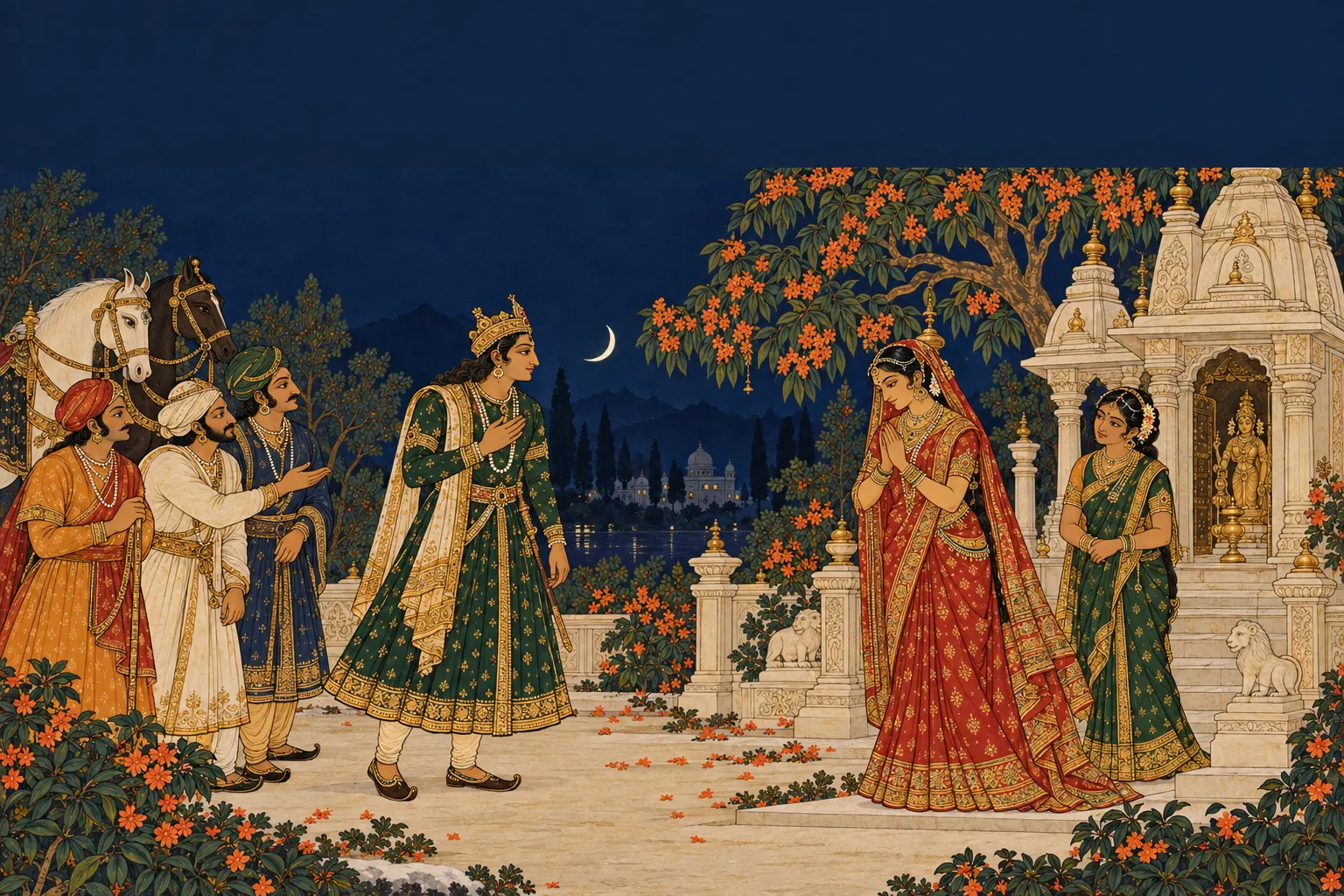
Mrigankadatta and his ministers reached the city on horseback at night. The guards were drowsing, and the temple of Gauri in the city garden Pushpakaranda was easily found by the signs Shrutadhi had given. Meanwhile Shashankavati could not sleep: 'For me the heroes of both armies are dying. Father will not give me to that prince, because of the old enmity and pride. What use is even the goddess's promise in a dream, when fate is against me? Then why should I not give up my life first, before news comes of calamity to my father or my beloved?' She prayed before Gauri, 'O goddess, if not in this birth then in the next may Mrigankadatta be my husband.' She tied the noose of her scarf to an ashoka tree and put it round her neck.
Just then Vimalabuddhi said from behind the trees, 'Prince, some girl is hanging herself.' Mrigankadatta, seeing her beauty, could only stand and think, but her friends woke and cut the noose. Just then a voice came from inside the temple: 'Do not despair, Shashankavati. What I said in the dream is never false. Your husband, who was your husband in a former birth too, Mrigankadatta, has come before you. Go, enjoy the whole earth with him.' Then Vikramakesarin pointed to the prince and said, 'Princess, Bhavani has spoken truly. Here is your future husband.' Shashankavati glanced at him sidelong and became stock-still, the hair standing up on her body.
Mrigankadatta said in a soft voice, 'Fair one, you called me far, taking me from country, kingdom and kin. Now I have the fruit of my living in the forest, sleeping on the ground and eating roots. I want the war to stop, the welfare of both armies, and also my father's blessing.' Shashankavati said with lowered eyes, 'I have been bought by your virtues. Do whatever you think best.' Mrigankadatta bowed to Gauri and made the princess mount his horse. The ministers seated her friends. The city guards, seeing those eleven heroes ride off with swords drawn, did not dare to stop them.
The father-in-law's message, and the wedding
They all reached the palace of Mayavatu in Kanchanapura. In the morning Karmasena learned that his daughter was gone. He thought, 'Mrigankadatta has taken her by a stratagem. Never mind; who could be a better match?' He sent word that the prince should come to his palace, where he would have his daughter married. His allies said he was a wicked man, but Shrutadhi advised that it would be right to go, since Karmasena wanted the marriage done by the rules for his daughter's honour. Mrigankadatta said, 'But I will not marry without my parents.' He sent Bhimaparakrama to Ayodhya.
Meanwhile Amaradatta had learned from the people that his minister's charge against the prince was false. In anger he had that minister killed with his family. In grief for his son he had left the capital and was practising austerity in the Shiva temple at Nandigrama. When Bhimaparakrama fell at his feet and said, 'Your son has won Shashankavati by his valour and is waiting for you in Kanchanapura,' the king at once set out on an elephant with the queen and the army. When father and son met, the father's arms were filled, and the mother held her son as if afraid of another parting.
Karmasena sent his son Sushena to say that he himself would give his sister in marriage. Amaradatta replied, 'Who but Karmasena would show such good will? Let Sushena come to Ayodhya, and the wedding will be there.' In Ayodhya the city was decked as if it were Kubera's city. People were amazed to see Shashankavati. When Sushena came, Mrigankadatta brought him into the city in a chariot. Sushena said to his sister, 'Father says you have done nothing improper. He has learned that the goddess Gauri had named Mrigankadatta your husband in a dream.' Shashankavati's shame left her. Sushena gave her private wealth, two thousand bharas of gold, five camels loaded with ornaments. Then at the auspicious hour the circling of the fire was done, and at every circuit Sushena gave gifts of horses, elephants, gold and silk garments.
Then King Amaradatta honoured Sushena by tying a turban on him, and sent the Kirata, Shabara and Matanga kings, and Mrigankadatta's ministers and Shrutadhi, away with land, cows, horses and gold. Mrigankadatta lived happily among his ministers with Shashankavati, whom he had won after a long struggle. The tale was complete where it began: a dream, a promise, and companions who stood by it.
Note: This chapter is written directly from C. H. Tawney's English translation (Book 12, Chapters 69–74 and 100–103). Mrigankadatta's tale is the main tale of Book 12, inside which come the twenty-five tales of the vetala and many other tales, so in this chapter each minister's own tale of separation is not given in full, only its gist. The event that angers the minister, the betel juice, is in the original. The charge of witchcraft is an old belief, shown here only as a wicked minister's trick. Words like 'wicked' and 'clever' are the characters'. In Tawney's text there follows the episode of Amaradatta retiring and handing the kingdom to Mrigankadatta, which is only hinted at here.
Source: Somadeva Bhatta — the Kathasaritsagara (Kashmir, eleventh century), an abridgement of Gunadhya's lost Brihatkatha, Mrigankadatta's Quest