
Chapter 2
The King Who Did Not Know Grammar
The queen caught a king's slip of a single word while he played in the water — and from that one humiliation came a wager, a boon and a new grammar
The King Who Did Not Know Grammar is chapter 2 of Kathasaritsagara. Source: Kathasaritsagara, Book 1, Chapters 6–7. It is told in 5 scenes — A Brahman's son; Satavahana; The insult at the spring festival; Six years or six months?; Karttikeya's grace — followed by 10 quiz questions.
A Brahman's son
There was a city called Supratishthita, in the region of Pratishthana (today's Paithan). A Brahman named Somasharma lived there. He had two sons, Vatsa and Gulma, and a daughter, Shrutartha. After their parents died, the two brothers looked after their sister.
One day the brothers found that Shrutartha was with child. Each began to suspect the other, since no other man ever came to the house. Their sister read their thoughts and said, 'Do not think ill — hear the truth. Vasuki has a nephew, a naga prince named Kirtisena. He saw me as I was going to bathe, told me his name and his lineage, and married me in secret. He is of Brahman descent, and the child I carry is his.'
The brothers did not believe her. So Shrutartha quietly called the naga prince to mind, and he came at once. He said, 'I really have made her my wife. She is a heavenly woman who has come to earth under a curse, and you two are here for the same reason. She will have a son, and then the curse will end for all of you.' In a few days Shrutartha bore a son. At that very moment a voice from the sky said, 'This child is a part of Dharma. His name shall be Gunadhya.'
Then what had been foretold came to pass: the time of the curse ran out, and the mother and both uncles passed away. Gunadhya was left alone. He shook off his grief and, while still a boy, went south on his own resources. There he learned every branch of knowledge and made a name. When he came back with his pupils he was amazed at the streets of his city. In one place singers of the Sama Veda were chanting; in another, Brahmans were arguing over the meaning of the scriptures; in another, gamblers were praising gambling; and in another, merchants were telling stories of their earnings.
One of those merchants was speaking. 'Making money out of money is nothing. I earned mine with no capital. My father died before I was born. Relatives seized everything my mother had. She ran away with me in her womb and took shelter in the house of a friend of my father's, named Kumaradatta. I was born there. My mother brought me up working as a maidservant, and somehow had a teacher teach me to read and count. She said, "You are a merchant's son — trade. There is a rich banker named Vishakhila who lends capital to poor boys of good family. Ask him."
'I reached his house. At that very moment he was scolding some young man: "Look, there is a dead mouse lying on the floor. Even from that a clever man could make money! And I gave you so many dinars, and you neither grew them nor saved them." I said at once, "Very well, I take this mouse from you as capital." I wrote him a receipt, picked up the mouse and left. The banker burst out laughing.
'I sold that mouse to a merchant to feed his cat, and got two handfuls of gram. I ground the gram, took a pot of water, and sat in the shade at a crossroads outside the city. To the woodcutters who passed that way I respectfully gave water and gram. Each woodcutter gave me two sticks of wood in return. I sold the wood in the market and used a small part of it to buy gram again. Doing this every day, I built up some capital, and I bought up three days' worth of wood. Then, because of heavy rain, wood ran short, and I sold that same wood for hundreds of panas. With that money I opened a shop, and by my own skill I grew rich. Then I had a mouse made of gold and presented it to Vishakhila. He gave me his daughter in marriage. Since then people have known me as "the Mouse". That is how I earned all this without a single coin.'
All the merchants were astonished at hearing this. It was like drawing a picture without a wall.
Satavahana
When Gunadhya reached the king's palace, King Satavahana was sitting on a throne of jewels among his minister Sarvavarman and the other courtiers. The ministers said, 'Maharaj, this man is famous across the earth for every branch of knowledge. His name, Gunadhya — "rich in virtues" — fits his nature exactly.' The king was pleased and made him his minister. Gunadhya married, took charge of the king's affairs, and began to teach his pupils.
There is also a tale about Satavahana's name, which Gunadhya later told to Kanabhuti. There was a mighty king named Dvipikarni. His queen Shaktimati was dearer to him than life itself. One day, as she slept in the garden, a snake bit her and she died. In grief for her, the king took a vow of lifelong chastity, though he had no son. Then one night Shiva, whose crown is the moon, said to him in a dream, 'As you wander in the forest you will see a boy riding a lion. Take him home; he will be your son.'
Out of a love of hunting the king went into a distant forest. At noon, by the shore of a lotus pond, he saw a boy as radiant as the sun, riding a lion. The lion stopped to drink water and set the boy down. The king remembered his dream and killed the lion with a single arrow. At once the lion shed its lion form and became a man. The king asked, 'What is this?' He said, 'O king, I am a yaksha named Shata, a servant of Kubera. I once saw a sage's daughter bathing in the Ganga. She too saw me and fell for me. I married her in secret. When her kinsmen found out, they cursed us both: "May you both become lions." The sages decreed that the girl's curse would end when she had a child, and mine would last until you killed me with an arrow. We became a lion and a lioness. She became pregnant, and died after the birth of our son. I raised him on the milk of other lionesses. Today, by your arrow, I am freed from the curse. Take this son.' Having said this, Shata vanished.
The king brought the boy home. Because he had ridden on Shata (the yaksha), he named him Satavahana — 'carried by Shata'. When the time came, Dvipikarni went to the forest, and Satavahana became king of the whole earth.
The insult at the spring festival
At a spring festival King Satavahana went to the garden that, by the goddess's grace, had been made in Gunadhya's city. He strolled there like Indra, and then went down into the pond with his queens to play in the water. The queens and the king were splashing one another. One of the queens, a very delicate one, grew tired and said, 'Do not throw drops of water at me.' In Sanskrit the words were *mā udakaiḥ*.
Hearing this, the king at once had sweets sent for. For joined together, *mā udakaiḥ* makes *modakaiḥ*, which means 'with sweets'. The king thought the queen was asking for sweets.
The queen burst out laughing. 'Maharaj, what use are sweets in the water? I said, do not strike me with drops of water. Don't you know even the joining of *mā* and *udaka*? Don't you know even this chapter of grammar? How can you be such a fool?' The queen knew grammar. The servants laughed.
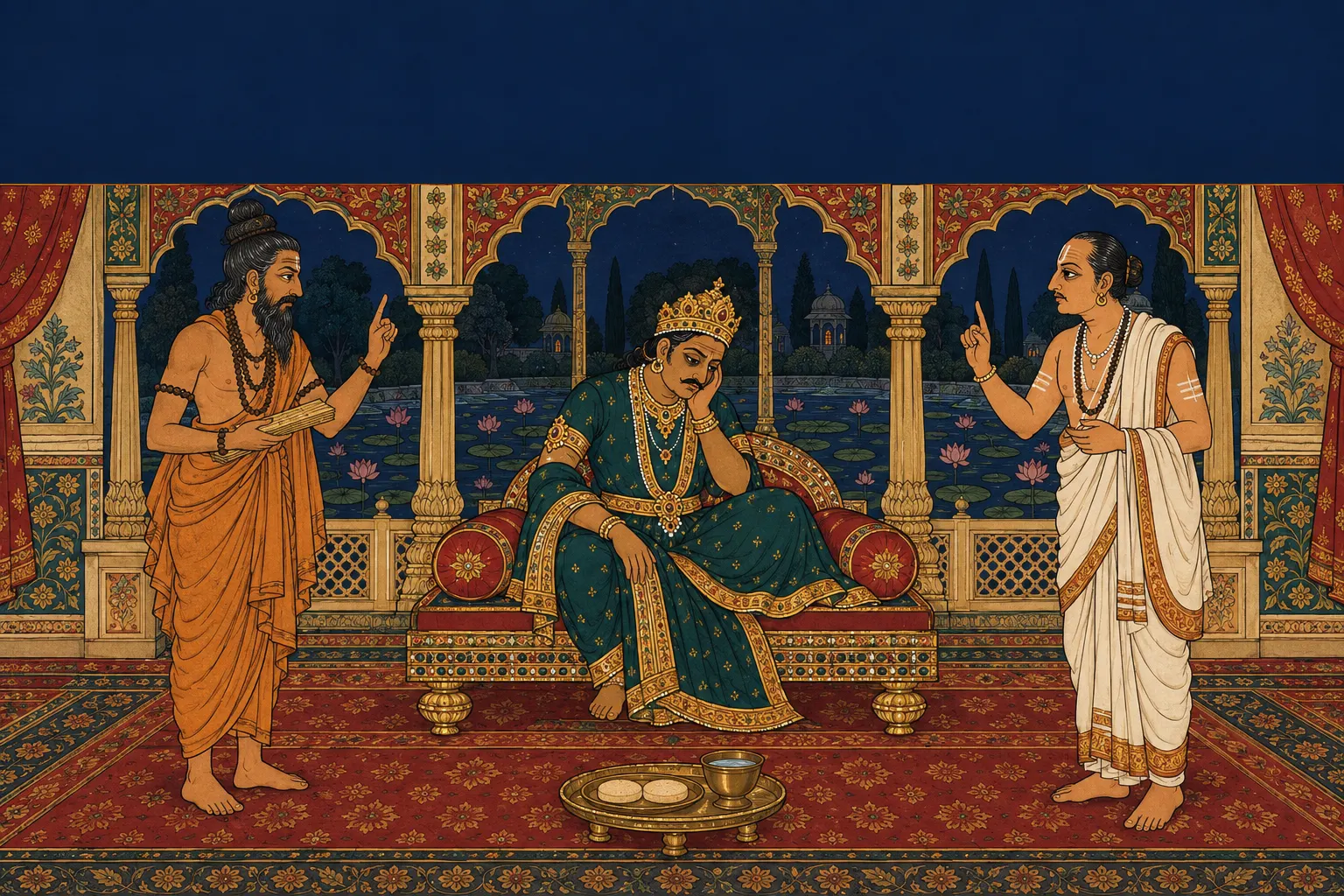
Satavahana was filled with shame inside. He came out of the water and went to the palace without a word. He stayed silent as a painting, said nothing even when questioned, gave up food and drink, and fell to brooding: either I will gain learning or I will die. He lay down on his bed.
Six years or six months?
All the courtiers were alarmed. By the time Gunadhya and Sarvavarman learned of it, the day had already waned. They sent for the king's attendant Rajahamsa and questioned him. He said, 'I have never seen the king like this. The other queens said angrily that today the learned queen, Vishnushakti's daughter, insulted the king.'
They thought, 'If it were an illness of the body we would call physicians, but this is an illness of the mind.' Then the wise Sarvavarman said, 'I know the reason. The king is grieved at his own ignorance. He always says, "I am a fool." I had guessed his wish earlier.' They got through the night and in the morning went to the king's private chamber, where no one was allowed to enter. Gunadhya went in with difficulty, and Sarvavarman after him.
Gunadhya asked, 'Maharaj, why are you sad for no reason?' The king stayed silent. Then Sarvavarman said, 'Maharaj, you once said to me, "Make me a scholar." Last night I called up a dream with a mantra, and saw a lotus fall from heaven; a divine youth opened it, and a heavenly woman in white garments came out of it and entered your mouth. I think it was Sarasvati.'
Then the king broke his silence. 'In how much time can a hardworking man gain learning? Without learning, royal splendour does not please me. For a fool, rank and power are like jewels on a log of wood.'
Gunadhya said, 'Maharaj, it takes twelve years to learn grammar, but I will teach it to you in six.' Hearing this, Sarvavarman burst out in jealousy: 'How will kings used to pleasure endure hardship for so long? I will teach it in six months.'
Gunadhya said in anger, 'If you teach the king grammar in six months, I will give up the three languages — Sanskrit, Prakrit and the vernacular — for ever.' Sarvavarman said, 'And if I fail, I will carry your shoes on my head for twelve years.' With that he left. The king's hope rose that one or other of them would give him learning.
Karttikeya's grace
Now Sarvavarman was in difficulty. He regretted it. He told his wife everything. She said, 'My lord, only the grace of the god Karttikeya can save you from this trouble.' Sarvavarman made up his mind to that.
In the last watch of the night, hungry and thirsty, he set out for Karttikeya's temple. Gunadhya's spies told him, and in the morning he told the king. Just then a loyal Rajput named Simhagupta spoke up: 'Maharaj, when I heard of your anxiety, I was going outside the city to cut off my own head before Durga for your good. Then a voice from the sky stopped me: "Do not do it. The king's wish will be fulfilled." So I am confident that you will succeed.' With this, Simhagupta sent two messengers after Sarvavarman.
Keeping silence and fasting, Sarvavarman at last reached Karttikeya's temple and wasted his body away with austerity. The god was pleased. With his own hand he gave him a new, short grammar. The god said, 'If you had not spoken the next sutra yourself, this grammar would have displaced Panini's. Because it is brief it will be called *Katantra*, and from the tail of my peacock (*kalapa*) it will also be called *Kalapaka*.' The god also told him that the king had been, in his last life, an ascetic named Krishna, who was cursed for loving a sage's daughter and was now born as Satavahana, so that the moment he saw Gunadhya he would remember all his knowledge. The god's attendants gave him a few grains of rice. On the way back he ate those grains every day, and they never ran out.
The messengers told the king the news of success. The king was glad, and Gunadhya dejected, as the chataka bird is glad and the swan sad at the sight of clouds. His wager had turned into a defeat. Sarvavarman came back, and as soon as he recalled the whole of learning, it descended into the king. There was a festival across the kingdom, with banners flying from every house. The king bowed and called Sarvavarman his teacher, gave him jewels and gave him the Bakakachchha region on the bank of the Narmada. To Simhagupta he gave wealth equal to his own. And the queen who had caused all this he raised above all the queens and consecrated with his own hand.
And Gunadhya, as he had said, gave up all three languages — Sanskrit, Prakrit and the vernacular — and took a vow of silence. Now in court he greeted the king with a bow of the head alone, and said nothing.
Note: This chapter is written directly from C. H. Tawney's English translation (Book 1, Chapters 6–7). 'Secret marriage' here stands for the original's 'gandharva marriage'; the details are deliberately not given. The joke-like inset tale of the Sama Veda singer and the courtesan has been left out. The tradition of Sarvavarman and the Katantra (Kalapa) grammar has also been recorded by later scholars; here only the book's own statement is given. Names such as Satavahana and 'Bakakachchha' are the text's.
Source: Somadeva Bhatta — the Kathasaritsagara (Kashmir, eleventh century), an abridgement of Gunadhya's lost Brihatkatha, The King Who Did Not Know Grammar