
Chapter 3
Seven Hundred Thousand Verses and a Fire
Seven hundred thousand verses in the language of the pisacas, written in blood for ink — and the king for whom they were written sent them back as 'a pisaca's tale'
Seven Hundred Thousand Verses and a Fire is chapter 3 of Kathasaritsagara. Source: Kathasaritsagara, Book 1, Chapters 7–8. It is told in 5 scenes — The Vindhya forest; Two names; Ink of blood; The king's disdain; The burning manuscripts — followed by 10 quiz questions.
The Vindhya forest
Gunadhya had taken his vow of silence. One day in court a Brahman recited a verse of his own making, and the king himself answered it in pure Sanskrit. The courtiers were delighted. The king told Sarvavarman to say for himself how the god had favoured him. Sarvavarman told everything.
Then Gunadhya bowed his head and took his leave of the king. The king did not want to let him go, but because of his oath about language he could not stay in the work of the court. He left the city with only two pupils. Setting his mind on austerity, he came to the temple of the Vindhya goddess, and in a dream the goddess commanded him to meet Kanabhuti. He went into the terrible Vindhya forest. A Pulinda showed him by signs where a caravan was, and somehow he reached the place where a band of pisacas gathered. There, listening to their talk from a distance, he learned their Paisachi language. It was a fourth language, in which he could speak without breaking his oath. So it was his wager itself that carried him to the language of the pisacas.
Kanabhuti had gone to Ujjayini at that time. Gunadhya stayed there waiting. When Kanabhuti came back, he told Gunadhya how he had learned of his arrival the night before. 'I have a rakshasa friend named Bhutivarman who has divine sight. In a garden in Ujjayini I asked him when my curse would end. He said, "By day our power does not work. I will tell you at night." When night came I asked why ghosts and spirits play only at night. He said, "I once heard Shiva speak to Brahma. Rakshasas, yakshas and pisacas are dazzled by the sun's glare by day, so they take their pleasure at night. Their power works where the gods are not worshipped, where Brahmans are not honoured as they should be, where people eat against the scriptures. They do not go where there is someone who has given up meat, or a faithful wife." Then Bhutivarman said, "Go — Gunadhya has come, the means of your release from the curse." So Kanabhuti came running.
Two names
Kanabhuti asked Gunadhya one thing: 'Why was Pushpadanta called Pushpadanta, and why were you called Malyavan?'
Gunadhya told him. On the bank of the Ganga was a Brahman village called Bahusuvarnaka. A learned man named Govindadatta lived there. He had five sons, handsome but foolish and unruly. One day a guest, Vaishvanara, arrived, and the sons greeted him with a laugh. The Brahman was angry and began to leave: 'Your sons are fools, so they have lost caste, and by living with them so have you.' Govindadatta swore that he would not even touch those sons. His wife said the same, and only then did the guest stay. Of the sons, Devadatta was so grieved at his father's harshness that he went to Badarikashrama for austerities. There he first ate leaves, then drank only smoke, and pleased Shiva. Shiva said, 'Gain learning, enjoy happiness on earth, and then your wish will be fulfilled.'
He went to Pataliputra to study. There the wife of his teacher Vedakumbha fell for him. Devadatta left that place and went to Pratishthana, where he learned every branch of knowledge from an old teacher, Mantrasvami. There Shri, the daughter of King Susharma, saw him at a window. Each looked at the other and was bound. The princess beckoned him closer by a sign, and then dropped a flower from her teeth before him. Devadatta did not understand the meaning of the sign and was distressed. His teacher saw his trouble and solved the riddle: 'By dropping the flower with her teeth she told you: go and wait in the temple full of flowers named Pushpadanta.' Devadatta went there. The princess also came to the temple, on the pretext of the eighth day of the month. She asked, 'How did you understand my sign?' He told the truth: 'My teacher explained it.' The princess grew angry and said, 'You are a fool,' and left. Devadatta withered again with sorrow.
Then Shiva sent his gana Panchashikha to help Devadatta. Panchashikha dressed him as a woman, took the form of an old Brahman himself, and went to King Susharma and said, 'My son has gone away; I am going to look for him. Until then I leave my daughter-in-law with you.' The king, afraid of a Brahman's curse, had her lodged in the princess's guarded palace. There Devadatta married the princess in secret. Then Panchashikha quietly took him out, removed his woman's disguise, and in the morning, becoming a Brahman again, said to the king, 'My son has been found; give my daughter-in-law back.' The king grew tired of searching for the daughter-in-law and, afraid of the Brahman's curse, gave his own daughter in marriage to Devadatta.
Later King Susharma made his grandson Mahidhara king and went to the forest. Devadatta too went to the forest with his wife, practised austerities and by Shiva's grace became a gana. 'Because he had failed to understand the sign of the flower dropped from his beloved's teeth,' Gunadhya said, 'he was called Pushpadanta in the assembly of the ganas, and his wife became Jaya, doorkeeper in Parvati's house.'
Then Gunadhya told his own story. He too was a son of the same Govindadatta, and his name was Somadatta. He too, grieved for the same reason, went to the Himalaya and kept offering Shiva garlands of forest flowers. Shiva said, 'You have offered me garlands of forest flowers brought by your own hand, so you shall be my gana and be called Malyavan.' From this came the name Malyavan.
Ink of blood
At Gunadhya's request Kanabhuti told that divine tale of the seven tales in his own language, and Gunadhya set it down in that same Paisachi language, in seven years, in seven hundred thousand verses. He had no ink, so, afraid the vidyadharas would steal it, the great poet wrote it in the forest with his own blood. Vidyadharas, siddhas and other divine beings came to listen, and where Kanabhuti was telling the tale the sky was covered over like a roof. Seeing the tale Gunadhya had written, Kanabhuti was freed from his curse and went to his own world. The other pisacas with him, having heard the tale, went to heaven too.
The king's disdain
Now Gunadhya began to think, 'The goddess said I must spread this tale on earth. But to whom shall I give it?' His two pupils, Gunadeva and Nandideva, said, 'King Satavahana alone is worthy of it. He is a connoisseur, and like the scent of a flower the wind will spread it.' Gunadhya agreed. He gave the tale to his pupils and sent them to the king, and himself stayed in the garden made by the goddess outside Pratishthana.
The pupils gave the king the manuscript and told him it was Gunadhya's work. The king saw the Paisachi language and saw the pisaca-like appearance of those pupils. In the pride of his learning he said mockingly, 'Seven hundred thousand verses are no small matter, but the Paisachi language is barbaric and the letters are written in blood. Take away this pisaca's tale.' The two pupils went back with the manuscript and told Gunadhya everything.
Who is not pained when a worthy man's work is rejected by one who knows? Gunadhya was filled with sorrow the moment he heard it.
The burning manuscripts
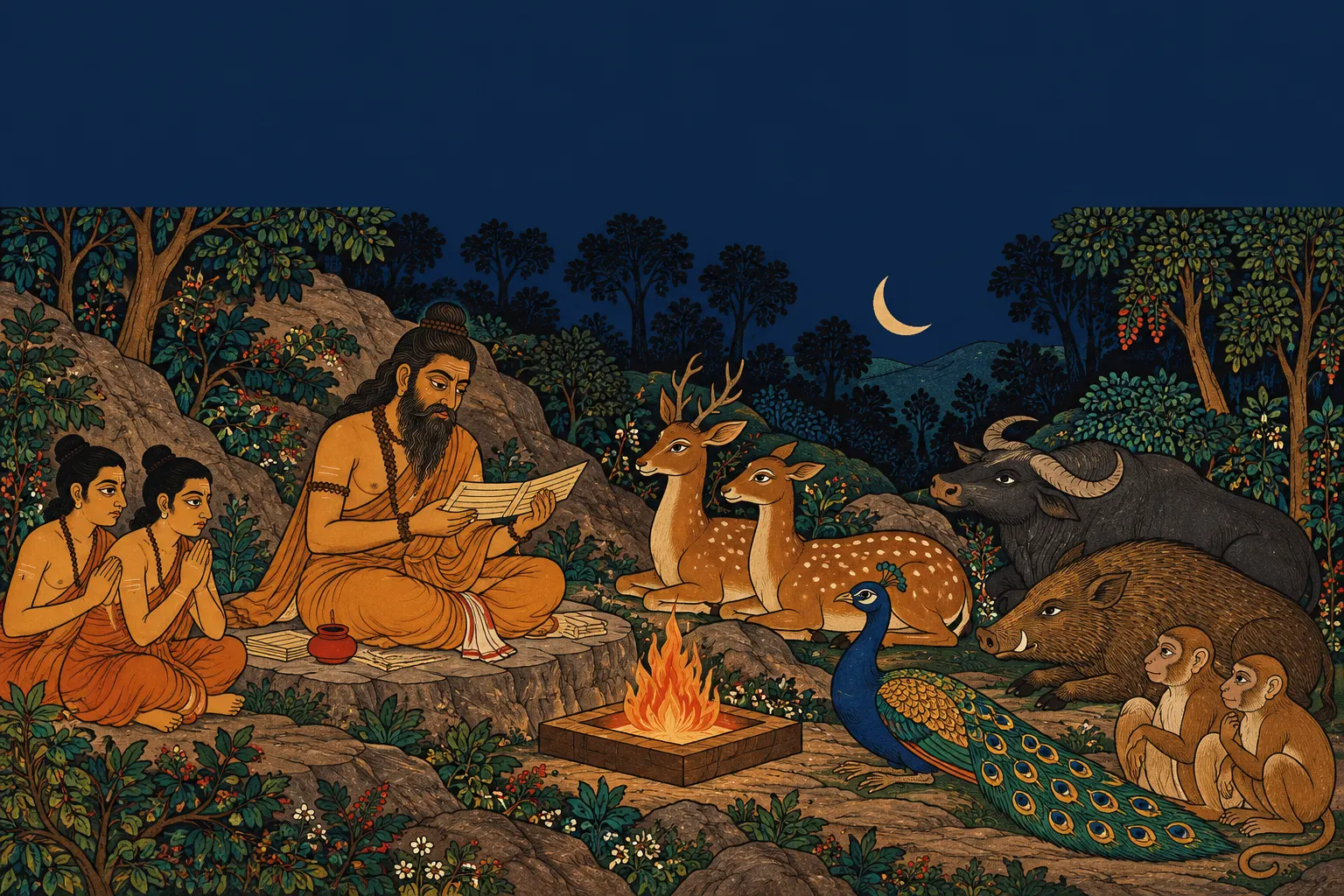
Gunadhya went with his pupils to a nearby rocky, deserted hill. There he first made a sacrificial pit, and then lifted the pages of the manuscript one by one, read them aloud to the beasts and birds, and threw them into the fire. His pupils watched, weeping. But one tale he saved: the tale of Naravahanadatta's life, in a hundred thousand verses, because that was the one both pupils loved best.
While he read and burned, deer, boars, buffaloes and all the beasts of the forest gave up grazing and came there, and stood round him listening with tears in their eyes. They could not move from the spot.
Meanwhile King Satavahana fell ill. The physicians said he was being fed meat with no nourishment in it. When the cooks were scolded they said that is how the hunters brought it. When the hunters were asked, they said, 'A short way from here, on a hill, a Brahman reads and throws every page into the fire. All the animals go there and keep listening; they do not graze, they go nowhere else. That is why their meat has no nourishment.'
Hearing this, the king went there with the hunters, full of curiosity. He recognised Gunadhya, who, covered in matted locks, looked like the smoke of a dying fire. He was standing among the weeping beasts. The king bowed to him and asked everything. Gunadhya told him his whole story in Paisachi: that he was an incarnation of Pushpadanta, and how the tale had come down to earth from Shiva's mouth. The king understood that he was the incarnation of a gana, touched his feet, and asked for that divine tale that had come from Shiva's mouth.
Gunadhya said, 'O king, I have burned six tales, six hundred thousand verses. One tale of a hundred thousand verses is left. Take it, and these two pupils of mine will explain its meaning to you.' Handing the Brihatkatha to the king, Gunadhya took his leave, and by the power of his yoga gave up his body. He was freed from the curse and went to his divine world.
The king returned to the city with the manuscript. He gave Gunadeva and Nandideva land, gold, garments, cattle, palaces and treasures. With their help he grasped the substance of the tale, and Satavahana composed the *Kathapitha* to tell how this tale first came to light in the Paisachi language. The tale was so varied and so full of flavour that people forgot the tales of the gods. Spreading through the city, it became famous in the three worlds.
Note: This chapter is written directly from C. H. Tawney's English translation (Book 1, Chapters 7–8). The book's claim about the Paisachi language is given here only as the book's own; scholars do not agree on the region of this language. 'Secret marriage' here stands for the original's 'gandharva marriage'. The episode of the woman's disguise in Devadatta's tale is in the original tale; only as much as the tale needs is given. Names like Bakakachchha, Pataliputra and Kausambi are the text's.
Source: Somadeva Bhatta — the Kathasaritsagara (Kashmir, eleventh century), an abridgement of Gunadhya's lost Brihatkatha, Seven Hundred Thousand Verses and a Fire