
Chapter 12
The Emperor and the End of the Tale
Seven jewels in a cave, an emperor across Kailasa — and the tale returning to where it began, down to a queen of Kashmir
The Emperor and the End of the Tale is chapter 12 of Kathasaritsagara. Source: Kathasaritsagara, Book 15 (Mahabhisheka), Chapters 109–110; Book 18 (Vishamashila), Chapters 120, 124, and the poet's epilogue. It is told in 8 scenes — The cave on the Malaya mountain; Across Kailasa; The lure of Meru, Narada's lesson; The coronation on Mount Rishabha; The father's visit; The tale Kanva told; Where it began, there it arrived; The poet's introduction — followed by 10 quiz questions.
The cave on the Malaya mountain
Naravahanadatta, son of King Udayana of Kausambi, was now on the road to becoming emperor of the vidyadharas. One day he sat in his court on the mountain Govindakuta when a vidyadhara named Amritaprabha descended from the sky. It was he who had earlier saved Naravahanadatta when he was flung down by his enemy on the Mountain of Fire. He said, 'In the south is the Malaya mountain, where lives a great sage named Vamadeva in his hermitage. He is inviting you alone for some great purpose.' Naravahanadatta left his wives and army and went with Amritaprabha through the sky to the Malaya.
Vamadeva was old, his hair waving like creepers. He said, 'In the inner cave of my hermitage are some jewels, which you must take. After getting them you will easily defeat Mandaradeva. By Shiva's command I have invited you for this.' Naravahanadatta went into the cave. There, after passing many obstacles, he saw a furious, roaring elephant. He struck it on the forehead with his fist, put his feet on its tusks, climbed on and mounted it. A voice came from the cave, 'Well done, emperor! You have won the elephant jewel.' Then he seized a sword that shone like a snake. The voice said, 'You have won the victorious sword jewel.' In the same way came the moonlight jewel, the wife jewel and the mantra jewel. Counting the two earlier ones, the lake and the sandalwood tree, he now had seven jewels. Vamadeva said, 'Go, son, and win the kingdom of both sides of Kailasa, north and south.'
Across Kailasa
Returning, he told everyone of winning the jewels. There was a festival. The next day, at an auspicious hour, he set off to defeat Mandaradeva in the chariot made by Brahma that Shiva had given him, with his army and wives. The kings of the gandharvas and vidyadharas, his commander Harishikha, and Chandasimha, his mother-in-law Dhanavati, who was like a mother, and Amritaprabha were all with him. Crossing Lake Manasa they reached the foot of Kailasa, where the Mandakini flows.
The vidyadhara Mandara said, 'Kailasa is Shiva's dwelling. Crossing over it destroys knowledge. To go to the other side you must go through the cave of Trishirsha, but its guardian Devamaya is very proud.' Naravahanadatta first sent a message of peace, which Devamaya did not accept. The next day there was battle. Chandasimha killed Devamaya's commander Varaha, and Naravahanadatta, without any magic power, took the wounded and weary Devamaya prisoner. From the chariots of the gods in the sky came the cry 'Well done! Well done!' Naravahanadatta consoled and freed the captive Devamaya. Devamaya submitted.
Next morning Devamaya told the history of the cave. 'In ancient times north and south Kailasa were two separate kingdoms. A vidyadhara named Rishabha pleased Shiva by austerity and became emperor of both. But while crossing Kailasa, by Shiva's anger his knowledge was taken from him and he fell. Doing austerity again he got a boon from Shiva, and asked what the way should be to go to both sides. Shiva split Kailasa and made this cave. But then the mountain grieved that this road was now open to men. For guards Shiva set the elephants of the quarters, serpents with poisonous gaze and guhyakas, and at the southern door Kalaratri Chandika. He made a rule that whoever has the jewels and is emperor of the vidyadharas may pass through this cave, and no one else. Rishabha later, in pride, fought the gods and was killed by Indra. At my birth a voice from the sky said that whoever conquers me will be emperor. You have conquered me, so you alone are lord of all.'
Naravahanadatta entered the cave in his chariot. The jewels removed every obstacle: the moonlight jewel the darkness, the sandalwood tree the poisonous-gazed serpents, the elephant jewel the elephants of the quarters, the sword jewel the guhyakas. He came out at the northern door and a voice from the sky said, 'Well done, emperor!' But Dhanavati and Devamaya said Kalaratri must be worshipped. At night the whole army fell unconscious; only Naravahanadatta stayed awake. He understood that Kalaratri was displeased at not being worshipped. He praised her. When the goddess was not appeased, he began to raise his sword to offer his own head, and then the goddess said, 'Do not be hasty, son! I am pleased with you. Let your army wake, and may you be victorious.' The army woke.
The next day he defeated Dhumashikha and brought him under his rule, then fought a great battle with Mandaradeva's army, in which kings like Kanchanadamshtra sided with Mandaradeva. In the end Mandaradeva went to the forest, and when his queens were ready to burn themselves, the emperor stopped them, and gave them houses and gifts and kept them like sisters. He gave Amitagati the kingdom of Mandaradeva, whom Shiva had already chosen.
The lure of Meru, Narada's lesson
Though he had become emperor of both sides, a desire for more rose in Naravahanadatta's mind. He set out, against his ministers' advice, to conquer the northern region of Mount Meru, the home of the gods. Then Narada came and said, 'O king, though you know policy, why do you desire the impossible? Ravana in his pride wished to uproot Kailasa and was humbled. Shiva has given you the kingdom of the vidyadharas, not of the gods. Meru is not for you.' Remembering Rishabha's end, Naravahanadatta gave up the idea, and at Narada's word went to the hermitage of Mandaradeva's father, the royal sage Akampana.
There he embraced Mandaradeva, who had become an ascetic, for true heroes honour even the defeated. Akampana gave his daughter Mandaradevi's hand to him. Mandaradevi said, 'We five friends, roaming the forest, had seen you in a grove of ascetics and had made a vow that we would all choose you as husband together, or else those of us who married alone would be the cause of the others entering the fire. How can I marry without my friends?' Her four friends were: Kanakavati, daughter of Kanchanadamshtra, Kalavati, daughter of Kalajihva, Shruta, daughter of Dirghadamshtra, and Ambaraprabha, daughter of the king of Paundra. The fathers were sent for and Naravahanadatta married all five.
The coronation on Mount Rishabha
Akampana and Devamaya said that the old emperors had been anointed on Mount Rishabha, and that he should be anointed there too. Harishikha suggested the nearby Mount Mandara, but a voice from the sky said, 'All the old emperors had their coronation on Mount Rishabha. You go there too.' He returned through the Trishirsha cave. On the way he thought that Shiva lived close by on Kailasa. He went with Gomukha to see him. Nandi opened the door. Inside Shiva was playing dice with Parvati. Naravahanadatta bowed to them both and circled them three times. Shiva said, 'It is well, son, that you came, or you might have suffered loss. Now all your sciences will be unfailing. Have your coronation on Mount Rishabha.'
On his return Madanamanchuka asked with a smile, 'Where have you been, my lord? It seems you found another five girls here too?' He told the truth and she was pleased.
The next day he went by chariot to Mount Rishabha with gandharvas, vidyadharas, wives and ministers. There all the vidyadharas, some out of devotion, some in fear, some defeated, brought gifts. They asked, 'Who will sit on half your throne?' He said, 'Queen Madanamanchuka.' The vidyadharas were left wondering, and a voice from the sky said, 'Vidyadharas, this Madanamanchuka is not a mortal but the incarnation of Rati, born to be the wife of your emperor Kama. The child of Kalingasena who was counted as Madanavega's daughter was changed by the gods, who put this girl in its place. Shiva has given her this honour because he was pleased with her austerity.'
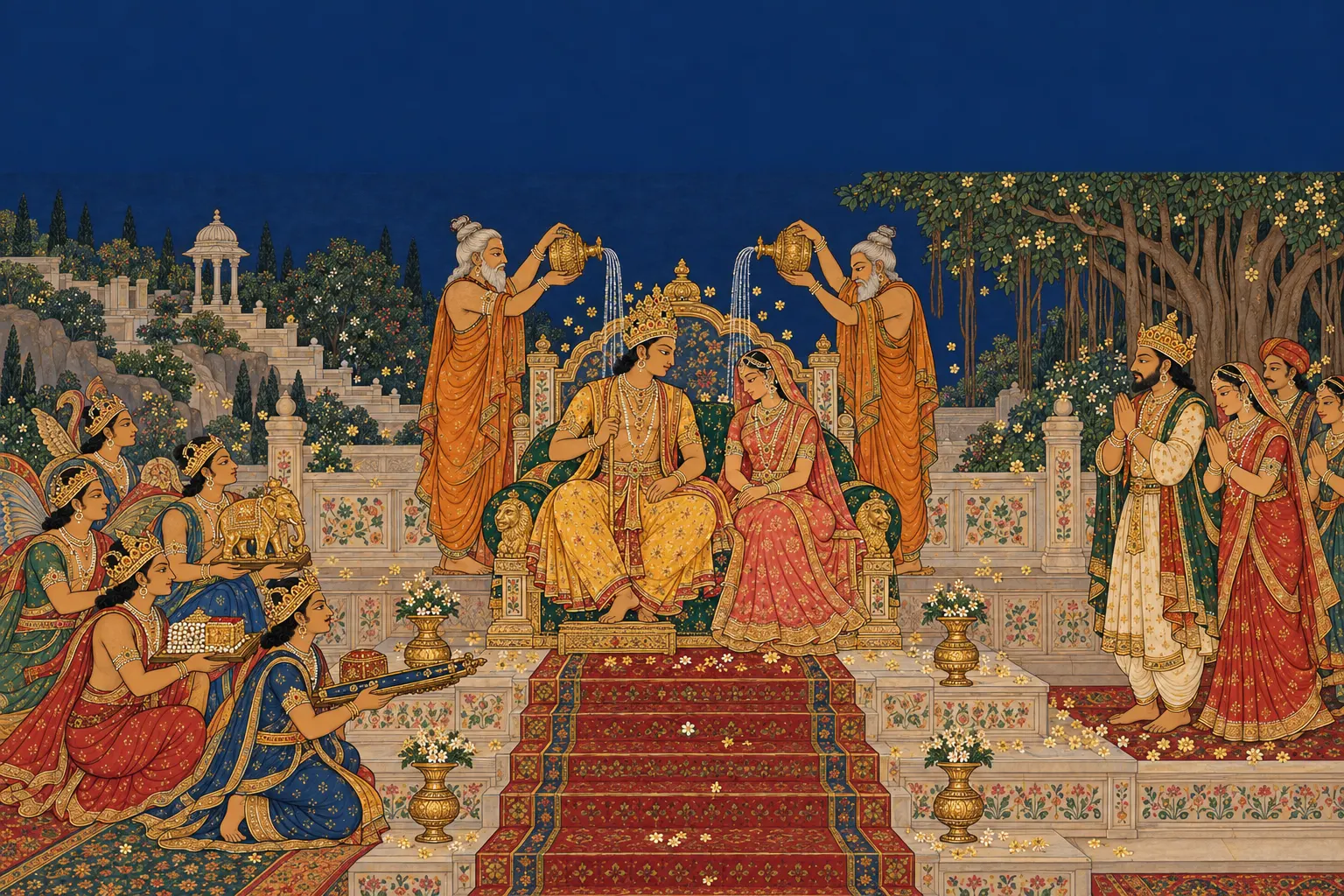
Then, on an auspicious day, great sages anointed the emperor with water from all the holy places in golden pots, and Madanamanchuka sat on the left half of the throne. The priest Shantisoma was busy, the instruments of the apsarases sounded, and the murmur of Brahmans' mantras filled the quarters. They say that as the water fell, the knot of enmity was washed away from the minds of his foes.
The father's visit
The emperor remembered his father and sent Vayupatha to Kausambi. He arrived with seventy million vidyadharas, and the people of the city were dumbfounded. He told Udayana of his son's victory and coronation. Udayana, Vasavadatta and Padmavati, Yaugandharayana and the other ministers, and the son's maternal uncle Gopalaka came through the sky in palanquins to Mount Rishabha. Naravahanadatta ran as soon as he saw his father and embraced him, and was anointed a second time by his father's tears of joy. Vasavadatta held him so long that he remembered his childhood. Kalingasena, seeing her daughter and son-in-law, could not contain her joy. Madanamanchuka, with Ratnaprabha, Alankaravati, Lalitalochana, Karpurika, Shaktiyasha and all the queens, bowed to their parents-in-law, and they showered blessings on them.
At the banquet there were jewelled goblets, flower-strewn courtyards and all kinds of dishes made by magic. Days passed and Udayana began to long for his city. He said to his son, 'Son, who would not value these divine pleasures? But the attraction of one's native land draws everyone. You rule here, being half god and half man. If a fit occasion comes, call me again. The fruit of my birth is that I have seen your moon-like face.' Naravahanadatta said in a tearful voice to Devamaya that a thousand bharas of gold and jewels should be sent ahead of his father. Udayana returned to Kausambi with his family and ministers in a divine chariot. His son went with him a long way, and his mother Vasavadatta turned him back in a choked voice.
The tale Kanva told
Now the tale returns to where Naravahanadatta had spoken of his separation. Sitting in Kashyapa's hermitage on the Black Mountain, Naravahanadatta said to the sages, 'When Vegavati, taking me away, left me in the protection of a science, and I was parted from my wife, I wanted to give up my life. Just then I met the great sage Kanva in the forest. He said to me, "Though you are a hero of the lunar race, why are you so sad? What seems impossible, such meetings do happen. I will tell you the tale of Vikramaditya."'
King Mahendraditya of Ujjayini worshipped Shiva for a son. Meanwhile on Kailasa the gods came to Shiva: 'Asuras born in the form of mlechchhas are stopping sacrifices and harassing Brahmans, so the gods' portion is shrinking.' (Here 'mlechchha' is the poet's word, meaning oppressors who do not honour dharma, not any community of today.) Shiva commanded his gana Malyavat to be born in the house of Mahendraditya and destroy them. Malyavat asked, 'In human life there are separation, old age and sickness.' Shiva said, 'These will not touch you.' The king heard Shiva's word in a dream, that he would have a valiant son, to be named Vikramaditya and Vishamashila. The queen in her dream crossed seven seas, and yakshas, vetalas and rakshasas served her. One day she gave birth to a son and flowers rained from the sky and the gods' drums sounded. The king showered so much wealth that, they say, except the Buddhists no one was without a god. The ministers' sons Mahamati, Bhadrayudha, the doorkeeper's son, and Shridhara, the priest's son, grew up with him.
(Many tales are woven into this tale of Vikramaditya by Kanva: of the yakshini Madanamanjari, of Kalingasena's marriage, of separations and reunions of husband and wife. They are not taken in this chapter.)
The lesson at the end of the tale was: 'In this way unexpected separations and reunions take place. So, Naravahanadatta, you too will soon meet your beloved. Be patient. Son of the king of Vatsa, you will long enjoy the position of emperor of the vidyadharas among your wives and ministers.' This counsel gave Naravahanadatta patience. In just this way he gained wives, sciences and the sovereignty of the vidyadharas, as he told the sages. After spending the rainy season with Gopalaka he returned in his chariot with his wives to Mount Rishabha, and for a kalpa, that is countless years, he reigned.
Where it began, there it arrived
The Kathasaritsagara says: this is the Brihatkatha which long ago, on the summit of Kailasa, the fearless Shiva told at the request of the Himalaya's daughter. Then Pushpadanta and his companions, born on earth by a curse as Katyayana and others, spread it through the world. And Shiva gave this tale a blessing: 'Whoever reads this tale that came from my mouth, or listens to it attentively, or keeps it with him will soon be freed from sins, will attain the rank of a splendid vidyadhara and enter my everlasting world.' So the first listener of the tale, Parvati, and its last emperor, Naravahanadatta, meet inside one and the same blessing.
The poet's introduction
At the end Somadeva wrote a few lines about himself. In Kashmir there was a king named Sangrama. His son was Ananta, whose fame spread far. Ananta married Suryavati, daughter of the king of Trigarta. Suryavati built fine monasteries and temples in Kashmir, built white palaces on the bank of the Vitasta, and gave gold, jewels, cows and land in charity. Her son was King Kalasa, and her grandson King Harsha. Somadeva says that he composed this abridgement of the essence of the Brihatkatha for that queen, who was busy with the rules of worship and learned from books, to amuse her mind for a while. The author was Soma, son of Rama, a good Brahman. At the end he wished that this ocean of streams of story, the work of the pure-minded Soma, might give delight to the hearts of good people.
Note: This chapter is written directly from C. H. Tawney's English translation (Book 15, Chapters 109–110; Book 18, Chapters 120 and 124). The poet's last verses were not in Brockhaus's Sanskrit text, and so are not in Tawney; later they were published in other Sanskrit editions. N. M. Penzer's edition has their English translation by L. D. Barnett, which Penzer presents as the first to appear in English; only the gist is taken here, not the notes. In the tale of Vikramaditya there are already many inset tales; the tale of Kalingasena's marriage is one of forced marriage and the rest are long, so only the birth and the frame are taken. The description of the preparation to offer the head to Kalaratri is kept restrained. The climb on Meru, the thought of Mandaradeva's queens burning themselves, and the word 'mlechchha' are the characters' and the poet's language.
Source: Somadeva Bhatta — the Kathasaritsagara (Kashmir, eleventh century), an abridgement of Gunadhya's lost Brihatkatha, The Emperor and the End of the Tale