
Chapter 1
The Tale Shiva Told
On Kailasa, Parvati asked for a story no one had ever heard — and a gana who listened in secret paid for it with a curse
The Tale Shiva Told is chapter 1 of Kathasaritsagara. Source: Kathasaritsagara, Book 1 (Kathapitha), Chapters 1–2. It is told in 5 scenes — Parvati's request; The closed door; The curse; The pisacha of the Vindhya forest; When memory returned — followed by 10 quiz questions.
Parvati's request
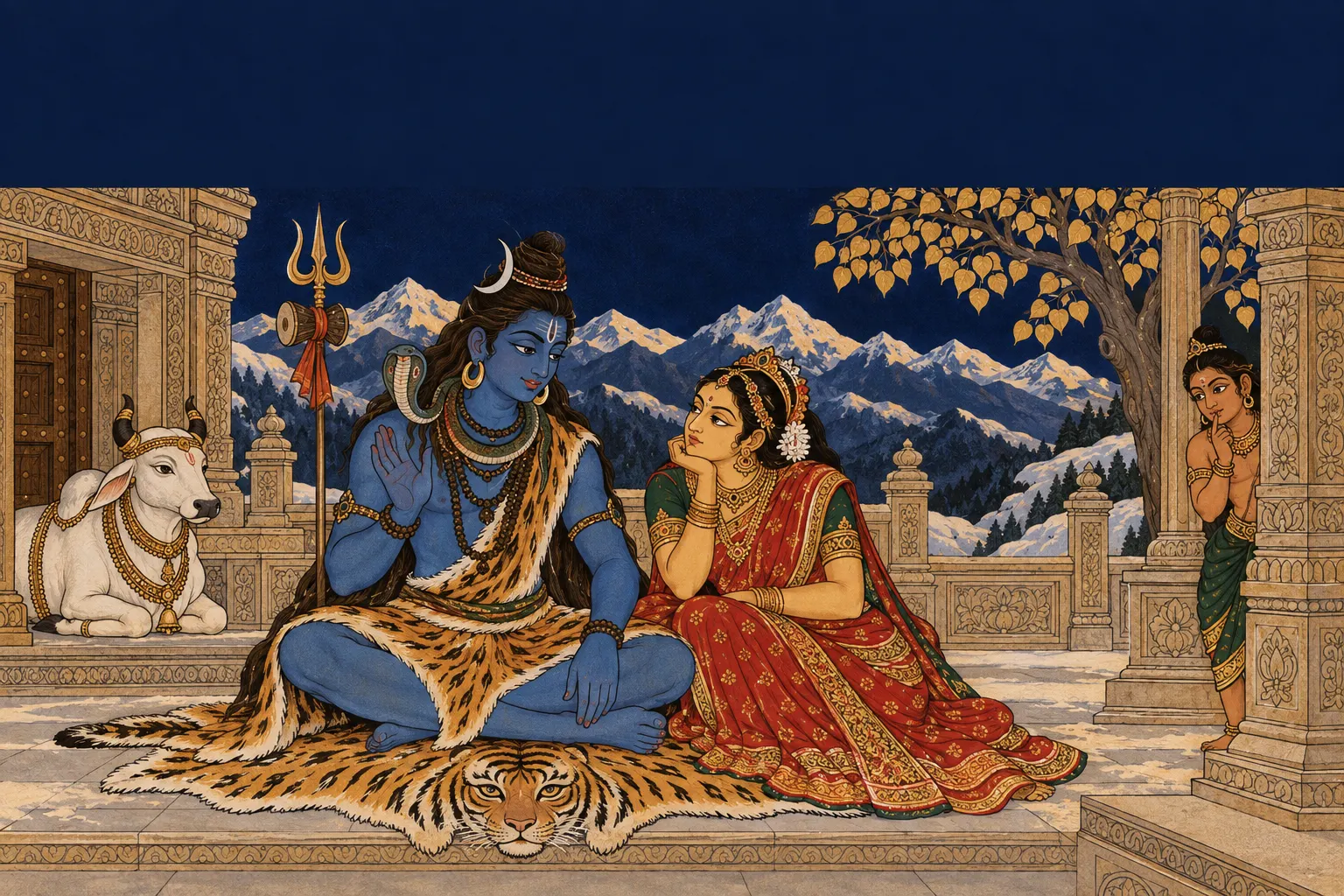
North of the Himalaya stands a lofty peak called Kailasa. There Maheshvara Shiva lived with his beloved Parvati, served by ganas, vidyadharas and siddhas. One day Parvati praised him in a hymn. Shiva was pleased; he took her on his lap and said, 'Tell me, what shall I do to make you happy?'
Parvati said, 'My lord, if you are truly pleased with me, tell me some charming tale — one that is entirely new.'
Shiva laughed. 'What is there, my dear, in the past, the present or the future that you do not know?' But Parvati was proud of Shiva's love for her. She stood her ground and kept repeating the same request.
So, to coax her, Shiva began a very short tale — about her own power. 'Once Brahma and Narayana, wandering about in order to see me, came to the foothills of the Himalaya. There they saw before them a huge pillar of flame, a lingam. One went up and the other went down to find its end, but neither could find it. Then they began to please me with austerities. I appeared and said, "Ask a boon." Brahma asked that I become his son. For that pride he is no longer fit to be worshipped. Narayana asked to remain in my service. So he was born as a part of me, in the form of you — for you and Narayana are one.'
Then Shiva said, 'And you were my wife in your last birth too.' Parvati was startled. 'How can that be?' Shiva told her that the Prajapati Daksha had many daughters, and she was one of them. Daksha gave her to Shiva and the others to Dharma and the rest. Then Daksha held a sacrifice and invited all his sons-in-law — all but Shiva. She asked her father why her husband had not been invited. Daksha answered cruelly, 'Your husband wears a garland of skulls round his neck. How can he be invited to a sacrifice?' In anger she gave up the very body she had received from that father. Shiva, in his fury, destroyed the sacrifice. Then that same Parvati was born as the daughter of the Himalaya. Shiva came to the Himalaya to practise austerities, her father set her to serve him, the gods sent Kama to win her for them, and Kama was burned to ashes by Shiva's glance. Then Parvati, through harsh austerity, won Shiva.
'That is my little story,' Shiva said. 'What more shall I tell?'
Parvati was not satisfied. She sulked. 'You are a deceiver,' she said. 'Even when I ask, you won't tell me a charming tale. Don't I know that you worship at twilight and carry the Ganga on your head?' Then Shiva began to coax her. He promised that he would tell her a marvellous tale.
The closed door
Parvati ordered that no one was to come in while Shiva told the story. Nandi began to stand guard at the door. Shiva said, 'The gods are always happy, men always sorrowful, and the deeds of the gods are very charming. So now I shall tell you the history of the vidyadharas.'
Just then one of Shiva's favourite ganas, Pushpadanta, arrived. Nandi stopped him. Pushpadanta grew curious — why was I the one stopped? He drew on the power of yoga won by his austerities, became invisible, slipped inside, and listened quietly. He heard the whole tale of the wonderful adventures of the seven vidyadharas.
Having heard it, he went home and told the same tale to his wife Jaya. 'Who can hide wealth or a secret from a woman?' — that is the poet's own remark at this point. Jaya, who was Parvati's doorkeeper, was astonished, and went and told Parvati the tale.
Parvati was filled with anger. She said to Shiva, 'You did not tell me any wonderful tale, since even Jaya knows it.'
The curse
Shiva meditated and learned the truth. He said, 'Pushpadanta entered by the power of yoga, heard everything, and told it to Jaya. My dear, no one else knows it.'
Parvati had Pushpadanta summoned. He stood before her trembling. Parvati cursed him: 'Become a man, you insolent servant.' She laid the same curse on a gana named Malyavan, who had spoken up for Pushpadanta.
Both ganas, with Jaya, fell at Parvati's feet and asked when the curse would end. Then Parvati answered slowly: 'In the Vindhya forest lives a yaksha named Supratika, who by Kubera's curse has had to become a pisacha, and who is known there as Kanabhuti. When you see him, remember your former identity and tell him this tale, Pushpadanta. Only then will you be freed from the curse. When Malyavan hears that tale from Kanabhuti, Kanabhuti will be freed. And Malyavan will be freed when he has spread this tale through the world.'
Having said this, Parvati fell silent, and the two ganas vanished in an instant, like a flash of lightning.
After some time, filled with compassion, Parvati asked Shiva, 'My lord, where on earth have those ganas I cursed been born?' Shiva answered, 'Pushpadanta has been born in the city of Kausambi, under the name Vararuchi. And Malyavan in the city of Supratishthita, under the name Gunadhya.' Having told her this, Shiva went back to living with Parvati in the bowers of Kailasa, woven of the branches of wishing-trees. But remembering the fall of his ever-obedient servants, a sorrow stayed in his heart.
The pisacha of the Vindhya forest
On earth Pushpadanta wandered as a man. He became famous under the names Vararuchi and Katyayana. Having mastered every branch of learning, he became minister to King Nanda; but one day his heart turned from it all, and he went to see the goddess in Durga's temple. The goddess was pleased with his austerities, and in a dream she commanded him to go into the thick of the Vindhya forest and meet Kanabhuti.
He went into that waterless, terrible forest, where tigers and monkeys roamed. There stood a tall banyan tree, and beside it, surrounded by hundreds of pisacas, sat the pisaca Kanabhuti, as tall as a sal tree. When Kanabhuti saw him, he respectfully clasped his feet. Katyayana asked, 'You seem a virtuous being — how did you fall into this state?'
Kanabhuti said, 'I know nothing about myself. But I will tell you what I once heard Shiva say in the cremation ground of Ujjayini. The goddess Durga asked Shiva, "Lord, why do you love skulls and cremation grounds?" And Shiva answered, "Long ago, at the end of the kalpa, when everything had been destroyed and the world had become water, I cut open my thigh and let fall a drop of blood. In the water that drop became an egg. From it the Supreme Person was born. From him came Nature, which I had made, and from them the other Prajapatis. Then that Supreme Person grew proud, so I cut off his head, and in remorse I took a hard vow. That is why I keep a skull in my hand, and why cremation grounds are dear to me."'
Kanabhuti went on, 'I was listening there out of curiosity. Then Parvati asked Shiva, "When will that Pushpadanta come back to us?" Shiva pointed at me and said, "This pisaca was once a yaksha, a servant of Kubera. He was friends with a rakshasa named Sthulashira. When Kubera saw that he kept company with a wicked being, he drove him out into the Vindhya forests. His brother Dirghajangha clasped Kubera's feet and asked when the curse would end. Kubera said, 'When your brother hears the great tale from Pushpadanta — who has become a man by a curse — and then tells it to Malyavan, he will be freed from the curse along with those two ganas.'" From that day I have been waiting here, hoping for this day.'
When memory returned
The moment Kanabhuti finished, Vararuchi remembered his former birth. He woke as one wakes from sleep. He said, 'I am that Pushpadanta. Hear the tale from me.'
Then Katyayana told him the seven great tales, in seven hundred thousand verses. When he had heard them, Kanabhuti said, 'Lord, you are an incarnation of Shiva. By your grace my curse has nearly fallen away. Now tell me also your own story, from your birth until now.' Vararuchi told him the whole story of his life — but that is a later tale.
So the tale travelled: Pushpadanta heard it from Shiva; Kanabhuti heard it from Pushpadanta, that is, Vararuchi; Gunadhya from Kanabhuti; and King Satavahana from Gunadhya. From the far end of this very chain the tale went out into the world, and, dividing into many streams, became an ocean.
Note: This chapter is written directly from C. H. Tawney's English translation (Book 1, Chapters 1–2). Shiva's first short tale to Parvati's request, Shiva's explanation of the skull, and the talk of earlier births belong to the book's own preface, and they are not weighed here one by one. The line 'who can hide a secret from a woman' is the poet's remark, not this website's. Forms of names: Pushpadanta = Vararuchi = Katyayana; Malyavan = Gunadhya; Kanabhuti (original name Supratika). Jaya is Parvati's doorkeeper.
Source: Somadeva Bhatta — the Kathasaritsagara (Kashmir, eleventh century), an abridgement of Gunadhya's lost Brihatkatha, The Tale Shiva Told