
Chapter 7
The City of Gold
A princess said, 'I will marry only the one who has seen the City of Gold' — and a gambler first lied about it, then truly vowed to find it
The City of Gold is chapter 7 of Kathasaritsagara. Source: Kathasaritsagara, Book 5 (Chaturdarika), Chapters 24–26 (Tale 29). It is told in 9 scenes — A guest's tale; The princess's condition; The false claim; A journey of true resolve; The banyan, the bird and the City of Gold; The four sisters and the closed roof; The true claim; On the same road again; The husband of four sisters — followed by 10 quiz questions.
A guest's tale
After the birth of Vasavadatta's son, one day a vidyadhara king descended from the sky to King Udayana of Vatsa. His name was Shaktivega, and he had come to see the feet of the newborn child, who was in time to become his own emperor too. The king asked how he had come to the world of men, and Shaktivega told his story. It is this.
The princess's condition
In the city of Vardhamana there was a king named Paropakari. His queen was Kanakaprabha, and they had a daughter, Kanakarekha, so beautiful that it seemed the Creator had made her to break Lakshmi's pride. When she grew up, the king began to worry where to marry her.
The queen said with a laugh, 'Your daughter does not want to marry at all. Today I saw her playing, making her doll a baby, and I asked in jest when I would see her wedding. She said angrily, "Don't say that. Do not marry me to anyone. I am well here. If I am married, take it that I will become a corpse. There is a reason for it."'
When the king asked his daughter, Kanakarekha said, with lowered eyes, 'Father, I do not want to marry just now.' The king explained to the girl the need for marriage. Then Kanakarekha spoke her mind: 'Father, if it must be so, then marry me to whichever Brahman or kshatriya has seen the City of Gold. And if none can be found, do not blame me for injustice.'
The king thought, well, at least she has agreed on one condition. And this girl must be part of some goddess, otherwise how would she know so much at so young an age? He asked in court whether anyone had seen the 'City of Gold'. They all looked at one another: 'We have not even heard its name.' Then the king told the doorkeeper to have it announced by drum through the whole city: 'Whichever young Brahman or kshatriya has seen the City of Gold, let him declare it. The king will give him his daughter and the rank of crown prince.'
The false claim
In that same city lived a Brahman's son named Shaktideva, the son of Baladeva. He was a gambler and had lost everything at dice. Now he could return neither to his father's house nor to any courtesan's house. He heard the drum announcement and thought, 'I have lost everything at gambling. Now I have no support. If I simply say I have seen that city, who will know? After all, who has seen it? Perhaps I will get the princess.' He went to the city guards and said, 'I have seen that city.' They took him to the doorkeeper, and the doorkeeper to the king. Even before the king he stuck to his claim. For a man ruined by gambling, what is hard about sticking to a lie?
To find the truth the king sent him to his daughter. Kanakarekha asked, 'Have you seen that City of Gold?' He said, 'Yes, I saw it when I was roaming the earth for learning.' She asked, 'By what route did you go, and what is it like?' The Brahman said, 'From here to Harapura, then Varanasi, then Paundravardhana, and from there the City of Gold. It is as beautiful as heaven, made for the delight of the gods. I gained learning there and after some time came back.' The princess laughed: 'Great Brahman, you really have seen it. But tell me again, by what route?' When he began to speak again with effrontery, the princess had the servants throw him out.
Then she went to her father. The king asked, 'Did that Brahman speak the truth?' Kanakarekha said, 'Father, though you are a king you act without thinking. Do you not know that swindlers deceive simple people? That Brahman wants to cheat me with a lie. He has never seen that city.' And she told a tale of swindlers: of two rogues named Shiva and Madhava who cheated a miserly priest of Ujjayini.
A journey of true resolve
Meanwhile Shaktideva, broken by the humiliation, thought, 'Today I lied and got humiliation, and did not get the princess. Now I will really roam the earth and look for that city; either I will see it or I will give up my life. Then I will return and win the princess as a prize.' He took a vow and set out south from Vardhamana.
Going on, he came to the dense Vindhya forest. In a deserted place he saw a great lake of cool clear water, with lotuses like parasols and swans like chowries. After bathing in it, he saw on the north shore a hermitage with fruit and flower trees. Under a peepal tree sat an old ascetic named Suryatapas, the beads of whose rosary seemed like the knots of his centuries. Shaktideva bowed. The ascetic gave him fruit and asked, 'Where are you from, where are you going?' Shaktideva said, 'I come from Vardhamana and am going to the City of Gold because of a vow. But I do not know where it is. If you know, tell me.' The ascetic said, 'Son, I have been in this hermitage for eight hundred years and I have never even heard the name of that city.' Shaktideva, dejected, said, 'Then my wandering will end here, in my death.' The ascetic, learning of his resolve, said, 'If your resolve is firm, listen to me. Three yojanas from here is the country of Kampilya, and in it a mountain named Uttara, and there is a hermitage. There lives my elder brother Dirghatapas. He is old; perhaps he knows.'
Shaktideva went there. Dirghatapas too said, 'Old as I am, I heard the name of this city for the first time from you. But it must be on some distant island. In the middle of the sea is an island called Utsthala, where lives Satyavrata, the wealthy king of the Nishadas. He goes to and fro among all the islands. Perhaps he has heard of it. So first go to Vitankapura, a city on the sea coast, and from there by some merchant's ship to that island.'
Shaktideva reached Vitankapura. There was a merchant there named Samudradatta, who traded with Utsthala. Through his friendship Shaktideva boarded his ship. Only a little of the way remained when a black cloud gathered and a fearful storm blew up. Waves rose like winged mountains, and the ship broke apart. The merchant reached another ship with the help of a plank. But Shaktideva was swallowed, unhurt, by a huge fish.
The fish, wandering in the sea, came near the island of Utsthala, and Satyavrata's men caught it. Seeing its size the king ordered it cut open, and out of it came Shaktideva alive, as if born a second time from a womb. The king asked, 'Who are you, and how did this strange fate befall you?' Shaktideva told everything. The king said, 'I am Satyavrata and this is that island. But I have seen many islands and never seen such a city, though I have heard its name together with some distant island. Do not despair. Stay here tonight. Tomorrow I will find some way.' He was sent to the Brahmans' hall. There a Brahman named Vishnudatta gave him food, and in conversation it turned out that he was the son of his mother's brother, a kinsman from the same country, who had come here in childhood. To meet a relative in a foreign land is like finding a spring of nectar in a desert. Shaktideva thought his goal was now near.
The banyan, the bird and the City of Gold
Next morning Satyavrata said, 'Brahman, I have thought of a way. In the middle of the sea is an island called Ratnakuta, where there is a temple of Vishnu built by the Great Ocean. On the twelfth of the bright half of Ashadha there is a festival there, and people come from all the islands to worship. Perhaps someone knows the way to the City of Gold. Come, the day is near.' Shaktideva took the food Vishnudatta had given and boarded Satyavrata's ship.
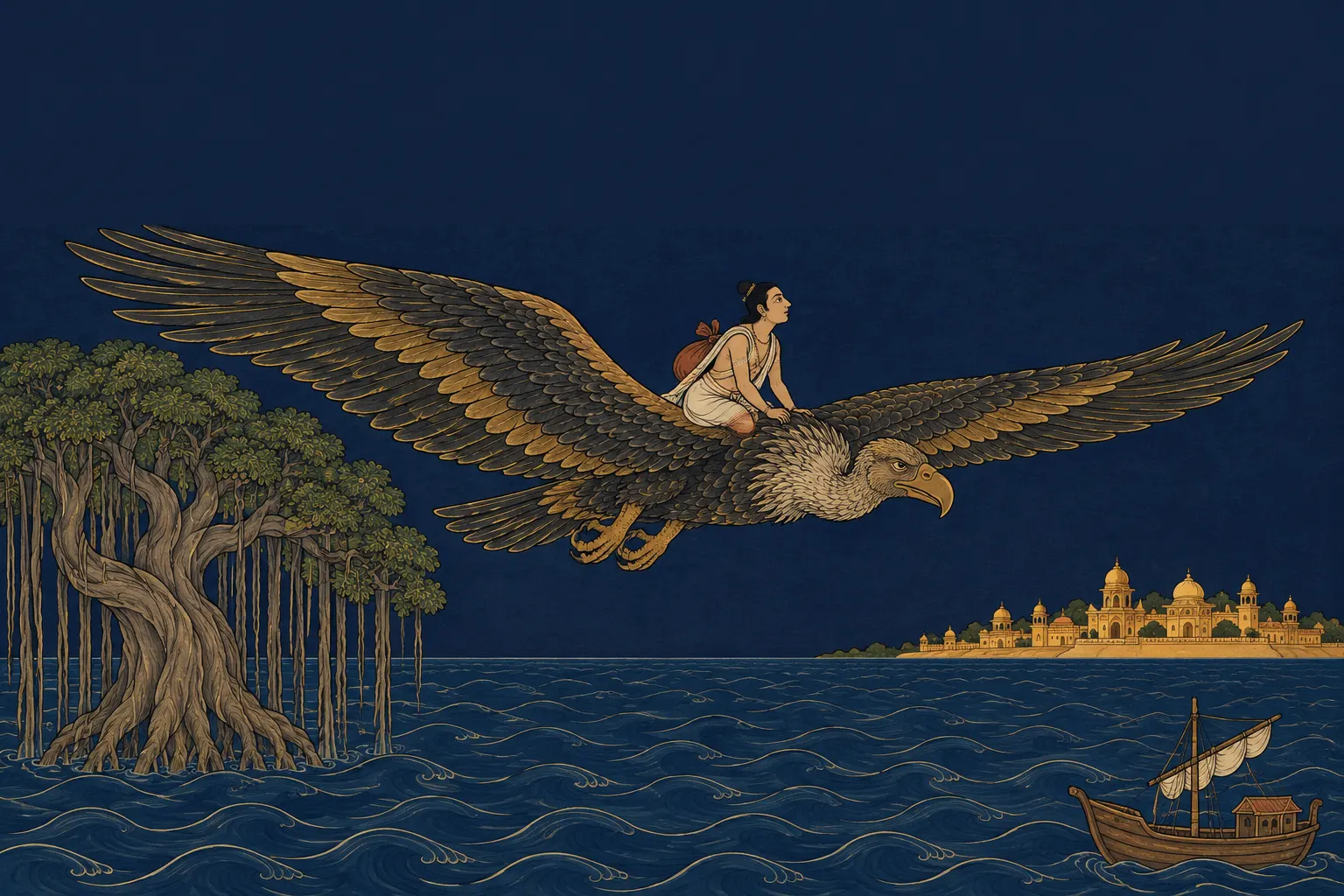
On the way he saw far out in the sea a huge tree, like a winged mountain. Satyavrata said, 'That is a banyan. Beneath it is a huge whirlpool like the mouth of the submarine fire. Whoever goes into it does not return. We must slip past on this side.' But just then the ship began to drift that way with the force of the wind. Satyavrata said, 'Brahman, our end is near. I cannot stop it. I do not grieve for myself, but that your wish is left unfulfilled. While I hold the ship still for a moment, climb into the branches of this banyan. Perhaps some means will turn up to save the life of one of such fine appearance.' When the ship reached the banyan, Shaktideva leapt and caught a broad branch. Satyavrata and his ship were swallowed by the whirlpool.
Sitting on the branch, Shaktideva despaired: 'I have not seen the City of Gold, and now I am dying in a deserted place. On top of that I have caused the death of a fisher king. Who prevails against the goddess of fortune?' So the day wore away.
At evening he saw huge birds like vultures coming to the banyan from all four directions. The waves of the sea leapt up with their wings. Hidden in the leaves he heard them talking in human speech. One spoke of some distant island, another of some mountain. An old bird said, 'I went today to roam in the City of Gold, and tomorrow morning I will go there again to eat. What is the use of going so far on tiring roads?' Hearing this, Shaktideva's sorrow was washed away as by a shower of nectar. He thought, 'Wonderful! That city really exists, and this huge bird has come as the means of taking me there.' He went slowly to it and hid in the feathers on the back of the sleeping bird. In the morning, when the other birds flew off in different directions, that old vulture flew straight to the City of Gold carrying Shaktideva on its back.
The bird came down in a garden. Shaktideva got down quietly. There he saw two women plucking flowers and asked, 'What place is this, and who are you?' They said, 'This is the City of Gold, a settlement of vidyadharas. A vidyadhari named Chandraprabha lives here, and we are the gardeners of her garden.' They took him to the palace, whose walls were of gold and pillars of jewels. The maids told Chandraprabha that a human had come, and she had the Brahman called in.
The four sisters and the closed roof
Chandraprabha asked about his family and name, and Shaktideva told everything: that he had come to see the City of Gold in order to win Kanakarekha. Chandraprabha thought and heaved a deep sigh, and said in private, 'Listen. We are four daughters of Shashikhanda, king of the vidyadharas of this land: I, Chandraprabha, the eldest, then Chandrarekha, then Shashirekha, then Shashiprabha. One day my three sisters went to bathe in the Ganga. I was ill, so I did not go. In play they splashed water on a sage named Agryatapas who was standing in the river. The angry sage cursed them: "Wicked girls, be born in the world of men." Our father came and appeased the sage, and the sage named for each a separate means for the curse to end, and said that in human form they would remember their former birth and have divine knowledge. They gave up their bodies and went to the world of men. My father gave me this city and, sorrowing, went to the forest. Once Durga told me in a dream that my husband would be a human. So many vidyadhara suitors came before me but I turned them all away. Now, by your coming and your handsome form, I am won over. I give myself to you. On the fourteenth I will go to Rishabha mountain to take my father's permission, where all the best vidyadharas come to worship Shiva. Stay here until then.'
When the fourteenth came she said, 'Today I go to ask my father's permission for your marriage. All my servants will go with me. You will be alone for two days, but never climb on to the middle roof of the palace.' She left, as if leaving her heart behind with him.
Shaktideva wandered the palace alone. Then curiosity rose in him as to why he had been forbidden that roof. 'People want to do just what they are forbidden.' He climbed to the middle roof and saw three hidden pavilions. One had its door open. Inside, on a bed inlaid with jewels, a woman lay covered with a sheet. He lifted the sheet and saw that Kanakarekha, daughter of King Paropakari, lay there as if dead. He thought, 'What wonder is this? Is it an unbreakable sleep, or an illusion of mine? She for whom I came to this foreign land lies here without breath, though in my country she is alive. And her beauty is just the same. Surely this is some illusion that Fate is showing me to beguile me for some reason.' Thinking so, he went into the other two pavilions as well and saw two more girls lying in the same way.
Astonished, he went out and kept looking at the very beautiful lake below the palace. On its shore he saw a horse with a jewelled saddle. He went down and approached it; there was no rider. Out of curiosity he tried to mount it, but the horse kicked him into the lake. He sank, and the next moment found himself emerging from the middle of a garden lake in his own city of Vardhamana.
The true claim
Astonished, he went to his father's house and by some excuse said he had gone off somewhere following the drum. His father took him in gladly. The next day when he went out he heard the same announcement again: 'Whichever Brahman or kshatriya has truly seen the City of Gold, let him declare it. The king will give him his daughter and make him crown prince.' This time he went straight to the announcers and said, 'I have seen that city.' He was taken before the king. The king recognised him and thought he was lying again. But Shaktideva said, 'If I lie, and have not really seen that city, give me the death sentence. Let the princess herself question me.'
The king had his daughter called. Seeing him, Kanakarekha said again, 'Father, he will lie again.' Shaktideva said, 'Princess, whether I speak truth or lie, satisfy one curiosity of mine. I saw you lying dead on a bed in the City of Gold, and here I see you alive. How can this be?' Hearing this, getting this true proof, Kanakarekha said before her father, 'This great soul has truly seen that city, and will soon be my husband, when I return there. There he will marry my three sisters too and become king of the city of the vidyadharas. Because of a sage's curse I had to be born in your house. The sage had fixed the end of the curse thus: "When you are in a human body, and some human sees your body in the City of Gold and tells the truth, then you will be freed and he will be your husband." Even in a human body I remember my origin and have divine knowledge. So now I go to my vidyadhara home.' Saying this, the princess gave up her body and vanished. There was an uproar in the palace.
On the same road again
Having won Kanakarekha, he had lost her; and he had been parted from Chandraprabha too. But he thought, 'Kanakarekha has said that my wish will be fulfilled. Then why am I despondent? Success comes only by courage. I will go again by the same road to the City of Gold, and Fate will find some way.' He reached Vitankapura again, where he met the same merchant, Samudradatta, who had survived the shipwreck. Floating for three days on a plank, he had found refuge on a ship in which was his father, long absent in foreign lands. Shaktideva reached Utsthala again, where the king's sons saw him and asked, 'You went with our father. How did you come back alone?' He told them that their father had gone into the whirlpool. The sons, in anger, took him for their father's killer and bound him in the Durga temple for sacrifice.
At night he kept praying to Durga. In a dream a woman said to him, 'Do not fear, Shaktideva. The king's daughter Vindumati will come tomorrow morning and choose you as her husband. Accept. She is not of the fisher caste; she is a divine woman fallen by a curse.' In the morning Vindumati came and freed him, and he made her his wife. In the tale there follow many more strange experiences of Shaktideva, in which he gets a magic sword and gains the power of flying through the sky as a vidyadhara.
The husband of four sisters
By the strength of the sword he flew with Vindumati through the sky to the City of Gold again. There he saw Kanakarekha, that is Chandrarekha, and the other sisters bowing before him, having entered their own divine bodies, which he had earlier seen lifeless in the three pavilions. Vindumati was there Shashirekha, and Chandraprabha was the eldest. Chandraprabha said, 'Noble sir, this is the very Kanakarekha you saw in Vardhamana, my sister Chandrarekha. This is that fisher's daughter Vindumati, whom you married in Utsthala, my sister Shashirekha. And this is my youngest sister Shashiprabha, who was brought to you and became your wife. Now come, let us all go to our father, and let him give us to you.'
They went with all four to the forest to meet their father. King Shashikhanda, learning everything from his daughters and prompted by a voice from the sky, gave him all four girls together. He also gave him his splendid kingdom and all his sciences, and named him 'Shaktivega'. Then he said, 'No one else will conquer you. But from the mighty king of Vatsa there will be born an emperor, who as Naravahanadatta will rule you vidyadharas and be greater than you. Only before him will you have to bow.' Shaktivega lived in the City of Gold with his wives.
Shaktivega told this whole tale to King Udayana of Vatsa. 'I am that Shaktideva, who have come to see the feet of your newborn son, who is our future emperor. Though a human, I have become king of the vidyadharas by Shiva's grace. Now I return home. May good be with you.' Saying this with folded hands, taking leave, he flew into the sky with the gleam of the moon.
Note: This chapter is written directly from C. H. Tawney's English translation (Book 5, Chapters 24–26). In the text this tale is very long and full of tales within the tale. Here the main journey is taken, and these inset tales are left out: the tale of the swindlers Shiva and Madhava, Harasvami's tale, the tale of Ashokadatta and Vijayadatta, and the tale of the gambler Devadatta. Shaktideva's further events in Utsthala — two marriages, a daitya and the winning of a magic sword — come in the text with some harsh and supernatural details; here they are told in a single sentence. The four sisters in the text are Chandraprabha, Chandrarekha, Shashirekha and Shashiprabha; in human birth Chandrarekha appears as Kanakarekha, Shashirekha as Vindumati and Shashiprabha as Vindurekha.
Source: Somadeva Bhatta — the Kathasaritsagara (Kashmir, eleventh century), an abridgement of Gunadhya's lost Brihatkatha, The City of Gold