
Chapter 4
The Artificial Elephant and the Lute Pupil
The king of Vatsa set out to catch an elephant with his lute and was caught himself — and the princess he had to teach music became the one he had to flee with
The Artificial Elephant and the Lute Pupil is chapter 4 of Kathasaritsagara. Source: Kathasaritsagara, Book 2 (Kathamukha), Chapters 9, 11–13. It is told in 5 scenes — The pool of blood; The snake and the lute; The artificial elephant; The condition of teaching music; Escape on the she-elephant — followed by 10 quiz questions.
The pool of blood
The tale now moves on from Gunadhya to the land of Vatsa. There, in the city of Kausambi, the line of King Shatanika ruled. His son Sahasranika married Mrigavati, princess of Ayodhya. But this marriage was tied to something from long before.
Indra called Sahasranika up to heaven and told him, 'Long ago I went to Brahma's court. There a Vasu named Vidhuma and an apsaras named Alambusha looked at each other and were smitten. In anger I cursed them both: "Be born on earth, and be husband and wife there." That Vasu is you, and the apsaras is Mrigavati, daughter of Kritavarma, king of Ayodhya.'
On the way back, the apsaras Tilottama said to the king, 'I have something to say to you — wait a moment.' But the king's mind was still on Mrigavati. He went on without listening. Tilottama cursed him in anger: 'You do not listen to me because your thoughts are on her — you shall be parted from her for fourteen years.' Indra's charioteer Matali heard this curse; the king did not.
Sahasranika married Mrigavati. After some time she became pregnant, and told the king of a strange longing: she wanted to bathe in a pool of blood. The righteous king, to fulfil her wish, had a pool filled with lac and other red dyes, so that it looked like blood. As the queen stood there drenched in red after her bath, a bird of the Garuda kind swooped down. Taking her for raw flesh, it picked her up and flew away.
The king fell unconscious. When he came to, Matali came and told him of Tilottama's curse, and also when it would end. The king, holding on to hope, somehow kept himself alive.
Meanwhile, when the bird found that it had carried off a living woman, it left her on a hill on Udayachala. Alone, in a single garment, she wept in the forest. A huge snake came to swallow her, and just then some heavenly hero descended, killed the snake and vanished. In despair she threw herself before a wild elephant, but even the elephant did not kill her. Then she set out to leap from the mountain and end her life, and a sage's son who had come looking for roots and tubers heard her weeping. He took her to Jamadagni's hermitage. Jamadagni said, 'Daughter, here you will have a son who will carry on his father's line, and you will be reunited with your husband. Do not weep.'
A few days later she bore a son. A voice from the sky said, 'A glorious king named Udayana is born, and his son will be emperor of all the vidyadharas.' Mrigavati's lost happiness returned.
The snake and the lute
Udayana grew up in the hermitage. Jamadagni performed his kshatriya rites and taught him learning and archery. In her love Mrigavati took off from her wrist the bracelet bearing Sahasranika's name and put it on his wrist.
One day Udayana was roaming the forest after a deer. He saw that a Shabara had caught a snake. Udayana took pity. He said, 'At my word, let this snake go.' The Shabara said, 'Master, this is my living. I am poor and I fill my belly by showing dancing snakes. My first snake died, so I searched the forest and brought this one under control with a mantra.' Udayana generously gave his mother's bracelet to the Shabara and had the snake set free.
The snake bowed its head before him and said, 'I am Vasunemi, Vasuki's elder brother. You saved me, so take this lute. Its strings sound sweet and its notes are divided into quarter-tones. With it, take the betel leaf, the art of weaving garlands that never wither, and the art of marking the forehead with tilaks that never fade.'
Udayana returned to the hermitage with the lute. Meanwhile the Shabara was caught trying to sell that same bracelet in the market. King Sahasranika's name was engraved on it. The king questioned him himself. The Shabara told the whole story. Recognising the bracelet, the king felt hope and doubt together. Then a voice from the sky said, 'O king, your curse has ended. Your wife Mrigavati is with her son in Jamadagni's hermitage.' The next day the king, with his army, took the road the Shabara showed to the hermitage on the eastern mountain. Bowing to Jamadagni, he brought Mrigavati and Udayana back to Kausambi. Udayana was made crown prince. The sons of the ministers, Yaugandharayana, Rumanvan and Vasantaka, became his companions. Then flowers rained from the sky and a voice said, 'With the help of these good ministers the prince will rule the whole earth.' Later, when old age came, Sahasranika gave the throne to Udayana and took the road to the Himalaya with his wife and ministers.
The artificial elephant
Udayana took up the kingdom of Vatsa and looked after his people in Kausambi. But little by little he left the work of the state to his ministers and sank into pleasure. Day and night he hunted, and played the lute that Vasuki's brother had given him. With the magic of that lute he charmed wild, rutting elephants and brought them home tamed.
He had only one worry: 'Nowhere do I find a woman of birth and beauty equal to mine. Only the girl called Vasavadatta pleases me. But how do I win her?'
In Ujjayini King Chandamahasena was thinking the same thing: 'For my daughter there is no worthy husband in the world but Udayana, and he has always been my enemy. How do I make him my son-in-law and my friend?' An idea came to him. 'He loves hunting, he wanders alone in the forest to catch elephants, he knows music. I will catch him by his own weakness, and make my daughter his pupil. Then he is sure to fall for her.' He went to Durga's temple and prayed, and heard a voice from the sky: 'This wish of yours will soon be fulfilled.' First he sent a messenger to Udayana with a proposal, but from Udayana's answer he understood that the proud king would not come of his own accord. And he could not send his daughter to Udayana's court either.
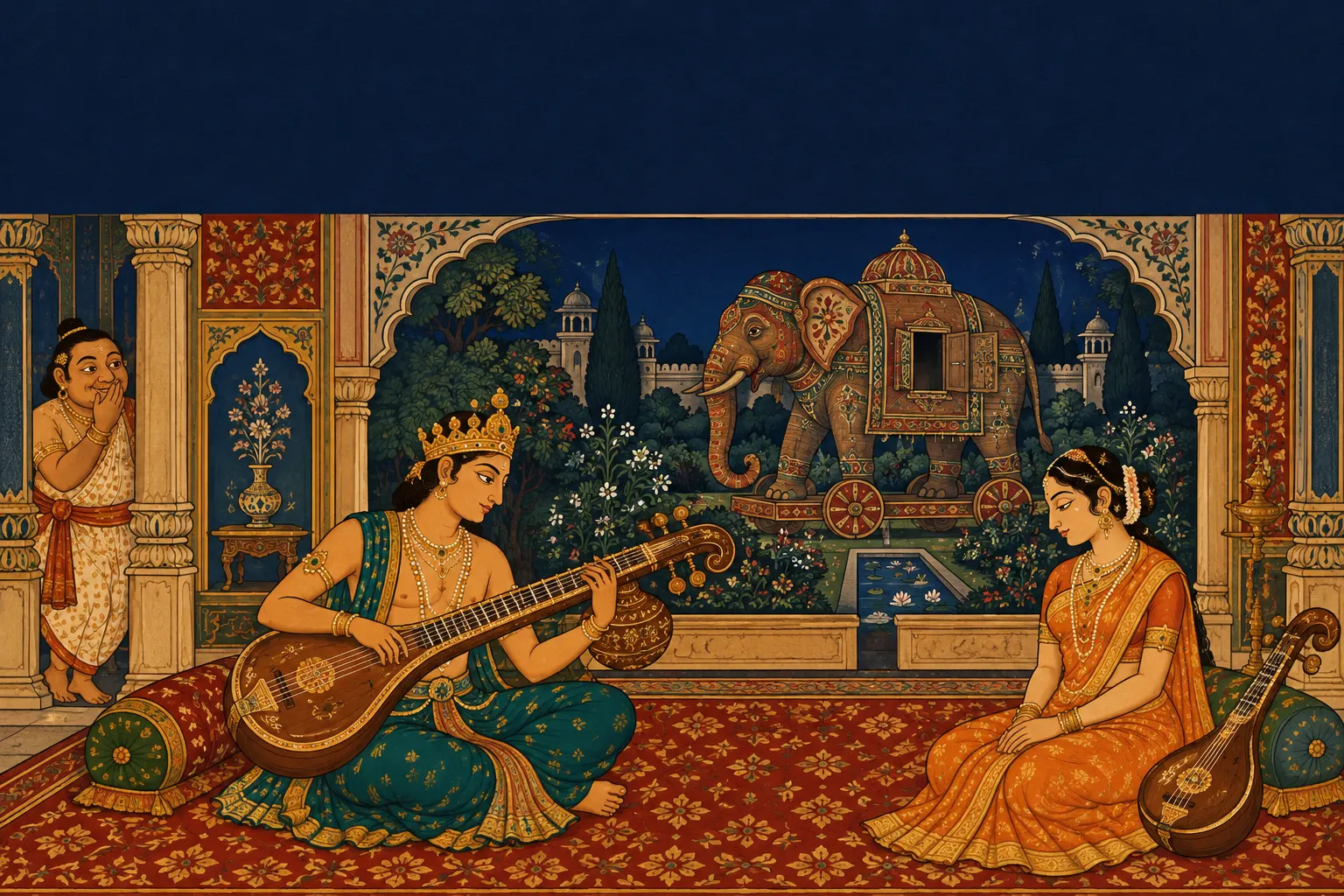
So, after consulting his ministers, he had a huge artificial elephant built, hid soldiers inside it, and had it stationed in the Vindhya forest. Udayana's spies saw it from afar and ran to tell the king: 'Maharaj, a lone elephant is roaming the forest, and there is not its equal in the whole world. It looks like a moving peak of the Vindhya.' Udayana gave them a hundred thousand gold coins, delighted. All night he thought: 'If I capture this elephant, which is a match for Nalagiri, Chandamahasena is sure to come under my power.' In the morning he set off, ignoring his ministers, and even ignoring the astrologers' warning that the fruit of departing at this hour was 'the gain of a maiden — and imprisonment'.
Reaching the Vindhya, he halted his army far off so that the elephant would not be frightened. Then, with his spies and his sweet lute in his hand, he went into the forest. On the southern slope he saw the elephant, which looked perfectly real. He went slowly towards it alone, playing the lute and singing in a sweet voice, thinking how he would bind it. Lost in music, he did not notice the evening darkness gathering, or that the elephant was false. The elephant kept flapping its ears as if delighted by the music, sometimes coming forward and sometimes drawing back, and so led the king very far. Then armoured soldiers burst out from inside the artificial elephant and surrounded Udayana. In anger he drew his hunting knife and fought those in front, but others seized him from behind. He was taken to Ujjayini.
The condition of teaching music
Chandamahasena came with great respect to receive him, and took him into the city. The citizens saw him, handsome as the moon but marked with the stain of humiliation. They thought he would be put to death, and out of affection for his qualities they sat down in protest. Then Chandamahasena calmed the townspeople, saying that he did not want to kill him but to make him a friend. He at once placed his daughter Vasavadatta in Udayana's charge to be taught music, and said, 'O king, teach this girl music. From it you will get good fruit for this adventure of yours. Do not despair.'
The moment he saw that beautiful girl, Udayana's anger vanished. His mind sank into love. Vasavadatta's heart turned to him in the same way; her eyes stayed lowered in modesty, but her mind did not. So the king of Vatsa lived in Chandamahasena's music room, teaching Vasavadatta to sing, his eyes resting on her all the time. His lute in his lap, song in his throat, and Vasavadatta standing before him.
Meanwhile in Kausambi the king's companions came back, and the whole kingdom was in an uproar. The angry people wanted to march on Ujjayini. But the commander Rumanvan stopped them: Chandamahasena was a powerful king, and an attack could endanger the king's life. They would have to act by strategy. The calm and resolute Yaugandharayana said, 'All of you stay here, be careful, and guard the country. I will go only with Vasantaka and bring the king back with my wits. I have mantras and drugs for breaking walls, cutting chains and becoming invisible.' By his mantra he gave himself a form that made onlookers think him mad, and gave Vasantaka a misshapen one, with bulging veins, a big belly and protruding teeth. Sending Vasantaka ahead, he entered Ujjayini dancing and singing, surrounded by Brahman boys, and reached the king's palace. Curiosity stirred among the queens, and Vasavadatta sent a maid to call him into the music room.
There, seeing Udayana in chains, Yaugandharayana, in his madman's guise, had tears in his eyes. He gave the king a sign. The king recognised him at once. Then Yaugandharayana by his power made himself invisible to Vasavadatta and her friends. All said in astonishment, 'Where did that madman suddenly go?' The king understood and cleverly said to Vasavadatta, 'Daughter, bring the materials for the worship of Sarasvati.' She went off with her friends. Then Yaugandharayana told the king the mantras for breaking his chains, and gave him mantras bound to the lute strings by which Vasavadatta's heart might be won. He said that Vasantaka was waiting outside and he should have him called in, and also that when Vasavadatta had come to trust him, he should do whatever he was told, and until then keep quiet.
When Vasavadatta came back with the worship materials, the king said, 'A Brahman is standing outside; call him in, he will conduct the worship of Sarasvati.' Vasantaka was called. Seeing the king he burst into tears, and then the king, to hide the secret, said, 'Brahman, I will cure this deformity of your sickness. Do not weep; stay here.' The king could not hold back his laughter at the sight of his face. Vasantaka caught on and laughed so hard that his twisted face became more twisted. Seeing him bare his teeth like a doll, Vasavadatta laughed too. She asked in jest, 'Brahman, what art do you know?' He said, 'Princess, I am skilled at telling tales.' She said, 'Then tell one.' And Vasantaka told her tales.
Escape on the she-elephant
As the days went by, Vasavadatta's affection for the king grew, and she began to side with him against her father. Then Yaugandharayana, invisible once more, came and advised the king in private: 'O king, Chandamahasena took you prisoner by deceit, and now he wants to give you his daughter and release you with honour. But let us carry off his daughter ourselves. In this way we will both pay him back for his pride and keep the world from thinking us weak. The king has given Vasavadatta a she-elephant named Bhadravati. Only Nalagiri is as fast as she, but he will not fight when he sees this she-elephant. Her mahout is Ashadhaka, whom I have won over with money. Arm yourself and ride out quietly at night on her with Vasavadatta. Have the superintendent of elephants made drunk so that he can suspect nothing. I am going to Pulindaka, who is your friend, so that he can guard the road.'
The king told all this to Vasavadatta. She agreed. She called Ashadhaka and prepared him, and under pretext of worshipping the gods got the superintendent of elephants and all the mahouts drunk and stupefied. In the evening, as clouds were thundering, Ashadhaka brought the she-elephant ready. While the harness was being fastened, she trumpeted. The superintendent, who understood the speech of elephants, heard her and said, stammering in his drunkenness, 'The she-elephant says that today she will go sixty-three yojanas.' But in his stupor it did not sink in, and the other mahouts did not hear it at all.
Udayana broke his chains with Yaugandharayana's mantras and took his lute, and Vasavadatta herself fetched his weapons. He mounted the she-elephant with Vasantaka, and then Vasavadatta climbed up with her friend Kanchanamala. The five of them, including the king and the mahout, left Ujjayini. In anger the she-elephant tore through the city wall, and the king killed two warriors, Virabahu and Talabhata, who were on guard there. Then he sped off, carrying his beloved.
Meanwhile the city watchmen saw the dead guards on the rampart and in a panic told the king. Chandamahasena learned that the king of Vatsa had fled with Vasavadatta. There was an uproar in the city, and one of his sons, Palaka, mounted Nalagiri and raced after them. But Nalagiri, seeing Bhadravati, would not fight at all. His brother Gopalaka, who wished his father well, held Palaka back.
By half a day they had reached the Vindhya forest. The she-elephant had gone sixty-three yojanas and was thirsty. The king and queen got down; the she-elephant drank, but the water was bad and she fell there and died. At that moment a voice came from the sky: 'O king, I am a vidyadhari named Mayavati, who for all these days was a she-elephant by a curse. Today I have done you a kindness, and I will do one for your son too. This queen of yours, Vasavadatta, is no ordinary woman. For a particular reason that goddess has been born on earth.'
Then the king sent Vasantaka to Pulindaka, and as he was walking slowly on foot with the queen, bandits ambushed and surrounded them. Alone with his bow the king killed a hundred and five bandits in front of Vasavadatta. Just then Pulindaka, Yaugandharayana and Vasantaka arrived. The king of the Bhillas held back the surviving bandits, bowed to the king, and took him and his beloved to his village. Next morning Rumanvan arrived with the whole army, so that it seemed the entire Vindhya forest was surrounded.
A little later a merchant friend of Yaugandharayana's came from Ujjayini and said, 'King Chandamahasena is happy to have you as his son-in-law. He is sending his doorkeeper.' A message followed that Chandamahasena said, 'You did well to take Vasavadatta yourself. That was why I had you brought to my court. During your captivity I did not give her to you, lest you stay angry with me. Now be kind enough to wait a little, so that the marriage can be done by the rites. My son Gopalaka will come to Kausambi and conduct this marriage with due ceremony.' The king was glad and set out for Kausambi with Vasavadatta. The people of the city looked at him as peacocks look at a cloud heavy with lightning. When Gopalaka came, Vasavadatta's eyes filled with tears at her father's message, and her life seemed fulfilled. The next day he had Vasavadatta married to the king of Vatsa with all the ritual. Udayana honoured Gopalaka and Pulindaka by tying turbans on them, and handed the reception of the visiting kings to Yaugandharayana and Rumanvan.
Note: This chapter is written directly from C. H. Tawney's English translation (Book 2, Chapters 9 and 11–13). Only the main thread of Udayana's episode is taken here. Chandamahasena's earlier episode of the magic sword (Angaravati and the daitya in boar form) and the tales Vasantaka tells (Rupinika, Devasmita and others) are not in this chapter. 'Sixty-three yojanas' is the text's figure. The details of the queens and the 'secret marriage' are deliberately not given. The names are as in the text: Sahasranika, Mrigavati, Udayana, Yaugandharayana, Rumanvan, Vasantaka, Chandamahasena, Vasavadatta, Nalagiri, Bhadravati.
Source: Somadeva Bhatta — the Kathasaritsagara (Kashmir, eleventh century), an abridgement of Gunadhya's lost Brihatkatha, The Artificial Elephant and the Lute Pupil