
Chapter 9
The Vetala's Boon
On the last night the vetala told the king that the ascetic really meant to sacrifice him — and the king turned the ascetic's own trick back on him
The Vetala's Boon is chapter 9 of Kathasaritsagara. Source: Kathasaritsagara, Book 12 (Shashankavati), Chapters 85, 96–99 (Tales 163c 11, 22–25). It is told in 6 scenes — The three delicate queens; The four brothers and the lion; The one who wept and then danced; The vetala's advice; The last circle in the cremation ground; The tale returns to where it began — followed by 10 quiz questions.
The three delicate queens
Another night, another round, another tale. This time the vetala spoke to the king of three queens.
In Ujjayini there was a king named Dharmadhvaja. He had three queens, all daughters of kings, and all dearer to him than life: Indulekha, Taravali and Mrigankavati. At a spring festival he went to the garden with all three. There creepers bent with flowers looked like the bows of Kama, and cuckoos seemed to be proclaiming Kama's command. In play Indulekha was pulling the king's hair when a blue lotus from his ear leapt and fell on her thigh. From that blow she got a wound and cried 'Ah!' and fainted. The king and the servants were alarmed. With cold water and fanning she came to, and the king took her to the palace, had the wound dressed, and had physicians treat her.
That night the king slept on the palace roof in the moonlight with Taravali. Through the lattice the moon's rays fell on her body, which was uncovered when her garment slipped. She woke screaming, 'Alas, I am burned!' and jumped from the bed and began rubbing her limbs. The king woke with a start and saw that blisters had come up on her body. He called the servants, had a bed of lotus leaves made and sandal paste applied.
The third queen, Mrigankavati, heard all this and set out from her palace to come to the king. In the open air, in the silence of the night, she clearly heard, from far off in some house, the sound of a pestle pounding rice. She sat down on the road saying 'Alas, I am dead!' and began shaking her hands. Her maids took her to her chamber and saw that bruises had come up on her hands, as if black bees had settled on lotuses. The king came in alarm. He asked the queen, and she showed her hands and said, 'As soon as I heard the pestle's sound, these bruises came up.' The king had sandal applied to her hands and thought: 'One queen was hurt by a lotus falling, the second was burned by moonlight, and the third was bruised just by the sound of a pestle. It is Fate that the greatest quality of my queens, their delicacy, has at once become their fault.' The night, which was of three watches, seemed a hundred. In the morning, by the physicians' treatment, the queens recovered.
The vetala asked, 'Tell me, O king, which of these queens was the most delicate? If you know and do not tell, the same curse will fall on you.' The king answered, 'The most delicate was the queen on whose hands bruises came up merely from hearing the sound of a pestle, without its touching her. The other two are not equal to her, for one got a wound from the touch of a lotus and the other got blisters from the touch of moonbeams.' The vetala again flew from his shoulder and the king again set off to fetch him.
The four brothers and the lion
The next night the vetala said, 'O king, you are good and brave, so hear this tale.'
In King Dharanivaraha's kingdom of Pataliputra there was a Brahman settlement called Brahmasthala. A Brahman named Vishnusvami lived there. He had four sons. When they had finished the Vedas and childhood was past, their father and mother died. The four brothers were orphaned, and relatives seized all their property. They decided to go to their maternal uncles' village, Yajnasthala. There the uncles at first gave them food and lodging, but knowing them to be poor, gradually began to insult them and gave up caring for their food and clothing.
Wounded by the insult, the eldest brother said one day to the others, 'Brothers, what shall we do? Everything is in the hands of fate. Today I wandered sadly to the cremation ground and saw a corpse lying there. I envied its peace. I thought how fortunate it was to have been freed from the burden of sorrow. I resolved to die and, tying a rope to a branch of a tree, tried to hang myself. I fainted but my breath did not go, and the rope broke. When I came to, some kind man was fanning me with his cloth. He said, "Friend, you are wise, so why are you so unhappy? Happiness comes from good deeds, sorrow from bad. If you are unhappy, do good deeds. Why seek the torments of hell by suicide?" Saying this, he went away, and I gave up my intention to die. Now I will go to some holy place and wear away my body by austerity, so that I never suffer the pain of poverty again.'
The younger brothers said, 'Brother, why are you, wise as you are, so sad about poverty? Do you not know that wealth goes like an autumn cloud? Who can rely on fickle Lakshmi and fickle women, however carefully held? A wise man should learn some high art by effort, so that he can bind and bring home wealth, which runs like a deer.' The eldest steadied himself. 'Then what art shall we learn?' They decided to travel the earth and learn some art of magic. Fixing a place to meet, they set off in four directions. After some time they came back and met and asked one another what they had learned. The first said, 'I have learned this secret: if I get a piece of bone of any animal, I can make flesh on it.' The second said, 'When flesh is made on the bone, I can make skin and hair suited to that animal.' The third said, 'And when skin, hair and flesh are made, I can make all that animal's limbs.' The fourth said, 'And when the animal's limbs are complete, I can put life into it.'
The four went into the forest to show their arts and looked for a piece of bone. They found a piece of bone of a lion, but they did not know what animal's it was. The first made flesh on it, the second skin and hair, the third all the limbs, and when it had become a lion, the fourth put life into it. The terrible lion stood up, with thick mane and a frightening mouth with fangs, claws curved on its paws. And the moment it rose, it sprang on its four makers and killed them on the spot, and, its belly full, went off into the forest. So those Brahmans died by the mistake of making an animal as dangerous as a lion. The tale says that if fate does not help, even a hard-won art brings not prosperity but ruin. The tree of valour bears fruit only when its root is watered with the water of wisdom and a moat of good policy surrounds it.
The vetala asked, 'O king, which of these four was to blame for the making of the lion, which killed them all? Tell me. And remember that the old condition still holds.' The king thought in his mind, 'This vetala wants me to speak and then escape. Never mind, I will bring him back again.' Then he said, 'He who put life into the lion is to blame. The other three, without knowing what animal they were making, made flesh, skin, hair and limbs by their art, so there is no fault in their ignorance. But he who, seeing the form of the lion, still put life into it merely to show his skill, is to blame for the death of those Brahmans.' The vetala flew away again.
The one who wept and then danced
Another night. The vetala said, 'O king, the work you are engaged in does not suit you, yet you are fearlessly steadfast in it. Hear a tale; I will tell it to remove your weariness.'
In the land of Kalinga there was a city named Shobhavati, whose king was Pradyumna. A wealthy Brahman named Yajnasoma lived there, who had mastered the Vedas. After his youth had faded a single son was born to him, the child of hundreds of vows, who was named Devasoma. At sixteen, when all admired his learning, modesty and virtues, he suddenly died of a fever.
Yajnasoma and his wife clung to the boy's body, weeping, and would not let it be burned. Elders gathered and began to explain: 'Brahman, you are learned. This world is like a bubble on water. Look at those kings who filled the earth with armies and thought themselves immortal, who slept on beds of jewels, smeared with sandal, surrounded by women. Even they could not be saved from the pyre and the jackals. What of others?' At last the relatives somehow separated him from the body and, with much lamentation, carried the bier to the cremation ground.
In that cremation ground at that very time lived an old Pashupata ascetic named Vamashiva, who had gained powers by practice. His body was dried up by age and austerity and bound with sinews, his hair white with ashes and his matted locks yellow as lightning. From his hut he heard the sound of weeping outside and said to his pupil, 'Go and see what this noise is.' But his pupil was a hypocrite and proud, and was angry at his teacher's scolding. He said, 'I am not going. You go; my time for alms is passing.' The teacher said that only half a watch had passed. The pupil said angrily, 'Old man! From now I am not your pupil and you are not my teacher. Here, take your water-pot and staff,' and left.
Vamashiva, laughing, came out of the hut and went to where the Brahman boy's body had been brought. He saw the people weeping for the flower of youth. He was afflicted by old age and knew siddhis, so he resolved to enter that body. He went aside, first wept loudly, then at once began to dance with gestures. Wishing to be young, he left his body and by the power of yoga entered the body of that Brahman boy. The boy, laid on the pyre, yawned and sat up. All raised a cry: 'He is alive! He is alive!'
The ascetic in the boy's body, who did not wish to give up his vow, lied: 'Just now I went to another world. There Shiva himself restored my life and told me to take the Pashupata vow. I must go into solitude now and perform it, or I cannot live. So all of you go home, and I will go too.' Having said this he sent everyone home. He himself threw his old body into a ditch and, young, went off to another place.
The vetala asked the king, 'Tell me, why did that magician weep first and then dance when passing into another body? I want to know.' The king, the sage of sages, broke his silence for fear of the curse: 'Hear the ascetic's feelings. He grieved at leaving the body he had lived in for so many years, through which he had gained his powers, and which in childhood his parents had cherished. So he wept bitterly, for attachment to the body is a deep-rooted feeling. But he danced because he was about to get a new body, through which he could win still greater powers. Whom does youth not please?' The vetala again flew from his shoulder.
The vetala's advice
In this way the vetala asked the king questions twenty-four times. The twenty-fourth tale, of such a tangle of relationships, the king could not answer at all. When the king kept walking on silently without answering, the vetala on his shoulder laughed to himself and thought, 'Now the king cannot speak, so he is walking fast, pleased. I cannot deceive this hero any more, and this is enough to stop the ascetic's plan. Now I will deceive that wicked one himself, and by my cleverness I will give the king the success for which he has taken such trouble.'
Then the vetala said to the king, 'O king, after so many rounds and so much weariness you are cheerful and have not given up your resolve in the least. I am pleased with your courage. Now take this corpse. I am leaving it. Hear a piece of friendly advice. That wicked ascetic for whom you have brought this corpse will at once invoke me into it and worship me. Then, wishing to offer you in sacrifice, he will say, "O king, lie down on the ground so that all eight limbs touch." Then you say to him, "First show me how to lie down, then I will do the same." He will lie down on the ground to show you, and at that moment you cut off his head with your sword. Then the kingdom of the vidyadharas that he wants will be yours. Having sacrificed him, enjoy the earth. Otherwise he will sacrifice you. That is why I put obstacles in your way all this time. Go, may good be with you.' Saying this, the vetala left the corpse. The king, knowing the ascetic to be his enemy, yet glad at heart, took the corpse to the ascetic, who sat under the banyan tree.
The last circle in the cremation ground
In that dark night in the cremation ground the king saw the ascetic sitting alone under the tree, waiting for him. The ascetic sat in a circle made of the yellow powder of bones, the ground inside smeared with blood, with pots of blood set in the four directions. He was preparing the worship of his deity. Seeing the corpse on the king's shoulder, he was delighted and praised him: 'Maharaj, you have done a hard kindness. At such a time and in such a place only one like you could do this. It is true that you are among the best of kings, who complete another's task without regard for your own good.'
The ascetic took the corpse down from the king's shoulder, bathed it, anointed it, garlanded it and placed it inside the circle. Then, smearing ashes on his limbs and dressing in clothes of the dead, he sat for some time in meditation. Then by his mantra he summoned that mighty vetala and made him enter the corpse and began to worship him. Having finished the worship he said to the king standing near, 'O king, fall on the ground and bow with all eight limbs to this lord of mantras, so that this giver of boons may fulfil your wish.'
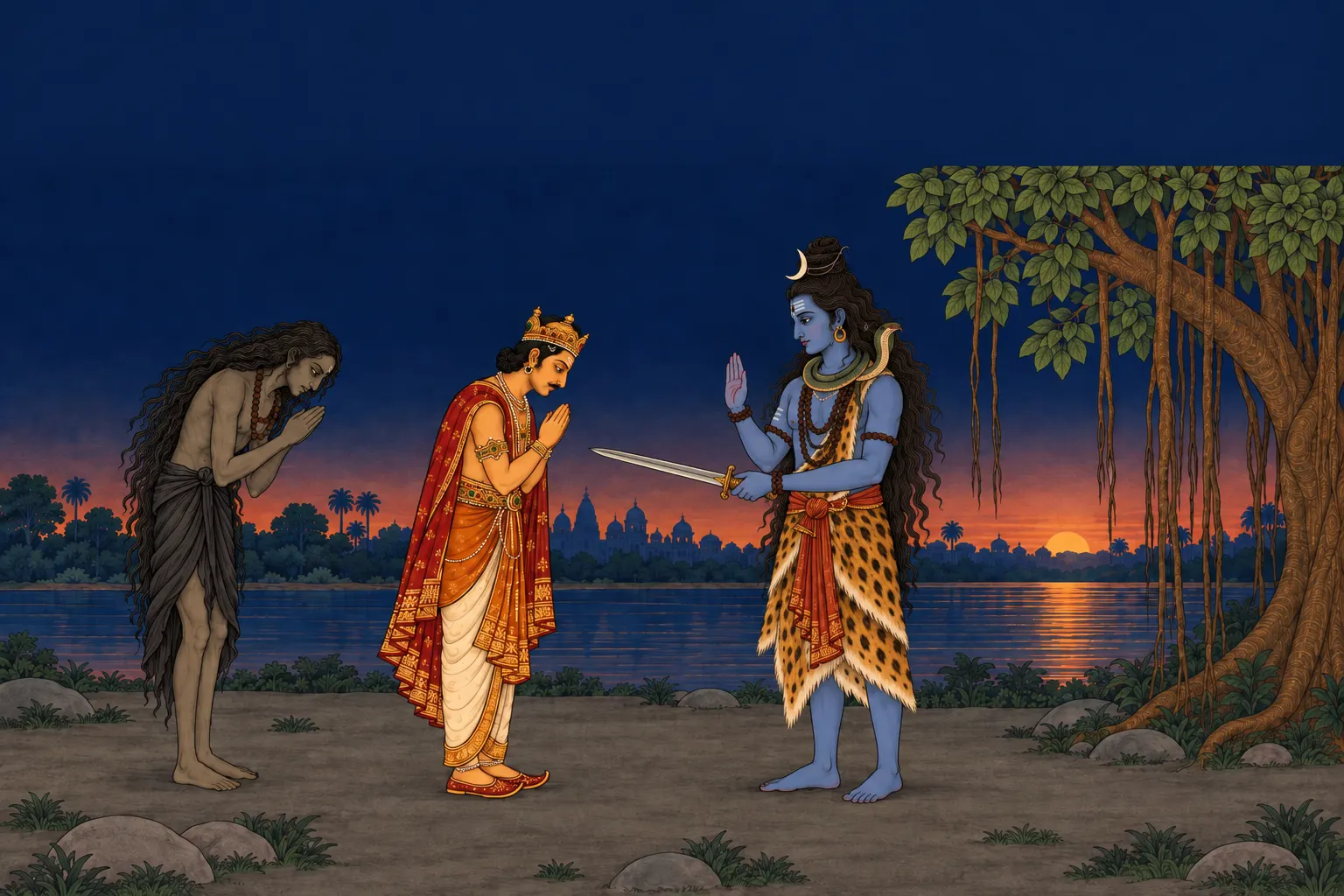
The king remembered the vetala's words. He said to the ascetic, 'I do not know how to do this, revered one. First show me, then I will do the same.' To teach the king, the ascetic lay down on the ground. At that very moment the king cut off his head with a single stroke of the sword. (In the text there follows a terrible detail of the offering of his heart and head to the vetala, which is left out here.) The pisacas all around raised a shout of joy.
From inside the corpse the vetala said to the king, 'O king, the kingdom of the vidyadharas that this ascetic wanted will come to you when you have enjoyed your earthly kingdom. I have caused you much trouble, so ask what boon you wish.' The king said, 'Since you are pleased with me, my every wish is fulfilled. Still, so that your words may not be in vain, I ask this boon: that these first twenty-four questions and answers, with their various tales, and this twenty-fifth concluding tale, become famous on earth and worthy of honour.' The vetala said, 'So be it. And hear one special feature of this which I tell you. This chain of tales, with these twenty-four and this last twenty-fifth, will be famous and beneficial on earth under the name "the Twenty-five Tales of the Vetala". Whoever reads even one verse of it with respect or listens to it read will at once be freed from a curse. And where it is recited, beings like yakshas, vetalas, kushmandas, dakinis and rakshasas will not be able to exercise their power.' Having said this the vetala left that human corpse and by his magic went to the place he wished.
Then Shiva appeared before the king with the gods and said, 'Well done, son! Today you have killed that hypocritical ascetic who had a powerful desire to gain the empire of the vidyadharas. I made you earlier from a part of myself as Vikramaditya, to destroy the asuras born in the form of mlechchhas. Now I have made you again as a brave king named Trivikramasena to defeat a reckless wicked man. Now you will bring the earth under your sway with the islands and the netherworlds, and soon become supreme king of the vidyadharas. After enjoying divine pleasures for a long time, when you grow weary you will give them up of your own will, and in the end you will certainly merge into me. Take this sword named "Ajeya"; with it you will win all this.' Shiva gave him his excellent sword and, having been worshipped, vanished.
The king saw that all was accomplished and the night was passing. He returned to his city Pratishthana. The people welcomed him, and the news of his night's doing had reached them. He spent the whole day in bathing, giving gifts, worship of Shiva, dance, song and music. Within a few days, by the strength of Shiva's sword, he was enjoying the earth, freed of enemies, with its islands and netherworlds. Then by Shiva's command he received the supreme empire of the vidyadharas, and after enjoying it for a long time he in the end merged into that Supreme Lord.
The tale returns to where it began
All this Vikramakesarin told Prince Mrigankadatta on the road. He said, 'Prince, that old Brahman told me all this in that village. Then he said to me, "Son, by the vetala's grace the brave King Trivikramasena got what he wished. You too take this mantra and its method, give up despair, and propitiate one of the vetala chiefs, so that you may meet Mrigankadatta again. Nothing is impossible for the patient." I took that mantra and method from him and, going to Ujjayini, invoked the vetala in the cremation ground at night and worshipped him. The vetala, pleased with my fearlessness, said, "Ask a boon." I said, "Take me to the place where my master Mrigankadatta is." The vetala put me on his shoulder and brought me here through the sky. Then, when he saw you on the road, he set me down and, his task done, went away. This is my long tale, my lord, since we were parted by that naga's curse.' Mrigankadatta was very glad to hear it, because he had found one of his lost ministers, and he took it as a good omen for the success of his undertaking.
Note: This chapter is written directly from C. H. Tawney's English translation (Book 12, Chapters 85 and 96–99). Of the vetala's original-order tales it takes numbers 11, 22 and 23; tale 24 (the one about the tangle of relationships) is only mentioned and its detail is deliberately left out. The text has a terrible detail of the ascetic's final worship and the king's blow at him, which is kept restrained; only as much is given as the sequence of the tale needs. The king's judgements, words like 'devoted wife', and characters' thoughts of pleasure and pain are the characters', not this website's. That Shiva connects the king with 'Vikramaditya' is the book's own statement.
Source: Somadeva Bhatta — the Kathasaritsagara (Kashmir, eleventh century), an abridgement of Gunadhya's lost Brihatkatha, The Vetala's Boon