
Chapter 8
The Vetala's First Question
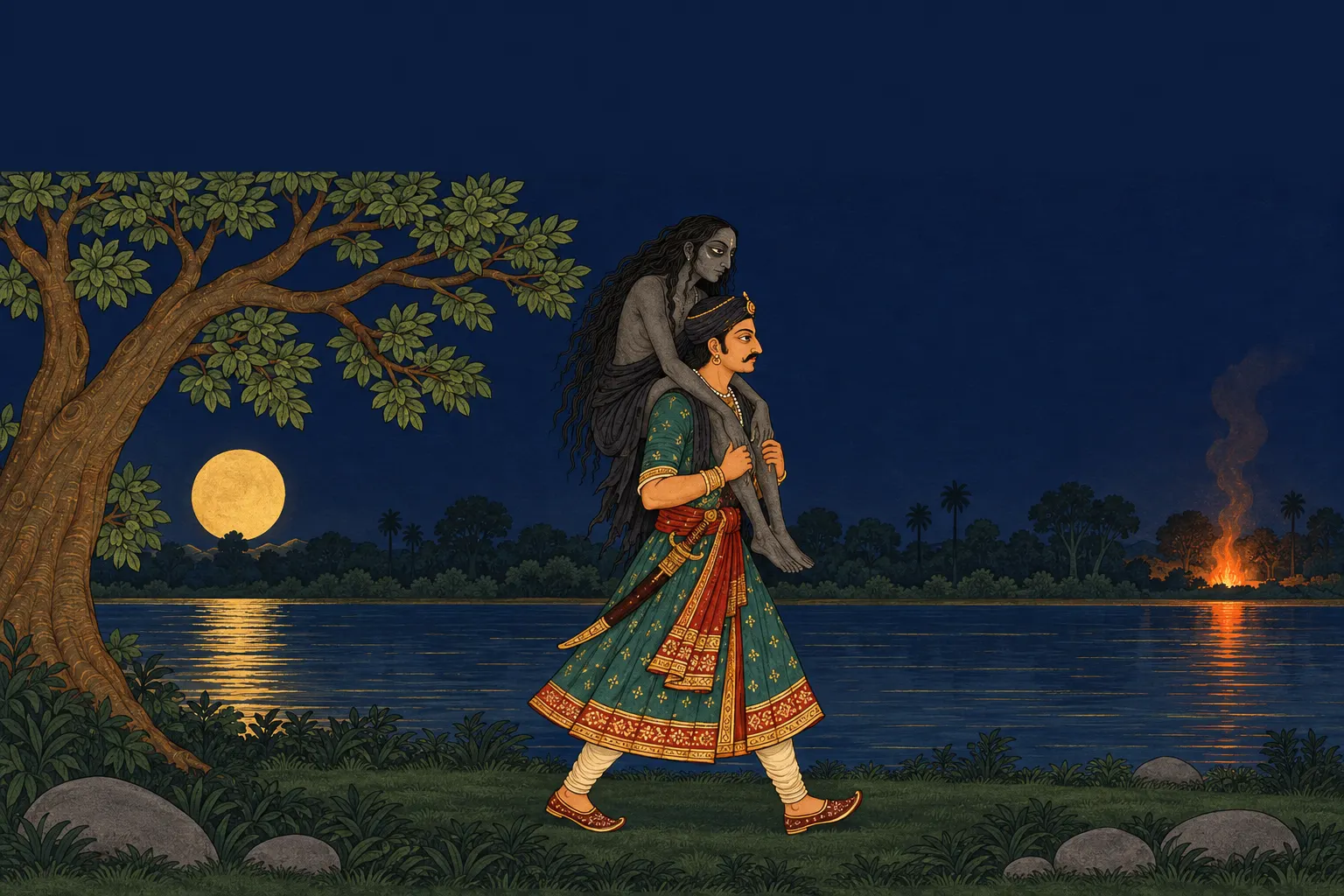
A corpse hanging in a cremation-ground tree, a vetala on the king's shoulder — and at the end of every tale a question, which he has barely answered before the vetala is back in the tree
The Vetala's First Question is chapter 8 of Kathasaritsagara. Source: Kathasaritsagara, Book 12 (Shashankavati), Chapters 75–82 (Tale 163c, 1–8). It is told in 7 scenes — The tale within the tale; The fruit and the jewel; The simsapa tree; The first tale: three Brahmans and a maiden; The second tale: Viravara; The third tale: Somaprabha and three suitors; The fourth tale: three fastidious brothers — followed by 10 quiz questions.
The tale within the tale
Now the story reaches Prince Mrigankadatta. He is on his way to Ujjayini to win his beloved Shashankavati. On the road he meets his lost minister Vikramakesarin, riding in the sky on the shoulder of an ugly man. Meeting, he tells his own story. In a village an old Brahman had been bitten by a snake, and he had drawn out the poison. In return the Brahman gave him a mantra for controlling vetalas. To tell him how that mantra worked the Brahman had told him the tale of King Trivikramasena and the vetala. That is the tale that now unfolds, which the world knows as the 'Vetala-panchavimshati', the twenty-five tales of the vetala.
The fruit and the jewel
On the bank of the Godavari there was a city called Pratishthana. Trivikramasena, son of Vikramasena, was king there, as mighty as Indra. Every day an ascetic named Kshantishila came to court, bowed to the king and presented him with a fruit. The king, taking it, would hand it to the treasurer. This went on for ten years.
One day, after the ascetic had gone, a tame monkey slipped from its keepers' hands and came in. The king gave it the fruit. When the monkey ate it, it burst open and out came a priceless jewel. The king asked the treasurer, 'Where are the fruits I kept giving you?' The terrified treasurer said, 'Maharaj, I kept throwing them through the window into the treasury; I never opened the door. If you permit, I will open it and look.' He went and looked. All the fruits had rotted, but in their place lay a heap of shining jewels. The king gave all the jewels to the treasurer.
The next day the king said to the ascetic, 'Why do you please me every day at such expense? Until you tell me, I will not take your fruit today.' The ascetic said in private, 'I have a rite to perform, for which I need the help of a brave man. O hero, help me.' The king gave his word. The ascetic said, 'On the night of the fourteenth of the coming dark fortnight I will wait for you under the banyan tree in the great cremation ground here.'
The simsapa tree
When the dark fortnight came the king remembered his promise. As night fell he wrapped a black cloth round his head, took his sword in hand, slipped quietly out of the palace and fearlessly reached the cremation ground. All around was thick darkness, fearful flames of funeral pyres, bones, skeletons and skulls scattered about, ghosts and vetalas busy at their terrible play and jackals shrieking. Under the banyan the ascetic was drawing a circle.
The king said, 'I have come. Tell me what to do.' The ascetic was pleased. 'O king, if you favour me, go far to the south from here. There you will find a simsapa tree. A corpse hangs on it. Bring it here.'
The king, walking by the light of the pyres, reached the tree with great difficulty. The tree was scorched by the smoke of the pyres, it smelled of raw flesh, and the corpse hung from its trunk as if from the shoulder of a demon. The king climbed, cut the rope and let the corpse fall. As it fell the corpse screamed with pain. Thinking it alive, the king out of compassion rubbed its body, and the corpse burst into a demonic laugh. The king understood that a vetala had entered it. Without fear he said, 'Why do you laugh? Come.' At once the corpse vanished from below and was seen hanging on the same tree again. The king climbed again and brought it down, for the hearts of the brave are harder than diamond. Then he put the corpse on his shoulder and set off quietly.
Then the vetala sitting on his shoulder said, 'O king, to shorten the road I will tell you a tale. But remember, at the end of the tale I will ask a question. If you know the answer and do not give it, your head will split into a hundred pieces.' The king would stay silent, but every time he had to answer, and as soon as he spoke the vetala vanished from his shoulder and returned to the same tree. Every time the king, untiring, went back to fetch him.
The first tale: three Brahmans and a maiden
On the bank of the Yamuna was a Brahman settlement called Brahmasthala. A Brahman named Agnisvami lived there, who had mastered the Vedas completely. His daughter Mandaravati was so beautiful that it seemed the Creator, having made her, had lost interest in apsarases. When she grew up, three young Brahmans from Kanyakubja, equal in every branch of knowledge, came there. All three asked her father for her hand, and all three would have given their lives rather than let anyone else have her. The father gave her to none, for he feared that if he gave her to one, two would lose their lives. So the girl stayed unmarried. The three gazed day and night at her moon-like face, like a chakora keeping its vow.
Then Mandaravati suddenly caught a high fever and died. The three, in grief, performed her rites as ordained. One of them built a hut right there in the cremation ground, made her ashes his bed and lived there, surviving on alms. The second took her bones and went to cast them into the Ganga. The third became an ascetic and went wandering to other countries.
The ascetic, wandering, reached a village named Vajraloka and became a guest in a Brahman's house. There he saw that the master of the house had a book of mantras, and by reading one mantra and sprinkling dust a dead child was brought back to life. His mind was calmed and he ate. (Here the text has a harsh detail of the child's death, which is left out.) The master of the house put the book in a niche and went to sleep. At night the ascetic got up fearfully, took the book and, wishing to revive his beloved, ran off. Walking day and night he reached the same cremation ground where she had been burned.
There he saw the second Brahman, who had returned after casting her bones in the Ganga, and the third, who lay asleep in the hut built over the ashes. He said to both, 'Remove this hut. From its ashes I will bring my beloved to life by a mantra.' After much pleading he had the hut removed, opened the book and read the mantra. When he scattered the dust charmed by the mantra on the ashes, Mandaravati rose alive. Because she had come out of the fire her body was even more beautiful than before, as if made of gold. Seeing her alive, all three, mad with desire, began to quarrel. The first said, 'She is my wife; I got her by the power of my mantra.' The second said, 'She is mine; she came alive through the power of the holy place.' The third said, 'She is mine, because I guarded her ashes and revived her by austerity.'
The vetala asked the king, 'Now give judgement. Whose wife should this girl be? If you know and do not speak, your head will break into pieces.' The king answered, 'He who revived her by the mantra, however much hardship he endured, must be regarded as her father, because he did a father's work. He who took her bones to the Ganga will be counted her son. But he who slept on the ashes in love and practised austerity living in the cremation ground, he shall be called her husband, because he behaved as a husband does.' Hearing this the vetala vanished from the king's shoulder. The king set off again to bring him back.
The second tale: Viravara
Another night, another round. This time the vetala said, 'O king, why do you take such trouble for this wicked ascetic? You are not acting with thought. Come, hear this tale.'
In a city named Shobhavati lived a brave king named Shudraka. In his kingdom righteousness had spread so far that the earth had forgotten even Rama. One day a Brahman named Viravara came from the land of Malava to take service with him. His wife was Dharmavati, his son Sattvavara, his daughter Viravati. His family was three people and his servants three: a dagger at his waist, a sword in one hand and a shield in the other. Even for so small a family he asked the king for five hundred dinars a day. The king, from his bearing, guessed his courage and granted the demand.
The king wanted to know whether he spent such a sum on his own pleasure or on some good cause. He quietly set spies on him. It turned out that Viravara met the king in the morning, at noon stood guard with his sword at the palace gate, then went home and gave his wife a hundred dinars for food, spent a hundred on clothes and betel, after bathing put a hundred into worship of Vishnu and Shiva, and gave two hundred to poor Brahmans. Then, after the fire sacrifice, he ate and at night again stood alone with sword at the palace gate. The king withdrew the spies and began to honour him.
The rainy season came. Day and night water poured in torrents, but Viravara stood unmoved at the palace gate all the same. One night the king climbed to the roof and called out, 'Who is at the gate?' Viravara said, 'It is I, Maharaj.' The king thought, 'He is fearless and devoted to me. I must give him high rank.' The next night the rain was heavier and the darkness deep. The king went to the roof again and called, 'Who is at the gate?' Viravara gave the same answer. Just then the king heard in the distance the sound of a woman weeping. The king thought, 'In my kingdom no one is sad or wretched. Why is this woman weeping alone at night?' He said to Viravara below, 'Some woman is weeping far away. Go and find out who she is and why she weeps.'
Viravara went with dagger at his waist and sword in hand. The king felt compassion and curiosity for him. He too, sword in hand, quietly followed. Viravara came to a pond outside the city. There in the middle of the water a woman was weeping, saying, 'Alas, hero! Kind one! Generous one! How will I live without you?' Viravara asked, 'Who are you and why do you weep?' She said, 'Viravara, I am the Earth. King Shudraka is my righteous lord. But three days from today he will die. Where shall I find another such lord? That is why I weep for myself and for him.' Viravara said in alarm, 'Goddess, is there any way to avert the death of this king, the protective armour of the world?' The Earth said, 'There is one way, which only you can do. If you offer your son Sattvavara to the goddess Chandi, whose temple the king has built near the palace, the king will live a hundred years more. But it must be done tonight, or on the third day he will die.' Viravara said, 'Goddess, I will do it now.' The Earth said, 'May good be with you,' and vanished. The king, hidden behind, hearing it all, stayed silent.
Viravara went home, woke his wife and told her what the Earth had said. Dharmavati said, 'My lord, we must do the king good. So wake the boy and tell him yourself.' Viravara woke the sleeping Sattvavara and told him. The small boy showed a hero's heart and made his name true. He said, 'If my giving my life saves the king's life, I have got everything, for I have repaid his food. Why wait? Take me before the goddess now.' Viravara said, 'Well done! You are truly my son.' The king, who followed behind and heard all this, said to himself, 'Wonderful! They are all equally brave.'
Then Viravara, with his son on his shoulder, and Dharmavati, with her daughter Viravati, went to Chandi's temple, and the king slipped after them. There Sattvavara bowed to the goddess and said, 'By the offering of my head may King Shudraka's life be saved, and may he rule a hundred years without opposition.' Viravara said 'Well done!' and offered his son to the goddess. At once a voice came from the sky: 'Well done, Viravara! Who is as devoted to a king as you, who gave your only son and gave the king life and kingdom?' Just then his daughter Viravati, clinging to her brother's body, wept so much that her heart broke and she died. The king saw and heard it all from his hiding place.
Then Dharmavati said to her husband, 'We have done the king good. Now I have one thing to say. My daughter has also died of grief for her brother, and I have lost two children. What use is my life now? That I did not offer the goddess my own head for the king first is my folly. Now permit me to enter the fire with the children's bodies.' Viravara said, 'Do so. May good be with you.' With wood gathered for the temple fence he made a pyre, laid the children on it and lit it. Dharmavati worshipped Chandi and prayed, 'May the husband of this life be my husband in the next, and may the king be blessed by the sacrifice of my life.' Then she entered the pyre. Viravara thought, 'I have completed the work for the king's good and repaid the debt of food. Now I am alone, so why live? Having sacrificed the family it was my duty to support, it is not right to save my own life.' Thinking so, he praised the goddess and offered himself too at her feet.
The king was watching all this from his hiding place. In astonishment he thought, 'This excellent man and his family have done such an extraordinary thing for me. If I do not repay it, what use is my kingdom?' He drew his sword from its sheath and said to the goddess, 'Goddess, bring this Brahman Viravara and his family back to life. In exchange I offer you my head.' Just as he went to cut off his head, a voice came from the sky: 'Do not be hasty. I am pleased with your courage. Let Viravara live, with his wife and children.' Viravara, his wife, son and daughter all rose alive, with no wound. The king watched them with tears of joy in his eyes, and then hid there again.
Viravara, as if waking from sleep, was astonished to see his wife and children alive. 'We had been burned to ashes, and I too had cut off my head. What has happened?' His wife and children said, 'It is the goddess's grace; we do not know it.' Viravara worshipped the goddess and took his family home. Then that same night he came back to the palace gate. The king went to the roof and called, 'Who is at the gate?' Viravara said, 'It is I, Maharaj. At your command I went in search of that woman, but like a rakshasi she vanished somewhere in a moment.' The king thought, 'High-minded people are deep as the ocean. Even after doing an extraordinary deed they do not speak of it.' In the morning in court the king told the ministers everything, and all were astonished. He gave Viravara and his son the territories of Lata and Karnata.
The vetala asked the king, 'Tell me, who was the greatest hero among them all? If you know and do not speak, a curse will fall on you.' The king said, 'King Shudraka was the greatest hero.' The vetala said, 'Is Viravara not greater, whose equal is nowhere on earth? Is his wife not greater, who as a mother watched her son sacrificed? Is his son not greater, who showed such courage at a tender age? Why then do you call the king the greatest?' The king said, 'Do not say so. Viravara was of high family, whose custom was to sacrifice life, son and wife to protect the king. His wife too was of high family, a devoted wife, whose highest duty was to follow the path her husband showed. And the son was their son. As the thread, so the cloth. But Shudraka was greatest of all, because he was ready to give his life for servants through whose giving of their lives kings save their own.' Hearing this the vetala vanished from his shoulder, and the king again took the road to the cremation ground.
The third tale: Somaprabha and three suitors
In Ujjayini lived a Brahman named Harisvami, who was minister to King Punyasena. His son was named Devasvami and his daughter Somaprabha, who was very proud of her beauty. When the time for her marriage came, she had her mother tell her father and brother, 'Give me to a man who has valour, knowledge or the power of magic. If my life is dear to you, give me to no one else.' Harisvami, worried, began to look for such a groom. Meanwhile he went as the king's envoy to a king of the south to arrange a treaty. His task was just done when a Brahman came and asked for his daughter's hand. Harisvami asked which of the three powers he had. He said, 'I have the power of magic.' Then by his art he made a chariot that flew through the sky and in a moment showed Harisvami heaven and all the worlds and brought him back to the same place. Harisvami promised him his daughter and fixed the wedding for the seventh day.
Meanwhile in Ujjayini another Brahman asked Devasvami for his sister's hand and declared himself a hero. He showed his skill with weapons, and Devasvami promised him his sister on that same seventh day, without telling his mother. At the same time a third man quietly asked the mother for her daughter's hand and said, 'I have knowledge.' The mother asked him questions about past and future and, seeing his learning, promised him her daughter too on that same seventh day.
The next day Harisvami returned home, and when each told of his separate promise, he was alarmed that three bridegrooms had now been summoned. On the wedding day all three bridegrooms arrived: the man of knowledge, the magician and the hero. Then something strange happened: Somaprabha suddenly vanished and could not be found though they searched. Harisvami quickly asked the man of knowledge, 'You tell me, where has my daughter gone?' The man of knowledge said, 'A rakshasa named Dhumashikha has taken her to his house in the Vindhya forest.' Harisvami was alarmed. The magician said, 'Do not worry. I will get you in a moment to where the man of knowledge says.' He again made the chariot that flew through the sky, put weapons in it, and seating Harisvami, the man of knowledge and the hero, took them in a moment to the rakshasa's house in the Vindhya forest. The rakshasa came out angry. The hero, put forward by Harisvami, challenged him to battle. A fearful fight broke out like that of Rama and Ravana. In a little while the hero cut off the head of that mighty rakshasa with a crescent-headed arrow. Then they all brought Somaprabha out of the house and returned seated in the magician's chariot.
Reaching home, the wedding did not take place even when the auspicious hour came, because the three fell to quarrelling. The man of knowledge said, 'If I had not told where she was, how would the hidden girl have been found? So she should be mine.' The magician said, 'If I had not made the flying chariot, how would you all have gone and come back like gods in a moment? And without the chariot how would you have fought the rakshasa, who had a chariot too? So give her to me, because even this auspicious hour is the fruit of my skill.' The hero said, 'If I had not killed the rakshasa in battle, who would have brought this girl here despite all your efforts? So she should be mine.' They went on quarrelling so, and Harisvami stood silent in confusion.
The vetala asked the king, 'So tell me, O king, to whom should that girl be given? If you know and do not speak, your head will burst.' The king said, 'She should be given to the hero, because by the strength of his arms, risking his life, he won her by killing the rakshasa. The man of knowledge and the magician were made by the Creator as his tools. Are not those who count and those who make always the helpers of others?' Hearing this the vetala vanished from his shoulder again, and the king again set off to bring him back.
The fourth tale: three fastidious brothers
In the Brahman grant of Vrikshaghata in the land of Anga lived a wealthy Brahman named Vishnusvami, who performed sacrifices. He had three sons who were exceptionally sharp. Once, when he began a sacrifice, he sent his three sons to fetch a tortoise from the seashore. They went, and found the tortoise, and the eldest said to his two brothers, 'One of you take the tortoise for father's sacrifice. I cannot; it is sticky with mud.' Both said, 'If you hesitate, why should we not hesitate?' The eldest said, 'You two take it, or father's sacrifice will be spoiled and you will go to hell.' They laughed: 'If you see your duty so clearly, why do you not see your own duty?' The eldest said, 'Don't you know how fastidious I am? I am very particular about food; I cannot touch anything disgusting.' The middle one said, 'Then I am more fastidious than you, for I am very delicate in my taste for women.' The eldest said, 'Then let the youngest pick up the tortoise.' The youngest wrinkled his nose and said, 'You are both fools. I am very delicate about beds, so I am the most fastidious of all.' The three brothers quarrelled, left the tortoise there in their pride, and went to Vitankapura, to King Prasenajit of that country, to have their quarrel settled.
The doorkeeper took them to the king. The king said, 'I will test each of you in turn. Stay here.' When the king's mealtime came, all three were seated on seats of honour and given a royal meal with all six flavours. All were eating, but the brother fastidious in food, making a face, did not take a single mouthful. The king asked the reason and he said softly, 'In this cooked rice I smell the smoke of corpses, so I cannot eat it, however delicious.' At the king's order everyone smelled the rice: 'This is white, good and fragrant.' But he would not accept it. The king had inquiry made and learned that the rice had grown in a field near a village cremation ground. The king was greatly astonished and pleased and said, 'You are truly very fastidious in food. Eat something else.'
After the meal the king sent the three to their rooms and called the most beautiful woman of his court. In the evening he sent her, adorned in beautiful jewels, to the room of the second Brahman, who was fastidious about women. That moon-faced beauty, with the king's servants, went to his room. But as soon as she came in and the room blazed with her radiance, that Brahman almost fainted, pressed his nose with his left hand and said to the king's servants, 'Take her away. Or I will die. She smells like a goat.' The servants brought the flustered woman back to the king. The king called that fastidious Brahman and said, 'How can this beauty, wearing such fragrant perfumes of sandal, camphor and aloe, smell like a goat?' But he stuck to what he said. Then the king grew suspicious. By asking questions cleverly he learned from the woman herself that in childhood, being separated from her mother and nurse, she had been brought up on goat's milk. The king was very astonished and praised that Brahman's discernment highly. Then, for the third Brahman, who was fastidious about beds, he had a bed laid as he liked, with seven mattresses and clean smooth sheets, and put him to sleep in a beautiful room. But before a watch of the night had passed he leapt up from the bed screaming with pain, hands pressed to his side. The king's servants saw that on his side there was a red crooked mark, as if a hair had been pressed in deep. They told the king. The king said, 'Look under the mattresses.' They looked under mattress after mattress, and at the very bottom, on the bedstead, they found a single hair. The king saw it and saw the mark too and was astonished, and thought all night how a hair could leave so deep a mark through seven mattresses. In the morning he gave the three three hundred thousand gold coins each, because they were extraordinary connoisseurs, and they began to live comfortably with the king. They forgot the tortoise and their father's spoiled sacrifice altogether.
The vetala asked the king, 'O king, remember my old curse, and tell me which of these three was the most fastidious?' The king said, 'In my opinion the one about beds was the most fastidious, because the mark showed clearly on his body, so there was no room for deceit. The other two may have had their information from someone else beforehand.' At this the vetala flew from his shoulder, and the king, untiring, set off again to bring him back.
Note: This chapter is written directly from C. H. Tawney's English translation (Book 12, Chapters 75–82). The Vetala-panchavimshati (twenty-five tales of the vetala) is a series of tales within the Kathasaritsagara, and also very famous as a separate book. Of the twenty-five, four tales (2, 4, 5, 8) are taken here. Tales 1, 3, 6 and 7 are left out, because they contain the humiliation of women, killing, or harsh details of suicide. In tale 2 a harsh incident involving a child, and in tale 4 (Viravara) the full detail of the son's sacrifice, are kept restrained, though the base of the tale is the same. What the characters say about 'sacrifice', 'devoted wife' and family custom are their own views, not this website's. The king's decisions in the vetala's answers belong to the sense of justice of that age.
Source: Somadeva Bhatta — the Kathasaritsagara (Kashmir, eleventh century), an abridgement of Gunadhya's lost Brihatkatha, The Vetala's First Question