
Chapter 5
Yaugandharayana's Gambit
A minister 'burned' his own queen — to make his king an emperor, and with the queen's own consent
Yaugandharayana's Gambit is chapter 5 of Kathasaritsagara. Source: Kathasaritsagara, Book 3 (Lavanaka), Chapters 15–16. It is told in 6 scenes — The minister's worry; Narada's visit; The fire at Lavanaka; Avantika; The king's grief; Reunion and the oath of truth — followed by 10 quiz questions.
The minister's worry
Having won Vasavadatta, King Udayana of Vatsa gradually drowned in her company. The burden of the kingdom was carried by his minister Yaugandharayana and his commander Rumanvan. One night Yaugandharayana, worried, called Rumanvan to his house and said, 'Our king is of the Pandava line, and the earth came to him from his ancestors. But he has even given up Hastinapura, his family's own city. He has no wish to conquer. He is taken up with women, wine and hunting, and has left all the care of the kingdom to us. So we must find, by our own wits, a way for him to gain the whole earth that is his line's right. Only then shall we fulfil our duty and our devotion to our king.'
He told a tale to make the point. There was a king named Mahasena. A powerful enemy marched against him, and his ministers advised him and brought him round to paying tribute. After paying it, the king grew so low that he developed an abscess in his belly, and came to the brink of death. Then a wise physician thought that this sickness would not go with medicine. He lied to the king: 'Maharaj, your queen has died.' With the shock of grief the abscess burst of itself and the king was cured. He lived happily again with his queen and conquered his enemies. 'The physician did the king good by his wits,' Yaugandharayana said. 'Let us do our king good too.'
Then he told his plan. 'We have only one great enemy, the king of Magadha, who keeps attacking us from behind. We must ask for his daughter Padmavati for our king. The king of Magadha has refused. He said, "I will not give my daughter, whom I love more than myself, to the king of Vatsa, for he is wrapped up in his wife Vasavadatta." And as long as the queen lives, the king will not marry again. So we will hide Vasavadatta somewhere and burn down her palace and spread everywhere that the queen is burned. Then Padmavati will come to the king. Magadha will become our kin and will not attack from behind. Then we will set out to conquer the east, then the other quarters, and in this way win the whole earth for the king. Besides, long ago a voice from the sky said just this.'
Rumanvan first voiced his fear that by such a trick they might both become objects of ridicule, but then agreed. He raised another worry: 'When the king hears that the queen has burned, he will give up his life. How do we stop him?' Yaugandharayana said, 'The queen is Gopalaka's younger sister and dearer to him than life. When the king sees that Gopalaka is not very grieved, he will think the queen may be alive. And he is brave; he will steady himself. The marriage with Padmavati will be over quickly too, and then we will bring the queen out of hiding.'
The three decided that all should go with the king and queen to Lavanaka. It was a region on the border of Magadha with good hunting grounds. The king would be far from the palace there, and they could set fire to the queens' quarters and carry out the plan. Next day Rumanvan said to the king, 'Maharaj, it is a long time since we went to Lavanaka. The place is very beautiful, the hunting is excellent and there is grass for the horses. The king of Magadha harasses that region, so let us go also under the pretext of protecting it.' The king, eager for every kind of pleasure, decided to go with Vasavadatta.
Narada's visit
The hour of the journey was fixed, when suddenly the great sage Narada came to him. He descended through the middle of the sky as if the moon had come down to earth out of love for his descendants. He gave the king a garland of parijata, and blessed the queen that she would have a son, a part of Kama, who would become king of all the vidyadharas.
Narada said to the king, 'Your ancestor Yudhishthira and his brothers had one wife, Draupadi, and she too was a beauty beyond compare, like Vasavadatta. I advised them to avoid jealousy, because it is the seed of calamities. I told them the tale of Sunda and Upasunda. They were two asura brothers. To destroy them Brahma had a woman of incomparable beauty made, named Tilottama. When she appeared before them in a garden on Kailasa, both tried to seize her at once, fought pulling at her, and both were killed.' He had come to bring this lesson to the king. He also warned that the king would have to endure sorrow for a time.
The fire at Lavanaka
The king reached Lavanaka. At the echo of his army it seemed that the ministers' purpose was bound to succeed. The king of Magadha heard that the king of Vatsa had come with so great an army, and trembled in fear of attack. But he was wise, and sent a messenger to Yaugandharayana, who received him courteously.
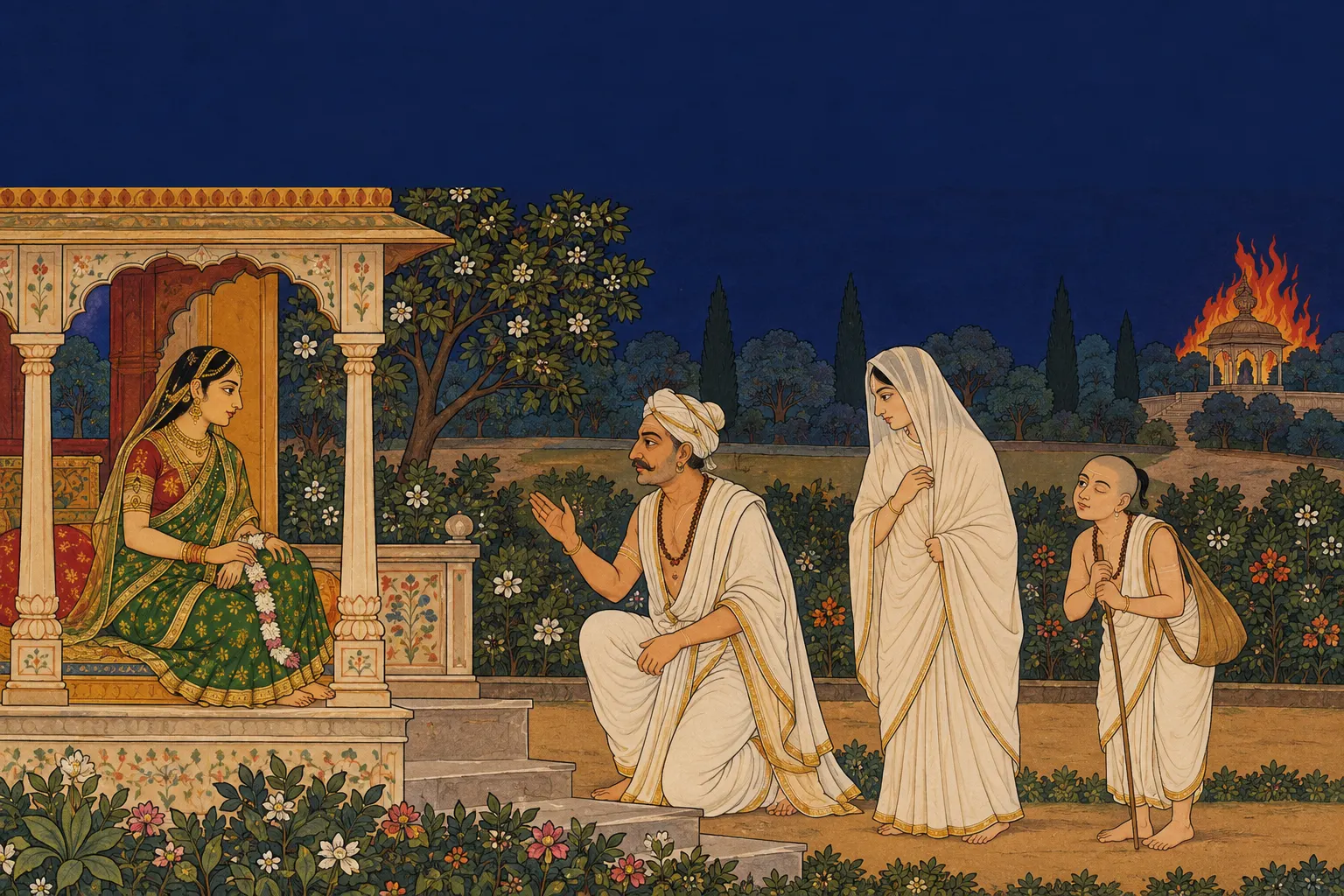
Every day the king went off hunting in the forest. One day, while he was out hunting, Yaugandharayana went secretly with Gopalaka, Rumanvan and Vasantaka to Queen Vasavadatta. The queen had already had the full account of the plan from her brother. The minister persuaded her in various ways to cooperate for the king's good. Despite the pain of separation she agreed. What do well-born women who love their husbands not endure? Yaugandharayana gave her a mantra by which she took the form of a Brahman woman. He made Vasantaka one-eyed, like a Brahman boy, and himself took the guise of an old Brahman. Then, taking the queen and Vasantaka, he set off slowly for the city of Magadha. Vasavadatta walked the road in body, but in mind she was with her husband.
At that moment Rumanvan set fire to her pavilion and cried out, 'Alas, alas! The queen and Vasantaka are burned!' In that place flames and lamentation rose together to the sky. The flames died down slowly, but the lamentation did not.
Avantika
Yaugandharayana reached the city of Magadha with Vasavadatta and Vasantaka. In the garden he saw Princess Padmavati. Though the guards tried to stop him, he went up to her. The moment she saw Vasavadatta in her Brahman woman's guise, Padmavati took to her at first sight. She stopped the guards and had the old Brahman called to her. She asked, 'Great Brahman, who is this girl with you, and why have you come?' He answered, 'Princess, this is my daughter Avantika. Her husband is a wastrel and has gone off somewhere, leaving her. I am leaving her with you as a trust while I go to look for her husband, who will return soon. This one-eyed boy is her brother; he will stay with her so that she is not alone.' Padmavati agreed. The minister went back to Lavanaka that very night.
Padmavati took Vasavadatta, who was living under the name Avantika, and Vasantaka in his one-eyed boy's form to her beautiful palace. On its walls were pictures of the story of Rama, and seeing Sita among them Vasavadatta found strength to bear her sorrow. Padmavati saw from Avantika's beauty, her gentleness, her way of sitting and eating, and the lotus-like fragrance of her body, that she seemed to come from a very high family. She thought, 'This must be some woman of high rank living in hiding. Draupadi too lived in hiding in Virata's palace.' So she kept her in every comfort.
Out of affection for Padmavati Vasavadatta made for her never-withering garlands and forehead tilaks, which she had learned from her king. Padmavati's mother, seeing her daughter adorned with them, asked who had made them. Padmavati said that in our house lives a woman named Avantika, and it was she who made them. The mother said, 'Then, daughter, she is no ordinary woman; she is some goddess. People with such skills go to live in the houses of good people in disguise.' And she told the tale of Kunti and Durvasa: King Kuntibhoja placed his daughter Kunti in the service of the sage Durvasa, and the sage, to test her, had a pot of hot rice-milk set on her back. Though her back was burning, Kunti stood calm, and the sage, pleased, gave her a boon. 'So try to keep her happy,' the mother said. Padmavati did so. Parted from her husband, Vasavadatta stayed there withered like a night lotus, but Vasantaka's childish antics kept bringing a smile to her face.
The king's grief
Meanwhile the king of Vatsa, roaming far hunting grounds, returned to Lavanaka late in the evening. He saw the queens' quarters turned to ashes and heard from the ministers that the queen and Vasantaka were burned. At the words he fell unconscious. A moment later he came to, and in his heart, along with the queen's image, a fire of grief blazed up. He wept, and resolved to give up his life. Then in a moment he remembered Narada's words: 'From this queen a son will be born who will rule all the vidyadharas. Narada also said I would have sorrow for a time. And Gopalaka's grief looks light. In Yaugandharayana and the other ministers too there is not much sorrow to be seen. Perhaps the queen is alive and the ministers have devised some stratagem. Then I will meet her someday.' Thinking so, and at the ministers' urging, he steadied his mind. Gopalaka too quietly sent a messenger to his sister and told her how things stood.
The spies of Magadha had told their king everything. He was a king who always waited for his chance. He again sent the king of Vatsa the proposal of his daughter, which the ministers had asked for earlier. On Yaugandharayana's advice the king of Vatsa agreed, thinking that perhaps the queen had been hidden for this very reason. Yaugandharayana sent a message to the king of Magadha: 'Your wish is acceptable to us. Seven days from today the king of Vatsa will come to your court and marry Padmavati, so that he may soon forget Vasavadatta.' When Vasavadatta got this news her heart sank. But Vasantaka said, 'In this way the enemy becomes a friend, and your husband's heart will not turn away from you.' At this she steadied herself. She again made garlands and tilaks of divine beauty for Padmavati's wedding.
On the seventh day the king of Vatsa arrived with his army and ministers. Even in his grief at separation, how could he have accepted this marriage had he not had, deep within, a hope of the queen's return? The king of Magadha came with great joy to receive him, as the sea advances to welcome the moon. In the marriage hall the king of Vatsa saw Padmavati adorned. He saw that she wore garlands and tilaks which only he could make, and was astonished to wonder where she had got them. Stepping on to the altar, he took her hand. The smoke of the altar brought tears to his eyes, as if out of such love for Vasavadatta he could not bear to watch this marriage. Padmavati's face was reddened by the circling of the fire, as if she were angry, knowing her husband's mind. Even after the wedding Vasavadatta's image did not leave the king of Vatsa's heart for a moment. The king of Magadha gave him so many jewels that the earth seemed emptied of them. Yaugandharayana, making the fire the witness, took a promise from the king of Magadha that he would never harm his master.
Reunion and the oath of truth
Amid the wedding festivities Vasavadatta watched quietly with hope, like the crescent moon asleep in the daytime. Yaugandharayana feared that the king would go to the queens' quarters and see her, and the whole secret would be out. He told the king of Magadha that the king of Vatsa would leave that very day, and told the king the same. The king set out with the whole army and his new bride Padmavati. Vasavadatta followed behind the army quietly in a carriage sent by Padmavati, keeping Vasantaka walking ahead. Reaching Lavanaka, the king went into his palace, but in his mind he thought only of Vasavadatta. The queen also arrived at night and went to her brother Gopalaka's house, keeping the guards outside. Brother and sister embraced and wept. At that moment Yaugandharayana and Rumanvan too arrived there.
Meanwhile Padmavati's guards told her that Avantika had come, but had strangely sent them away and gone to Gopalaka's house. Padmavati, alarmed, said before the king, 'Go and tell Avantika, "The queen says you are my trust. What business do you have here? Come to me."' Then the king asked Padmavati in private who had made these priceless garlands and tilaks. Padmavati said, 'That is Avantika's handiwork, whom a Brahman left with me as a trust.' At once the king went straight to Gopalaka's house, thinking that Vasavadatta must surely be there. At the door were eunuch guards. Inside were the queen, Gopalaka and the two ministers. He saw Vasavadatta, returned from her exile, like the moon released from an eclipse. He fell unconscious, struck by the poison of sorrow. Vasavadatta too, pale from separation, fell and began to blame herself.
Hearing both of them lament, tears began to flow from Yaugandharayana's eyes too. Padmavati, hearing the sound of weeping, came there in alarm. Slowly she too learned the truth about the king and Vasavadatta, and she became just like them, for good women are tender-hearted. Vasavadatta said again and again, weeping, 'What use is my life, which brings my husband only sorrow?' Then the calm Yaugandharayana said to the king, 'Maharaj, I did all this to make you emperor, to have you married to the daughter of the king of Magadha. The queen is not at all at fault. Padmavati, her co-wife, is witness to her good conduct all this time.' Free of jealousy, Padmavati said, 'I am ready to enter the fire at once to prove her innocence.' The king said, 'The fault is mine, since because of me the queen had to bear this suffering.' Vasavadatta said firmly, 'I will enter the fire so that doubt may be removed from the king's mind.'
Then Yaugandharayana, best of the righteous, sipped water, faced east and spoke pure words: 'If I have done this king good, and if the queen is without blemish, then speak, O guardians of the world. If this is not true, I will give up my body.' When he fell silent, a voice was heard from the sky: 'O king, you are blessed to have such a minister as Yaugandharayana and such a wife as Vasavadatta, who was a goddess in a former birth. There is not the slightest fault in her.' All present who heard that sound, which echoed in every direction like the thunder of the first rain clouds, raised their arms like peacocks and danced for joy. The king and Gopalaka praised Yaugandharayana's work, and the king accepted that the whole earth would now be under his sway. He lived in supreme happiness with both his wives, whose affection for him grew every day by living together.
Note: This chapter is written directly from C. H. Tawney's English translation (Book 3, Chapters 15–16). The Sanskrit play *Svapnavasavadattam* is believed to be based on this very stratagem (credited to Bhasa, though this is disputed). In the play the king comes fully to believe the queen has burned; in Somadeva's text the king retains a doubt. Names such as 'Pradyota' or 'the king of Magadha' are mixed in places in the book; here 'the king of Magadha' is used. The inset tales of Sunda–Upasunda and Kunti–Durvasa are given briefly. This episode of testing the queen's 'devotion to her husband' belongs to the tale-tradition of that time; it should not be read as an expectation of any woman today.
Source: Somadeva Bhatta — the Kathasaritsagara (Kashmir, eleventh century), an abridgement of Gunadhya's lost Brihatkatha, Yaugandharayana's Gambit