Kanda 2

Midnight, and a river

On the night the guard was heaviest, somebody walked out

When everyone fell asleep

All of Mathura was waiting for the eighth birth. Security had been doubled. Devaki's chains were tight, every prison door was locked, and soldiers stood guard at every turn.

At midnight the child was born. And in that instant, the entire prison seemed to hold its breath.

The guards slipped into sleep. Devaki's chains came open with a rattle. And the heavy iron doors, which took four men to push, slid aside on their own without a sound.

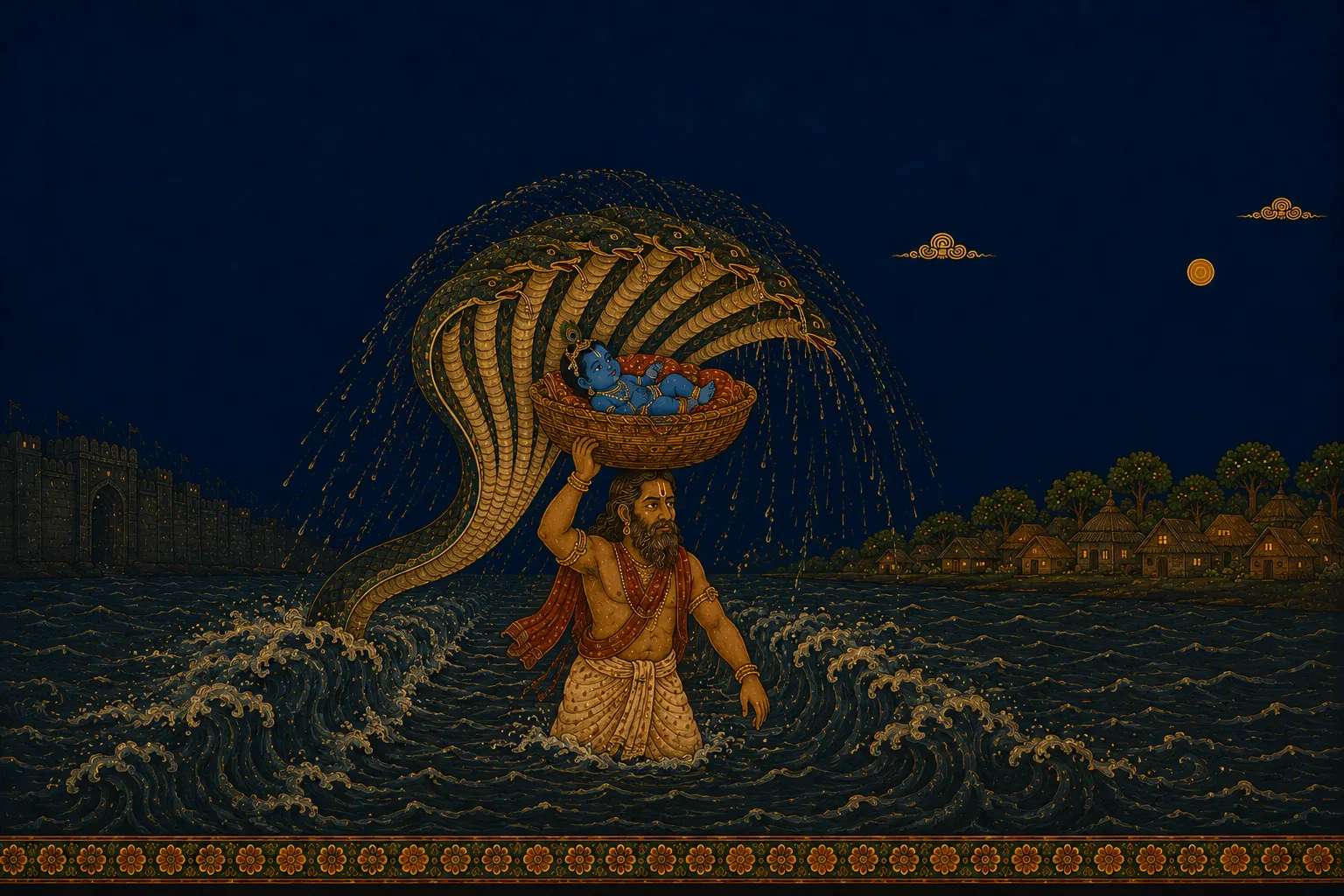
Vasudeva lifted the child, put him in a basket, balanced it on his head, and walked out along the corridor. Not one soldier opened an eye.

The Yamuna, that night

Outside, a storm was raging. The rain was so heavy that Vasudeva could barely see an arm's length ahead, and the Yamuna was up over both its banks, roaring.

Vasudeva stepped into the water. There was no way back — the prison behind him, this river ahead.

The Bhagavata's story says that the waters parted and made way for him, and above him a huge Shesha spread his hoods and held the rain off the child.

An old man, a basket on his head, floodwater to his waist — and all around him something was happening that the laws of nature should not have allowed. Vasudeva did not look back.

The swap in Gokul

Nanda's house lay asleep. Yashoda had given birth to a girl that same night and was fast asleep from exhaustion — she never knew anyone had come in.

Vasudeva laid his son down beside Yashoda, picked up her girl, and immediately started back. He said not a word, woke nobody.

The moment he returned to the prison, everything went back to the way it had been — doors shut, chains tight, guards awake. As though Vasudeva had never risen.

Then the girl cried. And the instant they heard her, the soldiers ran to fetch Kamsa.

The one who slipped out of his hands

Kamsa came half-asleep, a bare sword in his hand. He stopped the moment he entered the cell — it was a girl.

For a moment he hesitated. Then he told himself the prophecy could be false, but the risk could not be taken. He took the child by the hair and raised his arm to dash her against the stone threshold.

The child slipped out of his fist and rose into the air. Where she had been, an eight-armed goddess now stood.

"The one you are looking for has already been born — and he is not here."

Then she vanished. Kamsa was left standing alone, sword in hand, with nothing left to strike.

Note: The guards falling asleep, the chains opening, the crossing of the Yamuna and the swap in Gokul — this whole sequence is found in the tenth skandha of the Bhagavata Purana. The current text of the Harivamsha also has the swap and the child turning into a goddess, along with one detail the Bhagavata does not have in this form: Kamsa regrets it afterwards. The detail of the water parting by itself is plain in the Bhagavata; it did not appear in that same chapter of the Harivamsha, so it should not be treated as something every text says.

Source: from several texts, Midnight, and a river

Now — how much stayed with you?

What happened?

On the night Krishna was born, what happened in the prison?

  • The guards stopped Vasudeva, but he fought his way out
  • Kamsa opened the door himself
  • Vasudeva bribed the guards
  • The guards fell asleep, the chains came open and the doors slid aside by themselves
Read the whole story — An escape made without a fight

In the tenth skandha of the Bhagavata Purana this whole scene happens without any violence — sleep, chains opening, doors sliding.

The story's weight is on this: all of Mathura's preparation came to nothing. Doubled guard, locks, chains — and somebody walked out quietly.

The same manner returns later: the harder Kamsa pushes, the less effect it has.

Who am I?

I was born that same night, but I did not stay in the house I was born in. A murderer tried to dash me against a stone, and I slipped out of his hands. Who am I?

  • Devaki
  • Satyabhama
  • Rohini
  • Yashoda's daughter, who is called Yogamaya
Read the whole story — The girl who came in the swap

In the Bhagavata Purana this child is called Yogamaya, and on slipping from Kamsa's hands she appears as an eight-armed goddess.

The current text of the Harivamsha has the same swap and the same goddess-form — which is to say this episode is not the property of one text.

The interesting difference is that in that Harivamsha text Kamsa is later shown regretting it. The Bhagavata's tone there is more triumphant, not one of regret.

Fact

Which river did Vasudeva cross with the child?

  • The Saraswati
  • The Godavari
  • The Yamuna
  • The Ganga
Read the whole story — The same river, again and again

The Yamuna keeps returning through this whole epic — from this night's crossing to the Kaliya episode, and on into the stories of the gopis.

In the Bhagavata's story the water itself makes way that night. This detail is found plainly in the Bhagavata.

In the available text of the Harivamsha this parting-of-the-water detail did not appear in that chapter — so it should not be treated as present everywhere.

Why is that?

Why did Vasudeva take the child to Gokul in particular?

  • Because Gokul was very far from Mathura
  • Because Nanda's house was there, and a girl had been born at Yashoda's that same night
  • Because Kamsa's rule did not reach Gokul
  • Because Rohini had called for him
Read the whole story — What the swap depended on

The plan could only have worked that one night, because a second newborn was needed to make the exchange.

Nanda and Vasudeva had an old connection, and Rohini was already living in Gokul — which is to say the house was already a trusted one.

Being out of Kamsa's reach was not the reason. He goes on to send killers like Putana into Gokul soon enough.

Who said it?

"The one you are looking for has already been born — and he is not here." Who said this?

  • Devaki
  • Vasudeva
  • Narada
  • The child who slipped from Kamsa's hands, in the form of a goddess
Read the whole story — The last warning

This sentence is the second warning to Kamsa — the first was the voice from the sky, and this one is worse, because now nothing could be done.

In the Bhagavata this goddess appears with eight arms and stands fixed in the sky.

After this Kamsa's strategy changes: he stops waiting and starts sending killers. The next kanda begins there.

Riddle

I became an umbrella that night. My body was nothing like a boat, but the rain got no further than me. Who am I?

  • Garuda
  • A wave of the Yamuna
  • Shesha
  • Nanda's shawl
Read the whole story — An umbrella of hoods

Tradition also connects Shesha with Balarama, so his arrival in this scene ties one more thread inside the story.

In the Bhagavata this detail gives the scene its most recognisable form — the storm, the river, the basket on the head, and the spread hoods above.

The whole force of the story is in that contrast: below, a tired man is walking through water, and above him something extraordinary is going on.

Fact

What was Yashoda doing that night, when the swap happened?

  • She was travelling with Nanda
  • She had gone to Mathura
  • She was awake with her child
  • She was sleeping, unconscious with exhaustion after giving birth to a girl
Read the whole story — The one who never found out

This is the most affecting part of the story — for years Yashoda did not know that the child she was raising was not the one she bore.

Which is why every episode that follows — the butter, the rope, the scolding — belongs to a mother who is completely a mother, without any condition attached.

Devaki gave birth, Yashoda raised him. Tradition holds both to be his mother and does not try to choose between them.

What happened?

What did Kamsa do when he saw the girl?

  • He let her go, because the prophecy was about a son
  • He kept her in the prison
  • Even though it was a girl, he picked her up and went to dash her against the stone
  • He sent her to Nanda
Read the whole story — Fear does no arithmetic

The prophecy was about an eighth son, so a girl was no danger to Kamsa at all. He raised his hand anyway.

Here the story says something about Kamsa that no sermon could have said: past a certain point, fear does not listen to reason.

In the current text of the Harivamsha Kamsa is shown regretting this afterwards — a detail that stops him short of being made a complete monster.

Put it in order

What is the correct order of that night's events?

  • Crossing the Yamuna → the birth → the swap → the goddess appearing
  • The goddess appearing → the birth → crossing the Yamuna → the swap
  • The birth → the chains opening → crossing the Yamuna → the swap → the goddess appearing
  • The swap → the birth → crossing the Yamuna → the goddess appearing
Read the whole story — All in one night

The whole kanda is one night — birth, escape, river, swap and return, all before morning.

That tightness is what makes this episode read like a thriller. There is a shortage of time at every step, and any delay would have wrecked everything.

When the guards woke in the morning, as far as they knew nothing had happened in the night.

Why is that?

Why did Vasudeva come back to the prison carrying the girl? Why did he not stay in Gokul?

  • Because coming back was the plan
  • Because the way was closed
  • Because he did not want to leave Devaki
  • Because Nanda would not let him stay
Read the whole story — Going back was necessary

The whole point of the swap was that Kamsa should get something — a child, so that he would think the count was complete.

If the prison were found empty in the morning, the hunt would have begun that same day, and Gokul would have been the first place looked at.

Vasudeva did not choose his own freedom. He went back and was bound in those same chains again, so that someone outside could be safe.