
Kanda 9
Akrura's chariot
The one sent to carry the invitation knew this was no invitation
In the name of the bow-sacrifice
In Mathura, Kamsa announced — there would be a great bow-sacrifice, there would be wrestling matches, people from the villages around would be called in, and the huge sacrificial bow in whose name the festival was held would be set before the public.
That was how the invitation was presented in Vraj: there is a festival, the king has invited you, let's go.
But Kamsa's real plan was already waiting in Mathura. Famed wrestlers like Chanura and Mushtika had been brought in. And at the gate of the arena a maddened elephant named Kuvalayapida had been tied, with the instruction that whichever two boys came in, it was to crush them.
Who was sent
Kamsa summoned the best man in his court — Akrura, who was a Yadava and also a devotee of Krishna.
"Go to Vrindavan," said Kamsa. "Bring the two brothers back on your chariot, with full honour. They must feel this is an invitation of respect."
Akrura did not refuse — to refuse meant prison for himself. But the moment he took the reins in his hands he knew whom he was carrying, and into whose trap. The knowledge of what awaited them weighed on him throughout the journey.
In the waters of the Yamuna
Halfway there he went down into the Yamuna for the evening bath. Perhaps he hoped the water would quiet his mind for a moment.
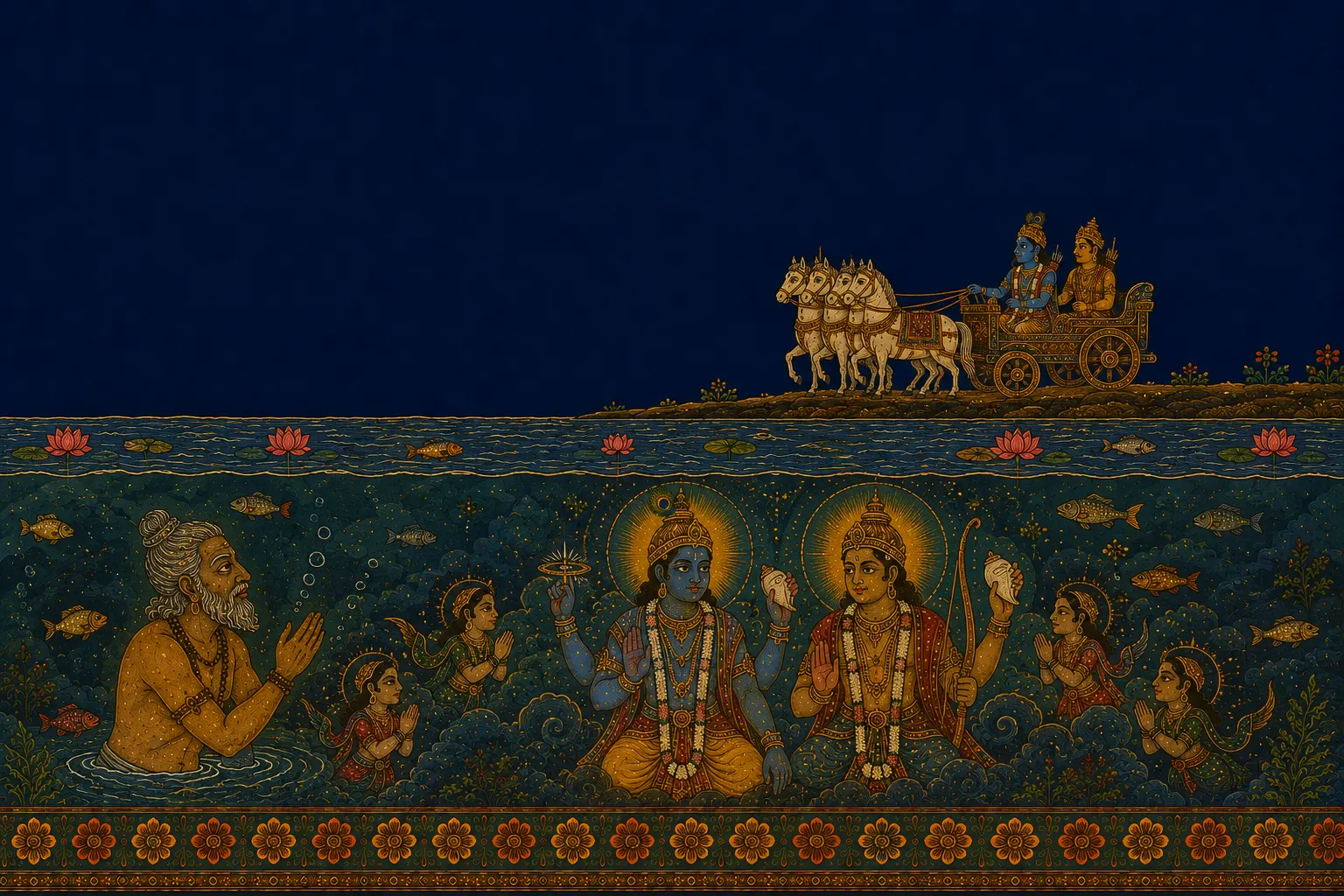
The Bhagavata's story says that under the water he saw the same two brothers he had left sitting on the chariot moments earlier — Krishna and Balarama. But there, below the water, Krishna had four arms, lay on the serpent Shesha, and the gods were worshipping him.
Akrura came up out of the water shaken. He looked back at the chariot — the two of them were sitting exactly as before, laughing, as though nothing had happened. In that moment the doubt left Akrura's mind about whom he was carrying. Whatever Kamsa had planned, Akrura now understood that these two were beyond his reach.
Vrindavan left behind
When the chariot moved, the whole village came after it — as though trying to hold on to the sound of the flute, and to the childhood that was ending with it.
One woman ran right up to the wheel. One came and stood in front of the chariot, blocking the road. One said nothing, only stood where she was, watching the chariot go far down the road.
The chariot did not stop. Krishna looked back and raised his hand — not a promise to return, only a goodbye. That moment marks the end of Krishna's childhood in Vrindavan. Everything after this belongs to Mathura, and in Mathura Krishna was never a child again.
Note: The bow-sacrifice excuse and the sending of Akrura are confirmed even down to the chapter titles in the current text of the Harivamsha. Akrura's experience in the Yamuna is found in the tenth skandha of the Bhagavata Purana, chapter thirty-nine; no such scene appears in the list of chapters covering this same journey in the Harivamsha, so it looks like the Bhagavata's own addition. Note that this conclusion rests on chapter titles, not the full text. The emotional detail of leaving Vrindavan behind is elaborated at great length in tradition and folk song, but it could not be confirmed here against any named chapter.
Source: from several texts, Akrura's chariot