Kanda 15

Dwarka

The sea had given the land, and one day it took it back

The decision to leave the city

Kalayavana was finished, but Jarasandha was not. He returned again and again, and each attack left Mathura more exhausted.

One day Krishna said, in front of his people, something no ruler says easily — "This city is not safe. We will have to leave it."

The senior Yadavas objected — Mathura was their ancestral home, their ancestors' city. But Krishna's argument was simple: "We are winning every battle, but the people who never fight are paying for every victory. That is not a victory."

Land asked of the sea

They went west, to India's western coast, where the land met the sea. There, near the shore, was a coastal site protected by the sea, but with too little land for an entire population.

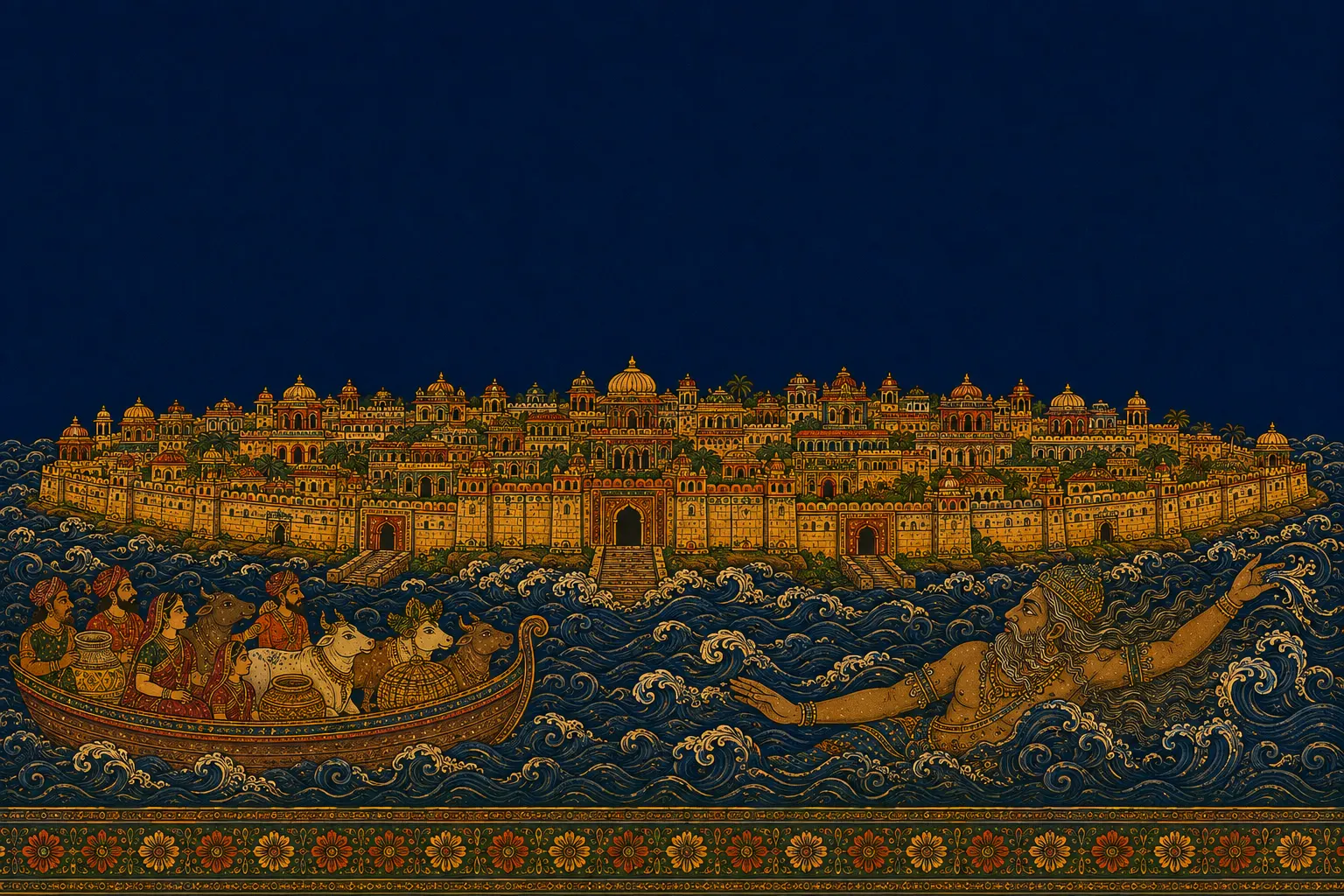
The story says Krishna asked the sea-god for land. "I need twelve yojanas, to settle my people."

And the sea drew back. The waters withdrew, revealing enough land for the new city.

Vishwakarma's city

On that land the city was built by Vishwakarma, the craftsman of the gods.

Palaces of gold, measured wide roads, gardens, assembly halls, and the sea water all around — a city you had to cross the sea to reach. It was named Dwarka, "the one with gates".

The whole Yadava population was moved there from Mathura — the elderly, the children and the families who could not fight, the cows, the household goods. And the next time Jarasandha reached Mathura with his army, he found an empty city. There was no one to fight.

And then the sea came back

This is not the end of the story — much was still to happen — but it is right to tell it here, because it is a mirror of the beginning.

Years later, when Krishna had left his body and the Yadava clan had destroyed itself in a fight among its own, the sea came forward again. The waves climbed Dwarka's streets, filled the palaces of gold, and the sea rose over Dwarka and swallowed the city.

The land the sea had once yielded, it finally reclaimed.

Note: Dwarka's being built by Vishwakarma, the land coming from the sea and the measure of twelve yojanas — this shape is found in the Mahabharata, the Harivamsha and the Vishnu Purana, and in the Skanda Purana too. The Vishnu Purana calls it a city of golden palaces. The city's ending — going under the sea after Krishna left his body — is found in the Bhagavata Purana. The exact chapter numbers for these episodes could not be confirmed for every text in this check, so the names of the texts are given above, not the chapters.

Source: from several texts, Dwarka

Now — how much stayed with you?

Why is that?

Why did Krishna decide to leave Mathura?

  • Because he had lost to Jarasandha
  • Because Mathura was running out of room
  • Because Ugrasena had thrown him out
  • Because the price of every attack was being paid by the city's ordinary people, and going on winning was not enough
Read the whole story — Victory, and its price

This is an unusual turn in the story — no king admits that his city is not safe.

Krishna's arithmetic is not about the fighting but about the people. What died in every siege were not soldiers but the people of the city.

In the previous kanda he had drawn Kalayavana out of the city. Here that same thinking grows larger and arrives at moving the whole city out.

Who am I?

I built that city — palaces of gold, wide roads, and water all around. Who am I?

  • Varuna
  • Akrura
  • Vishwakarma
  • Sandipani
Read the whole story — The craftsman of the gods

Tradition holds Vishwakarma to be the maker of those cities and buildings no ordinary craftsman could build.

Dwarka's being built by his hands is found in several texts — it is mentioned in the Mahabharata, the Harivamsha and the Vishnu Purana, and in the Skanda Purana too.

The Vishnu Purana calls it a city of golden palaces.

What happened?

Where did the land for building the city come from?

  • It was cleared out of forest
  • It was asked of the sea, and the sea drew back
  • It was taken from a neighbouring king
  • It was lying empty already
Read the whole story — Talking to the sea

In the story this happens not through any fight but through asking — and that detail is what makes this city's end so affecting later.

The land that came out, tradition puts at twelve yojanas.

This detail is not one text's alone; the same shape is found in several sources.

Fact

According to tradition, how much land came from the sea?

  • Four yojanas
  • Twelve yojanas
  • Eight yojanas
  • A hundred yojanas
Read the whole story — A measurement that gets repeated

A yojana is an ancient measure of distance, and its length has been taken differently at different times.

What matters in the detail is not the number but that the story gives a measurement at all — which is to say this is not an imagined place but a founded city.

Which is why Dwarka remains a subject of search and excavation even now.

What happened?

When Jarasandha next came to Mathura, what did he find?

  • Another battle
  • A proposal of treaty
  • An empty city
  • Krishna's army, standing ready
Read the whole story — A battle that never happened

This is the cleverest part of the kanda: Jarasandha was not defeated, he was made useless.

His whole power rested on one thing — a city that could be attacked again and again. That city moved away.

The same manner shows again and again in the Krishna-Leela: winning not by force but by changing the place.

Riddle

I gave a city its place, and I also took that same city into myself. What am I?

  • The Yamuna
  • Govardhan
  • The Ganga
  • The sea
Read the whole story — Beginning and end, both from water

This is the clearest circle in the story: the city begins with the sea drawing back, and ends with the sea moving forward.

The Bhagavata Purana says that after Krishna left his body that city went under the water.

Which is to say Dwarka's whole lifetime is bound between two waves.

What happened?

After Krishna left his body, what happened to Dwarka?

  • The sea moved forward and the city went under it
  • It was conquered by Jarasandha's descendants
  • It remained the capital
  • It was deserted and slowly fell into ruin
Read the whole story — Land given back

This ending is stated plainly in the Bhagavata Purana, and in terms of storytelling craft it is extremely tight.

The city did not lose to any army. Whatever had given it its place took that place back.

Which is why Dwarka holds a particular kind of place in Indian memory — built, settled, and then completely gone.

Put it in order

What is the correct order of this kanda?

  • The decision to leave Mathura → land from the sea → Vishwakarma's city → the people going → years later the sea returning
  • Vishwakarma building the city → asking the sea for land → leaving Mathura
  • The sea returning → the city being built → leaving Mathura
  • The people going → the decision to leave Mathura → land from the sea → the city being built
Read the whole story — Beginning with a decision

This kanda begins not with an attack or a miracle but with a decision — and that is what sets it apart from the others.

Everything else is a consequence of that decision: the land, the city, the migration, and at the end the ending already mentioned here.

A large part of the story will now pass in Dwarka — the Syamantaka jewel and Narakasura kandas both belong there.

Fact

Which texts is the story of Dwarka's founding found in?

  • Only the Bhagavata Purana
  • Only the Mahabharata
  • In several texts
  • In no ancient text
Read the whole story — One that several texts agree on

Many episodes of the Krishna-Leela stay confined to one or two texts. Dwarka is among those where several sources say the same thing.

Vishwakarma's building, land from the sea, and golden palaces — this shape is repeated in several places.

The exact chapter numbers could not be confirmed for every text in this check, so the names of the texts are given here, not the chapters.

Why is that?

Why was Dwarka founded in the middle of the sea, and not in some other safe place?

  • Because the water was a wall in itself
  • Because trade was good there
  • Because there was already a city there
  • Because Vishwakarma could only build there
Read the whole story — A wall that did not have to be built

Mathura's greatest weakness was exactly that any army could reach it directly.

A city set in the middle of the sea removes that problem at the root — an attacker has to deal with the water first.

And the story's irony is hidden right there: the very thing that was the city's greatest protection is what took it in the end.