Kanda 7

Govardhan

A boy told a whole village to stop worshipping Indra. Then the sky broke open

"What is this worship for?"

Every year, just before the monsoon, the same bustle swept through Gokul — the preparations for Indra's worship. Pots were scoured, grain was gathered, milk and ghee were set aside.

Krishna stopped Nanda in the middle of the preparations and asked — "Baba, who is all this for?"

"For Indra, Kanha. He sends the clouds, he brings the rain. Anger him and there will be famine."

"Clouds rain because that is their nature," said Krishna. "And our living comes from these cows, and from that hill — from Govardhan — which gives us grass, springs of water, firewood. What has Indra ever given us, that we should send him an offering every year?" Some of the cowherds laughed; others stopped to listen. Krishna did not let the question be brushed aside — "Worship should go to whoever actually feeds you. This time, worship Govardhan."

Facing the hill, with their backs to the sky

To everyone's surprise, the village agreed. Everything that had been made for Indra for years went to the foot of Govardhan — fifty-six kinds of food, rivers of milk, heaps of flowers.

And then a sight appeared that nobody could make sense of. The hill itself showed in a huge form, and with its own hands lifted that whole offering and ate it — "annam vai aham," I am this food.

And in front of that same hill Krishna stood in his ordinary cowherd's form, hands folded, head bowed. Without knowing it, Gokul had worshipped the god standing right in front of them.

The sky's answer

Above, in heaven, Indra was furious. A cowherd boy had stopped his centuries-old worship with a few words. He could not bear the insult.

He unleashed the Samvartaka clouds — the clouds made for the time of dissolution, when creation is to be drowned.

Lightning cracked so hard that day turned to night. The wind began to scream. And then the water came down — not in drops, but in sheets, as though the sky itself were breaking and falling. Cows ran bellowing in every direction, calves were washed away, the roofs came off the huts.

"Kanha!" an old man called in a shaking voice, over the roar of the rain. "What do we do now?"

The sky held up on a finger

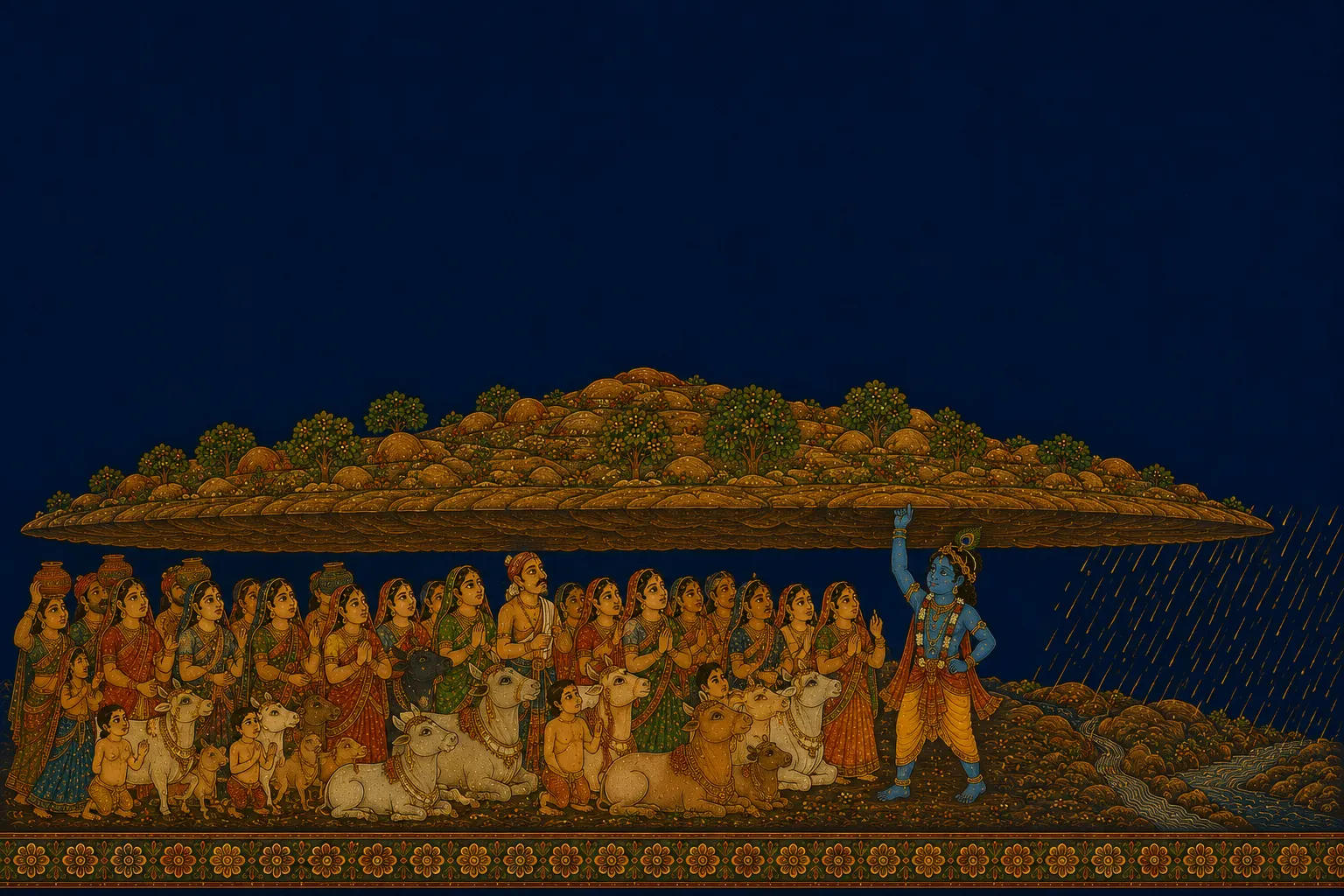
Krishna went quietly over to Govardhan. He bent down, slipped the little finger of his left hand beneath the hill, and lifted the whole of it — the way a man lifts an umbrella.

"Everyone, come underneath," was all he said. "Bring the cows too, and the carts."

The whole of Gokul gathered under that canopy — men, women, children, cows, calves, bullock carts, belongings. Above them the rain roared on, and below they all stood dry, looking up at Krishna's finger, which did not tremble once.

Seven days, seven nights it went on. On the seventh day Indra gave in. The rain stopped, the clouds cleared, and Indra himself came down on Airavata — to bow his head before the boy whose worship he thought he had stopped, and who alone was worthy of it.

Note: The Govardhan episode is firmly located at chapter level in the Bhagavata Purana (tenth skandha, chapters 24–25), and is also present by name in the critical edition of the Harivamsha. The core story is the same in both, but the Harivamsha does not make Indra's humiliation as harsh as the Bhagavata does — a real example of stories growing more dramatic over time.

Source: from several texts, Govardhan

Now — how much stayed with you?

Who said it?

"Clouds rain because that is their nature. Our real living was given by the cows and this hill, not by Indra." — who said this?

  • Balarama
  • Nanda
  • Krishna
  • Yashoda
Read the whole story — The argument for turning the worship around

In the tenth skandha of the Bhagavata Purana, chapter 24, Krishna asks the cowherds why Indra is worshipped, and reminds them that their living comes from Govardhan's pastures and their cows, not from Indra's favour.

His argument was direct — worship should go to whatever gives you your living. The cowherds heard it and agreed.

That suggestion became the root of Indra's anger and of the whole lifting of Govardhan.

Fact

Once Indra's worship was stopped, who was worshipped in his place?

  • Mount Govardhan
  • The river Yamuna
  • The kadamba tree
  • The sun
Read the whole story — Worshipped in his own presence

The Bhagavata Purana says Krishna took a huge form and, as Govardhan, ate the heap of food the cowherds had offered, while also standing there in an ordinary form and bowing to the hill.

The cowherds had no idea that the one they were worshipping was also standing among them.

This scene is part of a shape that returns again and again in the Krishna-Leela — God hides himself and stands among his devotees.

What happened?

Angered by the worship of Govardhan, what did Indra do?

  • He fought Krishna directly
  • He had Gokul set on fire
  • He loosed the Samvartaka clouds and made seven days of destroying rain
  • He poisoned the water of the Yamuna
Read the whole story — The clouds of dissolution

In chapter 25 of the Bhagavata Purana, Indra looses on Gokul the Samvartaka clouds, the ones made for the time of dissolution.

The rain was so terrible that animals, birds, children and the old all ran to take refuge with Krishna, because no other way was left.

That is the moment Krishna decides to lift Govardhan — protection was no longer a suggestion, it had become a necessity.

Fact

On which finger did Krishna lift Mount Govardhan?

  • The smallest finger of his left hand
  • The forefinger of his right hand
  • With both hands
  • On his shoulder
Read the whole story — A whole hill on one finger

In chapter 25 of the Bhagavata Purana the detail is explicit — Krishna lifted the entire hill on the smallest finger of his left hand, as though lifting a toy.

Underneath, all of Gokul — people, cows, bullock carts, calves — had taken shelter.

This image went on to become one of the most repeated images of Krishna in art and in temples — Krishna the holder of Govardhan.

Put it in order

Which is the correct order of these events?

  • Indra's apology → the suggestion of worshipping Govardhan → the rain → lifting the hill
  • The suggestion of worshipping Govardhan → Indra's anger → seven days of rain → lifting the hill and Indra's apology
  • The rain beginning → the suggestion of worshipping Govardhan → Indra's anger → lifting the hill
  • Lifting the hill → the rain → Indra's anger → the suggestion of worshipping Govardhan
Read the whole story — Seven days that began with one decision

The whole thing begins with an ordinary question — "why this worship?" — and arrives at seven days of dissolution.

The Bhagavata Purana tells it across two consecutive chapters (24 and 25), as though it happened in one breath.

At the end Indra himself anoints Krishna with the milk of his cow Kamadhenu and asks forgiveness — and tradition ties the name "Govinda" to this.

Who am I?

I am the king of the gods, lord of clouds and rain. A cowherd boy stopped my worship, and in anger I tried to drown all of Gokul. Who am I?

  • Yama
  • Agni
  • Varuna
  • Indra
Read the whole story — Indra, made humble by defeat

In the Bhagavata Purana this anger of Indra's is treated as an example of the gods' own arrogance — the moment his worship stops, he comes straight down to destruction.

For seven days Krishna stood unmoving and the hill did not waver in the least. Indra understood that what stood in front of him was no ordinary boy.

Admitting defeat he came to Krishna himself, anointed him with Kamadhenu's milk and asked forgiveness. The story ends here not in anger but in a settlement.

Why is that?

Why, in the end, did Indra come and ask forgiveness himself instead of continuing the fight?

  • Because his clouds had run out
  • Because Brahma intervened
  • Because the cowherds had come out to fight him
  • Because after seven days the hill had not wavered at all, and Indra realised this was no ordinary boy
Read the whole story — Defeat before an unmoving hill

According to the Bhagavata Purana, all of Indra's power came to nothing against the unbroken steadiness with which Krishna held the hill.

The Harivamsha's account does not make the humiliation as harsh as the Bhagavata does — there Indra's bending comes more easily and less shamefully, as though the god admits his mistake soon enough.

The core story is the same in both texts — Indra comes defeated — but this difference of tone is worth seeing.

What happened?

After the seven days of rain, what did Indra come and do?

  • He anointed Krishna with the milk of the cow Kamadhenu and asked forgiveness
  • He challenged Krishna to a fight
  • He cursed Mount Govardhan
  • He went back quietly without saying anything
Read the whole story — Turning a defeat into an honouring

According to the Bhagavata Purana, Indra came himself on Airavata, came down, and anointed Krishna with Kamadhenu's milk.

This was not only an apology — coming from the king of the gods, the act also amounted to recognising Krishna as the protector of the cows.

The tradition attached to this event is where Krishna comes to be called "Govinda" — the protector of cows.

Fact

Which chapters of the tenth skandha of the Bhagavata Purana is this whole episode in?

  • Chapters 5–6
  • Chapters 24 and 25
  • Chapters 43–44
  • Chapter 16
Read the whole story — Several great events in one tenth skandha

The tenth skandha of the Bhagavata Purana keeps Krishna's whole story in order, and the Govardhan episode comes at chapters 24–25 within it.

The taming of Kaliya has already come in chapter 16, and the killing of Kamsa is still ahead in chapters 43–44 — which is to say the journey from childhood to youth is recorded in consecutive chapters.

That order is also the thinking behind the kanda numbers on this site — the events move forward by age, even where the kanda numbers are joined up differently.

Why is that?

Both the Harivamsha and the Bhagavata have the Govardhan episode, but one difference is held to lie between them. What is it?

  • In the Harivamsha the hill is never lifted at all
  • In the Bhagavata the suggestion to worship Govardhan comes from Balarama
  • In the Bhagavata Indra never asks forgiveness
  • The Harivamsha does not make Indra's humiliation as harsh as the Bhagavata does
Read the whole story — One event, a different tone

This is one of those few places where two texts have the same story and yet are pitched differently.

The Bhagavata Purana shows Indra's arrogance and its breaking more dramatically — the anger larger, the rain more terrible, the defeat just as plain.

The Harivamsha's account keeps the same event somewhat softer — Indra's bending comes there less shamefully and more easily. Stories often grow more dramatic over time, and this is a good example of it.