
Kanda 14
Jarasandha and Ranchhod
He left the field and ran, and that running gave him one of his names
The same army, again
Kamsa was the son-in-law of Jarasandha, the king of Magadha — Kamsa had married two of Jarasandha's daughters. When Kamsa died, both widowed daughters came weeping to their father, and Jarasandha swore to wipe Mathura out.
Jarasandha marched on Mathura with a vast army. He was defeated and withdrew.
Then he came again. Again he was defeated. Again he withdrew. This was not one battle — it was a siege that kept returning. The army came, Mathura fought from inside its fort, the army drew back, and a few months later the dust clouds rose on the horizon again. This happened over and over, and each time the city broke a little more.
One more, from the other side
Meanwhile another threat came in from the west — Kalayavana, a mleccha king, with his great army. Narada had told him that a worthy opponent awaited him in Mathura.
Now Mathura was surrounded on two sides — in the east, Jarasandha preparing yet another campaign; in the west, Kalayavana.
And inside the fort were the elderly, the children and the families who could not fight. Every battle was being paid for by people who never carried a weapon.
A king who ran
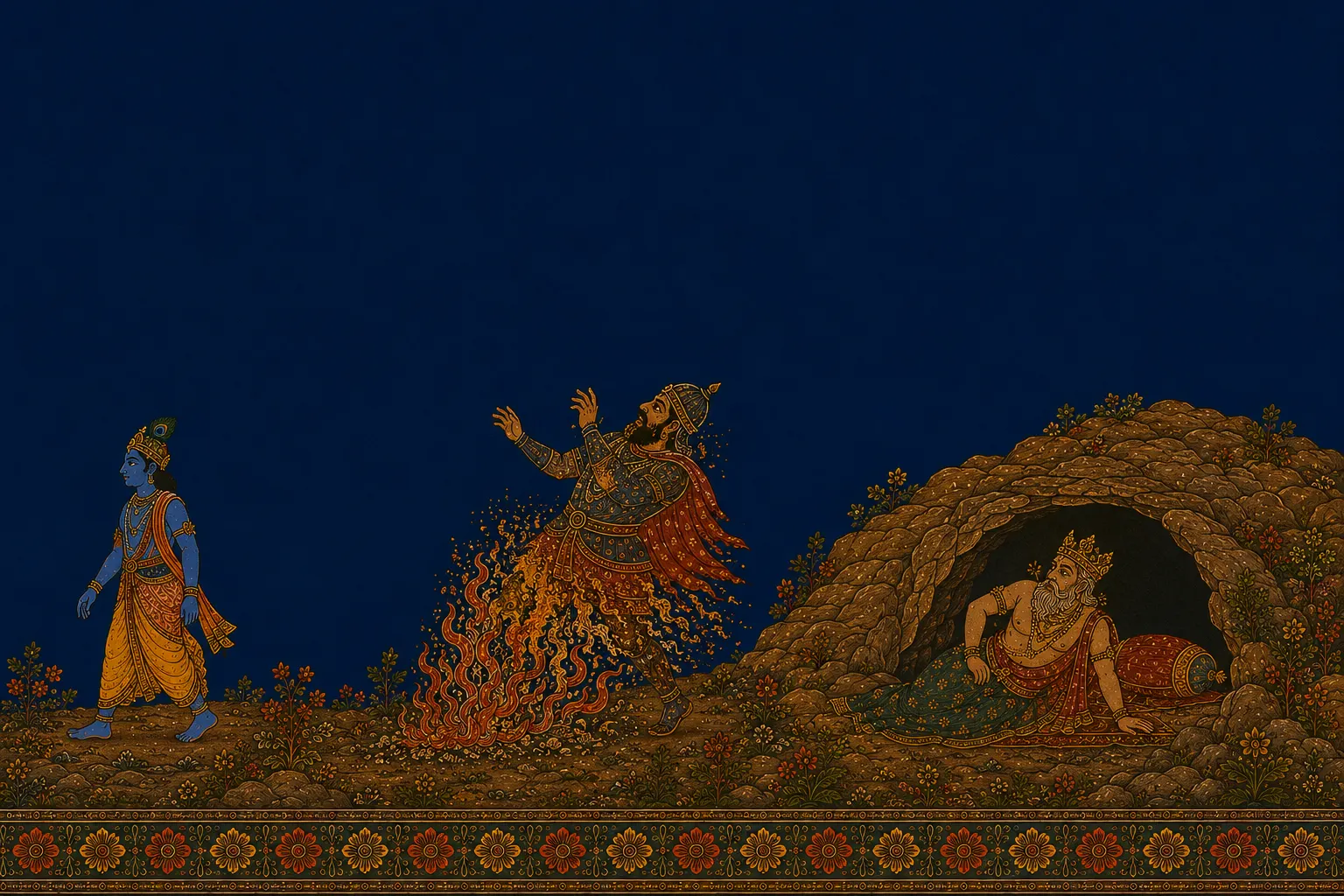
Kalayavana came right up to the fort looking for Krishna — alone, calling out. "Come out, Yadava."
And Krishna, without lifting a weapon, turned and ran — out of the fort, into the open ground, then towards the hills.
Kalayavana ran after him. Krishna stayed just far enough ahead to remain out of reach — now close, now a little further. Running like this, they went into a hill cave, and Kalayavana behind him, inside. Kalayavana was convinced Krishna was tiring and looking for somewhere to hide.
The man asleep in the cave
Inside the cave it was pitch dark. A man was sleeping on the ground, a sheet drawn up over his head. Krishna slipped past him and disappeared into the darkness.
Kalayavana took the sleeping man for Krishna — tired, his face hidden in a sheet. "Get up! Where will you run now?" He kicked him awake.
It was Muchukunda — a very old king, who had fought for the gods against the demons, and, worn out, had asked as a boon for a long, deep sleep, and that whoever woke him would be burned to ash by his first glance.
Muchukunda's eyes opened. He looked towards Kalayavana. In an instant, Kalayavana was reduced to ash.
Note: The Kalayavana episode is found in both the Vishnu Purana and the Harivamsha, and in the Bhagavata Purana it comes in the same section where the founding of Dwarka follows. The Muchukunda pattern — a sleeping king's boon, and whoever wakes him burning to ash — is told the same way across tradition. Two things need keeping clear. First: the count of Jarasandha's campaigns is given differently in different places (seventeen, or an eighteenth alongside Kalayavana), and it could not be confirmed against any original text in this check. Second: the name "Ranchhod" was not found in any ancient text in this check — it appears to be a name attached to temple traditions such as Dwarkadhish and Dakor, that is, a later comment on an old story, one that reads the running as strategic wisdom.
Source: from several texts, Jarasandha and Ranchhod