Kanda 5

Kaliya

At one bend of the Yamuna no birds flew and no animals drank — and one day a ball landed there

The river that had forgotten to breathe

There was one place in Gokul that everyone avoided. That bend of the Yamuna where flame-like steam came off the water, and on the bank stood a single dried-out kadamba — every other tree had withered and gone black.

Birds circled around it rather than fly overhead. Cows would low and back away before they even reached the water.

The old men of the village warned the children from a distance: "Don't go that way. Kaliya lives there — a serpent of a hundred hoods, who spits his venom into the Yamuna."

For years that bend of the Yamuna had remained like that — a stretch of river that seemed to have forgotten how to breathe.

The ball, and the foolishness only children can manage

One afternoon the cowherd boys were playing ball. Somebody hit it hard, the ball flew up, and landed exactly in that poisoned bend.

The game stopped. They looked at one another — nobody was going to fetch that ball.

"Don't, Kanha!" somebody shouted. But by then Krishna had climbed the kadamba. Standing on an upper branch he looked once at the boiling black water below, tightened his belt, and jumped.

The moment he entered the water, the pool erupted as though something had been plunged into a furnace. The whole pool came to the boil, bubbles burst up from the bottom, and then a huge hood rose, splitting the water.

The dance on the hoods

Kaliya wrapped Krishna tightly in his coils, all the way to the neck. The children on the bank screamed. One of them ran to the village.

Yashoda came running, Nanda behind her, and half of Gokul. Everyone saw the thing they had feared for years — the water boiling red and black, and Krishna nowhere in sight. Nanda took a step towards the water; Balarama held him back — "Wait. Nothing will happen to him."

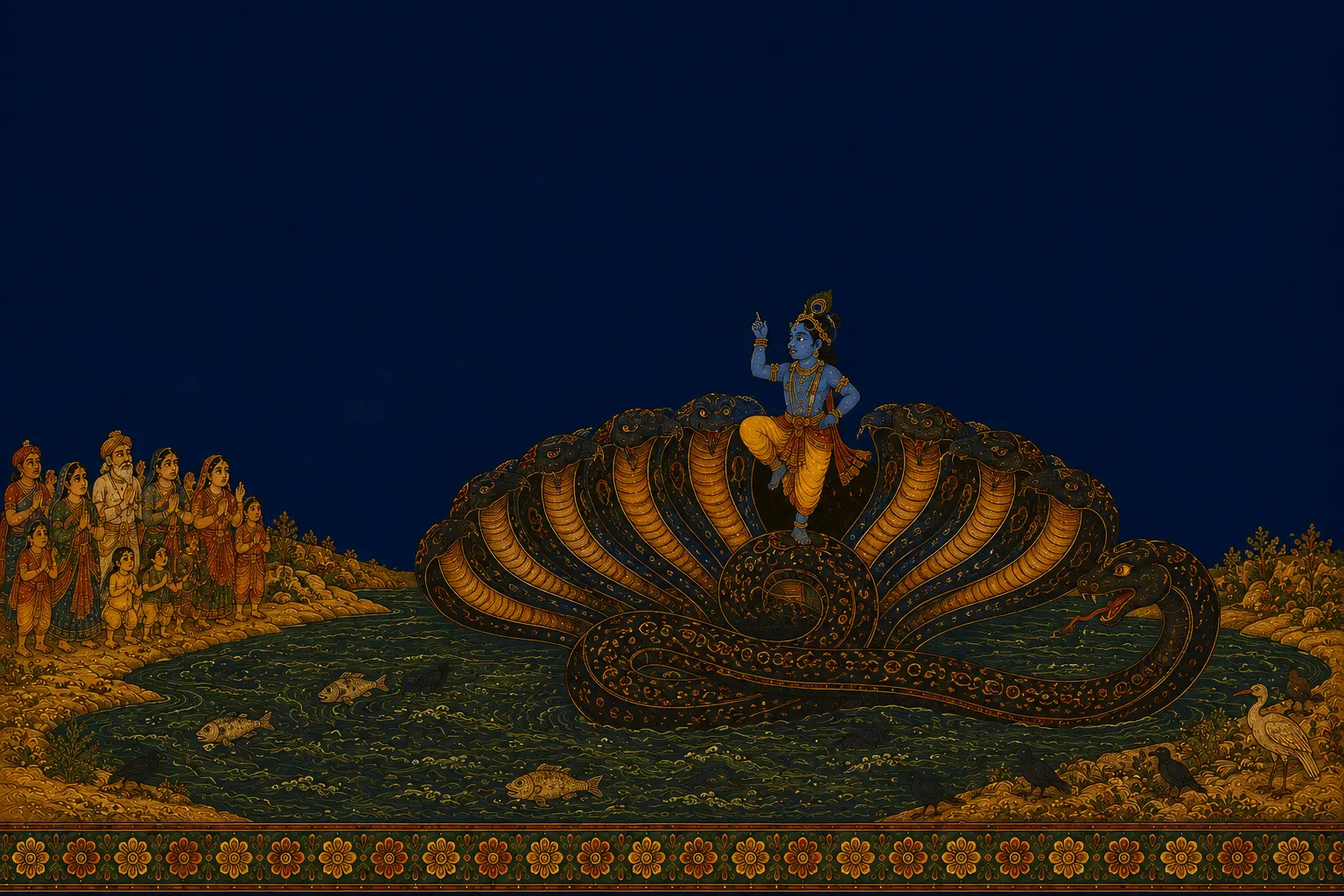
Then the water stirred. Krishna rose — but this time not in Kaliya's grip, on top of his highest hood.

And then he began to dance. Each step came down on another hood, forcing it lower until the serpent began to bleed. There were a hundred hoods, and Krishna danced across them one by one until every bit of the serpent's defiance was broken.

The one who was spared went, and in going was made safe

Then Kaliya's wives came up out of the water, hands folded. "Let him go, Lord. Venom is his nature — how much blame can he bear for being what he is?"

Krishna stopped. He did not kill Kaliya. He only gave an order: "Leave the Yamuna. Go back to the sea, to Ramanaka Island, where your home was."

He also gave Kaliya a promise: "The hoods marked by my feet will protect you. Garuda will not harm you." Kaliya had hidden in the Yamuna out of fear of Garuda; now the marks of Krishna's feet became his protection.

He went away crawling, his family with him — bearing the marks of his defeat as the very signs that would now protect him.

Note: The taming of Kaliya is firmly located at chapter level in the Bhagavata Purana (tenth skandha, chapter 16). The episode is also named in the table of contents of the critical edition of the Harivamsha (P. L. Vaidya, 1969–71), but its precise chapter number could not be found in this session — so all that is said here is that the episode exists in both texts, and no claim of equivalence is made.

Source: from several texts, Kaliya

Now — how much stayed with you?

Who am I?

In fear of Garuda I left my home and came to live in the Yamuna. Because of my poison one stretch of the river boiled without stopping. Who am I?

  • Shesha
  • Vasuki
  • Takshaka
  • Kaliya
Read the whole story — From Ramanaka island to the Yamuna

The whole story of Kaliya comes in the tenth skandha of the Bhagavata Purana, chapter 16.

Kaliya was afraid to face Garuda, so he went and hid in one pool of the Yamuna — where, because of some old curse, Garuda could not come.

His living there made that stretch of the Yamuna so poisonous that apart from one kadamba on the bank, no tree or plant survived.

Riddle

I jumped after a ball, went under poison, and when I came out my footprints were stamped forever on a snake's head. Who am I?

  • Krishna
  • Balarama
  • Arjuna
  • Nanda
Read the whole story — A mark that became protection

After the taming of Kaliya, Krishna promised that the serpent whose head carried his footprints would never be touched by Garuda again.

That same mark saved Kaliya's life and recorded his shame forever.

The Bhagavata Purana treats this as an example of Krishna's way with punishment — the punishment came, but not death; and protection came attached to the punishment.

Fact

Which skandha of the Bhagavata Purana has the taming of Kaliya?

  • The eleventh
  • The first
  • The ninth
  • The tenth
Read the whole story — The tenth skandha, Krishna's home

Of the Bhagavata Purana's twelve skandhas the tenth is the largest — around ninety chapters, four thousand verses — and it is the main home of the Krishna-Leela.

The butter-stealing, the taming of Kaliya, Govardhan, the killing of Kamsa — they all come one after another in this one skandha, moving from childhood towards youth.

Which is why, when somebody says "Krishna's story in the Bhagavata", they usually mean this tenth skandha.

What happened?

After Krishna climbed onto Kaliya's hoods and danced, what did Kaliya's wives do?

  • They abandoned Kaliya and fled
  • They came forward with folded hands and asked forgiveness
  • They attacked Krishna
  • They did nothing, and watched from a distance
Read the whole story — The wives' plea

According to the Bhagavata Purana, when Kaliya was bleeding and almost out of breath, his wives came out of the water and stood before Krishna.

They said Kaliya had spread poison only according to his own nature — that it was less his fault than his make — and they asked for mercy.

Krishna accepted it. That is the turn where punishment becomes compassion — Kaliya did not die, he was exiled.

Put it in order

Which is the correct order of these events?

  • Krishna jumping → the wives' plea → the ball falling → the dance on the hoods
  • The dance on the hoods → the ball falling → the wives' plea → the exile
  • The exile → the ball falling → the dance on the hoods → the wives' plea
  • The ball falling → Krishna jumping → the dance on the hoods → the wives' plea and the exile
Read the whole story — A whole story in one afternoon

According to the Bhagavata Purana the whole thing happens in a single day — beginning with a ball game and ending in exile.

Hearing the cowherd boys and the cows on the bank, Nanda and the gopis come running too, thinking Krishna has drowned.

By the time they arrive Krishna is already dancing on Kaliya's hood — and fear turns into something like a fair.

Why is that?

Why did Krishna not kill Kaliya, when he had beaten him so badly?

  • Because Kaliya's wives asked forgiveness, and Kaliya too gave in and took refuge
  • Because Kaliya was very strong
  • Because Garuda stopped him
  • Because the Yamuna's water had already run clean again
Read the whole story — Compassion that turned into exile

In the Bhagavata Purana this episode is not only a story of prowess, it is also a story about the difference between punishment and mercy.

Kaliya defended his own nature, his wives pleaded — and Krishna accepted that the punishment had been given and death was no longer needed.

So Kaliya was told to leave the Yamuna and go to Ramanaka island in the sea, and his life was spared.

Fact

After exiling Kaliya, where did Krishna tell him to go and live?

  • Back to Ramanaka island, out towards the sea
  • In the Ganga
  • In the Himalayas
  • In Patala
Read the whole story — Going home, with one condition

Krishna told Kaliya that the Yamuna would no longer be his place — he would have to return to the sea and live on Ramanaka island.

And he gave his word that the footprints on his hood would now protect him from Garuda.

The Bhagavata Purana ties this to the Yamuna's water running clean again — the moment Kaliya goes, the river becomes fit to live in and the birds come back.

Who am I?

When my son jumped into the poisoned water, I and everyone else stood on the bank weeping and screaming, thinking he had drowned. Who am I?

  • Devaki
  • Rohini
  • Yashoda (along with Nanda and the gopis)
  • Radha
Read the whole story — The uproar on the bank

The Bhagavata Purana says that when the cowherd boys, out looking for the ball, came running to Nanda and told him Krishna had jumped into the poisoned water, all of Gokul ran there.

Yashoda was close to losing consciousness. Some of the gopis were ready to go into the water themselves.

The uproar only stopped when Krishna came up dancing on Kaliya's hood — fear turned into a fair.

Fact

What is true about the critical edition of the Harivamsha?

  • It is only another name for the Garga Samhita
  • It too has a named episode of "the dance on Kaliya's hoods", but the precise chapter number could not be found in this session
  • It is longer than the Bhagavata Purana
  • It does not have the story of Kaliya at all
Read the whole story — Two texts, one story, different lengths

The table of contents of the critical edition of the Harivamsha, edited by P. L. Vaidya (1969–71), has the dance on Kaliya's hoods named in it.

But that table of contents does not tell you what chapter number the story sits at, or whether it is told at the Bhagavata's length or more briefly.

So honestly only this much can be said here: the episode is in both texts, but a fair comparison needs a deeper check.

Why is that?

Why could Garuda not come to the pool in the Yamuna where Kaliya was hiding?

  • Because Krishna had stopped him
  • Because on account of some old curse Garuda could not enter that particular pool
  • Because Garuda cannot fly over water
  • Because the Yamuna is a sacred river
Read the whole story — A hiding place that became a trap

According to the Bhagavata Purana, Kaliya chose that pool of the Yamuna because a curse kept Garuda out of it — the enemy of serpents was helpless there.

That same protection became his trap — he grew so easy that he went on poisoning the river, without thinking that somebody else might come there who was worth fearing as much as Garuda.

Krishna's arrival showed exactly that — safety is never safety from one danger only.