
Kanda 1
Kamsa and the voice from the sky
A man was told not the date of his death, but its condition
A brother driving the chariot
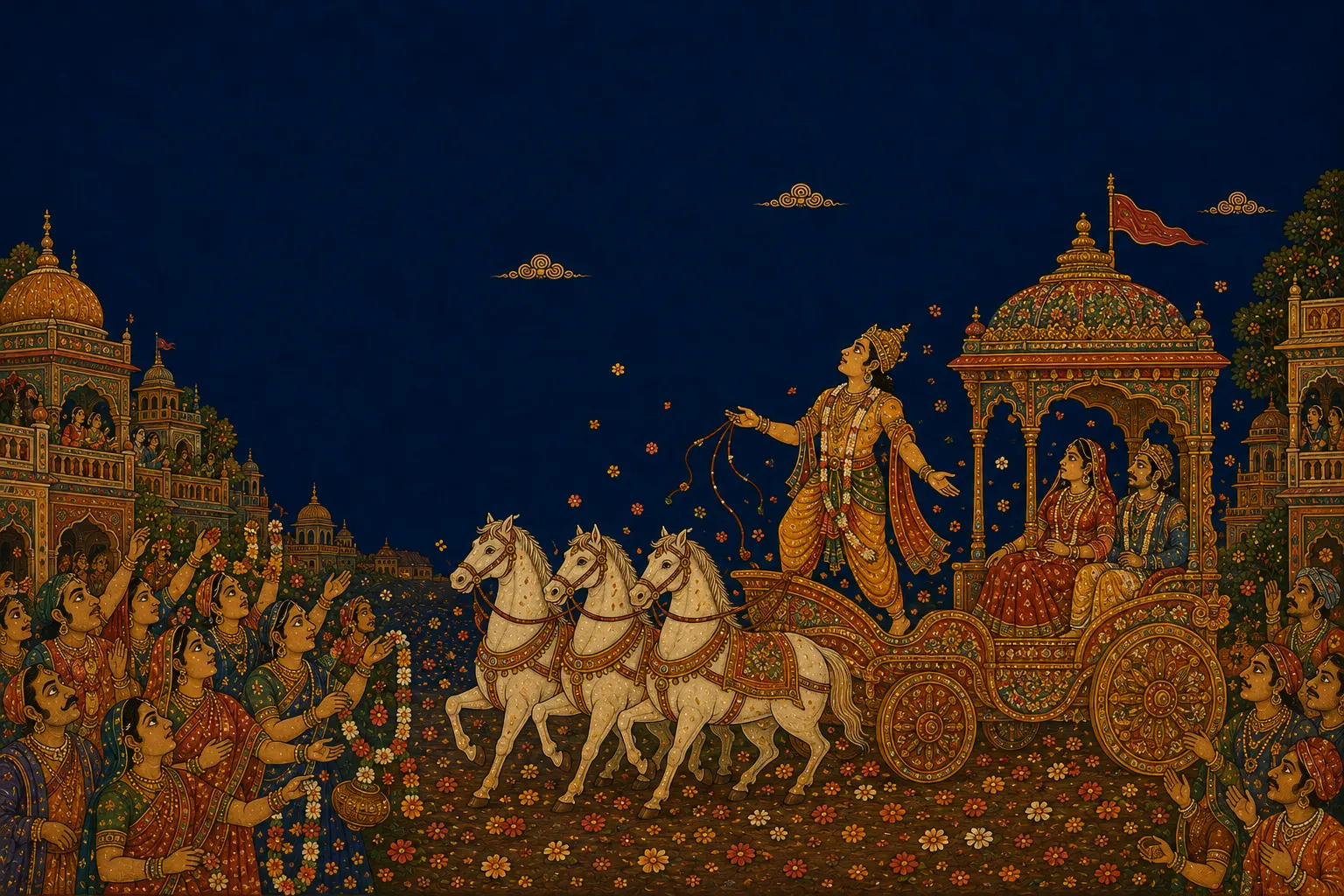
Mathura was covered in flowers that day. Devaki had been married to Vasudeva, and Kamsa himself was driving the chariot that carried his sister away to her new home — the reins in his own hands, happy to play the affectionate brother. People leaned down from the rooftops to watch. Flowers were being crushed under the wheels, and their scent filled the air.
Devaki was laughing. Every so often Kamsa would turn and say something to her, and she would laugh harder.
Then a voice came from the sky — deep and bodiless — and the entire crowd fell silent.
"Fool! The eighth son of the very girl whose chariot you are driving with such delight will be your end."
The reins slipped out of Kamsa's hands. The horses stopped on their own.
A sword, and a bargain
The next moment he jumped down from the chariot. He grabbed his sister by the hair with one hand and drew his sword with the other. His reasoning was brutally simple: if Devaki died, there could be no eighth son.
Devaki's scream stuck in her throat. The wedding party froze; nobody had the courage to step forward.
Vasudeva stepped in between. He did not plead or beg for mercy. He offered Kamsa a bargain.
"The danger to you is not from Devaki, Kamsa — it is from her sons. So I will give you the sons. Every child, the moment it is born, I will carry from my own hands into yours. That is my word."
Kamsa stopped. For Kamsa, it was convenient: the threat could be dealt with without the stain of murdering his own sister. He lowered the sword.
Before long Vasudeva and Devaki were put in prison, and every child Vasudeva had to carry from there into Kamsa's hands.
Six times, the same door
The first son was born. Vasudeva kept his word — lifted the newborn, walked the length of the prison corridor to Kamsa's chamber, and placed the child in his hands. Kamsa killed him there.
Then the second. Then the third.
Every time it was the same. The same door opened, the same tired steps echoed in the corridor, and behind the returning Vasudeva the same silence stayed. Devaki lay with her face to the wall.
Six sons died that way. Each time Kamsa grew a little more at ease.
The seventh, which went somewhere else
Then Devaki became pregnant for the seventh time — and word soon spread from the prison that the pregnancy had been lost.
Kamsa breathed easy. But the truth was something else. The child had been mysteriously transferred to Rohini in Gokul, Vasudeva's other wife, who lived there in Nanda's village. That child came to be called Balarama — Krishna's elder brother.
Now only the eighth birth remained. Kamsa doubled the guard, had Devaki's chains tightened further, and began keeping the count himself — as though a firm grip on the number could hold death off.
Note: The scene with the voice from the sky is found in the Vishnu Purana (fifth amsha) and the Bhagavata Purana (tenth skandha) — with Kamsa driving the bridal chariot himself. The current text of the Harivamsha begins differently: there Narada comes and tells Kamsa to his face, and there is no mention of a voice from the sky in that chapter. There is a difference in the count of the murdered children too — the Bhagavata and the Vishnu Purana say six, the vulgate text of the Harivamsha seven. Both are recorded here, and neither declared "the right one". (The Harivamsha text that is easily found is the vulgate; it may differ from BORI's critical edition.)
Source: from several texts, Kamsa and the voice from the sky