Kanda 11

The killing of Kamsa

An uncle invited his nephews to watch a wrestling match — knowing the invitation would be his death

An invitation that was a trap

Kamsa had lived with the prophecy for years. The boy who had come through Putana, through Kaliya, through Indra's deluge, was the one destined to bring about his death. The astrologers said so, his fear said so.

Instead of retreating, Kamsa decided to strike first.

"Make the bow-sacrifice the excuse," he told Akrura. "Call them to Mathura. The elephant at the gate will do the work the moment they enter. If they get past that, Chanura and Mushtika are in the arena. And if all of that fails, there is me." Akrura bowed his head in assent, but his mind was elsewhere.

What he saw on the road changed his mind

Crossing the Yamuna, Akrura looked down into the water, and caught the glimpse of an endless form lying on the serpent Shesha — that same boy, and at the same time something that was not a boy.

His hands shook. Whatever confidence Akrura had in Kamsa's plan disappeared — How could anyone lead such a being into a trap?

The moment they entered the streets of Mathura a hunchbacked servant woman came forward with a bowl of sandal paste. "Master, put this on." Krishna lifted her chin lightly, and she stood up straight, and her bent body straightened. Akrura stood and stared.

The bow that broke, the challenge that rang out

In the sacrificial hall the bow was kept under heavy guard. It was said that no ordinary man could even lift it.

Krishna lifted it with one hand, bent it to string it — and it broke through the middle. The sound was so loud that the whole city heard it, and Kamsa, hearing it in his palace, jumped up.

By the next morning the arena was full — drums, a screaming crowd, dust, and Kamsa on the platform with his fists clenched. When the two brothers came in, he shouted — "Chanura! Mushtika! Begin."

The last move on the platform

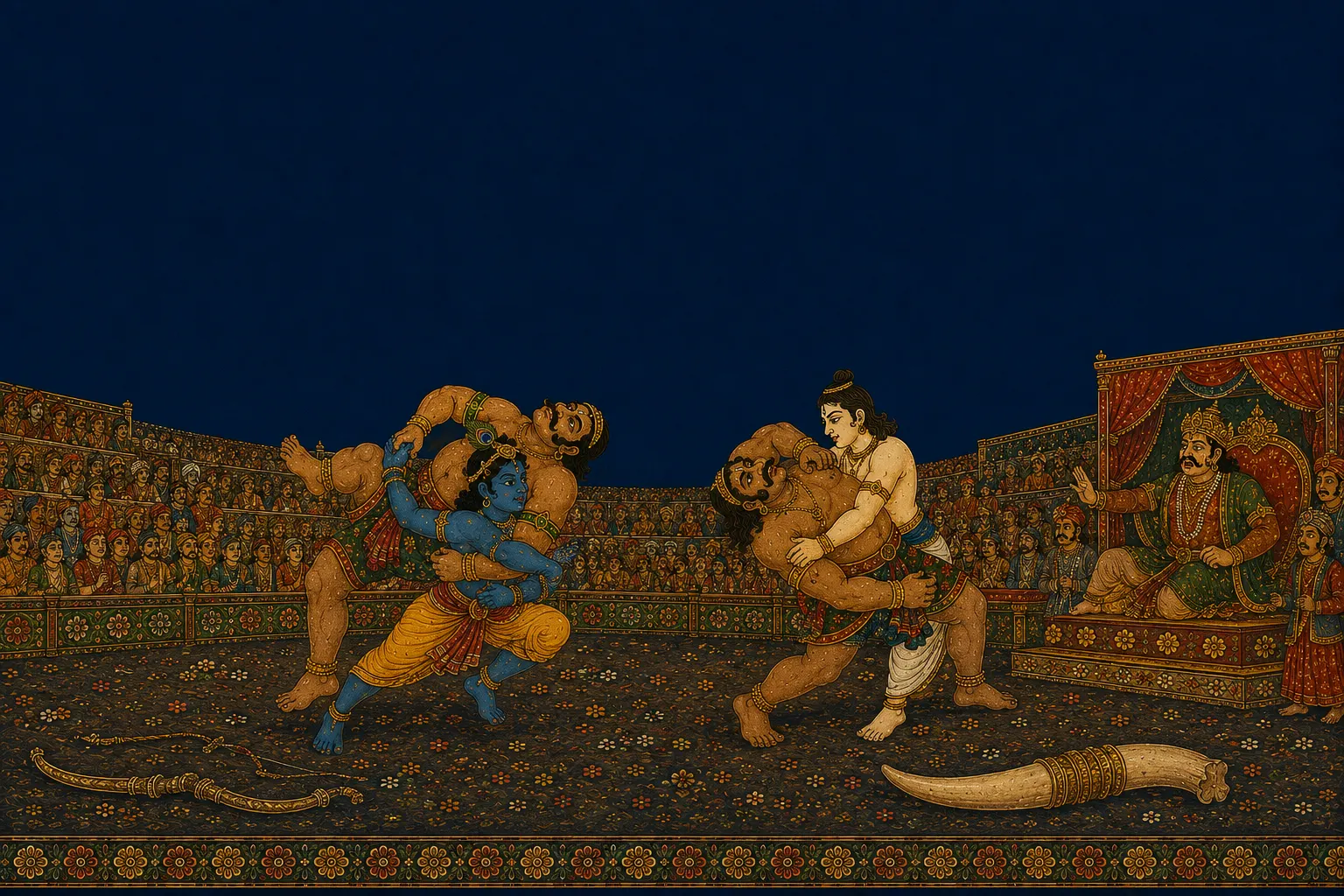
Chanura took on Krishna, Mushtika took on Balarama. Dust flew, the crowd watched holding its breath. Within moments, both wrestlers lay motionless on the ground.

Kamsa stood up. He ordered more wrestlers sent in, then elephants, then soldiers — and when none of it worked, he drew his own sword and screamed from the platform for the two to be seized.

But it was too late. Krishna climbed the platform in one leap, Kamsa's crown fell, his hair came into Krishna's fist — and with one pull the tyrant went down into the sand of the arena. The arena Kamsa had prepared as Krishna's death trap became the place of his own death. Then Krishna brought his aged father Ugrasena out of prison and set him back on the throne.

Note: The killing of Kamsa is firmly located at chapter level in the Bhagavata Purana (tenth skandha, chapters 43–44), and in the Harivamsha (vulgate edition) the whole chain from Akrura's arrival to the killing of Kamsa is found in named chapters. But the precise chapter numbers in P. L. Vaidya's critical edition, and the fine differences of staging between the two texts, could not be firmly checked in this session — so all that is said here is that the episode exists in both of the great texts.

Source: from several texts, The killing of Kamsa

Now — how much stayed with you?

Who am I?

Kamsa sent me to bring Krishna and Balarama to Mathura by deceit. On the way, in the waters of the Yamuna, I caught a glimpse of Krishna's vast form. Who am I?

  • Vasudeva
  • Akrura
  • Uddhava
  • Narada
Read the whole story — Akrura's divided mind

Akrura was a minister loyal to Kamsa, but inwardly also a great devotee of Krishna. The Bhagavata Purana shows this division openly.

Crossing the Yamuna he looked into the water and glimpsed Krishna's endless form — an image like Vishnu lying on Shesha.

That sight convinced him that the one he was carrying to Mathura was no ordinary cowherd boy.

Riddle

I was hunchbacked, and I sold sandal paste. One touch and I stood up straight. Who am I?

  • Manthara
  • Putana
  • Kubja
  • Shurpanakha
Read the whole story — Kubja, and one touch

According to the Bhagavata Purana, Kubja was Kamsa's servant, who prepared sandal paste for the king. As Krishna and Balarama entered Mathura she saw them and offered them the paste.

In return Krishna lightly touched her chin and lifted it, and her bent back straightened — she became an ordinary beautiful woman.

This small episode shows that Krishna's grace reaches the ordinary people met on the road before it ever gets inside the court.

Fact

Which two wrestlers did Kamsa send into the ring to kill Krishna and Balarama?

  • Jarasandha and Shishupala
  • Khara and Dushana
  • Kalayavana and Narakasura
  • Chanura and Mushtika
Read the whole story — The stage of the wrestling match

This whole wrestling match is described in the tenth skandha of the Bhagavata Purana, chapters 43–44.

Kamsa had thought that a death at the wrestlers' hands would look like an accident, and no charge would fall directly on the king.

But Krishna beat Chanura, and Balarama Mushtika, so easily that the whole assembly was stunned — and Kamsa's move stood exposed right there.

What happened?

What did Krishna do with the bow Kamsa had kept in the sacrificial hall?

  • He lifted it and broke it through the middle
  • He lifted it and put it back
  • He handed it back in front of Kamsa without touching it
  • He shot an arrow at Kamsa with it
Read the whole story — A bow that became a challenge

According to the Bhagavata Purana, Kamsa had that bow kept there deliberately, believing no ordinary person could even touch it.

Krishna lifted it as he came in, tried to string it, and it broke through the middle on its own — the sound so loud that it rang through the whole city.

For Kamsa this was the first clear sign that his plan was about to come apart.

Put it in order

Which is the correct order of these events?

  • The killing of Kamsa → breaking the bow → meeting Kubja → Akrura's arrival
  • Akrura's arrival → meeting Kubja → breaking the bow → the killing of Kamsa
  • Meeting Kubja → the killing of Kamsa → Akrura's arrival → breaking the bow
  • Breaking the bow → Akrura's arrival → meeting Kubja → the killing of Kamsa
Read the whole story — From the invitation to the killing

The Bhagavata Purana keeps this whole journey in a straight line — Akrura's coming, the glimpse in the Yamuna, Kubja standing straight, the bow breaking, the wrestling, and at the end the killing of Kamsa.

Every stage was one more warning for Kamsa, but he stayed fixed on his plan, believing the wrestlers would do what even the gods could not.

In the end exactly what he had feared for years came about — every attempt to escape the prophecy carried him closer to it.

Who am I?

I was the king of Mathura, and I feared my own sister's son, because a voice from the sky had said he would be the cause of my death. Who am I?

  • Vasudeva
  • Ugrasena
  • Kamsa
  • Jarasandha
Read the whole story — The fear that built all of it

Kamsa had imprisoned his own father Ugrasena and seized the throne, and at his sister Devaki's wedding he heard a voice from the sky — her eighth child would kill him.

In that fear he killed several of Devaki's children. It was to save Krishna that he was carried across the Yamuna to Vrindavan overnight.

Years later that same child came back to Mathura grown, exactly as the prophecy had said — and it was Kamsa himself who sent the invitation, calling his own death with his own hands.

Why is that?

Why did Kamsa call Krishna to Mathura, knowing he would be the cause of his death?

  • Because the voice from the sky had told him to call him
  • Because Devaki had begged him to
  • Because he wanted to make friends with Krishna
  • Because he wanted Krishna and Balarama killed by deceit, under cover of the bow-sacrifice and the wrestling
Read the whole story — A trap that turned around

According to the Bhagavata Purana, Kamsa thought that calling them into the open and finishing the work through "accidents" like wrestling and a bow was the safest road.

He expected the wrestlers Chanura and Mushtika and that huge bow to be enough, without his having to dirty his own hands.

But every trap turned around — the bow broke, the wrestlers died, and in the end Kamsa had to come down onto the platform himself, exactly where he had wanted not to be.

Fact

After killing Kamsa, whom did Krishna give the throne of Mathura to?

  • He sat on it himself
  • Vasudeva
  • Akrura
  • Ugrasena
Read the whole story — A throne given back

Both the Bhagavata Purana and the Harivamsha have the detail that after killing Kamsa, Krishna did not take power himself but restored the old, lawful king Ugrasena.

Ugrasena had been imprisoned by his own son Kamsa, and Mathura had lived under Kamsa's tyranny for years.

This decision shows something that repeats again and again in the Krishna-Leela — Krishna wins power, and does not keep it.

Fact

What is true about the killing of Kamsa in the Harivamsha?

  • In the Harivamsha it is Balarama, not Krishna, who kills Kamsa
  • The episode is simply not in the Harivamsha
  • The story is in both texts, but in this session the precise chapter number in the critical edition of the Harivamsha, and the fine differences of staging, could not be firmly checked
  • In the Harivamsha it is Akrura, not Ugrasena, who becomes king
Read the whole story — A central event, in both texts

The killing of Kamsa is the most central event of the Krishna-Leela, so it is found, as one would expect, in both of the great texts — the Harivamsha and the Bhagavata.

In the Harivamsha (vulgate edition) chapters are found by name for the sending of Akrura, the journey to the Yamuna, the wrestling and the killing of Kamsa.

But which chapter numbers this same material sits at in P. L. Vaidya's critical edition, and how far the staging differs from the Bhagavata's — this could not be firmly checked in this session, so no claim is made here.

Who am I?

I was Kamsa's old father, imprisoned by my own son. The moment Kamsa died I was given the throne again. Who am I?

  • Ugrasena
  • Jarasandha
  • Akrura
  • Vasudeva
Read the whole story — The king who was given back

Ugrasena's imprisonment was the foundation of Kamsa's whole power — while the father stayed a prisoner, the son's throne stayed safe.

The moment Kamsa died, the first thing Krishna did was exactly this — take Ugrasena out of prison and seat him on the throne.

This small decision shows that killing Kamsa was not only revenge, it was also the restoring of justice.