
Kanda 4
Butter, and the universe in a mouth
Every gopi in Gokul had the same complaint, and the same culprit
Uproar in the lane of the curd-sellers
It was not even six in the morning, and the third complaint of the week had already arrived at Yashoda's door. A gopi, a broken pot in one hand, the other fist planted on her hip.
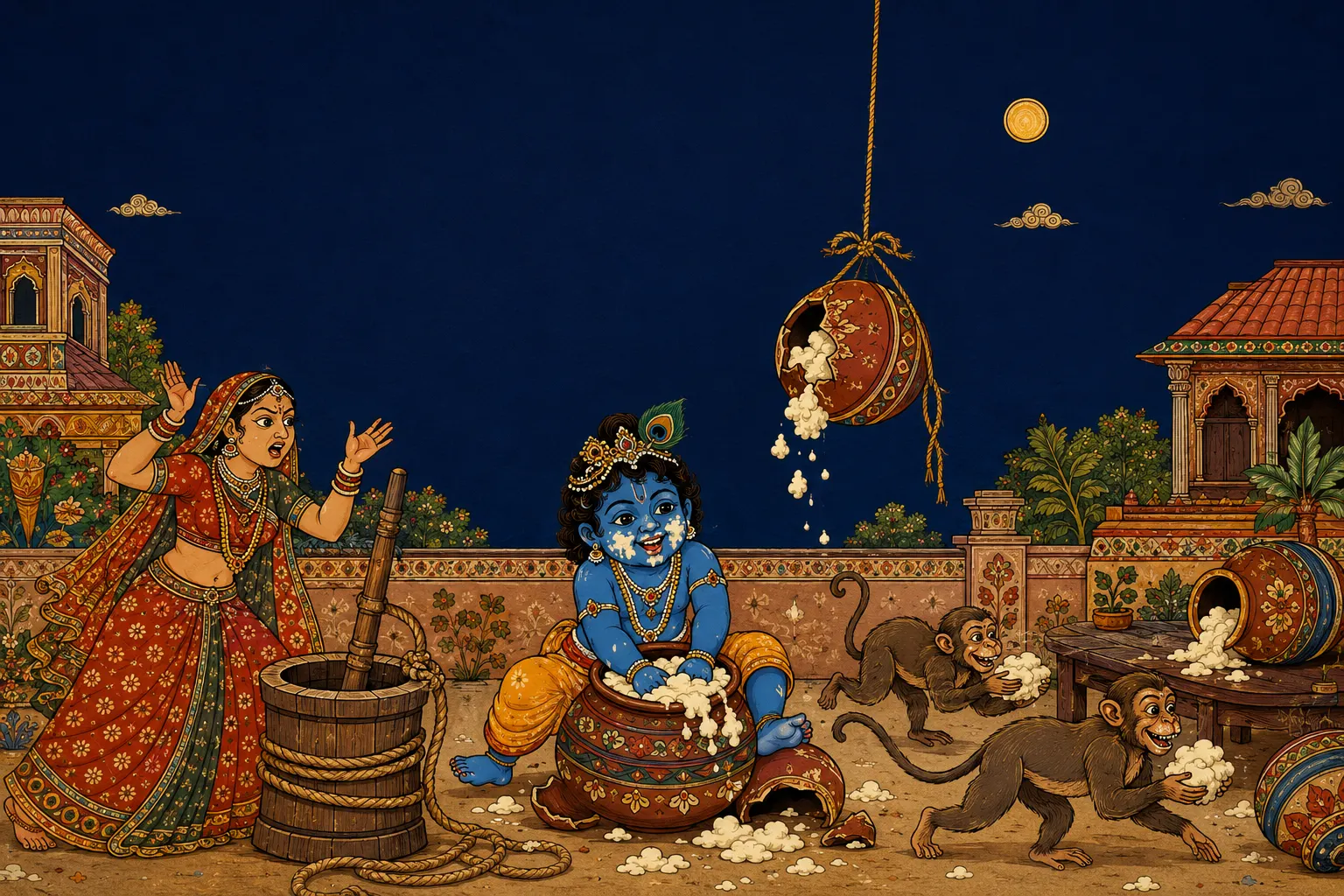
"Yashoda! Your boy got all the way up to the pot on the roof — and I had hung it high, on a full length of rope! Broke it, took the butter, handed it round to the monkeys, and by the time I came there wasn't a drop left."
Yashoda put a hand to her forehead. Krishna peeped out from behind her — cheeks full, a white smear on his chin, and no regret in his eyes.
"I didn't eat anything, Ma," he said. There was so much butter in his mouth that not even half the words came out clearly. The gopi burst out laughing, and the complaint ended there.
The universe in a mouth
The next day Balarama came running, thrilled to be the one with the news: "Ma! Kanha ate mud!"
Yashoda took him by the ear and made him open his mouth, the scolding ready on her lips — "This is too much now, Kanha."
And the moment she looked inside, the scolding stuck in her throat. There was no darkness in that mouth. There was the sun, the moon, a sky full of stars; there were mountains, oceans, rivers — and in that same view, in one corner, Yashoda herself, standing, looking into Kanha's mouth.
Yashoda's hands began to shake, her vision blurred. Then with a jolt everything was ordinary again — only a child with mud on his cheek, smiling up at his mother. And Yashoda forgot what she had seen.
Damodara — the rope that was never long enough
One afternoon the theft was caught red-handed. This time Yashoda came with a rope — "Today, I am tying you up, and that is that."
She wound the rope round his waist, but when she went to knot it, it fell two fingers short. She joined another rope to it. Still two fingers short. A third, a fourth.
Yashoda's forehead was wet with sweat, her bangles kept jingling, the end of her sari slipped off her shoulder — and every time the rope was short by exactly the same two fingers, as though someone were playing games with the measure.
In the end the child gave in to his tired mother — or rather, he chose to be bound. This time, the knot held. And that is where the name came from: Damodara — the one whose belly is bound with rope.
Yamalarjuna — two trees that were waiting to fall
Still tied, Krishna went out of the courtyard dragging the mortar behind him. At the edge of the courtyard stood two huge arjuna trees, close together.
The mortar caught between the two of them. Krishna paused a moment, then pulled forward with all his strength.
Both trees came up by the roots and crashed down. A cloud of dust rose, and when it settled two shining men stood there with folded hands — Nalakubara and Manigriva, the sons of Kubera, whom Narada had once cursed, for their arrogance, to live as trees, with this promise attached: that one day Krishna would free them.
They bowed and left. And it was the third sign to Gokul that day — this child is not merely mischievous.
Note: This whole detailed account of the Damodara binding and the butter-stealing is found in the Bhagavata Purana (tenth skandha, chapter 9). The freeing of the Yamalarjuna trees is also named in the table of contents of the critical edition of the Harivamsha, but the butter-stealing and the mortar-binding were not found named at that length in the Harivamsha — it appears to be the Bhagavata's own manner, and this could not be confirmed against a precise Harivamsha chapter number in this session.
Source: from several texts, Butter, and the universe in a mouth