Kanda 10

Mathura

Entering the city they met three people, and all three were treated differently

Three people on the road

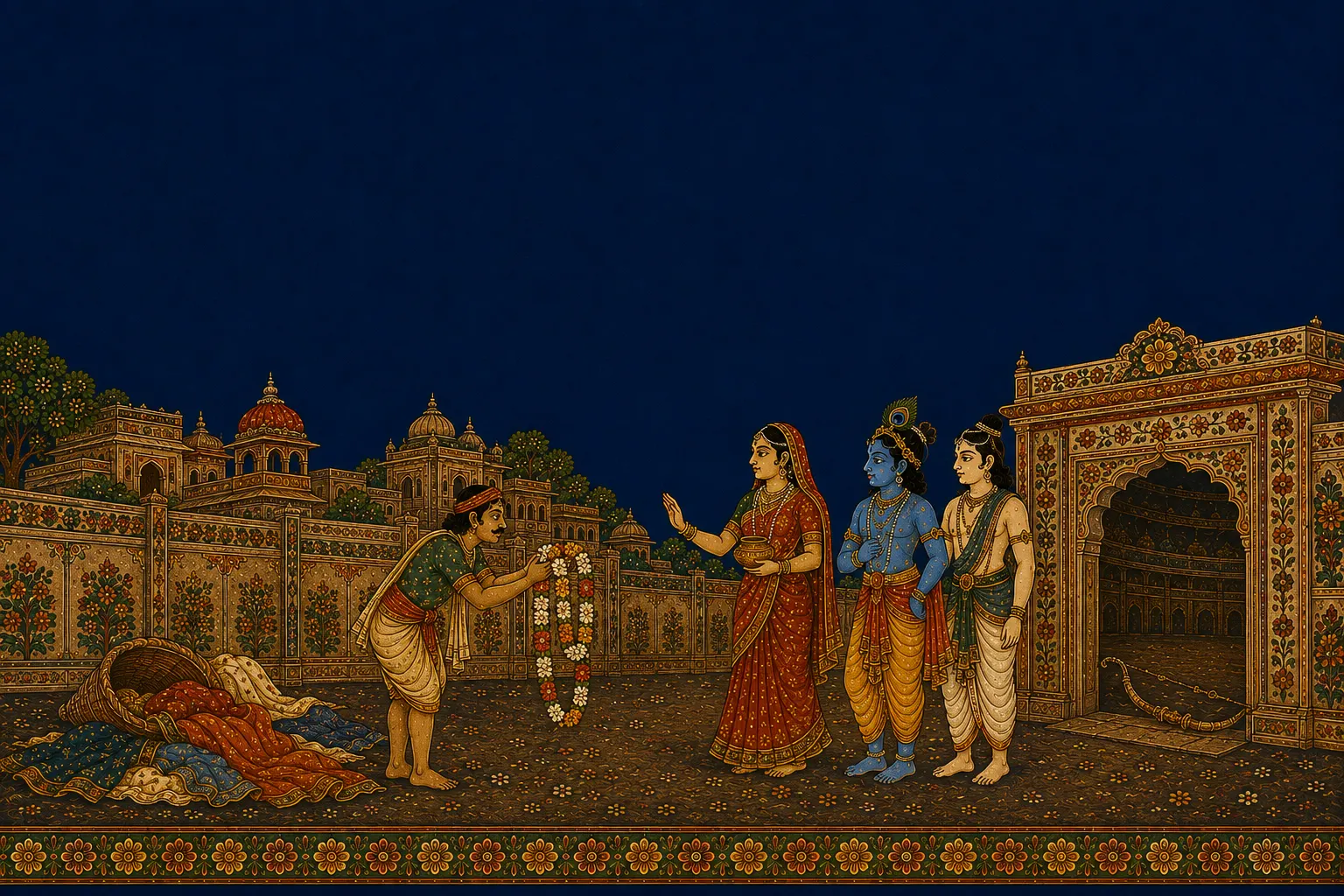
The first person the two brothers encountered in Mathura was a washerman, carrying a bundle of the king's laundered clothes on his head.

Krishna laughingly asked for a few — "We're going to a festival, let us wear something good." The washerman snapped at them. "The king's clothes? For cowherds? Be off, before I have you seized at the guard-post."

Krishna struck him, and the washerman fell where he stood. The two brothers sorted out clothes their size from the bundle and put them on.

A little farther on, they met a gardener. Without a word, without being asked, he lifted his best garlands and put them round the necks of the two, and begged them to come to his house. Krishna blessed him — there would never be want in his home.

Then they met a woman — Kubja, whose body was bent in three places. She was carrying sandal paste for the king. She smeared that same fragrant paste on the foreheads and arms of the two brothers. Krishna set the toes of his foot on her feet, took her chin and lifted it gently — and her bent back went straight.

The bow

In the sacrificial hall stood the bow in whose name the whole festival had been held — so heavy that several men together could barely move it; several men together could not shift it. Guards surrounded it on every side.

Krishna walked past the guard and went in. He lifted the bow with one hand, bent it to string it — and it snapped in two with a deafening crack.

That sound rang through all of Mathura, reached the palace. The guards rushed in with weapons. They too fell there, beside the two halves of the broken bow.

The elephant at the gate

The next morning Kuvalayapida blocked the entrance to the arena. The mahout had been ordered to intoxicate the elephant, and the moment he saw Krishna he goaded him on with the hook.

The elephant reached out his trunk to wrap Krishna up. Krishna slipped between his legs, evaded him until the elephant tired, then took hold of the trunk and threw him to the ground.

The two brothers wrenched out one of the elephant's tusks — one in Krishna's hand, one in Balarama's — and holding them like clubs they went into the arena.

Inside, where everything was ready

The arena was packed. On one side, on a high platform, sat Kamsa, his fists clenched. Below, the wrestlers waited, oiled and gleaming, slapping their arms in challenge.

The two brothers came through the crowd and stood in the middle — the washerman's clothes on their bodies, the gardener's garlands round their necks, Kubja's sandal paste on their foreheads, and Kuvalayapida's tusk in hand.

Kamsa looked down at them and remembered the voice from the sky that had haunted him for years.

Note: Breaking the bow and the collision with Kuvalayapida — both episodes are told in both the Bhagavata Purana and the Harivamsha. The Kubja episode is in the Bhagavata, and later in the Brahmavaivarta Purana and Surdas's Sursagar too — but the Vishnu Purana has no account of Krishna going to Kubja's house. Whether this episode is in the Harivamsha could not be settled in this check, so no claim is made about it here. The washerman and gardener episodes come in this same order in tradition, but they could not be checked chapter by chapter across the different texts.

Source: from several texts, Mathura

Now — how much stayed with you?

What happened?

What happened with the washerman in the streets of Mathura?

  • He got frightened and ran
  • He sent word to Kamsa
  • He refused to give the clothes, spoke with a swagger, and was struck down
  • He handed over the clothes and was rewarded
Read the whole story — The city's first answer

This scene passes very quickly in the story, and its purpose seems to be exactly this: to show that things have changed now.

In Gokul Krishna played with children; in Mathura the first man who blocks the road falls.

The gardener and Kubja follow in the same sequence — and the three are treated differently, which is the real point of the story.

Who am I?

I was carrying sandal paste for the king, and I put that paste on two strangers I met on the road. Who am I?

  • Yashoda
  • Devaki
  • Rohini
  • Kubja
Read the whole story — The one who gave without being asked

In this episode Kubja does what the washerman did not — what she was carrying, she gave without being asked.

In the story her bent back is straightened. Tradition holds this as the answer to her generosity, not as any comment on her form.

This episode became very popular in the bhakti tradition, and it still returns again and again in folk singing.

The texts disagree

Which texts is the Kubja episode found in?

  • Only the Harivamsha
  • The same in every ancient text
  • Found in the Bhagavata and some later texts, but not recorded in the Vishnu Purana
  • In no text; it comes only from films
Read the whole story — The dearest episode may also be the newest

The story of Kubja is found in the Bhagavata Purana, and later in the Brahmavaivarta Purana and in Surdas's Sursagar too.

The Vishnu Purana does not have any account of Krishna going to Kubja's house — this is stated plainly in scholarly notes.

Whether this episode is in the Harivamsha could not be settled in this check, so no claim is made about it here.

This does not mean the episode is "false". It only means it does not look like part of the oldest layer of the story.

Fact

What did the gardener do?

  • He blocked the road
  • Without being asked, he garlanded them and invited them home
  • He sent word to Kamsa
  • He applied sandal paste
Read the whole story — Three people, three answers

The three episodes of this street seem made to be read together: one refused, one gave without being asked, and one gave what was not even her own to give.

What happened to each of them matches their conduct — and the story does not try to explain it, only shows it.

Which is why this stretch of entering Mathura is remembered more than any fight.

What happened?

What happened to the bow kept in the sacrificial hall?

  • Krishna strung it and took aim
  • Balarama broke it
  • Krishna lifted it and broke it in the very act of stringing it
  • Nobody could lift it at all
Read the whole story — The very thing he was called for, broken

The whole festival had been held in the name of the bow-sacrifice, and that same bow broke — the excuse for the invitation was gone.

Both the Bhagavata and the Harivamsha tell this episode, and this is the moment Kamsa understands that control is slipping out of his hands.

After this Kamsa has no option to wait; the arena is set up the very next morning.

Who am I?

I was tied at the gate of the arena, so that whoever tried to go in would not get through. Who am I?

  • Dhenuka
  • Kuvalayapida
  • Pralamba
  • Kaliya
Read the whole story — A danger set up at the gate

The purpose of putting the elephant there was plain — whoever wanted to enter would first have to get past him.

Both the Bhagavata and the Harivamsha are said to describe this collision, and in both the two brothers go inside carrying one of the elephant's tusks.

That same tusk goes on to serve as a weapon in the arena.

Why is that?

Why did the two brothers go into the arena carrying the elephant's tusk?

  • Because it was both a weapon and a message that the trick at the gate had failed
  • Because it was an item for worship
  • Because it was a prize
  • Because the mahout had given it to them
Read the whole story — A way of walking in

This scene seems very deliberate in the story: into a packed arena, the two brothers enter carrying the very thing set there to stop them.

For Kamsa this was the worst possible news, and it reached him without a single word said.

Right after this the wrestlers are brought out, and the next kanda begins right there.

Put it in order

What is the correct order from entering Mathura to the arena?

  • The bow → the washerman → the gardener → Kubja → the elephant
  • Kubja → the elephant → the washerman → the bow → the gardener
  • The elephant → the bow → the washerman → the gardener → Kubja
  • The washerman → the gardener → Kubja → the bow → the elephant → the arena
Read the whole story — One city, one day

This is roughly the order the Bhagavata's chapters run in — the three street episodes, then the sacrificial hall, then the arena the next morning.

There is no great battle in this whole stretch, and yet the mood of the city shifts with every scene.

By the time the two brothers reach the arena, word has already spread through Mathura that something extraordinary is happening.

Why is that?

Why were the washerman, the gardener and Kubja treated so differently?

  • Because the three were of different castes
  • Because Kamsa had sent all three
  • Because Krishna already knew all three
  • Because the three behaved differently
Read the whole story — Three answers, three outcomes

This part of the story seems placed almost like a test — three ordinary people of the city, and three different responses.

Worth noticing: none of the three is a major character. The story barely even gives them names.

And yet these three scenes are what give the whole entry into Mathura its meaning.

Fact

On reaching the arena, what did the two brothers have with them?

  • The washerman's clothes, the gardener's garland, Kubja's sandal paste, and the elephant's tusk
  • Royal dress given by Kamsa
  • Only weapons
  • Nothing at all
Read the whole story — The whole road carried with them

This detail is beautiful in terms of storytelling — entering the arena, the whole day's account is present on their bodies.

What was taken, what was given, what came unasked, and what was won by fighting — all four together.

The next kanda begins right from this stage, and there Kamsa has no move left.