Kanda 18

Narakasura and the sixteen thousand

Thousands of women were shut in an asura's palace. Krishna went not only to free them but to give them back their standing

A complaint that came from heaven

Narakasura, the asura-king of Pragjyotishpura, had not spared even the gods. He had taken Varuna's parasol, had stolen the earrings of Aditi, the mother of the gods, and abducted women from the royal families he had defeated and locked them in his palace — thousands of them.

Indra himself had lost to him. After the defeat he came to Dwarka to ask for help.

Krishna listened, then prepared to march against Narakasura.

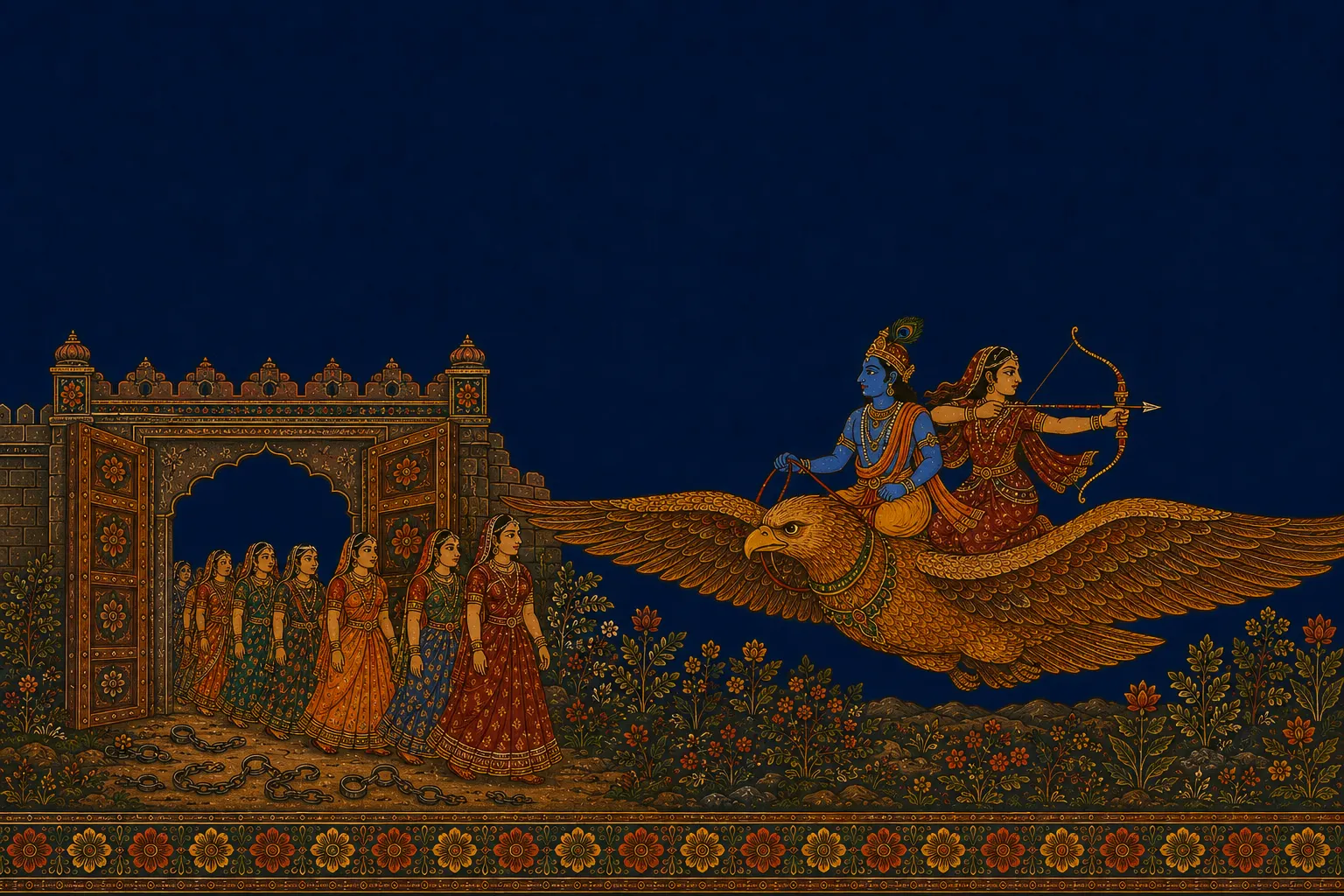
Riding Garuda, with a wife beside him

Krishna did not go alone. His wife Satyabhama went with him — on the campaign against Pragjyotishpura, a bow in her hand. They flew east on Garuda.

Outside the city the first clash was with Narakasura's general Mura — a five-headed asura, hidden near the city's defences. The fight was fierce but short; Krishna cut him down with his discus, and from that came one of his names — Murari.

Then the real battle at the gate of Pragjyotishpura. A fort of seven rings of hills and weapons, and arrows coming down from above. At one point Krishna appeared stunned, under one of Narakasura's weapons — and Satyabhama took the front herself, raised the bow, and held the attack together, until Krishna stood again and brought Narakasura down.

Inside the palace, dark cells

Narakasura fell. Krishna spared Narakasura's son Bhagadatta and placed him on the throne, and set aside Aditi's earrings to be returned.

Then he went inside the palace, and there was silence there. Rows of shut doors, and behind every door women — years in captivity, hundreds of miles from their homes.

Krishna had every door opened. The women came out — in some eyes there was only relief, while others faced a frightening question: what now? If we go home, will our fathers, our husbands take us back? What will society say?

Standing, not force

The women faced a harsh social reality: captivity could leave them rejected even by their own families.; for her there were taunts, there was shunning, there was a life like a servant's.

Krishna offered them a choice: whoever wished could come to Dwarka as Krishna's wife — with a name, a standing, protection and a home. The marriage offered them social standing, protection and a home.

Sixteen thousand women chose to come to Dwarka. Each was given her own home, her own name, the standing of a queen — and the story presents this as restoring the status and security that captivity had taken from them.

Note: The story of the killing of Narakasura is found in the Bhagavata Purana, the Vishnu Purana and the Harivamsha — all three. The texts disagree on the number of women freed — the Bhagavata Purana says sixteen thousand, the Vishnu Purana and the Harivamsha sixteen thousand one hundred. Both numbers are recorded here, with neither declared "the right one".

Source: from several texts, Narakasura and the sixteen thousand

Now — how much stayed with you?

Who am I?

I ruled Pragjyotishpura, stole the earrings of Indra's mother, and held thousands of women prisoner. Who am I?

  • Jarasandha
  • Narakasura
  • Mura
  • Kamsa
Read the whole story — A tyrant even the gods could not stop

Both the Bhagavata Purana and the Vishnu Purana make Narakasura so powerful that even Indra had lost to him and came to Krishna for help.

He had taken not only Indra's mother's earrings but held captive the daughters and wives of many kings, defeated in war.

That tyranny became the root of Krishna and Satyabhama's expedition to Pragjyotishpura.

Who am I?

I am Krishna's wife, and in the war against Narakasura I took up a weapon and fought myself. Who am I?

  • Jambavati
  • Devaki
  • Rukmini
  • Satyabhama
Read the whole story — A wife who was also a warrior

Both the Bhagavata Purana and the Vishnu Purana show Satyabhama in this war not as a wife who came along but as an active fighter.

When at one moment in the battle Krishna was surrounded, Satyabhama took up a bow herself and held the line.

This episode is one of the few places in the Krishna-Leela where a woman character comes directly onto the battlefield rather than staying in the background.

Fact

What did Krishna do about the women freed from Narakasura's palace?

  • He made them servants in Dwarka
  • He sent them to the forest to do penance
  • He returned them to their old kingdoms and did nothing further
  • He married all of them, so that even after captivity they would have respect and protection in society
Read the whole story — One way of giving standing back

The Bhagavata Purana presents this plainly as a step of protection and restoring honour, not as a tally of conquest.

In the society of that time women taken captive in war were often not accepted back, whatever fault was or was not theirs.

Through marriage Krishna gave each of them the standing of a queen, protection and a place in society — and that is the purpose the story gives for the decision.

The texts disagree

What is the difference between the Bhagavata Purana and the Vishnu Purana–Harivamsha over the number of women freed?

  • The Bhagavata Purana says sixteen thousand, the Vishnu Purana and the Harivamsha sixteen thousand one hundred
  • Both say ten thousand
  • The Bhagavata twenty thousand, the Vishnu Purana ten thousand
  • There is no difference, both give the same number
Read the whole story — A difference of a hundred, held for centuries

By the Bhagavata Purana's count, sixteen thousand women were freed from Narakasura's palace.

The Vishnu Purana and the Harivamsha put the same event at sixteen thousand one hundred — exactly a hundred more.

The difference is neither large nor the root of any dispute, but it is a good example of how, even in a story that looks the same, small figures change from text to text — and on this site both numbers are given, with neither declared "the right one".

Who am I?

I was Narakasura's guardian asura. Reaching Pragjyotishpura, Krishna fought me first of all. Who am I?

  • Ravana
  • Kalayavana
  • Mura
  • Chanura
Read the whole story — The first obstacle on the road

Both the Bhagavata Purana and the Vishnu Purana make Mura the first and greatest obstacle in Narakasura's line of defence.

Krishna had to defeat Mura before he could reach Narakasura, and it is from this battle that one of Krishna's names, "Murari" — enemy of Mura — comes.

It shows that Narakasura was not alone; he had set powerful guardians all around himself.

What happened?

After killing Narakasura, what did Krishna do with Aditi's earrings?

  • He carried them back to heaven and returned them to Indra's mother Aditi
  • He destroyed them
  • He kept them himself
  • He gave them to Satyabhama
Read the whole story — A stolen thing, back in the right place

According to the Bhagavata Purana, Narakasura had taken Aditi's earrings years before, and they had become a symbol of his power and his arrogance.

Immediately after killing Narakasura, Krishna took the earrings and made the journey to heaven to return them to Aditi.

This small episode shows that the killing of Narakasura was not only the freeing of women but also the settling of an old account of the gods.

Put it in order

Which is the correct order of these events?

  • The fight with Mura → the killing of Narakasura → the freeing of the women → returning the earrings, and the marriages
  • The killing of Narakasura → the fight with Mura → returning the earrings → the freeing of the women
  • The freeing of the women → the killing of Narakasura → the fight with Mura → returning the earrings
  • Returning the earrings → the fight with Mura → the killing of Narakasura → the freeing of the women
Read the whole story — One expedition, several accounts settled

The Bhagavata Purana keeps this expedition in a straight line — first the obstacle on the road (Mura), then the main battle (Narakasura), then the human consequence (the freeing of the women), and at the end the gods' account (returning the earrings).

This order shows the expedition was not only about killing a demon — the gods' old score, justice in human society, and Krishna's new marriages are all woven into it at once.

Which is why the killing of Narakasura is counted among the greatest episodes of the Krishna-Leela, and not because of the battle alone.

Why is that?

Why did Krishna marry the freed women rather than simply setting them free and leaving?

  • Because Satyabhama told him to
  • Because the society of that time often did not accept women who had been held captive, and marriage gave them both standing and protection
  • Because they themselves demanded marriage
  • Because it was Narakasura's condition
Read the whole story — Protection given the name of marriage

Both the Bhagavata Purana and the Vishnu Purana present these marriages not as a tally of conquest but as a way of restoring protection and honour.

For women taken captive, return was not easy in the society of that period — family and society often would not take them back.

Krishna's proposal of marriage was a direct solution to that problem — each woman received the standing of a queen, which nobody could then refuse her. On this site it is kept in exactly that context, not as a list of conquests.

Fact

Which texts is the full story of the killing of Narakasura found in?

  • Only the Garga Samhita
  • In no major text, only in later tradition
  • Only the Mahabharata
  • The Bhagavata Purana, the Vishnu Purana and the Harivamsha
Read the whole story — One story, three witnesses

The killing of Narakasura is among those episodes of the Krishna-Leela found at once in the Bhagavata Purana, the Vishnu Purana and the Harivamsha.

Which is why a difference of figures like "sixteen thousand" against "sixteen thousand one hundred" can be put firmly side by side — had the story been in only one text, no comparison would arise.

Being present in three texts also shows this is among those events of the Krishna-Leela that tradition treated as central from the start.

Fact

In what tone is this story kept on the site — how are the sixteen thousand marriages presented?

  • As a moral sermon, criticising Krishna
  • As a step that returned social standing and protection to women who had been held captive
  • As comedy, joking about the number
  • As a romantic list of conquests
Read the whole story — What lies behind the number

A large figure like sixteen thousand often comes loose from the story and survives as nothing but a spicy statistic.

The aim on this site has been to keep the real event behind the number clear — women taken captive in war, whom society had decided in advance to refuse, and who were given standing and protection through marriage.

It has not been made into romance, nor into an occasion for criticism — only the fact recorded in the texts is stated, with the same restraint kept everywhere else on the site.