Kanda 3

Putana

A beautiful woman came to Gokul, and asked for the child to hold

Sent from Mathura

After the goddess's warning Kamsa stopped waiting. His strategy changed. If he could not identify the child, he would send killers after every child of the same age. Sooner or later, he thought, one of them would be the right one.

Putana was one of those killers. But she did not come with an army, or with a sword.

She came in disguise as a gentle, smiling woman, the kind no mother would think to fear.

The one who looked kindest

The stranger who came to Gokul that day was the most beautiful of all, and spoke the sweetest. She fussed affectionately over the children, and her sweet manner disarmed the women of the village.

"How lovely he is," she said in every courtyard, holding a child to her cheek, and moving on. Nobody stopped her, nobody asked who she was.

Then she reached Yashoda's house. She looked at the child lying in the cradle and, without asking, picked him up. Yashoda was right there — she too found the woman kind.

Putana moved into the shade of a wall, settled the child in her lap, and began to nurse him. Her breast had been smeared with poison.

What he drank, and what came back

The child took hold — and did not let go.

Putana's face began to tighten. She tried to pull him away; the child would not let go, as though he had fastened himself to her very life. She strained again, and then a scream came out of her that rang through every lane of Gokul.

She got up and ran, the child hanging from her breast. With every step, her beautiful disguise began to fall away — first the face, then the limbs, then the whole body.

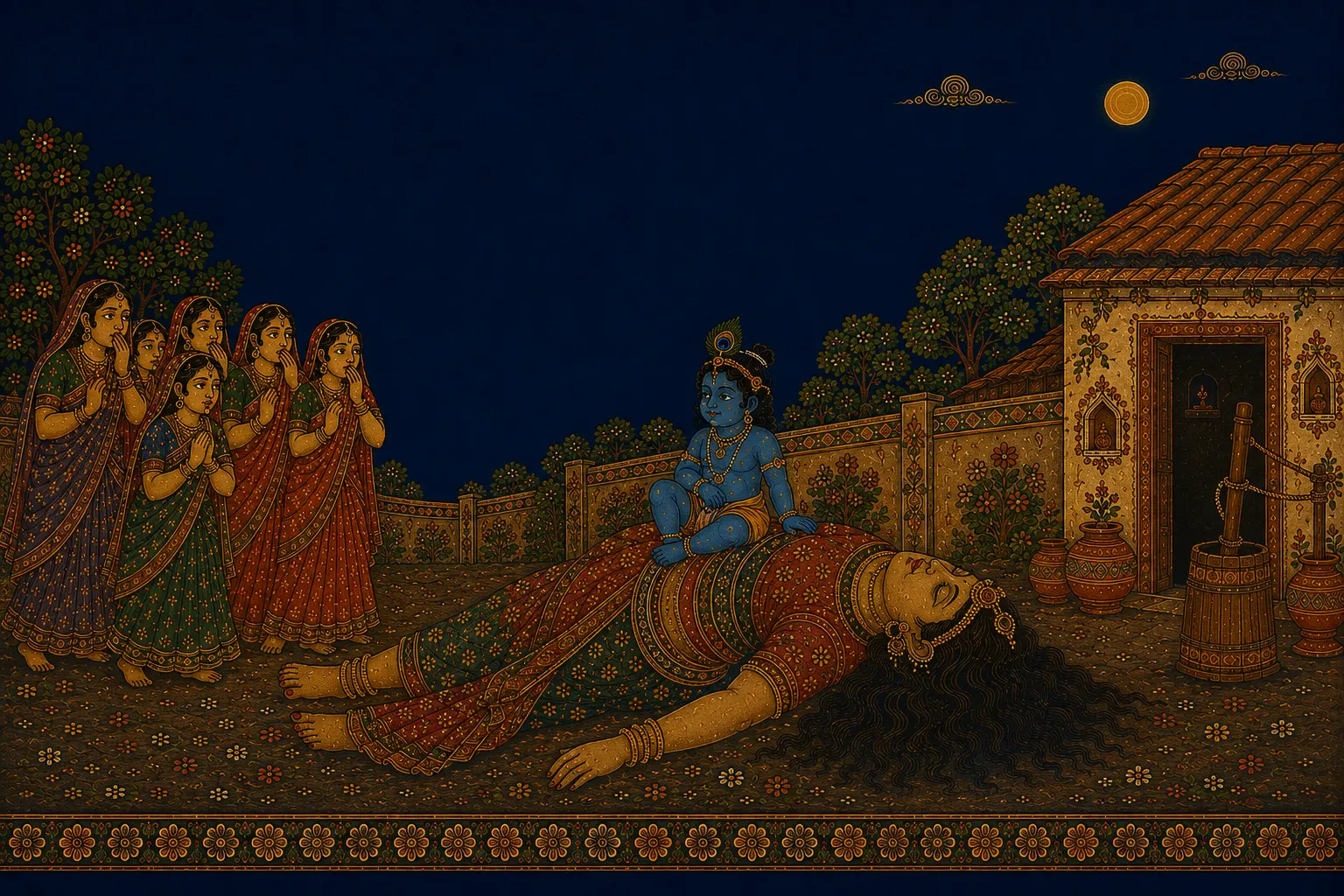
The people of Gokul came running at the scream. In the courtyard lay the corpse of a huge demoness, sprawled across the courtyard — and on her chest a child was playing, crowing with delight.

The one who was called a mother

With shaking hands Yashoda picked the child up and looked at him from every side. He did not have so much as a scratch.

The villagers cut the huge corpse into pieces and disposed of it, and the smoke that rose, it is said, smelled of sandalwood. But the story does not end there.

Tradition says that Putana was nevertheless granted the spiritual reward of a mother. Whatever her intention had been, this was the last thing she did — she had given the child milk.

Note: The Putana episode is among the most-repeated episodes of the Krishna-Leela — it is found in the Bhagavata Purana, the Harivamsha and the Vishnu Purana, and in later texts as well. There are differences in the details: some older accounts have not poison on the breast but a drugging paste, and in later tellings it becomes plain poison. Putana's liberation runs through the whole tradition, but in this check it could not be confirmed from any named chapter of any one text — so it is written here as tradition, not on the authority of a text.

Source: from several texts, Putana

Now — how much stayed with you?

Who am I?

I came to kill, and I am remembered not as a killer but as a mother. Who am I?

  • Devaki
  • Yashoda
  • Putana
  • Rohini
Read the whole story — A killer, and a mother

This is the strangest thing about the episode, and tradition does not try to resolve it — it accepts it.

The argument given is that whatever her intention, she gave Krishna milk, and that relation stands.

This shape returns again and again in the bhakti tradition: reaching Krishna by any road at all, even the road of enmity, is in the end still held to be reaching him.

What happened?

What disguise did Putana come to Gokul in?

  • She came as a soldier
  • She came as a beautiful, sweet-spoken woman and went about fussing over the children
  • She came in the form of a cow
  • She came dressed as an ascetic
Read the whole story — The disguise was the weapon

The fear in this story does not come from a fight, it comes from trust — the killer is the one who was invited inside the house.

The gopis were not at fault. What came to them looked kind in every way.

Which is why this episode, for all that it is a children's story, is really a story about fear.

Fact

Who had sent Putana?

  • Kamsa
  • Narakasura
  • Jarasandha
  • Shishupala
Read the whole story — The strategy changed

As long as the prophecy was only a warning, Kamsa could wait. Once the goddess said the child had already been born, waiting was useless.

Several of the stories that follow come out of this single decision — one killer after another, and failure every time.

Worth noticing: Kamsa did not know where the child was. Which is why the target was not one child but a whole age.

The texts disagree

How many texts is the story of Putana found in?

  • Only the Bhagavata Purana
  • Only the Garga Samhita
  • In no ancient text; it is only folk tale
  • In several texts
Read the whole story — The one they all agree on

Among the episodes of Krishna's childhood, Putana is one of the few stories that returns in nearly every major source.

There are differences in the details. Some older accounts have not poison on the breast but a drugging paste; in later tellings it becomes plain poison.

The liberation — that Putana was given a high state in return — runs through the whole tradition, but in this check it could not be tied to any named chapter of any one text. So it is written here as tradition, not on the authority of a named text.

Why is that?

Why did the gopis let Putana near the child?

  • Because she was a relative of Nanda's
  • Because they had known her before
  • Because Yashoda had called for her
  • Because she looked kind and sweet, and there was no reason to suspect her
Read the whole story — The price of trust

Nobody in this episode is careless. The village did what any village would do — it let a kind-looking woman come in.

That is what makes the story uncomfortable: the escape did not come from anyone's watchfulness, it came because the target had been chosen wrong.

In the episodes that follow Gokul is more watchful, but the danger comes in a new disguise every time.

Riddle

I was put there so the child would die. The child drank me, and the one who died turned out to be the one who gave. What am I?

  • The water of the Yamuna
  • The poison on Putana's breast
  • Butter
  • A bowl of milk
Read the whole story — What came back on the one who sent it

Older accounts call it a drugging paste, later ones plain poison. The result is the same in both.

The shape of the story is a reversal: the weapon stays the same, the direction changes.

That shape repeats through Kamsa's whole story — every attempt turns back against him.

Who said it?

After Putana died, who was the first in Gokul to pick up the child?

  • Nanda
  • Rohini
  • Yashoda
  • Balarama
Read the whole story — A mother's first movement

The plainest and truest thing in the whole scene is this — in the middle of a miracle a mother comes running, and the first thing she does is check whether the child is all right.

In the Bhagavata the gopis go on to perform several rites to protect the child. The fear was real, and it stayed real afterwards.

That fear runs in the background of every episode that follows, until Krishna reaches Mathura.

Fact

When did Putana's real form show?

  • When the child began to feed and did not let go
  • Several days after she died
  • The moment she reached Gokul
  • In front of Kamsa in Mathura
Read the whole story — The disguise breaking

The turn comes suddenly in the story — one moment before, the scene is domestic, and the next there is a huge body lying in the courtyard.

It is that suddenness that makes this episode frightening, not any fight or any blood.

What the people of Gokul saw was not a fight — they arrived when it was already over.

Put it in order

What is the correct order of events?

  • Putana's real form → picking up the child → Kamsa sending her → the people of Gokul arriving
  • Kamsa sending killers → Putana coming in disguise → picking the child up → the real form being revealed → the people of Gokul arriving
  • Putana arriving → the people of Gokul stopping her → Kamsa sending her → the real form
  • The people of Gokul arriving → Putana arriving → picking up the child → Kamsa sending her
Read the whole story — Nobody stopped her

The most striking thing about this order is that there is no check anywhere in it.

Putana gets all the way inside, picks the child up, and only after that does the story turn.

The Bhagavata does not hurry this scene along — it gives room to all three: the disguise, the trust, and then the reversal.

Why is that?

Why did Kamsa target a whole age of children instead of one child?

  • Because he did not know which child it was or where
  • Because he hated everyone
  • Because the prophecy mentioned several children
  • Because Gokul had stopped paying him tribute
Read the whole story — When you do not know the target

The swap had succeeded precisely because Kamsa had no name and no address — only an age.

That became his greatest weakness. He had to look everywhere, and Krishna had only to stay hidden in one place.

The same thing repeats in the kandas that follow: the killers Kamsa sends get bigger and more frightening, and every time they come to that one village and fail.