Kanda 8

Raas

One night's dance, which over centuries became a whole theology

An autumn night

It was an autumn night. The sky was clear, the moonlight bright and unobstructed, and the scent of night-lilies in the air. From somewhere along the Yamuna a flute began to sound.

The women of Gokul who heard the melody rose from whatever they were doing. One left the milk on the boil, one with her hair half-braided, one without telling her family, slipping out in the dark.

No one asked where the others were going, or why. There was no need to ask. The flute was calling, and their feet were already carrying them towards it.

The circle

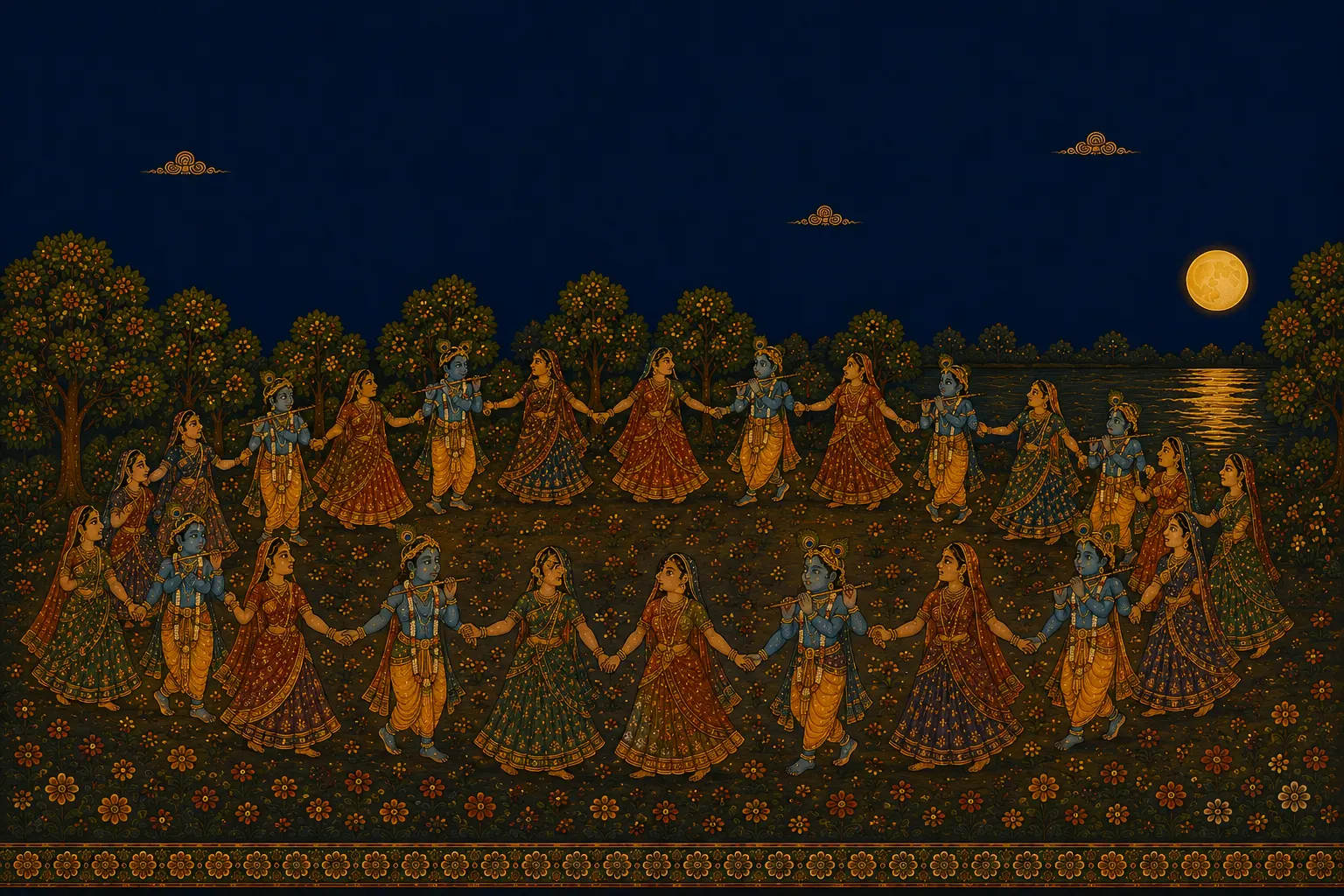
They gathered in the forest, on the sandy bank of the Yamuna, and the dance began — a wide circle, Krishna in the middle, the flute in his hand.

At first, the dance went on as expected. Then each woman began to feel that Krishna was, right now, with her alone — holding her hand, looking only at her.

And the story says this plainly: the feeling was not wrong. Krishna divided himself into as many forms as there were women. There was only one circle, yet Krishna stood between every pair — with each of them, all at once.

The night went on. Nobody noticed the time, nobody noticed being tired. There was only the dance, and the flute, and the moonlight.

And then he was not there

Then, without warning, Krishna was gone.

The flute stopped. The dance broke. The women stood still, looking at one another — Where had he gone?

They went out searching through the forest. "Have you seen him?" they asked the trees. They asked the vines. They asked the deer. In the end they began asking their own footprints in the ground — "Tell us, which way did he go?"

Then they sat down on the sand and sang — in his memory, in their reproach, to bring him back. That song is sung even today; in the Bhagavata it is called the Gopi-Gita.

The return

And then Krishna returned.

The story does not say why he had gone, and it does not say why he returned. It says only this — that something freely given, is understood at its true worth only when it draws away once, for a little while.

The dance resumed — the circle, the flute, the moonlight — but the mood had changed. What had seemed effortless before was now understood as a gift.

Note: In the Bhagavata Purana this episode is called the "Rasa-panchadhyayi" — chapters twenty-nine to thirty-three of the tenth skandha, of which the thirty-first is the Gopi-Gita (only nineteen verses). In the Harivamsha the same night comes in a single episode called Hallisaka — the name of a circle folk-dance, carrying no philosophical weight. So the difference is not only of length but of the way of seeing. Radha's name does not appear in this episode in any of these texts; she becomes central in a much later tradition. (The Harivamsha's chapter number is taken from the current text, not the critical edition.)

Source: from several texts, Raas

Now — how much stayed with you?

Fact

What sound did the gopis hear from their homes that night that made them leave?

  • A drum
  • A flute
  • A temple bell
  • A conch
Read the whole story — One sound, and homes left behind

The flute is the most recognisable mark of the Krishna-Leela, and its role is always the same — to call.

The Bhagavata gives the detail here that one woman left work half-done, one left her adornment half made.

That incompleteness is the meaning of the story: when the call comes, no account is kept.

The texts disagree

How much room does the Raas episode take up in the Bhagavata and the Harivamsha?

  • Five whole chapters in the Bhagavata, and in the Harivamsha only one small episode called Hallisaka
  • More in the Harivamsha, less in the Bhagavata
  • In neither; it is later tradition
  • Roughly equal in both
Read the whole story — One night, two very different texts

In the Bhagavata Purana this episode is called the "Rasa-panchadhyayi" — chapters twenty-nine to thirty-three of the tenth skandha, five whole chapters.

In the Harivamsha the same basic thing is settled in a single episode, named Hallisaka — the name of a folk dance performed in a circle, carrying no scriptural or philosophical weight.

Which is to say the shape is the same — a moonlit night, a circle, a dance — but one text records it as a folk dance and the other makes it the centre of devotion.

This is one of the very few places where it shows plainly how, across the centuries, the same event becomes a different kind of text.

What happened?

Dancing in the circle, what happens that the story states plainly?

  • Krishna danced with each woman in turn
  • Krishna sat in the middle and went on playing the flute
  • Every woman felt Krishna was with her, and her alone
  • Everyone went home in the middle of the dance
Read the whole story — One circle, everywhere at once

This detail is plain in the Bhagavata, and it is exactly what sets it apart from a description of folk dance.

Tradition holds it as a figure of devotion — that what belongs to everyone loses nothing by belonging fully to any one.

The Harivamsha does not carry this elaboration. There, Hallisaka is a dance, and its account stays at that scale.

Fact

The song the gopis sang when Krishna disappeared is in which chapter of the Bhagavata?

  • The thirty-first chapter of the tenth skandha
  • The twenty-fourth chapter of the tenth skandha
  • The forty-seventh chapter of the tenth skandha
  • The sixteenth chapter of the tenth skandha
Read the whole story — A song of nineteen verses

The Gopi-Gita is counted among the most quoted parts of the Bhagavata, and it is very short — only nineteen verses.

It carries both complaint and calling, and it is read not as a sermon but as the sound of separation.

In the next chapter the gopis also put a direct question to Krishna, and the conversation turns philosophical.

Fact

In these two texts — the Bhagavata and the Harivamsha — where does Radha's name appear in this episode?

  • In both, as the central character
  • Only in the Harivamsha
  • In neither
  • Only in the Bhagavata
Read the whole story — A name that came later, and then came to stand foremost

Radha is not found as a named character in any of the Mahabharata, the Harivamsha, the Vishnu Purana or the Bhagavata Purana. This is a surprising fact, since today Krishna's name is rarely spoken alone.

She comes to the centre nearly in the twelfth century, in Jayadeva's Gita Govinda. That is a Sanskrit poem, and in it, for the first time, Radha is a full, named, speaking heroine — in love, in pride, and in anger too.

After that this current spread very fast. The Brahmavaivarta Purana calls her Krishna's eternal companion and the very form of Shakti. After Vidyapati, Chandidas, Mira and Surdas, the whole language of Braj cannot be imagined without Radha — and even today the greeting is "Radhe-Radhe", not "Krishna-Krishna".

The bhakti tradition is not troubled by this absence. It has its own answer: what is most inward opens up last, and Radha was already present among the gopis, only without being named.

So it is not being said here that "Radha was not there". It is only being said that this name does not appear in these four texts, and that this tradition comes after them — which does not weaken it, only dates it.

Why is that?

According to the story, why did Krishna disappear in the middle of the dance?

  • Because a summons had come from Mathura
  • Because he was tired
  • The story gives no clear reason at all
  • Because the gopis had angered him
Read the whole story — A leaving given no reason

At this turn the Bhagavata counts out no cause, and tradition has spent centuries trying to fill that same emptiness.

The explanations that circulate are later ones — the text itself is silent.

In terms of storytelling craft this is the most effective turn there is: what has kept giving itself unasked is understood at its worth only once it is taken away.

Riddle

I was in the forest, but I gave no answer. The gopis asked even me which way he had gone. What am I?

  • The Yamuna
  • The flute
  • The moon
  • The trees and vines of the forest
Read the whole story — Asking the trees

This scene is among the most tender parts of the Bhagavata — the gopis wander the forest asking the trees, the vines and the marks made in the earth.

Tradition calls this the state of viraha, separation, and it became a very large subject in bhakti literature.

This whole part is not in the Harivamsha. There, there is dancing, not this search.

Who am I?

I am the name of a folk dance. In the Harivamsha that night is recorded under this same name — the night that later received five chapters elsewhere. What am I?

  • The Gopi-Gita
  • The Rasa-panchadhyayi
  • Hallisaka
  • The Bhramara-Gita
Read the whole story — The difference hidden in a name

Hallisaka is the name of a dance form — several women, one circle, one man in the middle. There is no divinity in the name itself.

The Bhagavata's "Rasa" takes the same shape and makes it the centre of devotion, attaching both song and philosophy to it.

Changing the name here is not a small thing — that one change tells you what light the text is viewing that night in.

A caution: the chapter number for this episode in the Harivamsha is taken from the current text; that number could differ in BORI's critical edition.

Put it in order

What is the correct order of that night's events?

  • The flute → the circle → Krishna's disappearance → the search and the Gopi-Gita → the return
  • Krishna's disappearance → the flute → the circle → the return
  • The flute → Krishna's disappearance → the circle → the Gopi-Gita
  • The circle → the flute → Krishna's disappearance → the Gopi-Gita
Read the whole story — Finding, losing, finding again

This shape returns again and again in bhakti literature, and the Bhagavata lays it out here in full.

Of the five chapters, the middle portion belongs to the search and the song — which is to say the greatest space is given not to the meeting but to the separation.

The Harivamsha does not have this whole rise and fall. There, the dance happens and the episode is complete.

Why is that?

Why did the gopis leave their homes without telling anybody?

  • Because Yashoda had sent them
  • Because the moment they heard the sound they did not think, they simply went
  • Because there was a festival in the forest and everyone was going
  • Because a summons had been sent to them
Read the whole story — Rising without counting the cost

The Bhagavata pauses on this detail — who left what behind — and that detail becomes the meaning of the whole episode.

Tradition holds this as the highest state of devotion: where no room is left, between the call and the answer, for thinking.

Which is why this episode went on being a subject of poetry, music and painting for centuries.