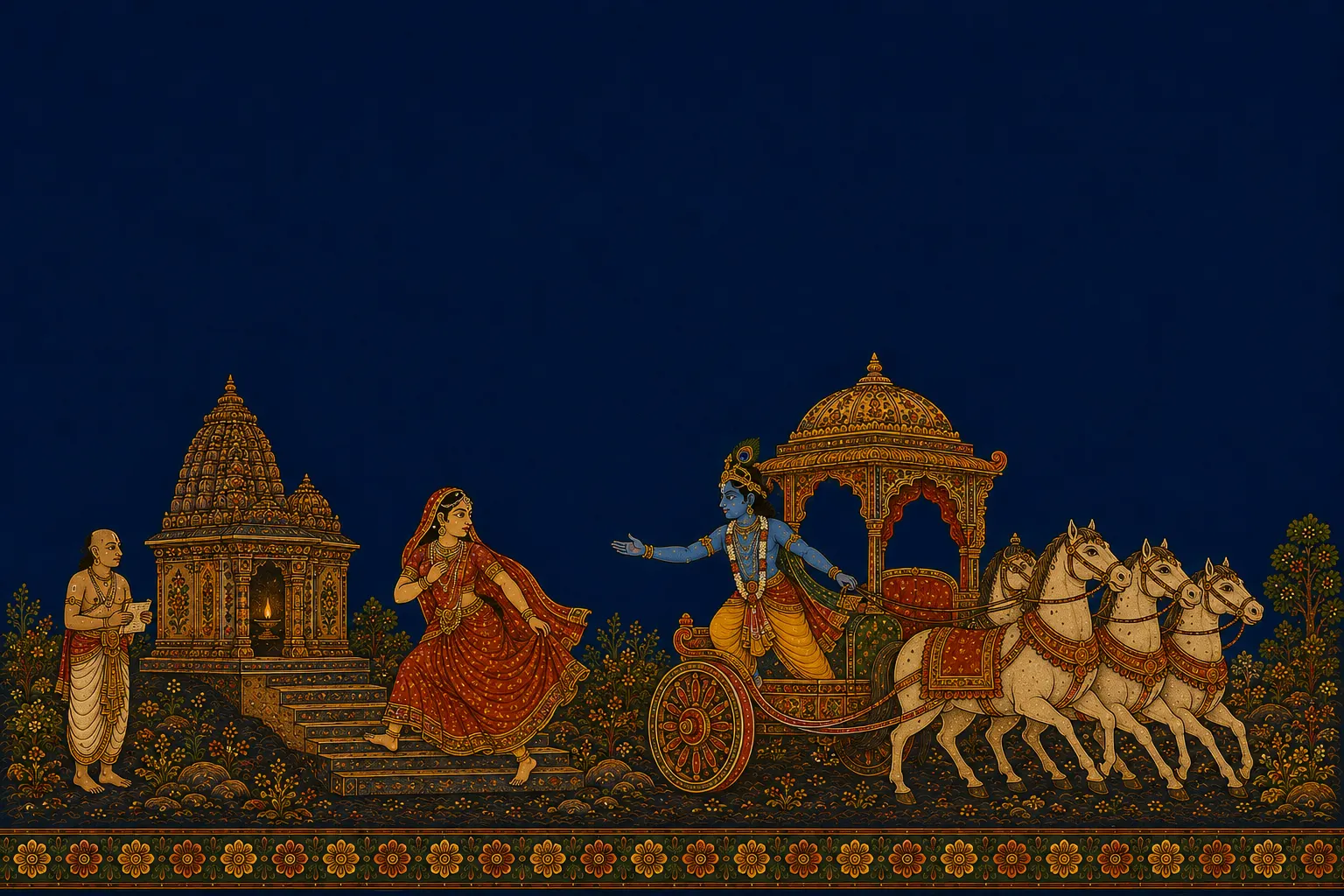
Kanda 16

Rukmini

Everyone called it an abduction, but the plan belonged to the one carried away

The one who decided for herself

Rukmini, the princess of Vidarbha, had never seen Krishna. She had heard about him from those who came and went at the court — that Yadava of Mathura, who killed Kamsa, who founded Dwarka — and and had decided that if she married anyone, it would be Krishna.

Her family, however, had other plans. Her elder brother Rukmi, who was a friend of Jarasandha, settled her marriage to Shishupala, the king of Chedi.

Rukmini knew that arguing at home would change nothing — her father was silent, her brother set on it. So Rukmini did not speak. She wrote.

The letter

A trusted brahmin was chosen, and the letter was carried in secret to Dwarka.

The letter was not a plea. It was a plan. "The day before the wedding, as custom requires, I will go to the temple of the family goddess outside the city. No one stops a bride from going there. The road will be open. Take me from there."

And at the end it also said — "If you do not come, I will not go through with this marriage. I will give up my life, and in the next birth choose you again."

From the temple

The day came. Rukmini, dressed for the wedding, went to the temple with her companions. She bowed her head before the goddess and made just one prayer.

When she stepped outside, the chariot was standing there, and Krishna on it.

Rukmini climbed onto the chariot in full view of everyone, and the chariot moved. Shishupala's men and Jarasandha's forces gave chase, weapons drawn. There was a fight in the open ground, and they went back beaten.

The brother

Rukmi pursued them the farthest and fought the longest. He had sworn he would not return to Vidarbha without bringing his sister back.

He lost, fell in the dust, unarmed. Krishna raised his sword — and Rukmini got down from the chariot and came in between.

"Do not kill him. Whatever he is, he is my brother." Krishna stopped. He spared Rukmi's life, but as a punishment shaved his head and moustache with a razor, and left him like that.

Rukmi kept his oath — Humiliated and partly shaven, he kept his oath and did not return to Vidarbha. He built a new town nearby, Bhojakata, and stayed there.

Note: Rukmini's letter is found in the fifty-second chapter of the tenth skandha of the Bhagavata Purana, and the whole episode runs from the fifty-second to the fifty-fourth chapter. The detail of Rukmi's life being spared and his head and moustache shaved is said to belong to this same part of the Bhagavata. One thing needs keeping clear: the check on this kanda is incomplete — how the Harivamsha and the Vishnu Purana treat Rukmini's story, or whether they treat it at all, could not be looked at in this check. So everything said here rests on the Bhagavata, and it is possible that this kanda is among the few parts of this whole epic that come mainly from a single text.

Source: from several texts, Rukmini

Now — how much stayed with you?

Who am I?

I had never seen him, but I had decided. And when my family settled me elsewhere, I wrote a letter. Who am I?

  • Satyabhama
  • Radha
  • Rukmini
  • Kubja
Read the whole story — The one who took the first step

This story is often called "Rukmini-harana", the carrying away — but the first step taken was Rukmini's.

The Bhagavata gives the full text of her letter, and it holds a clear plan more than any pleading.

Which is why, reading this kanda, it is plain that the most deliberate character in the story is the one being carried away.

What happened?

How did Rukmini get her word to Krishna?

  • Through her brother
  • In a dream
  • By sending a letter in the hands of a brahmin
  • By going to Dwarka herself
Read the whole story — One letter, and one man trusted

The fifty-second chapter of the tenth skandha of the Bhagavata Purana is given to this letter.

The letter held more than feeling — the place, the time and the method were all written in it.

The whole plan rested on trusting one brahmin, and that is the most fragile part of this story.

Fact

Which chapter of the tenth skandha of the Bhagavata Purana is Rukmini's letter in?

  • The fifty-second
  • The forty-seventh
  • The thirty-ninth
  • The fifty-sixth
Read the whole story — A story of three chapters

In the Bhagavata this episode begins at the fifty-second chapter and runs to the fifty-fourth — the letter, then the carrying away, then the collision with Rukmi.

The letter's text is given within the chapter, so this is one of the very few parts where a character states her own plan in her own words.

Which is why this episode became so popular in tradition.

Why is that?

Why did Rukmini choose the day of the temple visit?

  • Because the priests there were going to help
  • Because there was no guard that day
  • Because visiting the family goddess's temple before a wedding was custom, and her going out that day would strike nobody as strange
  • Because the temple was on the road to Dwarka
Read the whole story — A plan built inside a custom

This detail shows how carefully the plan was made — no new road was invented, the road already open was the one chosen.

A bride going to the temple could not be stopped, and that was the plan's greatest strength.

In the Bhagavata both the place and the occasion are written into the letter itself.

Who am I?

I settled my sister's marriage elsewhere, fought furthest forward, lost — and still went back alive. Who am I?

  • Rukmi
  • Shishupala
  • Jarasandha
  • Akrura
Read the whole story — The one who went back with his life

Rukmi's survival was not owing to his own strength — his sister came in between and asked for his life.

According to the Bhagavata his life was spared, but his head and moustache were shaved off and he was sent back in that state.

Tradition says he never went back to Vidarbha after that — less because of the defeat than because of that humiliation.

What happened?

What happened to Rukmi in the end?

  • He was killed
  • He was taken prisoner
  • He was released under a treaty
  • His life was spared, but his head and moustache were shaved off
Read the whole story — A punishment worse than death

By the reckoning of that time this punishment was held to be no less than taking a life — for a warrior it was public humiliation.

This detail is found in this same episode in the Bhagavata, and it is not described as any later tradition's addition.

Rukmi appears in the Mahabharata later too, and there as well his place stays off to the side.

Riddle

I was no weapon, and no army. But the whole battle happened because of me, and a brahmin kept me hidden on his person. What am I?

  • Rukmini's garland
  • Rukmini's letter
  • The Syamantaka jewel
  • The Panchajanya conch
Read the whole story — A plan written on paper

There are plenty of weapons in the Krishna-Leela, but this is one of the very few episodes where the most effective thing is a letter.

The letter held the place, the day and the method — which is to say it was less a letter of feeling than a paper of planning.

The Bhagavata records it in full, and that is why Rukmini's voice is heard directly in the story.

Put it in order

What is the correct order of this kanda?

  • The marriage being settled with Shishupala → Rukmini's letter → the carrying away from the temple → the fight with Rukmi → Rukmi's humiliation
  • The carrying away → the letter → the fight with Rukmi → the marriage being settled
  • The letter → the marriage being settled → the carrying away → Rukmi's humiliation
  • The fight with Rukmi → the carrying away → the letter → the marriage being settled
Read the whole story — Beginning with somebody else's decision

The story begins with Rukmi's decision — which is to say Rukmini's plan is an answer, not an opening move.

But the way of answering is entirely her own, and every event that follows comes out of that letter.

Which is why calling this kanda only an "abduction" is incomplete.

Why is that?

Why is calling this episode "Rukmini-harana" incomplete?

  • Because the plan was Rukmini's own
  • Because Rukmini went back later
  • Because there was no carrying away at all
  • Because Krishna never got there
Read the whole story — The gap between a name and a story

The word "harana" suggests that something was seized from somebody, and that the one carried away had no part in it.

The Bhagavata's text shows the opposite: the letter, the place, the time — all of it settled by Rukmini.

The fight and the chariot come afterwards. The first and most necessary step was a piece of paper.

Fact

In the letter, Rukmini also wrote what she would do if Krishna did not come. What was it?

  • She would marry Shishupala
  • She would leave Vidarbha
  • She would fight her brother
  • She would not go through with this marriage
Read the whole story — A condition, plainly written

The letter did not hold only an invitation; it also held what would happen if he did not come.

That is what separates it from pleading — this was a decision, being announced.

The letter's text is given in this same chapter of the Bhagavata, so this is not anyone's interpretation but the text's own statement.