Kanda 12

Sandipani

The teacher asked, as his fee, for the one thing nobody could give

Schooling that began late

After Kamsa's death the two brothers were sent for a formal education — to the city of Avanti, to the ashram of the sage Sandipani. By then they were well past the age of an ordinary student.

At the ashram they received no special treatment. They lived like the other students — fetching wood from the forest, drawing water for the teacher, cleaning the ashram, before sitting down to their lessons.

The story says that the sixty-four arts, which take years to learn, they learned in sixty-four days — one a day. It was here at the ashram that they made friends with a poor brahmin boy named Sudama.

The teacher's fee

When the studies were done the two brothers stood before the teacher with folded hands. "What may we offer you as guru-dakshina?"

Sandipani was silent for a while. Then his wife spoke, her eyes lowered.

Their only son had been lost years before at Prabhasa, by the sea, during a pilgrimage. He had been searched for and not found; he had never come back. "If you can, bring him back."

Silence fell over the ashram. This was no ordinary request. It seemed impossible — how does anyone return a child lost years ago by the sea.

Under the sea

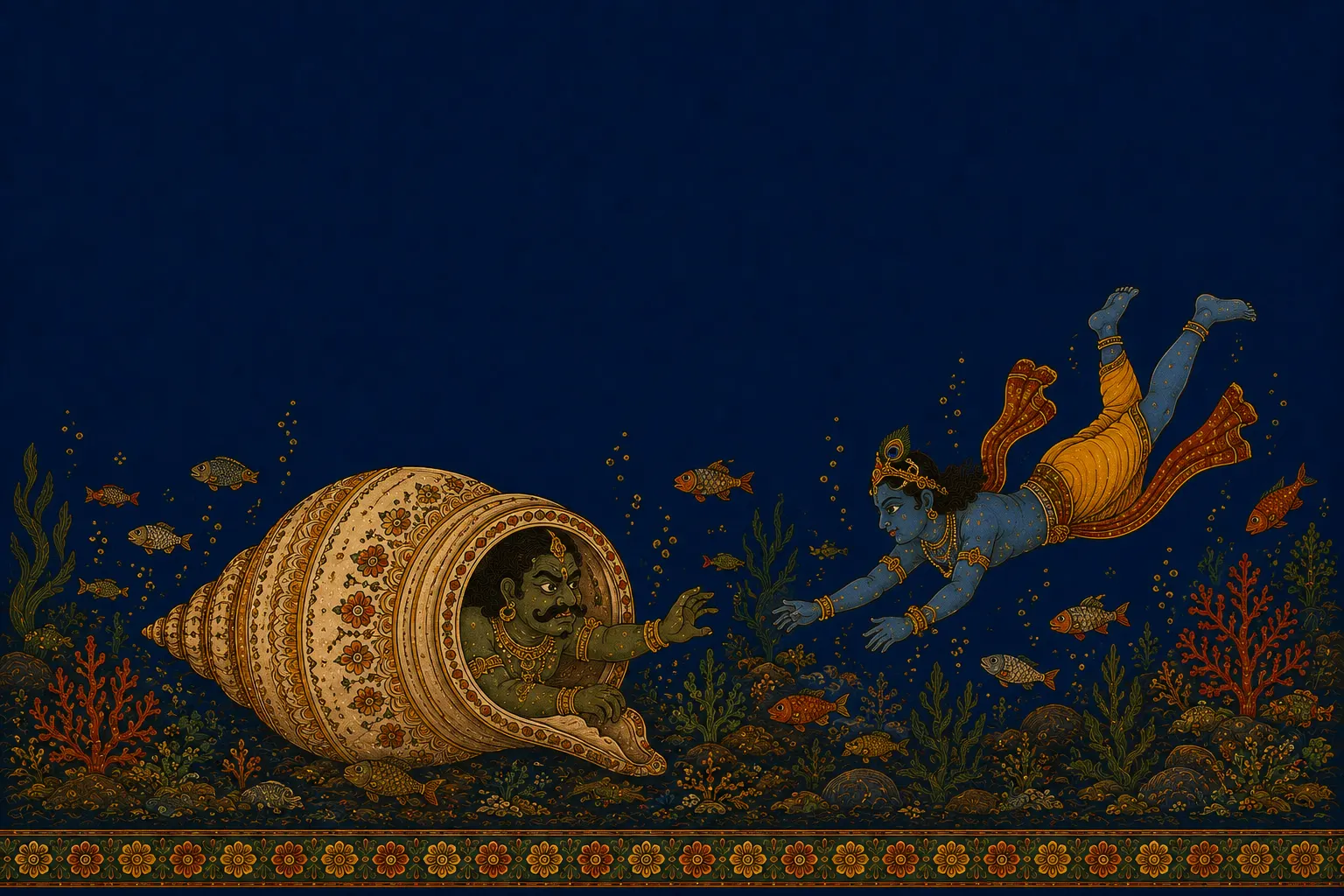
The two brothers went to Prabhasa and went straight to the sea.

On the sea floor lived an asura named Panchajana, hidden inside a huge conch. It was said he was the one who had picked the boy up from the shore that day.

Krishna found him and killed him. But inside him, or in his home, the boy was nowhere to be found.

What Krishna found was the conch — Panchajana's own body. He picked it up. That conch came to be called the Panchajanya, and on the field of Kurukshetra it was that same conch that sounded in Krishna's hand.

Where nobody returns from

Now it was clear where the boy was — in Yamaloka, the world of the dead.

The two brothers went there. At Yama's gate Krishna blew his conch, and Yama himself came forward. Krishna explained why they had come: they had promised to return their teacher's son as guru-dakshina. Yama gave the boy back.

They brought him to Avanti and stood him before the teacher, exactly the age he had been when he was lost. Their guru-dakshina was complete.

Note: This episode is found in the Bhagavata Purana, and there the search runs in two stages — first Panchajana under the sea at Prabhasa, and then Yamaloka. Note that these are not two separate traditions but two parts of one story. The Panchajanya conch takes its name from that same asura. Its exact chapter number in the Bhagavata could not be confirmed in this check (it is said to be around chapter forty-five of the tenth skandha), and how the Harivamsha and the Vishnu Purana give this episode is a separate thing to check.

Source: from several texts, Sandipani

Now — how much stayed with you?

What happened?

What did Sandipani's wife ask for as the teacher's fee?

  • Gold and cows
  • Land for the ashram
  • Her lost son, who had disappeared years before at Prabhasa, by the sea
  • That the two brothers stay on at the ashram
Read the whole story — What could not be asked for

In the tradition of the teacher's fee the student gives whatever the teacher asks, and this is exactly where the episode becomes extraordinary.

The asking was not for a test. It was a mother's asking, whose son had not come back.

With that one sentence this chapter leaves the story of a school and goes out to the sea and to the world of the dead.

Who am I?

I lived under the sea inside a conch, and I was accused of carrying off that boy. Who am I?

  • Kaliya
  • Jarasandha
  • Panchajana
  • Kuvalayapida
Read the whole story — The one who lived inside a conch

Panchajana is described in exactly this form — at the floor of the sea, hidden inside a conch.

Krishna kills him, but the boy does not turn up with him. Which is to say this turn does not end the story, it pushes it on.

The real result of this episode is not the boy but the conch that comes into Krishna's hands.

Fact

What name was the conch known by, that Krishna got after killing Panchajana?

  • Devadatta
  • Panchajanya
  • Anantavijaya
  • Sughosha
Read the whole story — The conch that sounded at Kurukshetra

This is the most interesting thing in the whole kanda: Krishna's most famous conch is not some divine weapon he was born with.

It came out of an asura's body, in this very chapter, in the middle of a journey undertaken to pay a teacher's fee.

Among the conches blown before the war begins in the Mahabharata, the Panchajanya is Krishna's — and its story is here, long before Kurukshetra.

Which is to say a "small" chapter goes on to connect to the greatest moment in the Mahabharata.

What happened?

When Panchajana was killed, where was the boy found?

  • He was inside the conch itself
  • He was lying unconscious on the shore
  • He had already returned to the ashram
  • He was not there at all
Read the whole story — Found out halfway

The story plays a trick here: the first target turns out to be wrong, and the search begins again.

Which is why this episode runs in two parts — first the sea, then the world of the dead — and it is one story, not two separate traditions.

This same sequence is found in the Bhagavata, with both stages joined together.

Who am I?

Nobody returns from my world. And yet that day a boy returned. Who am I?

  • Varuna
  • Indra
  • Yama
  • Brahma
Read the whole story — A journey to the world of the dead

This is one of the very few episodes where the story goes straight to Yamaloka and brings somebody back from there.

In some accounts there is a confrontation there too, and the boy is returned after an intervention.

Worth noticing: all of this is happening to pay a teacher's fee — not for any war or kingdom.

Why is that?

Why did the teacher's family ask for a fee that was impossible?

  • Because they knew Krishna was God
  • Because they needed nothing else
  • Because they wanted to test the two brothers
  • Because this was their real grief, and they asked for exactly that
Read the whole story — There was no move behind the asking

The power of this episode is that the ones asking are not being clever. A mother is naming her lost son.

Which is why this chapter is moving rather than miraculous — the miracle comes afterwards, the reason comes first.

And it is why a great symbol like the Panchajanya comes out of a journey made for a private grief.

Fact

According to the story, how many arts did the two brothers learn at the ashram?

  • Sixteen
  • Sixty-four
  • Eighteen
  • A hundred and eight
Read the whole story — The sixty-four arts

"The sixty-four arts" works almost as an idiom in Indian tradition for the complete list of knowledge and skill.

In the story it also means that the learning took no time at all — the real episode is not the studying, it is the fee.

While at the ashram the two brothers do the same work as any other student, and the story keeps this detail deliberately.

Riddle

I was once somebody's hiding place. Then I became something like a weapon, and the greatest of wars began with my voice. What am I?

  • Mount Govardhan
  • The Sudarshana chakra
  • The Panchajanya conch
  • Kaliya's hood
Read the whole story — From a hiding place to a declaration of war

The conch's journey is among the loveliest links in the storytelling tradition — an asura's dwelling, and then the beginning of a war.

In the Mahabharata conches are blown before the war, and in that scene the name of Krishna's conch is Panchajanya.

Which is why this chapter becomes a direct bridge between the Krishna-Leela and the Mahabharata.

Put it in order

What is the correct order of this kanda?

  • Yamaloka → the sea → the teacher's fee → the studying
  • The sea → the studying → Yamaloka → the teacher's fee
  • The teacher's fee → the studying → Yamaloka → the sea
  • The studying → the asking of the fee → the sea and Panchajana → Yamaloka → the boy's return
Read the whole story — Two stages, one journey

Worth noticing: the sea and Yamaloka are not separate stories. They are two stages of one search.

The first stage turns out to be wrong, but it is not wasted — that is where the conch comes from.

The second stage is the place returning from which is held to be impossible, and that is where the fee is paid in full.

Why is that?

Why, for all that it looks small, is this chapter so necessary to the story that follows?

  • Because this is where Krishna becomes king
  • Because this is where Dwarka is planned
  • Because this is where the Panchajanya conch enters the story, and it goes on all the way to the Mahabharata
  • Because this is where Balarama separates from him
Read the whole story — A small chapter, a long effect

On the face of it this is the "studies completed" chapter, and it is often told in a hurry.

But one of the most recognisable things about Krishna — his conch — comes from right here.

Links like this are what join the Krishna-Leela to the Mahabharata, and it is why reading either one alone stays incomplete.