
Kanda 17
The Syamantaka jewel
A jewel went missing, a man died, and the finger pointed at Krishna
What shines also draws suspicion
In Dwarka a Yadava named Satrajit had a remarkable jewel — the Syamantaka, given to him by Suryadeva himself. It was said to produce eight measures of gold each day and to protect the place where it was kept from famine, disease and misfortune.
Krishna advised Satrajit — "A jewel this great should not belong to one house. Put it in the royal treasury, so the whole kingdom benefits from it."
Satrajit refused, and kept the jewel in the shrine of his own house. People in Dwarka began to whisper: "See? Krishna wants the jewel for himself."
One piece of news did not come back from the forest
One morning Satrajit's brother Prasena rode out hunting on horseback, wearing that jewel round his neck. The day ended; he did not return.
By evening a crowd had gathered at Satrajit's door, and Satrajit was already naming a culprit. "Krishna wanted the jewel. I refused him over the treasury, and today my brother is gone. He must have had him killed, for the jewel."
The accusation spread quickly. Nobody asked for proof — the accusation was enough in itself. In the lanes of Dwarka Krishna's name began to be spoken like that of a thief and a killer.
The tracks found in the forest
Krishna decided to investigate the disappearance himself — not with accusations, but by following the evidence.
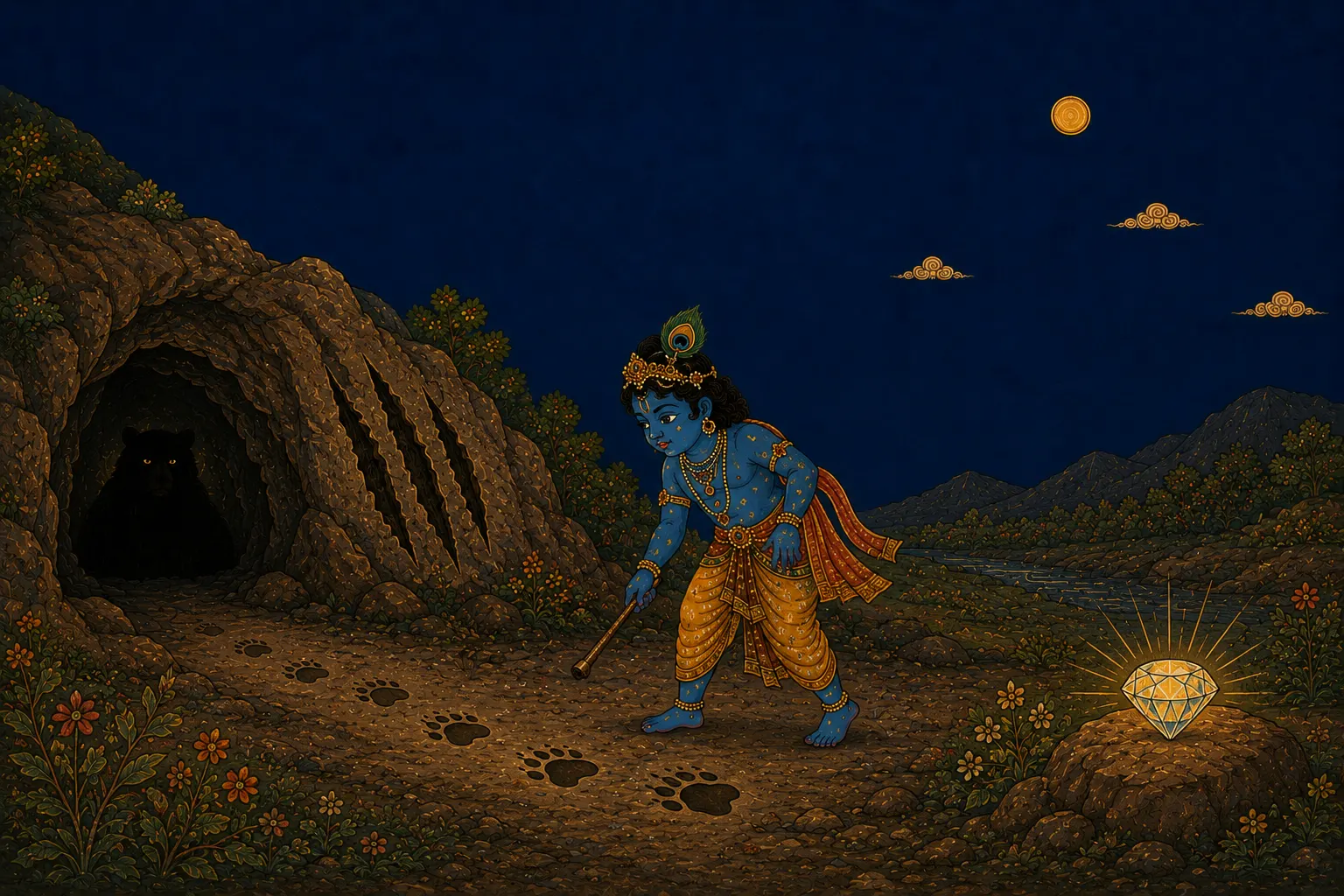
In the forest he picked up the hoofprints of Prasena's horse. At one place the horse and Prasena both lay dead — and from there, in place of a man's footsteps, a lion's pawprints led away.
He followed those pawprints. A little further the lion too lay dead — something else, something larger, had torn it open. And from that same place, the tracks of a much larger creature, straight towards a dark hill cave.
In the dark, for many days
Inside the cave, in a cradle, a small child was playing with the Syamantaka jewel — Jambavan's baby son, and a nurse had placed the shining stone in his hands to keep him occupied. Krishna stepped forward and asked for it, and the nurse screamed.
Out of the dark came a huge figure, roaring — Jambavan, king of the bears, the same who had once come to Rama's army to help build the bridge and fight. He did not recognise who was before him. "Who has come into my cave to lay a hand on this jewel!"
The fight began — fists thundered in the darkness and echoes rolled through the cave as the struggle went on day after day. On the twenty-eighth day the exhausted Jambavan stopped, and in the dark a recognition flashed in his eyes — this strength, this light, this is the one he had served in the Treta age. Jambavan lowered his weapons, and he bowed with folded hands.
Two marriages, and one man cleared
Jambavan returned the jewel, and with it gave the hand of his daughter Jambavati to Krishna.
Krishna returned to Dwarka and in the full assembly set the jewel before Satrajit — "Here is your answer. Your brother was killed by a lion, the lion by Jambavan. I have not come to take the jewel, but to tell you the truth."
Satrajit was overcome with shame. He apologised, and by way of amends wanted to give Krishna both the jewel and his daughter Satyabhama. Krishna accepted Satyabhama and returned the jewel. The story that had begun with a false accusation ended with two marriages.
Note: The whole story of the Syamantaka jewel is found in both the Vishnu Purana and the Bhagavata Purana. The two texts disagree on one point — the Vishnu Purana puts the search and the fight at twenty-one days, the Bhagavata Purana at twenty-seven or twenty-eight. No one number has been declared correct here; both are recorded.
Source: from several texts, The Syamantaka jewel