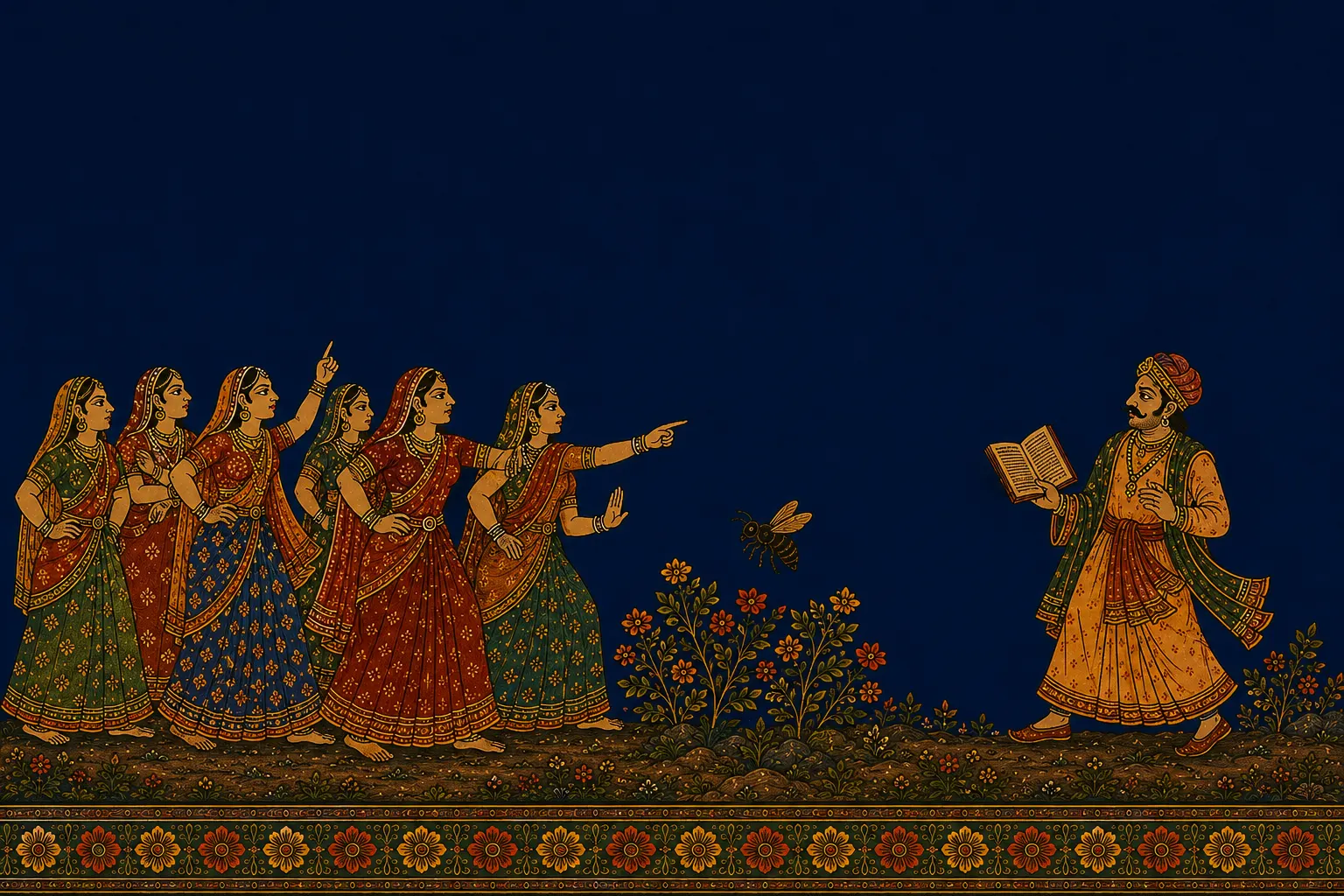
Kanda 13

Uddhava's message (the Bhramara-Gita)

Krishna sent a philosopher to explain. The gopis taunted him and sent him back

A learned messenger, a broken village

In Mathura Kamsa was dead, the old regime was gone. Krishna was now caught up in the affairs of Mathura, and had not gone back to Vrindavan — not in months, not in years.

In Vrindavan the gopis had stopped expecting to see him return. The sound of the flute now played only in memory.

Krishna sent his most trusted friend and counsellor Uddhava there — to explain that distance is nothing, that Krishna is everywhere, and that true devotion rises above form. Uddhava reached Vrindavan on his chariot, confident in the wisdom he had come to share — he had given this teaching hundreds of times in the court.

"Your knowledge comes from books"

"Meditate," Uddhava told the gopis. "Understand Krishna as formless, all-pervading. He has not gone anywhere. How can the one who is everywhere be far from you?"

One gopi laughed, and the rest behind her.

"That teaching may work for someone who has never touched Krishna, who has not heard that flute," she said, and the sharpness in her voice was plain. "Don't teach us the formless, Uddhava. Give us back our Krishna who has a colour, who has a laugh, who wears yellow silk. Your all-pervading Krishna is of no use to us." Uddhava had no answer to that.

A complaint to a bee

Just then a black bee began hovering among the nearby flowers. One gopi turned to it, and leaving Uddhava aside, began speaking to the bee.

"Come then, dark one. Sit down. You too are just like him — took the nectar of one flower and flew off; settled on the next. You were never made to belong to one flower for long. Go, tell that friend of yours that we don't want his messages."

Every line carried a reproach, and inside every reproach love was hidden. Uddhava stood listening. This was not only grief, not only complaint — it was both at once, and so sharp that all his learned arguments suddenly seemed small beside it.

A philosopher who returned as a student

That night Uddhava could not sleep. He said to himself what he had never thought before — that in his next birth he would rather be a vine of Vrindavan, a shrub, the dust here that these gopis' feet fall on. To him, that now seemed greater than being a god in some distant heaven.

In the morning he went back to Mathura. The chariot was the same, the driver was the same. But the man inside was not the one who had come — he had gone to teach, and returned as the one who had been taught.

Note: The Bhramara-Gita is firmly located at chapter level in the tenth skandha of the Bhagavata Purana, chapter 47. Identifying the gopi who addresses the bee by any particular name does not appear to be part of the original verses — that identification is held to belong to the later commentarial tradition, and it is stated here only that far and taken no further.

Source: from several texts, Uddhava's message (the Bhramara-Gita)

Now — how much stayed with you?

Who am I?

Krishna sent me to Vrindavan to explain that he is everywhere and that distance does not matter. When I returned I was not the same. Who am I?

  • Akrura
  • Balarama
  • Uddhava
  • Narada
Read the whole story — Uddhava, who went to teach

The episode is in the tenth skandha of the Bhagavata Purana, chapter 47. Uddhava was Krishna's closest friend and student, a firm follower of the path of knowledge.

He went to show the gopis of Vrindavan the "correct" road — formless meditation, rising above separation.

But seeing the gopis' direct, unreasoning love, he said himself that his knowledge stood small before such devotion. He returned asking for the dust that lay under the gopis' feet in Vrindavan.

Riddle

I am black, I hover here and there, I take nectar from flower to flower and fly off — and one day some women decided I was their beloved's messenger. Who am I?

  • A peacock
  • A bee (bhramara)
  • A parrot
  • A crow
Read the whole story — A glimpse of Krishna in a bee

In this same chapter of the Bhagavata Purana the gopis address the bee at length in reproach — you too are black like Krishna, you too wander flower to flower, you keep faith with nobody.

The reproach was really meant for Krishna, said under cover of the bee — the barb so sharp that a listener would both laugh and wince.

This same song-form was later used at length by poets like Surdas in their own compositions.

Fact

What was Krishna's purpose in sending Uddhava to Vrindavan?

  • To call the gopis to Mathura
  • To warn them of Kamsa's conspiracy
  • To explain to the gopis that Krishna is present everywhere in a formless way, and that distance does not matter
  • To give the gopis wealth
Read the whole story — Knowledge that bowed before love

In the Bhagavata Purana this mission of Uddhava's sets the non-dual path of knowledge against the path of love.

Uddhava explains that Krishna is not to be bound to body, form or place — he is in every heart. Intellectually the argument is strong.

But the gopis' answer was direct — such knowledge is only of use to somebody who has not lost anyone while drowning in love. Uddhava had no answer to this.

What happened?

After hearing Uddhava's formless teaching, what did the gopis do?

  • They decided to forget Krishna
  • They threw Uddhava out of Vrindavan
  • They quietly accepted it
  • Gently refusing what he said, they used the bee to pour out their separation and their reproach against Krishna in songs
Read the whole story — Answering knowledge with a song

The Bhagavata Purana shows that the gopis do not directly call Uddhava's argument wrong; instead they prove it small against their own experience.

Their point was: your formless Krishna comes from books; our Krishna is the one who played the flute, who played with us, and who has now left us and gone.

Reproach and devotion come together here — and it is that mixture that was called the Bhramara-Gita.

Put it in order

Which is the correct order of these events?

  • Uddhava's arrival → the formless teaching → the Bhramara-Gita → Uddhava returning changed
  • The Bhramara-Gita → Uddhava's arrival → the formless teaching → Uddhava's change
  • Uddhava returning changed → the Bhramara-Gita → the formless teaching → Uddhava's arrival
  • The formless teaching → Uddhava returning changed → Uddhava's arrival → the Bhramara-Gita
Read the whole story — A journey that turned around

The Bhagavata Purana weaves this whole episode as a kind of reversed journey — Uddhava came to teach, and went back having learned.

Beginning with formless knowledge, the story arrives at the songs of the Bhramara-Gita, and at the end Uddhava himself asks for the gopis' dust.

This order shows a large theme of the Krishna-Leela — the collision that appears to stand between knowledge and devotion usually ends in devotion's favour.

Why is that?

Why did the gopis not take up Uddhava's formless teaching?

  • Because they were angry with Krishna
  • Because their love rested on experience, not on argument
  • Because they did not trust Uddhava
  • Because Uddhava was speaking in Sanskrit
Read the whole story — Experience outweighing argument

In the Bhagavata Purana this episode reads like a debate between the path of knowledge and the path of devotion, and it leans towards devotion.

The gopis' argument is direct — to someone who remembers the sound of the flute and remembers a touch, being told "he is everywhere" is not consolation but provocation.

Uddhava had no refutation. Which is why he returned changed rather than winning the argument.

Fact

Which chapter of the Bhagavata Purana is this episode found in?

  • Chapter 90
  • Chapter 47
  • Chapter 16
  • Chapter 25
Read the whole story — Chapter 47, a different note in the story

In the tenth skandha of the Bhagavata Purana this chapter stands apart from a great many of the other events — no demon dies here, no hill is lifted.

The whole chapter rests on conversation and feeling — Uddhava's teaching, the gopis' reproach, and the conversation with the bee.

This same chapter later became a great source for the bhakti-poetry tradition (Surdas's verses among them).

Who am I?

I am the feeling that came into the gopis' songs carrying complaint and love at once — addressed to a bee. What was I called?

  • Rasa-lila
  • Kaliya-daman
  • Govardhan-lila
  • The Bhramara-Gita
Read the whole story — A name that came out of the story itself

The name Bhramara-Gita comes straight from this scene — bhramara means bee, and gita means the verses the gopis sang addressing it.

In the Bhagavata Purana this section is held to be very rich poetically, and later became something like an independent genre in Hindi devotional literature.

Several of Surdas's verses carry this same Bhramara-Gita tradition forward, taking up the same style of reproaching the bee — sharp, quick-witted, sometimes funny and sometimes cutting.

What happened?

At the end of the whole episode, what had changed inside Uddhava?

  • He held to the path of knowledge more firmly than before
  • He went back to Mathura angry with Krishna
  • He settled in Vrindavan
  • He came to hold the gopis' unconditional devotion higher than his own path of knowledge
Read the whole story — The teacher who became the student

According to the Bhagavata Purana, Uddhava went so far as to wish for the gopis' dust on his own head — saying that in his next birth he would rather be a creeper or the dust of Vrindavan than a god in some other world.

Coming from a great follower of the path of knowledge, this admission is perhaps the greatest tribute ever paid to the path of devotion.

He returned to Krishna and told him this experience exactly as it had been.

Why is that?

The gopi shown talking to the bee in the Bhramara-Gita is often called by a name. But what is true about the original Bhagavata text?

  • The original text plainly names that gopi as Radha
  • The episode centres on Yashoda rather than the gopis
  • The original Bhagavata text does not single out any one gopi by name
  • The original text says this gopi is Kubja
Read the whole story — A name that came from commentary

Chapter 47 of the Bhagavata Purana speaks of the gopis talking to the bee as a group — not singling any one out by name.

Later, commentators and the devotional tradition began to attach these verses particularly to one leading gopi, but that identification is not found directly in the original verses.

This difference is stated deliberately on this site — what is in the original text, and what the commentarial tradition added later, are two different things.