Kanda 6

The forest fire

This kanda belongs to the elder brother — but somebody else swallowed the fire

Talavana, where nobody went

The palm trees of Talavana were heavy with ripe fruit, yet none of the boys from Gokul dared enter. The reason was Dhenuka — an asura in the form of a donkey, who, with his companions, had taken over the entire forest. Anyone who went in to pick fruit, he killed with his kicks.

The boys put it to Balarama and Krishna — "There is so much fruit that the ground is covered with it, but no one can go in and eat any."

Balarama smiled. "Come on, then."

He caught a tree and shook it; ripe palm-fruit began to thud to the ground. Hearing the noise, Dhenuka came at a gallop, kicking.

Balarama did not step back an inch. He caught his two hind legs, swung him over his head, and flung him against a tall palm. Dhenuka struck the tree and was killed on the spot.

A stranger in the game

Some days later the boys were playing a game — the loser carried the winner on his back and ran to a fixed spot.

That day there was a new boy in the group. Nobody looked hard at him; he looked like any other boy in the game.

When his turn came he had to run with Balarama on his back. He ran — and kept running, past the fixed spot, away from the group, and faster, and faster.

Balarama, on his back, felt the body under him growing, getting heavier. This was not a boy. This was Pralamba, another asura sent by Kamsa.

Balarama struck him once on the head. Pralamba crashed to the ground and died. From this Balarama got one of his names — Pralambari.

And then the forest caught fire

One day the cows grazed their way far into the dry forest, and the boys went after them, looking. Evening was beginning to fall.

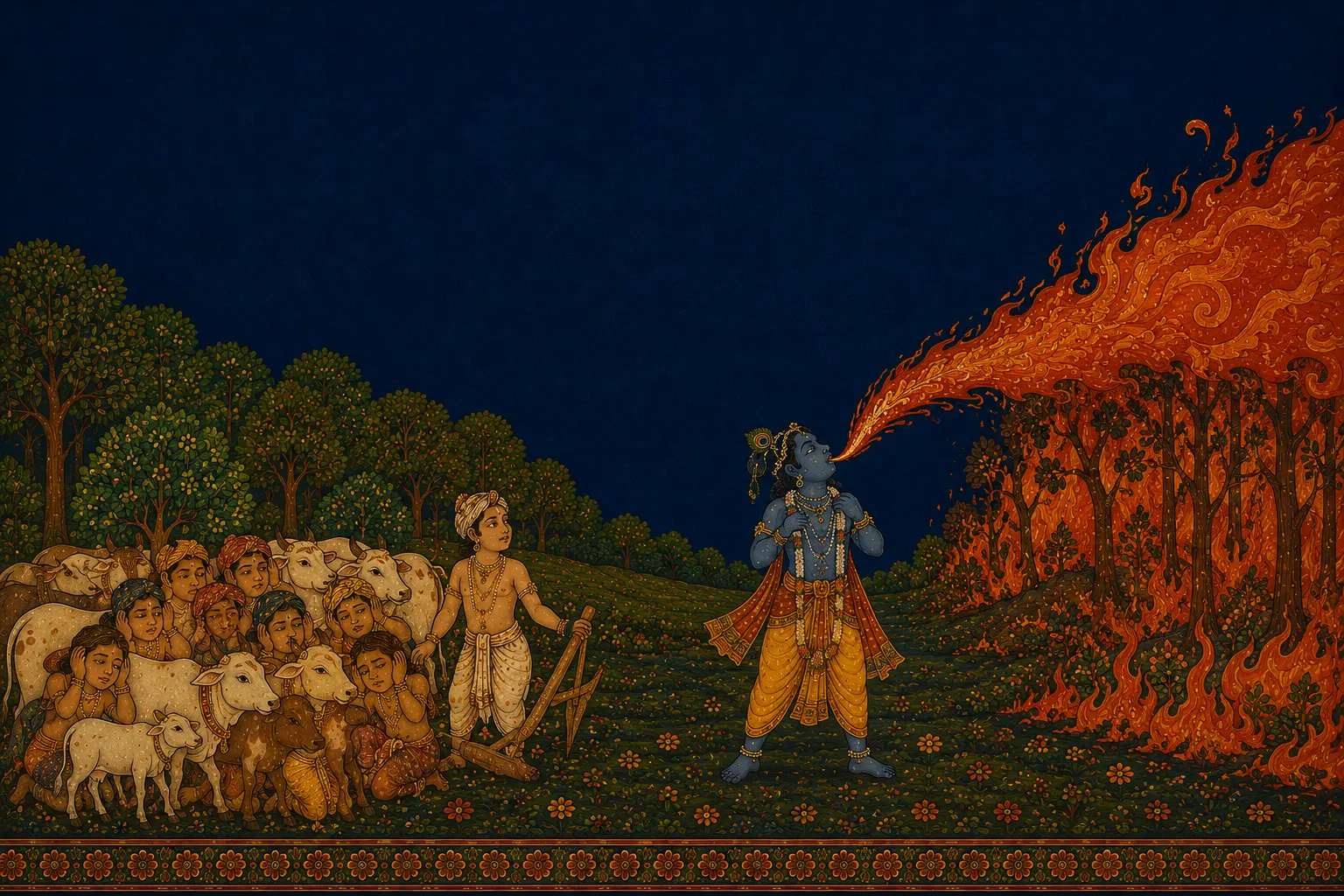
No one saw how the fire began. All they knew was that suddenly there were flames all around — in the dry Talavana a fire spreads faster than the wind — and in the middle of the ring, the cows and the boys.

The boys panicked. Smoke was filling their eyes, the cows were bellowing.

"Shut your eyes," somebody said — perhaps Krishna. "And don't open them until I say."

What happened, nobody saw

The boys shut their eyes. The heat was on their faces, then slowly it lessened, then it was gone.

"Open them now."

Their eyes opened, and the forest was quiet. No flames, no crackle, not even smoke. The cows stood there, safe.

Krishna had swallowed the entire forest fire in a single breath.

Two asuras died in this kanda, and both at Balarama's hands. But the moment everyone's life was saved was Krishna's. The two asura battles belong to Balarama; the final miracle belongs to Krishna.

Note: Dhenuka is killed by Balarama — this is found in both the Harivamsha and the Vishnu Purana, and the method described is almost the same in both. Pralamba too dies at Balarama's hands (mentioned in the Vishnu Purana and the Mahabharata; the eighteenth chapter of the Bhagavata's tenth skandha is also given to it). Swallowing the forest fire is Krishna's work and its firm location is the Bhagavata Purana — this same detail was not found in the Harivamsha in this check, so it cannot be called something every text says.

Source: from several texts, The forest fire

Now — how much stayed with you?

Who am I?

I had taken hold of a whole forest in the form of a donkey. In fear of me nobody would so much as pick a palm fruit. Who am I?

  • Kaliya
  • Putana
  • Dhenuka
  • Pralamba
Read the whole story — Fruit nobody could pick

In both the Harivamsha and the Vishnu Purana Dhenuka is killed by Balarama, and both describe almost the same method — catching the hind legs, swinging, and flinging him against a tree.

The Vishnu Purana also has the detail of the body being thrown up into a palm.

The real meaning of this episode is a small one, and that is what makes it interesting: it is not the story of some great war, it is the story of making a forest usable again.

Fact

Who killed Dhenuka?

  • Balarama
  • Nanda
  • Krishna
  • The band of cowherd boys together
Read the whole story — Balarama's share

Balarama often gets left behind in the Krishna-Leela, but this kanda is mostly his — two asuras, both at his hands.

In the Harivamsha the killing is described directly and physically: catching the legs, swinging, striking against the tree.

The Vishnu Purana has almost the same method, which is to say this detail is not one text's own invention.

What happened?

How was Pralamba caught out?

  • Krishna had already recognised him and stopped him
  • The gopis recognised him
  • He revealed his own form
  • In the game he ran off with Balarama on his back, away from the group, and Balarama understood that what was under him was not a boy
Read the whole story — A hunt hidden inside a game

Both the Vishnu Purana and the Mahabharata make Pralamba's death Balarama's work. The eighteenth chapter of the Bhagavata's tenth skandha is also given to it.

The trick was a clever one — the loser carries the winner on his back, which is to say the prey climbs onto the hunter's back of its own accord.

He was caught out because he did not stop. Running was his mistake.

Riddle

No weapon killed me, no mantra put me out. I was simply drunk. What am I?

  • The forest fire
  • The poison of the Yamuna
  • Putana's poison
  • Indra's rain
Read the whole story — The scene of swallowing the fire

In the tenth skandha of the Bhagavata Purana this episode comes almost twice — once in the seventeenth chapter, and again in the nineteenth as the fire at Munjavana.

The manner of the scene is unlike the other fights: no collision, no weapon. The children shut their eyes, and when they open them everything is quiet.

This detail of swallowing the fire was not found in the Harivamsha in this check, so it should not be treated as something every text says.

Fact

Who saved the cows and the children from the fire?

  • Balarama
  • The fire went out by itself
  • Nanda and the cowherds together
  • Krishna
Read the whole story — Whose kanda, and whose moment

This whole section is often called "Balarama's kanda", and by the count that is fair enough — Dhenuka and Pralamba, both his.

But the moment everyone's life hung on is Krishna's. The name belongs to the elder brother, and the greatest work to the younger.

This division between the two brothers continues later as well — Balarama has strength, and Krishna has the thing that has no name.

Who said it?

"Come on, then." — who said this, setting off towards Talavana?

  • Nanda
  • Krishna
  • Balarama
  • The head of the cowherds
Read the whole story — Settled in two words

This kanda does not begin with any plan — the boys want fruit, and the elder brother stands up.

Balarama's character is built this way: few words, direct work.

The same manner shows in the Pralamba episode too — one blow the moment he recognises him, and it is over.

Why is that?

Why did the boys go to Talavana at all, when everyone knew there was danger there?

  • Because the palm fruit was lying there loaded, and nobody could pick it
  • Because they wanted revenge on Dhenuka
  • Because Kamsa had sent them
  • Because the cows had gone that way
Read the whole story — A small reason, a large result

The story claims no great purpose here. The boys wanted to eat fruit.

That plainness is what sets these episodes apart from the rest of the epic — here the fights are not for a kingdom, they are for pasture and fruit.

The result comes out large anyway: a whole forest returns to Gokul's use.

Fact

Which skandha of the Bhagavata Purana are all these episodes in?

  • The seventh
  • The twelfth
  • The tenth
  • The ninth
Read the whole story — One skandha, many stories

The Bhagavata's tenth skandha is like a whole text on its own — ninety chapters, and nearly the entire story of Krishna inside it.

This kanda's cluster lies there in order: Dhenuka, Kaliya, the forest fire, Pralamba, and then the fire at Munjavana.

Which is why it is more accurate to treat these episodes as links in one chain rather than as separate stories.

Put it in order

What is the correct order of this kanda's events?

  • Dhenuka → Pralamba → the forest fire
  • Pralamba → the forest fire → Dhenuka
  • Dhenuka → the forest fire → Pralamba
  • The forest fire → Dhenuka → Pralamba
Read the whole story — Two fires, much alike

The room for confusion is real — the fire episode comes once in the seventeenth chapter of the Bhagavata and again in the nineteenth, under the name of Munjavana.

Which is why the order shifts a little between different tellers.

The order taken here follows the Bhagavata's chapters: Dhenuka (15), the fire (17), Pralamba (18), and then Munjavana (19).

Why is that?

Why is this kanda called "Balarama's kanda", when the greatest work is Krishna's?

  • Because both asuras of this section
  • Because Balarama put the fire out as well
  • Because Krishna is not present in this kanda at all
  • Because Balarama is the elder brother and the name goes to him
Read the whole story — How the two brothers divide it

Reading this kanda it is plain that the story gives the two brothers different kinds of power.

What Balarama does can be seen and understood — catching, swinging, striking.

What Krishna does is never given a method. The children shut their eyes, and when they open them there is no fire.