
Parva 1
Adi Parva
A river, a fisherman's daughter, and a line that almost ended before it began
How the story begins
This story was first told at a sacrifice, and the sacrifice was an act of revenge.
King Janamejaya's father, Parikshit, had died of the bite of a snake named Takshaka. To avenge him, the son held a snake sacrifice, a rite in which the mantras drew snakes from across the earth helplessly into the fire.
The fire burned. The snakes fell. And in that very assembly, Vyasa's disciple Vaishampayana began telling Janamejaya the story of his own lineage. Much later, a bard named Ugrashrava told the same story again to a gathering of sages in the Naimisha forest. So the Mahabharata is, from its very beginning, a story within a story, someone telling it to someone, having himself heard it from someone else. Vyasa is regarded as its author, but he is also a character inside it.
Ganga's condition
The story turns back to Shantanu, king of Hastinapura. One day, on the bank of the Ganga, he saw a woman and proposed marriage. She agreed, but on one condition, Shantanu would never stop her from doing anything, and never ask why she did it. The day he questioned her, she would leave. Shantanu agreed.
Their first son was born. Ganga carried him to the river and let him go into the water. Shantanu said nothing. The same happened with the second, then the third, the fourth, all the way to the seventh. Each time Shantanu stayed silent, because he knew that questioning her meant she would leave. But at the eighth child, he could not hold himself back.
Then Ganga explained. All eight infants were Vasus, gods who had been cursed to be born as mortals. Seven were freed from that life the moment they were born. The eighth had to live a full human life. That child was Devavrata, who would later be called Bhishma.
Bhishma's vow
Years later Shantanu fell in love with Satyavati. Her father set a condition on the marriage, that only her son could become king of Hastinapura. Shantanu already had a worthy heir in Devavrata, so he said nothing and went home.
Devavrata learned the reason for his father's sorrow and went himself to Satyavati's father. He said he would never claim the throne. The answer came back, your sons might. So Devavrata took a second, far heavier vow, that he would never marry, and would have no children at all. It was this terrible vow that earned him the name Bhishma. Shantanu, moved, granted him a boon, that he could choose the hour of his own death.
Vyasa's three sons
Satyavati's two sons in turn became kings, but both died without heirs. The line was about to end when Satyavati revealed an old secret. Before her marriage, she had borne a son to the sage Parashara, Vyasa. Vyasa was summoned. Through the custom of niyoga, Dhritarashtra was born to Ambika, Pandu to Ambalika, and Vidura to a serving woman. Dhritarashtra was blind from birth, so Pandu became king. Vidura could never be king, but he would go on to give the clearest, hardest counsel in the whole story.
Then Pandu's life took a turn. Out hunting, he shot an arrow at a deer, which was in fact the sage Kindama in that form, together with his wife. Dying, the sage cursed him, that the moment Pandu came together with his wife, he would die. Pandu gave up the throne and went to the forest.
But Kunti held a mantra given to her by the sage Durvasa, one that let her summon any god. Before her marriage, simply to test whether it truly worked, she had called upon the Sun. A son was born to her, wearing armor and earrings from birth. Unmarried and afraid, Kunti set the child adrift on the river in a basket. A charioteer couple, Adhiratha and Radha, raised him. That child would become Karna.
In the forest, the same mantra gave Pandu his children. Yudhishthira was born of Dharma, Bhima of the wind-god, and Arjuna of Indra. Madri called on the Ashvins and bore Nakula and Sahadeva. The five brothers grew up there. Then Pandu's curse came due, and he died. Kunti brought the five boys back to Hastinapura, where the Pandavas grew up alongside Dhritarashtra's sons, and where Duryodhana's insecurity grew with them, since Yudhishthira was the elder and had the stronger claim to the throne.
Drona and Drupada
The princes' education fell to Dronacharya. Drona's own story began with a broken promise. As boys, he and Drupada, prince of Panchala, had studied together, and Drupada had said that when he became king, half the kingdom would be Drona's. Years later, Drona arrived poor and reminded him. Drupada, now king, refused to honor the old friendship. Drona went home, but did not forget the insult.
Ekalavya's thumb
Around this time Arjuna emerged as Drona's most gifted student. Drona promised to make him the greatest archer alive. Then a Nishada youth, Ekalavya, came asking to be taught. Drona refused him. Ekalavya went into the forest, made a clay image of Drona, and practiced alone before it. When Drona later saw his extraordinary skill, he asked for a fee, the thumb of his right hand. Ekalavya cut it off and gave it without hesitation, and never shot the same way again.
The text does not say Drona was right. It simply records what happened, and that the promise had been made to Arjuna.
Karna crowned king of Anga
In the princes' public exhibition, Arjuna stood out above the rest. Then Karna stepped onto the field and challenged him. His birth was questioned, since a duel with a prince required royal standing. In that moment Duryodhana crowned Karna king of Anga. Karna asked what he wanted in return. Duryodhana asked only for his friendship, a friendship that would keep Karna bound to that side until the very last days of the war.
When the training ended, Drona asked for his fee, bring Drupada to me as a prisoner. Arjuna defeated Drupada and brought him before Drona, who took half his kingdom and said that now they were equals, and friendship was possible. Drupada returned home, carrying his humiliation with him. He performed a sacrifice to gain a son who could kill Drona. From that same fire came Dhrishtadyumna, and Draupadi.
The house of lac
Duryodhana now plotted to remove the Pandavas. A grand house was built for them at Varanavata, handsome to look at, made of lac, ghee, and other flammable things — that is why it was called the house of lac. Vidura warned Yudhishthira in signs. The Pandavas secretly had a tunnel dug. One night the house caught fire, and the Pandavas escaped with Kunti through the tunnel. In the morning, charred bodies were found, and everyone believed the Pandavas were dead.
Believed dead by the world, the Pandavas now wandered the forests in disguise. There the demon Hidimba attacked them, and Bhima killed him. Hidimba's sister Hidimba was drawn to Bhima. With Kunti's consent they married, and their son Ghatotkacha was born.
Draupadi's swayamvara
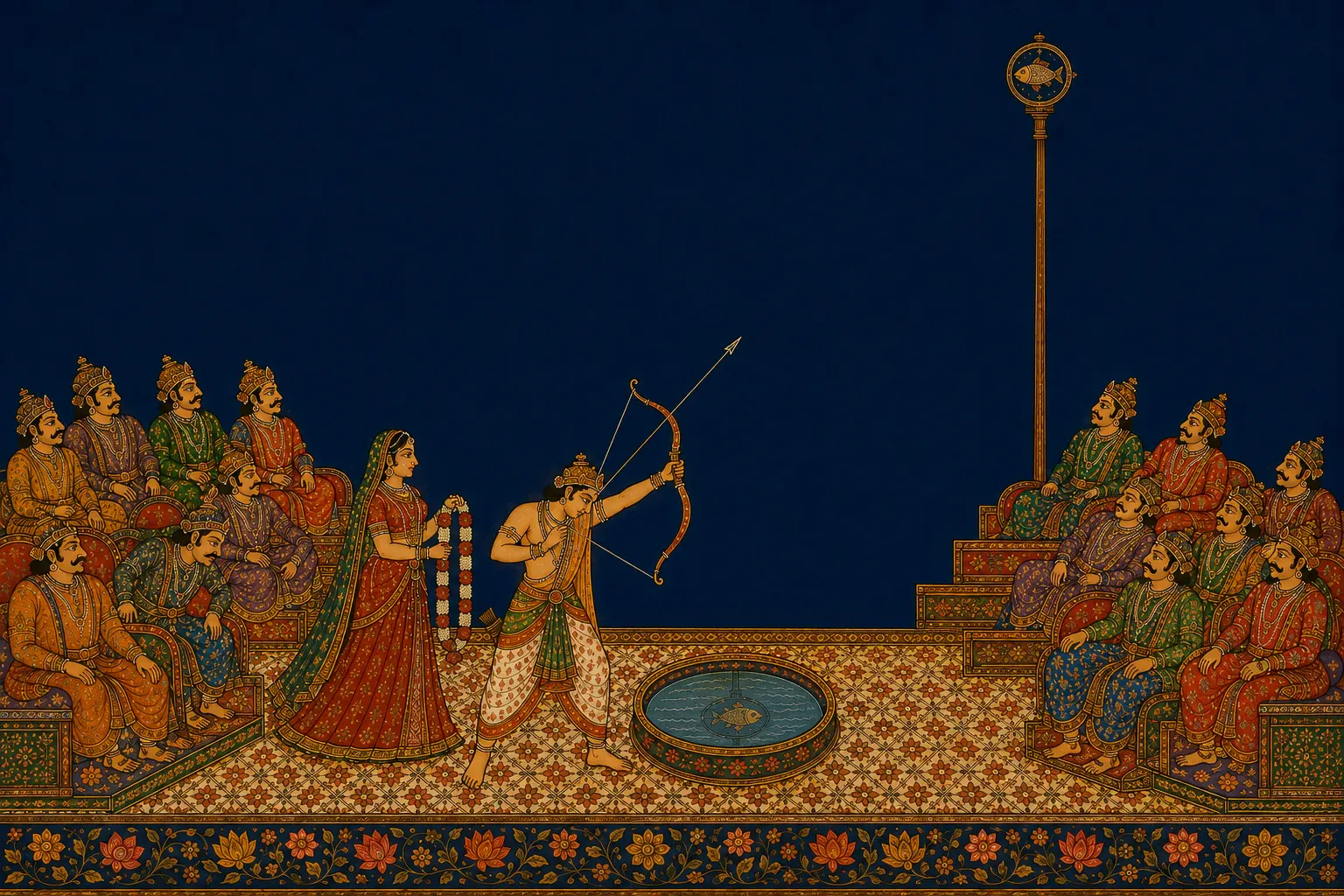
Some time later, Draupadi's swayamvara was held in Panchala. The test was hard, a fish turning above, water below. The archer had to aim by its reflection. Great kings failed. Then Arjuna, disguised as a Brahmin, rose and struck the mark. The Pandavas brought Draupadi home. Kunti, without looking, said, whatever you have brought, share it among yourselves. By the time she saw what her sons had brought, the words were already spoken. Vyasa later justified the marriage, and Draupadi became wife to all five Pandavas.
This is the strangest thing in the text, and the Mahabharata does not hide it. It tells it plainly, and returns to question it more than once.
Indraprastha
Once it was known that the Pandavas were alive, the question of power in Hastinapura opened again. In the end Dhritarashtra divided the kingdom. The Pandavas received Khandavaprastha, a barren, difficult tract of land. They settled it and made it Indraprastha.
The brothers had agreed on a rule among themselves: while one was with Draupadi, no other would enter. Whoever broke it would spend twelve years in the forest. One day Arjuna needed a weapon and walked into the room where Yudhishthira and Draupadi were. The reason was good, but the rule was the rule. Arjuna accepted twelve years of pilgrimage as the penalty. On this journey he married Ulupi, then Chitrangada, and later Krishna's sister Subhadra. Chitrangada bore Babhruvahana, and Subhadra bore Abhimanyu, who would go on to be at the center of one of the most decisive moments of the story at Kurukshetra.
After returning to Indraprastha, one more event took place, essential to understanding how the next parva begins. To help Agni, Krishna and Arjuna set fire to the Khandava forest. Among those who escaped the blaze was the demon Maya. Arjuna let him live. Grateful, Maya said he would build something for the Pandavas in return, the very assembly hall that would soon make Indraprastha famous.
It is from here that Krishna, too, becomes a permanent presence at the center of the story. He is kin to the Pandavas through Kunti, but far more important is this, that from here on, at every major turning point, he will be found standing beside some decision, sometimes as charioteer, sometimes as envoy, sometimes as counsel, and sometimes as the one person who sees the hidden way when no one else can.
Note: Shantanu and Ganga, the eight Vasus, Bhishma's vow and the boon of death at will, the three sons through Vyasa, Ekalavya's thumb, the house of lac, Draupadi's swayamvara and the burning of Khandava are all in the Adi Parva of Vyasa's Mahabharata. Ganesha writing the epic down, however, is not in the critical edition. Vyasa dictating while Ganesha wrote without stopping his pen comes from later tradition, and today it is one of the most repeated things about the epic. Draupadi's marriage to five brothers is in the text, and the text itself questions it in several places — nothing is concealed. In the Ekalavya episode the text offers no defence of Drona; it simply records what happened. The detailed form of the swayamvara test — the reflection in the water and the eye of the turning fish — is best known from the later retelling traditions; the critical edition describes the device and the target far more plainly.
Source: Mahabharata (ascribed by tradition to Vyasa), Adi Parva