Parva 15

Ashramavasika Parva

The old people leave Hastinapura, and one night the dead come back

Into the forest

Fifteen years passed. Dhritarashtra and Gandhari went on living in Hastinapura, among the very people who had killed their hundred sons, seeing those same faces every morning. Bhima never let them forget it, dropping some remark now and then that reminded Dhritarashtra who had killed whom, as if an old wound were never allowed to fully close.

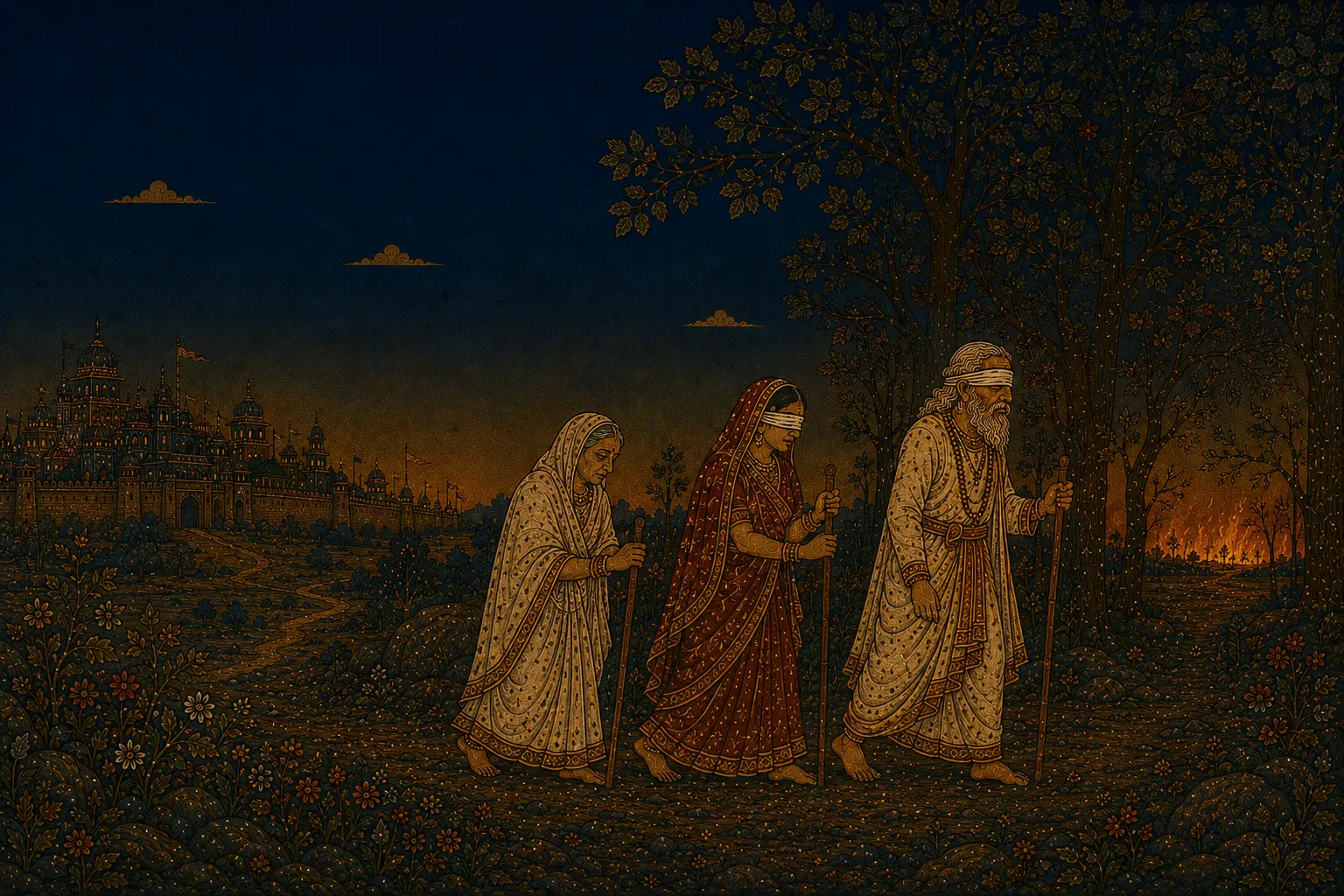
One day Dhritarashtra said he would go to the forest. Gandhari went with him. And so did Kunti. No one had asked her to, her own sons ruled the kingdom, every comfort of the palace was hers, but she chose this herself, to live out her days with the blind couple whose sons had been killed, as though she meant to spend the rest of her life in someone else's grief. Yudhishthira tried to stop her, pleaded with her, she would not stay.

The end of Vidura

Vidura too left palace life behind and took up harsh austerities in the forest. Sometime later Yudhishthira went to see him. Vidura had grown very frail. He looked at Yudhishthira without speaking, as though words no longer served any purpose. Then he gave up his body there. The story says his radiance passed into Yudhishthira, since the two of them were tied to Dharma itself, as if two streams had finally become one.

One night's meeting

Some time after, the Pandavas went to the forest to see them. Vyasa was there. For one night he summoned back the dead, an extraordinary act, rarely repeated. That night they rose from the river, Bhishma, Drona, Karna, Abhimanyu, Draupadi's five sons, Duryodhana and his brothers, men who only the day before had thirsted for each other's blood. There was no quarrel. There were no sides. Everyone met their own, talked, recalled old times, even laughed, and returned before dawn. It is the strangest and gentlest scene in the whole Mahabharata, one night after the war in which there was no war at all.

The forest fire

Two more years passed. One day a fire broke out in the forest, spreading fast. Sanjaya was with them. Dhritarashtra told him to get out, to save himself. Sanjaya escaped, and he alone survived that fire to tell what had happened there. Dhritarashtra, Gandhari, and Kunti all died in that same fire. They made no attempt to flee, as though this ending too had been their own choice.

Note: Dhritarashtra and Gandhari going to the forest, Kunti going with them by her own choice, Vidura leaving his body, Vyasa calling up the dead for one night, all three dying in the forest fire and Sanjaya surviving it are all in the Ashramavasika Parva of Vyasa's Mahabharata. Kunti's going is her own decision in the text, not something told to her by anyone — and it is the least repeated thing in this book.

Source: Mahabharata (ascribed by tradition to Vyasa), Ashramavasika Parva

Now — how much stayed with you?

Why is that?

Why did Kunti go to the forest with Dhritarashtra and Gandhari rather than live in her own sons' kingdom?

  • Because Yudhishthira sent her
  • Because she was ill
  • Because she did not like the court
  • She chose it herself, to be with the blind couple whose sons had been killed
Read the whole story — The one who went along

All five of Kunti's sons were alive and ruling. All hundred of Gandhari's were dead.

Kunti chose the forest. The Mahabharata does not explain the decision.

This is the same woman who set Karna on the water after his birth, and went to meet him before the war.

Her end comes in a forest fire, with Dhritarashtra and Gandhari — that is, not with her sons.

What happened?

What happened to Vidura in the forest?

  • He died in the fire
  • He left his body while looking at Yudhishthira; it is said he entered into him
  • He returned to Hastinapura
  • He went to the Himalaya with Sanjaya
Read the whole story — Two who were one

Vidura and Yudhishthira are both held to be portions of dharma.

The Mahabharata never states this emphatically. It joins the two here, in this one scene.

Through the whole book Vidura is the man who says the right thing and is not listened to — in the assembly of the dice, in the assembly of the peace, everywhere.

His end comes without a word. He simply looks, and goes.

Riddle

I am a night. In me the dead came back, without weapons and without enmity, and left at daybreak. Who made me possible?

  • Krishna
  • Gandhari
  • Vyasa
  • Dhritarashtra
Read the whole story — One night, without enmity

From the water of the Ganga rose Bhishma, Drona, Karna, Abhimanyu, Duryodhana and his brothers, Draupadi's five sons — all of them.

Men who had spent eighteen days killing each other were together that night. Not one of them had a weapon.

At daybreak they all went back. Vyasa told the widows that any who wished to go with their husbands should walk into the Ganga — and some did.

It is the one scene in the Mahabharata where the dead come forward for a night on no condition at all, and the purpose is only to lessen grief.

Fact

How did Dhritarashtra, Gandhari and Kunti die?

  • In a forest fire
  • Of illness
  • After returning to Hastinapura
  • By walking into the Ganga
Read the whole story — The ones who stayed in the forest

They lived two more years in the forest. Then the fire came.

The text says they did not try to escape, and Narada explains afterwards that the fire had spread from Dhritarashtra's own sacrificial fire. It is not presented as an accident.

Sanjaya was there at the time and got out. He went towards the Himalaya, and does not appear in the Mahabharata again.

Dhritarashtra's end comes here — the same man who, in the first parva of the war, refused to see and chose to listen.