Parva 14

Ashvamedhika Parva

The greatest sacrifice anyone had seen, and the mongoose who was unimpressed

The decision to sacrifice

The kingdom had been won, the teaching had been given, and Yudhishthira was still in grief. Vyasa and Krishna told him to perform the Ashvamedha, the horse sacrifice. That, they said, was the way forward.

The Anugita

Before that, one more thing happened. Arjuna told Krishna that he no longer remembered clearly what he had said before the war, and asked him to say it again. Krishna said that moment belonged to itself and could not be repeated exactly. So he explained the same matter a second way. This is the Anugita, not a repeat of the Gita, but an admission that some things are complete only in their own moment.

The birth of Parikshit

Uttara's child was born dead, the same one struck in the womb by Ashwatthama's weapon. Krishna brought him back to life. He was named Parikshit. This child was the only heir left to carry forward the Kuru line. It is his son, Janamejaya, at whose sacrifice this very story is being told.

The horse's journey

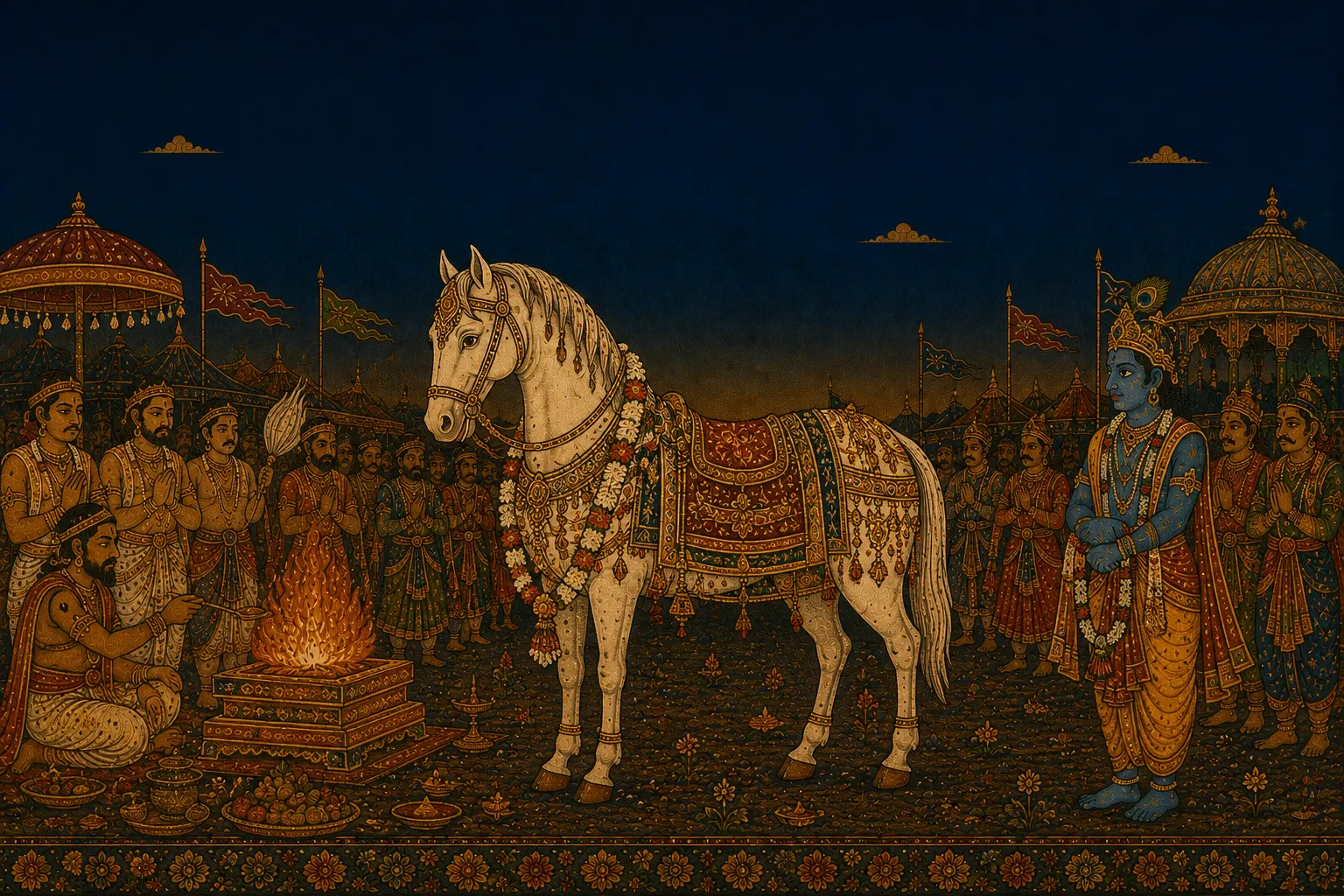
Then the horse was released. In the Ashvamedha the horse was set loose to wander freely. Any kingdom it crossed unopposed was taken to have accepted Yudhishthira's supremacy. Whoever stopped it would have to fight. Arjuna followed it with an army. Battles broke out in several places. The horse reached Manipura, where Arjuna's own son Babhruvahana, born of Chitrangada, was king. Knowing Arjuna was his father, he came out with Brahmins and gifts, bowing his head.

Arjuna did not take this well. He said this was no way for a kshatriya to behave, the sacrificial horse had entered his land, and instead of fighting, he stood there with offerings. Babhruvahana said nothing. Then Ulupi tore through the earth and appeared, the serpent princess, Arjuna's second wife and Babhruvahana's stepmother. She told Babhruvahana to fight. She had a reason no one else standing there knew. The Vasus had cursed Arjuna, for bringing down Bhishma from behind Shikhandi, that he would fall at the hands of his own son, and only then would the debt be cleared. Ulupi was making sure that curse played out here, so it could finally be finished.

They fought, and Arjuna fell. Babhruvahana fell too. Then Ulupi sent for the Mritasanjivani gem from the serpent realm and brought Arjuna back to life. When Arjuna heard the whole story, he was not angry.

The half-gold mongoose

The horse returned. The sacrifice was performed. Vast gifts were given. Everyone said no sacrifice like this had ever been held before. Then a mongoose appeared. Half its body was gold. It rolled on the sacrificial ground, then rose and said this sacrifice did not equal even the handful of barley meal he had once seen given. And he told the story.

A Brahmin's family had gone hungry for days. With great difficulty they had gathered a little barley meal, and the four of them were just sitting down to share it when a guest arrived. The Brahmin gave his own share, the guest's hunger was not satisfied. Then the wife gave hers, then the son, then the daughter-in-law. All four shares were gone, and all four remained hungry. Then the guest revealed his true form, he was Dharma. He granted all four passage to heaven on the spot, and all four went there at once.

The mongoose said that rolling in the grains of that same barley meal scattered on the ground had turned half its body to gold. He had come to this sacrifice hoping the other half would turn gold too. It did not. This tale comes at the very end of the Ashvamedhika Parva, and after the whole vast sacrifice, its effect is exactly this, it stops the reader precisely where he thought everything was already complete.

Note: The Anugita, the birth and revival of Parikshit, the rule of the Ashvamedha, the Babhruvahana episode and the mongoose story are all in the Ashvamedhika Parva of Vyasa's Mahabharata. In the Anugita Krishna says plainly that he cannot repeat the Gita — this is in the text, and it is an unusual thing in itself. The mongoose story comes at the very end, after the whole account of the sacrifice — and there it becomes the answer to the whole book.

Source: Mahabharata (ascribed by tradition to Vyasa), Ashvamedhika Parva

Now — how much stayed with you?

What happened?

Arjuna asked Krishna to give him the Gita again. What did Krishna do?

  • He said that speech belonged to that moment and could not be repeated as it was; then he had another conversation
  • He recited the Gita again
  • He refused and said nothing
  • He told him to ask Vyasa
Read the whole story — The second Gita

Arjuna said he had not properly kept what he heard at the edge of the war.

Krishna's answer says something in itself — that teaching was bound to its moment, and moments do not return.

What he said instead is the Anugita. It is not like the Gita — not as tight, and nowhere near as well known.

So the great conversation between Krishna and Arjuna happens twice in the Mahabharata, not once. Almost nobody knows the second.

Whose son?

I am Arjuna's son, and I struck my father down in battle. Who am I?

  • Abhimanyu
  • Iravan
  • Babhruvahana
  • Ghatotkacha
Read the whole story — A son found behind a horse

The rule of the horse sacrifice was exactly this — wherever the horse goes, either accept the claim on that land or fight.

At Manipura the one who stopped it turned out to be Arjuna's own son, whom he had not seen in years.

Babhruvahana struck him down. Then Ulupi came with a naga jewel and Arjuna was restored.

Fathers and sons face each other repeatedly in the Mahabharata — Drona and Ashwatthama, Karna and Vrishasena, Arjuna and Abhimanyu. This is the one where both survive.

Who am I?

I was born dead, and Krishna gave me life. The line continued through me. Who am I?

  • Janamejaya
  • Parikshit
  • Babhruvahana
  • Abhimanyu
Read the whole story — One child, and everything resting on him

Ashwatthama had turned the brahmashira towards Uttara's womb, and the child was born dead.

Krishna gave him life. Draupadi's five sons had all been killed, so there was one thread of the line left.

Parikshit becomes king of Hastinapura afterwards, and his son is Janamejaya.

And that closes the circle — this whole story is being told at Janamejaya's snake sacrifice.

Riddle

I am an animal. Half my body was gold, and I said this whole sacrifice was not equal to a handful of barley meal. What am I?

  • A deer
  • A horse
  • An owl
  • A mongoose
Read the whole story — A handful of barley meal

The mongoose said that in a famine a poor family had given a guest their own share of barley meal.

Rolling in the flour left over in that house had turned half its body to gold.

Hoping to turn the other half, it came to this vast sacrifice, rolled on the ground, and nothing happened.

The Mahabharata places this story right at the end of its greatest royal occasion, and makes no comment on it.

Why is that?

Why did Yudhishthira perform the horse sacrifice?

  • Because Vyasa and Krishna gave it as the road for his grief after the war
  • Because he wanted more kingdom
  • Because every king had to do it by custom
  • Because Bhishma had said so
Read the whole story — A grief that does not go

Even after the whole teaching of the Shanti and Anushasana Parvas, Yudhishthira's mind was not at rest.

The form of the horse sacrifice is a form of conquest — a horse is set loose, and wherever it goes that land counts as the king's.

But the reason given here is not conquest but atonement. A man who has won wants to be rid of his winning.

And at the end a mongoose comes and says all of it was not equal to one day's giving in a poor house.

Fact

What was done with the horse in a horse sacrifice?

  • It was sacrificed at once
  • It was kept in a temple
  • It was set loose, and wherever it went that land counted as the king's; whoever stopped it was fought
  • The king rode it himself
Read the whole story — One horse, and an army behind it

The horse was released and an army followed it. The horse's road was the road of the claim.

Any king who stopped the horse had to fight. So the sacrifice was as political as it was religious.

Arjuna fought in several places on this journey — Trigarta, Sindhu, Manipura.

In Sindhu he faced Jayadratha's house — the family of the king he had already killed.

Put it in order

Which is the right order of these events in the Ashvamedhika Parva?

  • The Anugita → the mongoose → Parikshit's birth → the horse's journey
  • The Anugita → Parikshit's birth → the horse's journey → the mongoose
  • Parikshit's birth → the Anugita → the horse's journey → the mongoose
  • The horse's journey → the Anugita → Parikshit's birth → the mongoose
Read the whole story — A parva after the winning

From outside, the Ashvamedhika Parva looks like a parva of victory — a sacrifice, a horse, conquest in all directions, gifts.

But both its ends say something else. At the start is a man whose grief will not go; at the end a mongoose that calls the whole occasion small.

In the middle a stillborn child is brought to life, and the whole line rests on him.

The parvas after this get shorter fast, and the story moves steadily towards its ending.