Parva 6

Bhishma Parva

Ten days when no one could get past Bhishma — and the night he told them how

Sanjaya's sight

Dhritarashtra was blind, and wanted to know everything of the war. Vyasa offered to grant him sight. He refused, saying he did not wish to watch his sons die with his own eyes. Vyasa then gave that sight to Sanjaya instead. Sanjaya could see everything happening in the war, however far away, and would relay it to Dhritarashtra. That is why this entire war reaches us through Sanjaya's voice, one man watching, telling it to another who cannot see.

Yudhishthira's blessing

On the first day the two armies stood facing each other. Yudhishthira walked toward the Kaurava army unarmed. Everyone was stunned. He went to Bhishma, then Drona, then Kripacharya, then Shalya, and asked each for permission and blessing to fight him. All four gave it. On his way back Yudhishthira asked if anyone from the other side wished to join them, and one man crossed over, Yuyutsu, Dhritarashtra's son, born of a Vaishya woman. Then they returned, and the war began.

The Bhagavad Gita

Arjuna asked Krishna to drive the chariot between the two armies, saying he wanted to see who he was about to fight. The chariot stopped between them. Arjuna looked at both sides. On one, Bhishma, in whose lap he had played as a child. Drona, who had taught him the bow. On the other, cousins, uncles, in-laws, friends. He set the Gandiva down. He said he did not want a kingdom at this price.

What followed is the Bhagavad Gita. Krishna first said that what lies within does not die, bodies change, that does not. Then, that every person has a task that is theirs alone, and fleeing from it is not freedom from it. Then, that acting and clinging to the fruit of the act are not the same thing, the act is his to do, the outcome is not. And finally, that even stepping back from the war would not resolve Arjuna's question, there was no clean path anywhere he stood, only a choice of how to stand. The conversation ended, and Arjuna picked up the bow again.

The first day

The first day alone showed what this would be. Uttara, Virata's son, the same boy who had once leapt off a chariot and fled and later returned as Arjuna's charioteer, was killed that very day. By evening the field was already full. Before the fighting began, Bhishma had set a condition, that he would kill ten thousand men each day, but none of the five Pandavas. He kept both promises.

Ten days

Bhishma fought as no one else fought. Every day the Pandava army was cut down, no one could stand against him. On the third day Arjuna faltered, unable to strike Bhishma with full force. Krishna stopped the chariot, stepped down, and picked up his discus. He had vowed not to take up arms, and he was about to break that vow. Arjuna ran and fell at his feet, saying he would fight. Krishna came back.

By the ninth night the Pandavas were close to giving up. That night they went to Bhishma's own tent and asked how he could be defeated. Bhishma told them himself. He said he would not raise weapons against anyone who had once been a woman, and named Shikhandi. In a past life Shikhandi had been Amba. Years earlier Bhishma had abducted three princesses of Kashi for his brother, and the eldest, Amba, said she loved another man, so Bhishma sent her back. But the man she loved would not accept her, since she had returned from another man's house. Bhishma too refused to marry her, bound by his own vow. With no place left for her, Amba came to see Bhishma as the cause of her life's ruin, and undertook penance with a single wish, to become the cause of his fall. She returned as Shikhandi.

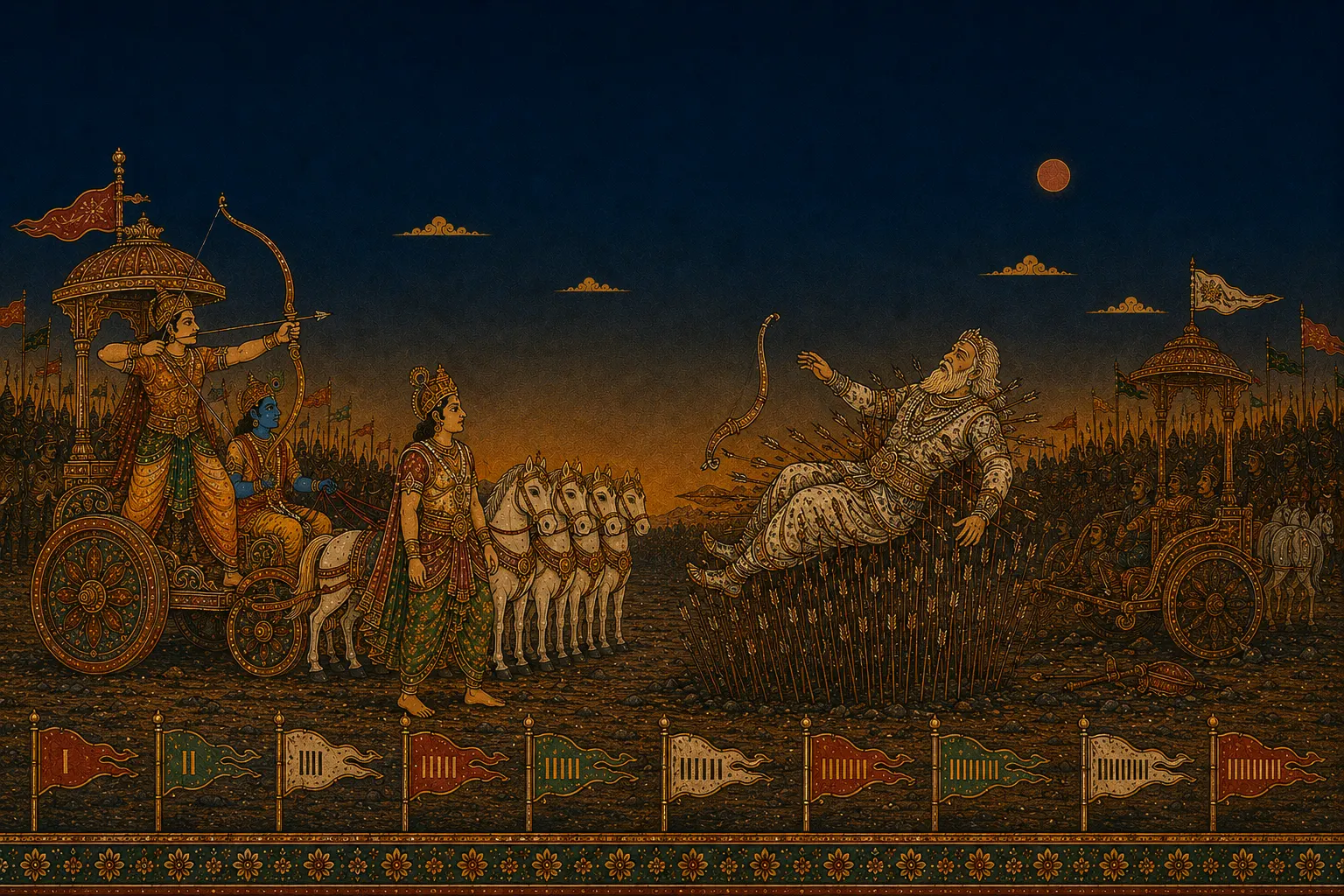
The next day Arjuna placed Shikhandi in front of him and shot from behind. Bhishma set down his bow.

The bed of arrows

He fell, but never reached the ground, so many arrows filled his body that he rested on them as on a bed. Both armies stopped fighting and gathered around. He asked for water, someone tried to bring a pitcher, he refused it. Arjuna raised his bow and struck the earth, and a stream of water rose straight into his mouth.

Then Bhishma said he would not leave yet. His father's boon meant death would come only at his own choosing, the sun was still in its southern course, and he would wait for it to turn north. He lay on that bed of arrows through the rest of the war, and beyond it, listening to the remainder of the battle from where he lay.

Note: Sanjaya's sight, Yudhishthira going unarmed to ask for a blessing, the teaching of the Gita, Bhishma's ten days, the condition about Shikhandi and the bed of arrows are all in the Bhishma Parva of Vyasa's Mahabharata. The Bhagavad Gita sits inside this book — it is not a separate text; being printed and read on its own came from later tradition. Bhishma telling his enemies how to defeat him is in the text too, and it is the hardest moment in this book.

Source: Mahabharata (ascribed by tradition to Vyasa), Bhishma Parva

Now — how much stayed with you?

Who am I?

I saw the whole war and never fought once. What I saw, I told to a blind king. Who am I?

  • Vidura
  • Kripacharya
  • Sanjaya
  • Yuyutsu
Read the whole story — The man who refused to see

Vyasa had gone to Dhritarashtra first and offered him the sight.

Dhritarashtra refused — he said he could not watch his own line destroyed, but he would listen.

So the sight went to Sanjaya, and the whole war of the Mahabharata runs through one man's mouth.

It changes the reading too. Every battle reaches us second-hand, with Dhritarashtra's interruptions audible in between.

Why is that?

Arjuna put down the Gandiva at the very edge of the war. What reason does the text give?

  • Because he saw his own people on both sides, and did not want a kingdom at that price
  • Because he was afraid of losing
  • Because Krishna had vowed not to take up a weapon
  • Because Bhishma was in front of him
Read the whole story — Where the chariot stopped

It was Arjuna himself who said take the chariot between the two armies, so I can see who I have to fight.

That is not a small thing. While an army is far off it is an army; up close it turns into faces.

Arjuna listed them — grandfather, teacher, uncles, fathers-in-law, sons. His argument was that there would be nothing left even in winning.

The Gita is the answer to that question, and the one answering is the man who drove the chariot there and stopped it.

Fact

Where does the Bhagavad Gita come in the Mahabharata?

  • It is a separate book, not part of the Mahabharata
  • In the Udyoga Parva
  • In the Shanti Parva
  • Inside the Bhishma Parva
Read the whole story — Eighteen and eighteen

The Gita has eighteen chapters, and the Mahabharata eighteen parvas. The war also runs eighteen days.

There are about seven hundred verses, and the whole conversation happens while both armies stand with their weapons raised.

In the middle Arjuna asked who he really was, and in answer saw the form that included the time still to come — the warriors in front of him were already dead in it.

Arjuna asked for that form to be withdrawn. At the end Krishna did not say fight — he said I have told you everything, now do as seems right to you.

What happened?

Before the war began, Yudhishthira put down his weapons and walked towards the Kaurava army. What happened then?

  • He asked for a settlement one last time
  • He asked Bhishma, Drona, Kripacharya and Shalya for permission and their blessing
  • He surrendered
  • He was taken prisoner
Read the whole story — His own army's alarm

His own side first thought Yudhishthira was changing sides out of fear.

He asked each elder the same thing — how am I to fight you without your permission?

All four blessed him, and each told him what bond held him on that side.

On the way back Yudhishthira made an open offer that anyone from the other side who wished could come. One man actually did.

Whose son?

I am Dhritarashtra's son, but I am not among Gandhari's hundred. I went over to the Pandavas before the war. Who am I?

  • Yuyutsu
  • Vikarna
  • Duhshasana
  • Vidura
Read the whole story — The only one who left

Yuyutsu was not Gandhari's son, and was never fully counted among the hundred brothers.

On Draupadi's day in the Sabha Parva, Vikarna had raised his voice but did not leave the side. Yuyutsu left.

In the whole war his is the only name that crossed over from the Kaurava side, and he only got the chance because of that one announcement.

In the end it served as well — after the war he was Dhritarashtra's one surviving son.

Why is that?

Krishna had vowed not to take up a weapon, yet he picked up a chariot wheel and went at Bhishma. Why did it happen, and what came of it?

  • He had forgotten the vow
  • Bhishma had challenged him
  • Arjuna was slackening and nobody could stop Bhishma; Arjuna ran and stopped him, promising to fight
  • He killed Bhishma
Read the whole story — The vow that nearly broke

This did not happen once. Krishna jumped down from the chariot more than once in those ten days.

It was a chariot wheel — not even a weapon, just whatever was to hand. The point is the intent, not the object.

The strange part is that Bhishma was pleased. He counted death at Krishna's hands good fortune, so a raised wheel was no threat to him.

It was Arjuna who stopped him, and Arjuna who paid for it — by promising there would be no slack now.

Who said it?

"Put Shikhandi in front." — who told the Pandavas this way?

  • Krishna
  • Shikhandi himself
  • Bhishma himself
  • Drona
Read the whole story — The man who drew the map of his own defeat

After nine days the Pandavas had no way left. They went at night with Krishna to Bhishma's tent.

Bhishma did not put them off. He repeated the same condition he had set on taking command — he would not raise a weapon against Shikhandi.

So this was no new secret. It was only that nobody had thought until now of using it.

Yudhishthira could not sleep that night. The man he had to fight was the one who had told him how to win.

Put it in order

Which is the right order of these events?

  • The Gita → Sanjaya being given sight → Yudhishthira asking for blessings → Bhishma's fall
  • Sanjaya being given sight → Yudhishthira asking for blessings → the Gita → Bhishma's fall
  • Sanjaya being given sight → Bhishma's fall → the Gita → Yudhishthira asking for blessings
  • Sanjaya being given sight → the Gita → Yudhishthira asking for blessings → Bhishma's fall
Read the whole story — One very long day

The Gita, Yudhishthira walking across, and Yuyutsu changing sides all happen before the conches of the first day.

That stretch is so long in the text that a reader forgets the armies are still standing there waiting.

After it the ten days go by very fast, and their account takes less room than the Gita does.

The Bhishma Parva ends right there — at his falling, not at his dying.

Fact

Why did Bhishma not reach the ground when he fell?

  • There were so many arrows in his body that he came to rest on them
  • Soldiers caught him
  • He stayed on his chariot
  • Arjuna lifted him
Read the whole story — A pillow and water

Bhishma asked for something under his head. Duryodhana brought soft pillows, which he sent back.

Then Arjuna drove three arrows into the ground and rested his head on them, and Bhishma said that is a warrior's pillow.

Then he asked for water. Arjuna struck the ground with an arrow and water came up there.

Both were done by the man who had brought him down, and the text makes no comment on it.

Riddle

I am a boon a father gave his son. Because of me he stayed alive for days after he fell. What am I?

  • A boon of being unbeatable
  • A boon of armour
  • The boon of choosing his own death
  • A boon of immortality
Read the whole story — The reward for a vow

Shantanu gave the boon when Bhishma had given up both the throne and children for his father's marriage.

It did not mean he would not die, nor that death would stop of itself. It meant only that when to die was his to decide.

Lying on the arrows he decided to wait for the sun's northward turn, and stayed on them until it came.

So the boon that was meant to be a convenience made his ending the longest of anyone's.

Vyasa or tradition?

Bhishma gave a long teaching on kingship and liberation from the bed of arrows. Where is that teaching in the Mahabharata?

  • It is entirely later tradition, not in the text
  • In the Bhishma Parva, right after he falls
  • Inside the Gita
  • Much later, in the Shanti and Anushasana Parvas
Read the whole story — The longest stretch in the book

The Shanti and Anushasana Parvas together make the largest part of the Mahabharata — larger than the whole account of the war.

The situation is that Bhishma is lying on the arrows, the war is over, and Yudhishthira is sitting beside him asking how a kingdom should be run.

Which is why looking for that teaching in the Bhishma Parva does not find it — the entire war and the mourning after it lie in between.

As reading, it is the Mahabharata's biggest jump — straight after the fighting, the book turns into a school.

Who am I?

Seeing me in front of him, the grandsire lowered his bow. I did not kill him, but without me he would not have fallen. Who am I?

  • Ghatotkacha
  • Shikhandi
  • Abhimanyu
  • Dhrishtadyumna
Read the whole story — Half the work, all the name

Bhishma held Shikhandi to have been born a woman, and so would not raise a weapon against him.

On the tenth day all Arjuna did was put Shikhandi in front. The decisive arrows were his own.

Which is why there is discomfort in the text about this death, and why Arjuna had kept putting it off.

At the decisive moment Shikhandi's work was to hold Bhishma still in front of him; the decisive arrows were Arjuna's.