Parva 7

Drona Parva

The book in which both sides broke the rules they had sworn to keep

Drona takes command

After Bhishma fell, Drona became commander. Duryodhana gave him one instruction, do not kill Yudhishthira, take him alive. His thinking was that with Yudhishthira in hand, another game of dice could be forced, and another exile. Drona tried, but as long as Arjuna stayed by Yudhishthira, no one could get close. So Arjuna had to be drawn away.

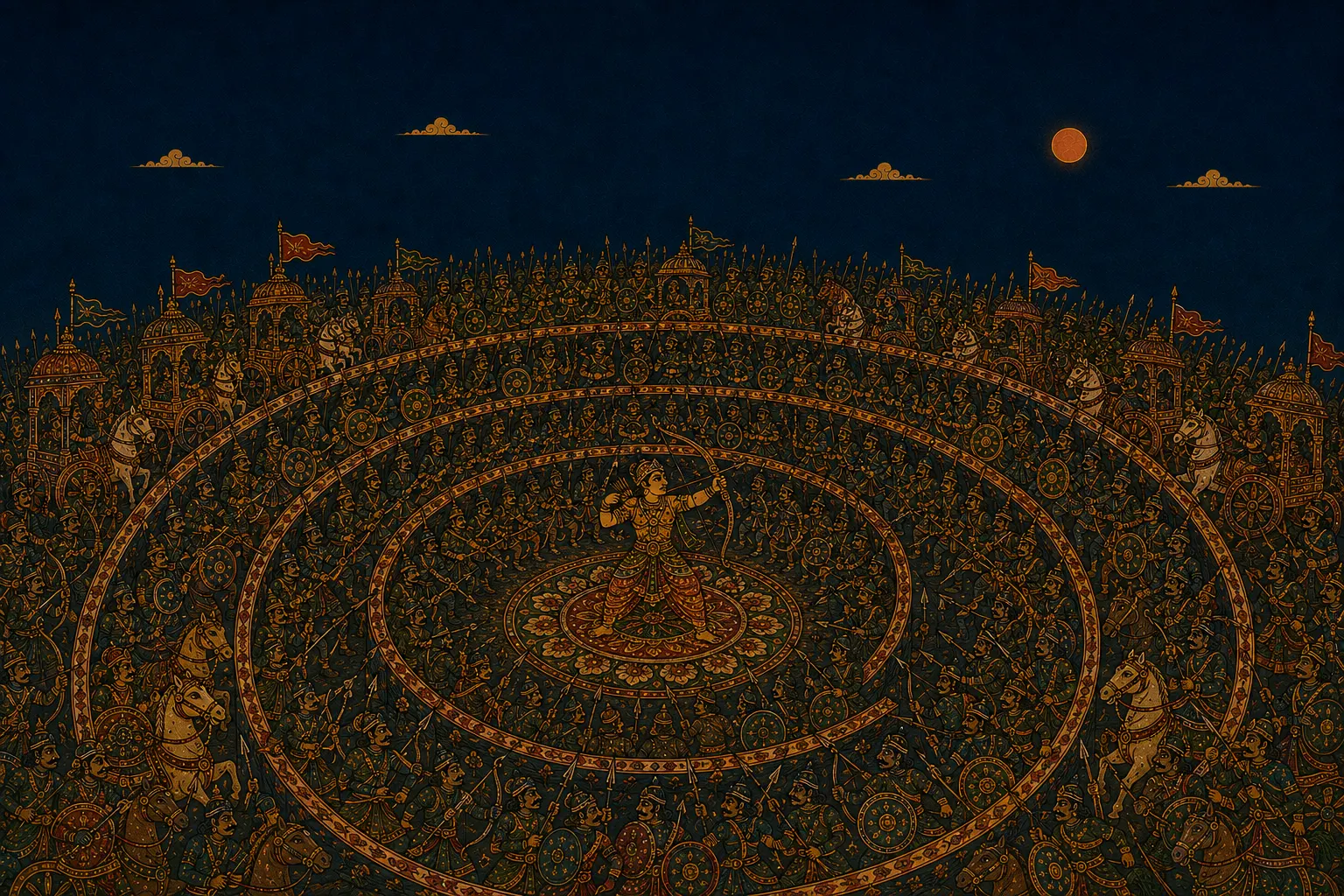
The chakravyuha

The Samshaptakas of Trigarta challenged Arjuna. They were men who had sworn either to kill Arjuna or die trying, never to return without one or the other. The rule was that such a challenge could not be refused. Arjuna had to go, and was drawn to the far end of the field. That same day Drona formed the Chakravyuha, a rotating formation, hard to enter and harder still to leave.

In the Pandava army that day, only one man knew how to break it, and he was still just a boy. Abhimanyu, son of Arjuna and Subhadra. The popular telling says he had heard the technique in his mother's womb, and that because Subhadra fell asleep partway through, he learned how to enter and not how to get out. In the main text Abhimanyu says only that he knows how to get in, not how to get out. The womb story became famous in later tradition. He said he would break in, and if the others followed close behind, the way would stay open. He went in. And no one behind him could follow.

Abhimanyu and Jayadratha

Jayadratha stood at the gate of the formation and blocked the rest of the Pandavas. He had received a boon from Shiva that one day he would be able to hold off all the Pandavas except Arjuna. This was that day. Inside, Abhimanyu was left alone. He fought for a long time, until his bow broke, his chariot was destroyed, his charioteer killed, and he fought on holding a wheel. None of this had broken on its own, six maharathas had surrounded him together and brought him down piece by piece, against every rule, no single warrior is meant to be encircled by many at once. Finally Duhshasana's son came forward with a mace. Both fell under mace blows, Duhshasana's son rose first, and as Abhimanyu was trying to stand, struck him on the head. Abhimanyu died there.

Arjuna returned that evening and learned what had happened. That night he vowed that before the sun set the next day he would kill Jayadratha, or walk into fire himself. The next day the Kauravas hid Jayadratha at the very back and put their whole army in front of him. The day wore on toward evening. Then Krishna used his power to bring on a darkness so complete that the sun seemed to vanish, and it looked as though the day had ended. Joy spread through the Kaurava ranks, and Jayadratha stepped out to watch Arjuna burn. At that instant the darkness lifted and light returned. Arjuna loosed his arrow.

The night battle

After that day the fighting continued into the nights as well, itself against the rules. Men fought by torchlight in the dark. Ghatotkacha was the heaviest blow that night, son of Bhima and Hidimba, his demonic power growing stronger after dark. The Kaurava army was being cut down. Finally Duryodhana told Karna to use his weapon, the one Indra had given him in exchange for his armor, usable only once. Karna had been saving it for Arjuna. He fired it at Ghatotkacha instead. Ghatotkacha died, and with him went the one weapon Karna had kept in reserve for Arjuna. Krishna was glad that night, and said outright that Ghatotkacha had saved Arjuna's life.

An elephant named Ashwatthama

Drona could not be stopped. Krishna said that as long as the bow was in his hands, no one could defeat him, and he would set it down only in one circumstance, if he believed his son Ashwatthama was dead. Bhima then killed an elephant named Ashwatthama, and shouted that Ashwatthama was dead. Drona did not believe it, and asked Yudhishthira, since Yudhishthira never lied. Yudhishthira said, Ashwatthama is dead, the elephant. He said the last word so quietly that Drona never heard it, he heard only the first part, not the second. He set down his bow and sat on the ground. Dhrishtadyumna beheaded him in that state. Dhrishtadyumna was Drupada's son, and Drupada had performed that sacrifice for exactly this day, to avenge himself on Drona.

The Narayanastra

Ashwatthama learned how his father had died. He released the Narayanastra. It was a weapon that grew stronger against anyone who fought it. Krishna told everyone to lay down their weapons and lie flat on the ground, it would not harm anyone who did not fight. Everyone did. Bhima refused at first, but was pulled down and made to lie there too. The weapon passed harmlessly overhead.

Note: The order to take Yudhishthira alive, the Samshaptakas' challenge, the chakravyuha, Jayadratha holding the gate, the killing of Abhimanyu, the killing of Jayadratha, the night battle, Indra's weapon used on Ghatotkacha, the elephant named Ashwatthama and the killing of Drona are all in the Drona Parva of Vyasa's Mahabharata. But Abhimanyu hearing the chakravyuha in the womb is not in the main text — there he says only that he knows how to enter, not how to leave. The womb story became famous in later tradition. In this book both sides broke the rules, and the text records both — the Kauravas surrounded Abhimanyu and killed him, the Pandavas killed Drona with a half-truth. The darkness before Jayadratha's death is by Krishna's power of yoga in the text — the version where the Sudarshana discus covers the sun is from later tradition, and it is a separate claim.

Source: Mahabharata (ascribed by tradition to Vyasa), Drona Parva

Now — how much stayed with you?

Fact

What had Duryodhana asked Drona to do in the war?

  • Kill Arjuna
  • Take Yudhishthira alive
  • Kill Bhima
  • Take Krishna prisoner
Read the whole story — A game to be played again

Duryodhana's reckoning was simple — Yudhishthira cannot refuse a summons to dice.

So more than winning the war, he wanted to run the old trick again, the one that had already worked once.

Drona set the condition that Arjuna had to be taken off the field first, or Yudhishthira could not be reached.

Out of that condition came the day Arjuna was drawn to the other side and the chakravyuha was formed.

Why is that?

Why was Arjuna at the far end of the field on the day of the chakravyuha?

  • He was wounded
  • He was in council with Krishna
  • He was behind, guarding Yudhishthira
  • The samshaptakas of Trigarta had challenged him, and refusing a challenge was against the rules
Read the whole story — A rule turned into a weapon

The samshaptakas were warriors who had vowed either to kill Arjuna or die.

Their job was not to kill Arjuna. Their job was to keep him busy, and in that they succeeded.

Arjuna could not refuse a challenge. That was the whole plan of the day — to use the rule itself as the trap.

On the day Arjuna was far off, a formation was made whose way in was known on the Pandava side only to Arjuna and Krishna.

What happened?

Abhimanyu got into the chakravyuha, but his brothers could not follow. Why?

  • Jayadratha stood in the gate and held them back
  • They forgot the way
  • Yudhishthira stopped them
  • The formation closed
Read the whole story — A boon for one day

Jayadratha is the one who tried to carry off Draupadi in the Vana Parva and was humiliated by Bhima.

He did austerities afterwards. The boon was that for one day he could hold back the Pandavas — but not Arjuna.

And that day turned out to be exactly the day Arjuna was not on the field.

Which is why Arjuna's anger fell not on Drona or Duryodhana but on Jayadratha. He was the one who held the gate.

Vyasa or tradition?

Abhimanyu heard how to enter the chakravyuha while in his mother's womb — where is this story from?

  • It is part of the main text
  • It is in the Gita
  • It is entirely invented, in no tradition
  • It became famous in later tradition; in the main text Abhimanyu only says he knows how to get in, not out
Read the whole story — Half a knowledge

The text states the incompleteness and does not explain it. Abhimanyu says it and moves on.

The story of hearing it in the womb gives that incompleteness a clean reason — Subhadra fell asleep partway, so the rest was not heard.

Which is why it is so popular. It explains away something that nags.

The text leaves it open, and open it sits heavier.

Whose son?

I am the son of Arjuna and Subhadra, and Krishna is my uncle. I was killed on the thirteenth day. Who am I?

  • Ghatotkacha
  • Iravan
  • Abhimanyu
  • Vrishasena
Read the whole story — The line that survived

Abhimanyu had married Uttara at the end of the Virata Parva.

At his death Uttara was pregnant, and Parikshit was born of that pregnancy.

After the war the throne of Hastinapura goes to Parikshit — so the whole line continues through that one child.

Which makes Abhimanyu's death more than grief. There will be another attack on that womb, and it becomes the Mahabharata's largest stake.

What happened?

Arjuna vowed Jayadratha would die before sunset the next day. The day ended and Jayadratha was alive. Then?

  • Arjuna walked into the fire
  • The darkness lifted, the light showed again, Jayadratha had come out, and Arjuna shot that same instant
  • Jayadratha escaped
  • The vow was set aside
Read the whole story — A head that must not touch the ground

Jayadratha's father had a boon that whoever made his son's head fall to the ground would have his own head split.

Krishna had told Arjuna beforehand, so Arjuna held the severed head in the air with arrows.

He carried it far off and dropped it into the lap of the father, who was sitting in penance nearby.

The father started up and the head rolled from his lap to the ground, and by the terms his own head split. Boons often turn round like this in the Mahabharata.

Who said it?

"Ashwatthama is dead." — from whose mouth did Drona have to hear this before he put down his weapons?

  • Bhima
  • Krishna
  • Yudhishthira
  • Dhrishtadyumna
Read the whole story — A half-truth that was a whole lie

Bhima had killed an elephant named Ashwatthama, so the sentence was not technically false.

Yudhishthira said — Ashwatthama is dead, the elephant. He said the second part quietly, and conches were sounded at the same moment.

Drona heard only the first part and put down his bow. The whole war turns behind that one sentence.

It is said that Yudhishthira's chariot, which until then had run a little above the ground, came down in that instant. That was his punishment.

Riddle

I am an animal. I was killed so that my name could be used in a sentence. What am I?

  • An elephant named Ashwatthama
  • Karna's horse
  • Drona's horse
  • Bhima's elephant
Read the whole story — A battle fought with a name

There was no way left to stop Drona. He was outweighing a whole army by himself that day.

Krishna said he would put down his weapons only if he thought his son was dead, and that it had to come from Yudhishthira's mouth.

Bhima killed the elephant to give the sentence a way of being true, so that Yudhishthira would not be lying outright.

The text does not accept the defence. The punishment comes anyway, and the real Ashwatthama lives to do the worst thing in the book.

What happened?

Karna had the shakti from Indra, usable once and never missing. On whom did he use it?

  • On Arjuna
  • On Ghatotkacha
  • On Bhima
  • On Dhrishtadyumna
Read the whole story — The death Krishna danced at

Ghatotkacha was the son of Bhima and Hidimba, and night was held to be his time.

That night he did so much damage to the Kaurava army that Duryodhana told Karna to use the weapon.

The Pandavas were plunged in grief. Krishna stood up on the chariot in delight, and Arjuna took it badly.

Krishna's reason was plain — as long as that shakti was in Karna's hands, Arjuna was not safe for a day. Ghatotkacha took it on himself and used it up.

Why is that?

Drona was killed by Dhrishtadyumna. Why by him?

  • Because he was the greatest warrior
  • Because Arjuna refused
  • Because Krishna chose him
  • Because Drupada had held a sacrifice for revenge on Drona, and Dhrishtadyumna is held to have been born of it
Read the whole story — What began in the Adi Parva

Drona had his students take Drupada prisoner as his teacher's fee, and then released him after taking half his kingdom.

Drupada did not forget the humiliation. He held a sacrifice, from which Dhrishtadyumna and Draupadi are held to have come.

So the Pandavas' commander and the Pandavas' wife both come out of that one old enmity.

But when it is completed, the revenge does not look like what was intended. Drona did not die fighting — he was sitting in meditation with his weapons down.

Who am I?

I watched my father made to put down his weapons and then killed, and that same night I loosed the weapon that kills whoever fights it. Who am I?

  • Ashwatthama
  • Kripacharya
  • Karna
  • Duryodhana
Read the whole story — The one whose cure was not fighting

The narayanastra's rule ran backwards — whoever faced it had it grow more terrible against them.

Krishna told everyone to put down their weapons, get off their chariots and lie on the ground.

Bhima refused and went on fighting alone. The full force of the weapon came onto him, and Arjuna and Krishna took his weapons away by force.

The weapon went quiet. Ashwatthama's anger did not — and that becomes the Sauptika Parva.

Fact

What was the way to survive the narayanastra?

  • Cutting it down with another weapon
  • Running away
  • Putting down your weapons and lying on the ground
  • Hiding behind a shield
Read the whole story — A weapon that ran on anger

It is among the very few weapons in the Mahabharata whose answer is not force.

A whole army putting down its weapons and getting down is a strange sight in itself, and the text tells it without a joke in it.

Bhima's refusal is entirely in character — he does not put down weapons under any circumstances.

Which is why saving him took force. He was not saved by his own consent.

Put it in order

Which is the right order of these events in the Drona Parva?

  • Jayadratha's killing → Abhimanyu's killing → Ghatotkacha's killing → Drona's killing
  • Abhimanyu's killing → Ghatotkacha's killing → Jayadratha's killing → Drona's killing
  • Abhimanyu's killing → Jayadratha's killing → Drona's killing → Ghatotkacha's killing
  • Abhimanyu's killing → Jayadratha's killing → Ghatotkacha's killing → Drona's killing
Read the whole story — Five days

Drona was commander of the Kaurava army from the eleventh day to the fifteenth — five days.

The largest part of the war is finished inside those five days, and this is one of the longest parvas in the Mahabharata.

The fourteenth day alone is so long that it runs on into the night — Jayadratha's killing and Ghatotkacha both belong to that one day and night.

Some rule breaks in every major event, and by the end it becomes hard to count which side broke more.

Why is that?

Why does the Mahabharata treat Abhimanyu's killing as a breach of the rules?

  • Because he was unarmed
  • Because several great warriors surrounded and killed a single warrior together
  • Because he was a child
  • Because it was night
Read the whole story — The day the count changed

Rules had been settled before the war — equal weapons, no striking the unarmed, not many against one.

With Abhimanyu they all broke at once. The chariot broken, the driver killed, the bow cut, the sword broken, and at the end he fought with a wheel.

After this the Pandava side was not so strict about the rules either. Drona's killing, Karna's killing and Duryodhana's killing all have something broken in them.

The Mahabharata does not show this as coincidence. What breaks first becomes the permission for what breaks next.