Parva 8

Karna Parva

Two days as commander, and a charioteer who would not stop talking

Karna made commander

After Drona, Karna became commander. He set a condition. He said Arjuna had Krishna on his chariot, and he needed a charioteer of the same rank. He named Shalya, king of Madra and uncle to Nakula and Sahadeva.

Shalya had actually been coming to fight for the Pandavas. Along the way he was received with great honor, camps, feasts, everything. Believing the Pandavas had arranged it, he happily said, ask of me whatever you wish. It was Duryodhana who stepped forward, he had arranged it all. He asked only that Shalya fight on his side. Shalya had already given his word. But from there he went straight to the Pandavas and told them everything. Yudhishthira asked him for one thing, that if he ever drove Karna's chariot, he should keep breaking Karna's spirit. Shalya agreed.

Shalya found it an insult, a king driving another man's chariot. Duryodhana talked him into it, and Shalya agreed, but on one condition, that he would say whatever he wished, and Karna would not stop him. Karna accepted. Shalya mounted the chariot, on Karna's side, but not for Karna.

The charioteer's condition

The chariot moved, and Shalya began to speak. He kept saying that Arjuna was greater, that Karna was nothing before him, that the outcome was already decided. Once Karna said he would kill Arjuna. Shalya laughed and said he had said that many times before, and every time Arjuna had come back alive. Karna did not stop him, he could not, that had been the condition. The very man driving his chariot kept breaking him down, and kept the promise made to Yudhishthira. The chariot rolled on. This is the real battle of this parva, and it was fought inside the chariot.

The killing of Duhshasana

That same day Bhima found Duhshasana. He did exactly what he had sworn before the full court, he tore open his chest. The vow made in that hall was fulfilled word for word.

Four brothers spared

That day Karna fought Yudhishthira and wounded him badly. But he did not kill him, he let him go. Then Nakula, then Sahadeva, then Bhima, each time the same, Karna won, and let them live. He was keeping his promise to Kunti to the letter. Yudhishthira, wounded, returned to camp. Arjuna came to see him. Yudhishthira, still angry, told Arjuna that his Gandiva was useless, better to give it to someone else. Arjuna drew his sword, for he had sworn that he would kill anyone who told him to give up the Gandiva, and the one who had said it was his own elder brother. Krishna stepped in and found a way through, saying that insulting an elder was as good as killing him. Arjuna said bitter things to Yudhishthira instead, and the vow remained unbroken. Yudhishthira then said himself that the fault had been his.

The chariot wheel

Karna and Arjuna finally faced each other. Both armies stopped fighting to watch. The fight was evenly matched. Karna knocked down Arjuna's crown, Arjuna forced Karna's chariot back. Karna fired the Nagastra, in which rode a serpent named Ashvasena, whose mother had died in the burning of the Khandava forest and who wanted revenge on Arjuna. The arrow flew straight at Arjuna's head. Krishna pressed the chariot down into the earth with his foot, the chariot sank, and the arrow only carried away the crown. Ashvasena came back and told Karna to fire it again, this time it would not miss. Karna refused, saying he never fired the same arrow twice.

Before the two closed again, Arjuna killed Karna's son Vrishasena in front of his father's eyes, an answer to Abhimanyu, cut down the same way.

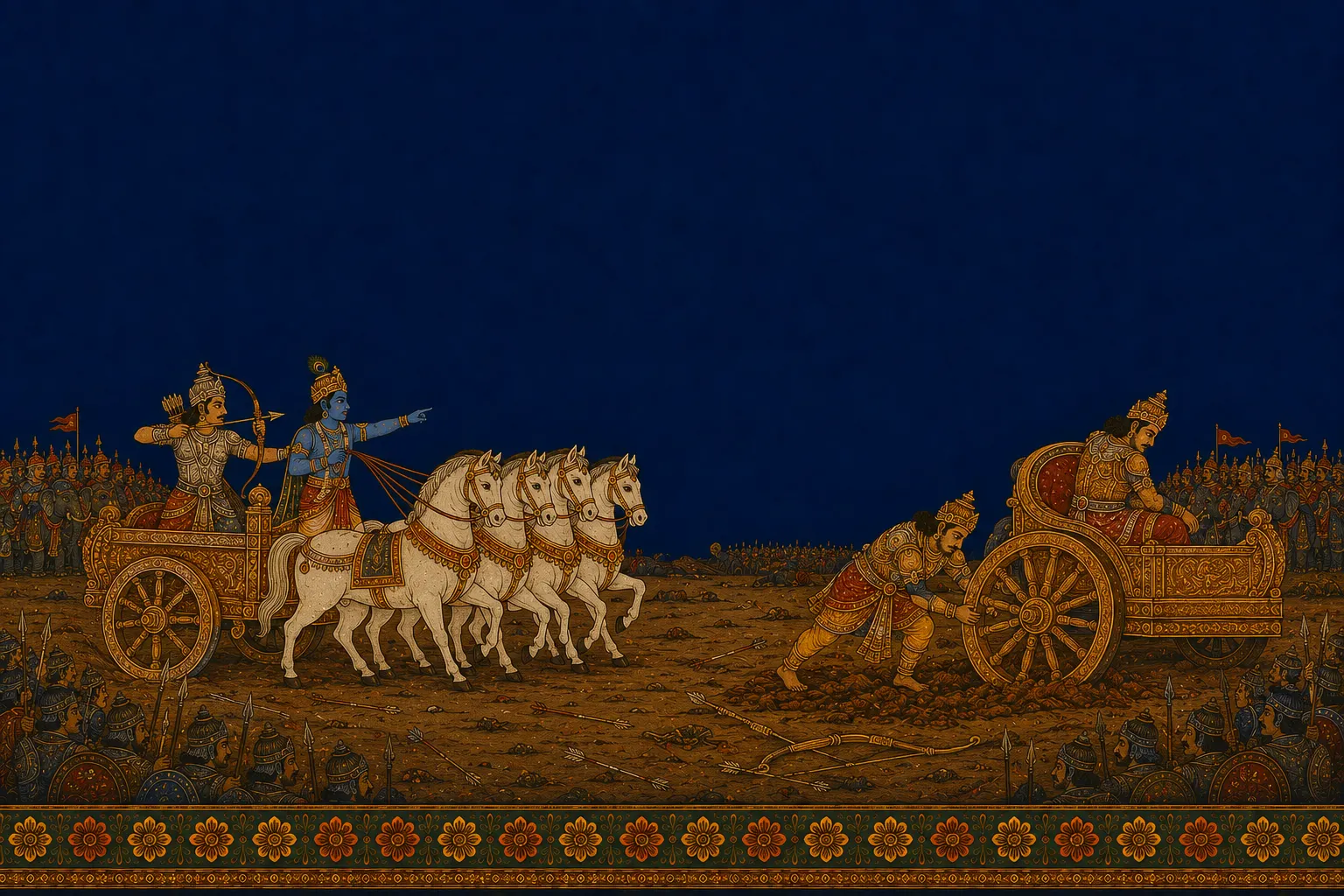
Then the wheel of Karna's chariot sank into the ground. He climbed down and began pulling it free, and called out to Arjuna to stop, since the rule was that an unarmed man was not to be struck. Krishna answered. One by one he listed the moments when Karna himself had broken that same rule, the dice hall, the disrobing, the encircling of Abhimanyu in the Chakravyuha. Karna fell silent.

The wheel had not sunk on its own. Years earlier Karna had unknowingly killed a Brahmin's cow, and the Brahmin had cursed him, that on the day of his greatest battle, the earth would swallow his chariot wheel. That day had come. He then tried to recall the weapon he had learned from Parashurama, and it would not come to him. Karna had studied under Parashurama disguised as a Brahmin, and when the truth came out, Parashurama had cursed him, that at the moment of greatest need, the knowledge would fail him. That moment had also come.

Arjuna fired his arrow. Karna fell.

Note: Karna made commander, asking for Shalya as charioteer and his condition, the killing of Duhshasana, Karna sparing the four brothers, the Gandiva episode between Yudhishthira and Arjuna, the sinking of the wheel, Krishna's answer and both curses are all in the Karna Parva of Vyasa's Mahabharata. The full story of both curses comes in the Shanti Parva — the cow curse lands on the wheel and the Parashurama curse on the knowledge, and both are fulfilled in the same moment. Karna sparing the four brothers is the keeping of the same promise he made to Kunti in the Udyoga Parva. Several famous stories of Karna's generosity — such as breaking off a gold tooth to give away as he died — come from later tradition and folklore, not the main text.

Source: Mahabharata (ascribed by tradition to Vyasa), Karna Parva

Now — how much stayed with you?

Who am I?

I am a king, but in this parva I drive another man's chariot. I drove it while breaking my own warrior's nerve. Who am I?

  • Kripacharya
  • Ashwatthama
  • Shalya
  • Sanjaya
Read the whole story — The condition that was accepted

Shalya flared up at first — a king was being asked to drive a charioteer's son.

He agreed when Duryodhana coaxed him, but set the condition that on the chariot he would say whatever he liked and Karna would not check him.

The condition was accepted, and Shalya used it fully. He kept telling Karna he was the lesser of the two.

So Karna's biggest day went by with a man on his own chariot talking at him without stopping.

Why is that?

Karna asked for Shalya as his charioteer as soon as he was made commander. Why?

  • Because Krishna was on Arjuna's chariot, and Karna wanted a driver of the same rank
  • Because Shalya was his friend
  • Because Duryodhana told him to
  • Because Shalya was related to the Pandavas
Read the whole story — The second man on the chariot

In the Mahabharata a charioteer does not only handle horses. He decides where and when to take the warrior.

The effect of Krishna being on Arjuna's chariot shows through the whole war, and Karna had seen it.

Shalya was held Krishna's equal at driving, which is why his was the name.

But one difference remained. Krishna holds Arjuna together; Shalya breaks Karna down.

What happened?

Bhima had made a vow about Duhshasana on the day in the Sabha Parva. What became of it here?

  • It was left unfulfilled
  • Duhshasana apologised
  • Duhshasana fled the war
  • Bhima kept it, exactly as he had said in open assembly
Read the whole story — Remembered for thirteen years

It was Duhshasana who dragged Draupadi into the assembly by her hair.

Bhima made two vows that day — one about Duhshasana, one about Duryodhana's thigh.

The first is kept in this parva, the second in the next. Between them lie thirteen years of exile and seventeen days of war.

The Mahabharata neither hides this scene nor admires it. The men on the field step back, and the text moves on.

Whose son?

I am Karna's son. I was killed in front of my father, just before he was killed himself. Who am I?

  • Abhimanyu
  • Vrishasena
  • Ghatotkacha
  • Lakshmana
Read the whole story — An account squared

Karna was among those who surrounded and killed Abhimanyu, and Arjuna had not forgotten.

He killed Vrishasena directly in front of Karna, so that the father would see what Arjuna had seen.

Karna and Arjuna face each other immediately after, and Karna is in grief at the time.

The Mahabharata does not call this justice. It only shows that in this war every blow comes back in the same coin.

Fact

What happened to Karna's chariot in his last fight?

  • It broke
  • The horses were killed
  • Its wheel sank into the ground
  • The driver ran
Read the whole story — A calf, long before

Karna had unknowingly killed a brahmin's calf. He was cursed even after apologising.

The curse was that on the day he needed it most, his chariot wheel would sink into the ground.

Karna's defeat in the Mahabharata does not come as one blow. It is a row of old debts, all falling due on the same day.

The armour and earrings were already gone, Indra's shakti was spent on Ghatotkacha, and now the wheel and the mantra failed together.

Why is that?

Karna could not remember the brahmastra mantra at the crucial moment. Why?

  • Parashurama's curse, because Karna had taken the knowledge by passing as a brahmin
  • He panicked
  • He had never learned the weapon
  • Krishna took his memory
Read the whole story — A lie whose price came due at the end

Parashurama did not teach kshatriyas, so Karna said he was a brahmin.

It came out when his teacher was asleep with his head on Karna's thigh and an insect bored into it — Karna did not move, and Parashurama understood that no brahmin bears that much pain.

The curse was exactly this: the knowledge will leave you at the moment you most need it.

Karna's whole story rests on this tangle — the identity he should have had was withheld, and the one he made for himself is what sank him.

Riddle

I was part of someone's body from birth, and I was cut off and given away. What came in exchange was used once, and not on Arjuna. What am I?

  • The Gandiva
  • Karna's armour and earrings
  • The brahmastra
  • The Sudarshana
Read the whole story — A bargain that failed at both ends

The armour and earrings were born with Karna's body, and while he had them he could not be killed.

Indra came asking in a brahmin's guise. The sun had warned Karna beforehand, and he still did not refuse.

The shakti he got in return could be used once, and he saved it for Arjuna.

It was spent on Ghatotkacha. So the bargain that cost him his protection did not deliver its gain either.

Who said it?

"Give the Gandiva to somebody else." — who said this, and what crisis did it cause?

  • Karna, to provoke Arjuna
  • Krishna, to test Arjuna
  • Draupadi
  • Yudhishthira, wounded, in the camp; and Arjuna had vowed to kill anyone who said it
Read the whole story — Two vows, settled in words

Karna had wounded Yudhishthira badly. In the camp he assumed Arjuna had killed Karna and come.

Finding he had not, he said the one sentence that collided with Arjuna's vow. Arjuna drew his sword.

Krishna found the way out — humiliating an elder counts as killing him, so Arjuna said something bitter instead.

Then Arjuna, regretting it, went to kill himself, and Krishna said praise yourself with your own mouth and it counts the same. The Pandava side broke that evening from inside, not from outside.

Vyasa or tradition?

Krishna came as a brahmin to the dying Karna and asked for alms, and Karna broke out his gold teeth and gave them. Where is this from?

  • It is in the main text
  • It is in the Gita
  • It comes from later tradition and folklore
  • It is in the Vana Parva
Read the whole story — The mark of a giver

The giving of the armour and earrings is in the text, and that is what establishes Karna as a giver.

Later tradition stretched that identity to his last breath — even dying, the man could not refuse.

Which is why the story stuck. It shows a single quality at its furthest limit.

The Karna of the main text is different, and perhaps more tangled — he is the giver, and he is also the man who spoke most bitterly in the assembly about Draupadi.

Put it in order

Which is the right order of these events in the Karna Parva?

  • Karna made commander → Duhshasana's killing → Vrishasena's killing → Karna's killing
  • Duhshasana's killing → Karna made commander → Vrishasena's killing → Karna's killing
  • Karna made commander → Vrishasena's killing → Duhshasana's killing → Karna's killing
  • Karna made commander → Duhshasana's killing → Karna's killing → Vrishasena's killing
Read the whole story — Two days

Karna was commander for two days only — the sixteenth and the seventeenth.

So the warrior the whole book builds its tension around gets two days of fighting on the field.

For the first ten he sat out because of the vow about Bhishma, and after that came Drona's five days.

Which is why the Karna Parva reads as though it is in a hurry. A wait of seventeen days is finished in two.

What happened?

Karna got down to free his wheel and appealed to Arjuna about the rules. What happened then?

  • Arjuna stopped and Karna freed the wheel
  • Krishna told Arjuna to stop
  • Karna surrendered
  • Krishna counted out every time Karna had not kept the rules himself, and Arjuna shot
Read the whole story — Who remembers the rules

Krishna counted — the house of lac, the dice, Draupadi in open assembly, and the circle round Abhimanyu.

Karna had not raised the question of rules on any of those occasions, and had taken part in several of them.

Karna had no answer to it. He was killed standing beside the wheel.

Duryodhana wept openly for the first time that day — it is the one death in the whole war that breaks him.