Parva 16

Mausala Parva

Thirty-six years on, Gandhari's curse comes due

The sages' curse

Thirty-six years had passed since the war at Kurukshetra. Dvaraka was prosperous and the Yadava clan powerful. No great threat was visible from outside. But the destruction Gandhari had foretold after the war was now beginning to take shape from within. Then a group of sages came to Dvaraka. Some of the Yadava youths thought up a prank, the kind that often lands very badly. They dressed Krishna's son Samba as a woman, tied something around his belly, and brought him before the sages. They asked, this woman is pregnant, tell us what she will bear. The sages were in no mood for jokes. They answered that she would bear an iron pestle, and that pestle would destroy the entire Yadava clan.

The iron pestle

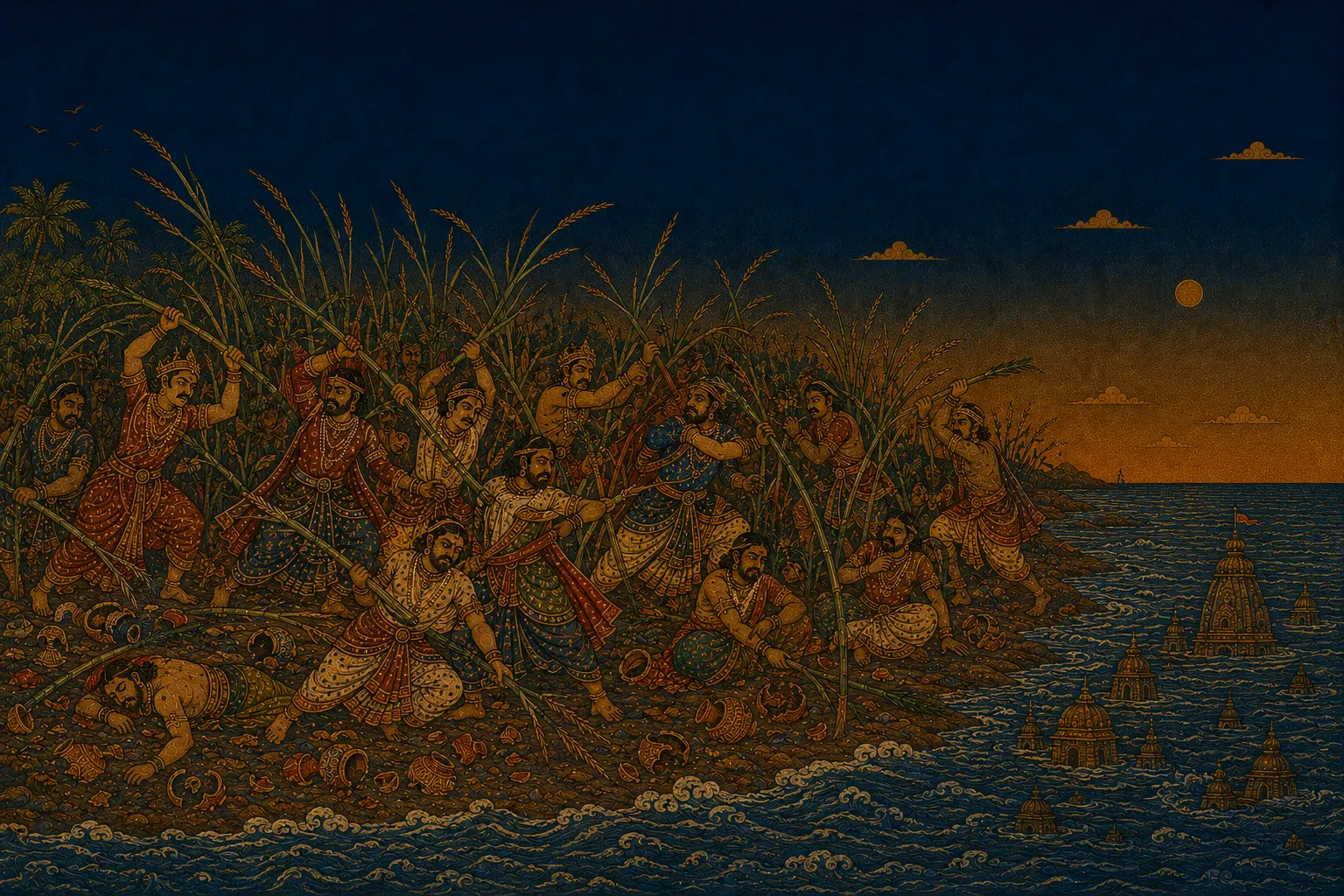
It happened exactly so. Samba produced an iron pestle, just as the sages had said. King Ugrasena panicked, had it ground down to powder and thrown into the sea, believing the danger had passed. The powder washed ashore and a kind of grass grew from it. One fragment had not ground down, a fish swallowed it, and that fragment eventually found its way to a hunter.

Prabhasa

Years later the Yadavas went on pilgrimage to Prabhasa. A festival was held there, and a great deal of wine was drunk. Then old talk surfaced, talk of the war, who had killed whom, who had stood on which side, who had truly been brave and who had not. The argument turned into a brawl, the brawl into blows. What weapons were at hand were used up quickly. Then, in desperation, someone tore up that same grass growing on the shore, not knowing what it was. The moment it was gripped in a hand, it turned as hard as an iron pestle. That evening almost every leading Yadava warrior was killed fighting his own kin. The clan no outside enemy had ever broken was broken by its own people. Gandhari's curse, given in the Stri Parva, was fulfilled here.

The end of Krishna

Balarama went and sat by the shore and left his body there. The text says a white serpent came out of his mouth and made for the sea. Krishna lay down under a tree, tired, alone. His foot was raised. A hunter, watching from a distance, mistook it for a deer and shot an arrow. His name was Jara, and his arrow was made from that same surviving fragment of iron, the very piece thrown into the sea years before. Krishna said nothing to him, no complaint. Gandhari had said he would die alone. So it happened.

The drowning of Dvaraka

Arjuna reached Dvaraka. He took those who survived, mostly women and children, and set out for Hastinapura. On the way, bandits surrounded them. Arjuna raised the Gandiva, the same bow that had once held off the entire Kaurava army. And he could not stop them. The bow was the same, but the old strength was gone from his hands, as if an age had ended and the weapon itself knew it. Many of the women were carried off by the bandits, and Arjuna stood there watching, helpless. Behind him, Dvaraka sank into the sea.

Note: The sages' curse, the iron pestle, the Yadavas killing one another at Prabhasa, the deaths of Balarama and Krishna, the hunter named Jara, Arjuna unable to use the Gandiva and the drowning of Dvaraka are all in the Mausala Parva of Vyasa's Mahabharata. Gandhari's curse is from the Stri Parva and is fulfilled here, thirty-six years on. Arjuna losing to the robbers is in the text — the Gandiva is the same, and so is Arjuna; what has gone is the power he once had.

Source: Mahabharata (ascribed by tradition to Vyasa), Mausala Parva

Now — how much stayed with you?

What happened?

What did the sages say about Samba, and what came of it?

  • That he would be king
  • That he would fall ill
  • That he would give birth to an iron pestle, which would destroy the Yadava line
  • That Dwaraka would sink
Read the whole story — A joke that cost too much

The Yadava boys dressed Samba as a woman and asked the sages what she would give birth to.

The sages were guests in Dwaraka at the time. The answer did not come back as a joke.

A pestle really did come out. It was ground to powder and thrown into the sea.

The powder washed ashore and became grass, and the last unground piece was swallowed by a fish. Both are used later.

Riddle

I was grass growing on the shore. In the hand of whoever pulled me, I became an iron pestle. Where did I come from?

  • From the powder of that same pestle, thrown into the sea
  • The gods grew me
  • I was ordinary grass
  • Krishna grew me
Read the whole story — The escape that made the road

The pestle was ground and thrown into the sea precisely in order to destroy it.

That same powder washed ashore and became eraka grass, in exactly the place the Yadavas later gathered.

When the quarrel began at Prabhasa nobody had a weapon. People pulled up that grass, and it became a pestle the moment it was held.

Curses are often fulfilled this way in the Mahabharata — the attempt to escape becomes the road.

Why is that?

Why could Arjuna not protect the women and children of Dwaraka from robbers?

  • He was alone
  • He was wounded
  • The robbers were too many
  • The Gandiva was the same, but the old power was no longer in his hands
Read the whole story — When the hand gave out

This is the same Arjuna who held off the Kaurava army alone and pushed back Bhishma, Drona and Karna.

Here, against ordinary robbers, the same bow does not work in his hand as it used to. Arjuna takes it in the end for the work of fate.

Arjuna goes to Vyasa and asks how it happened, and Vyasa says what had to be done is done.

Immediately after this the Pandavas leave everything and set out. Arjuna's hand giving out is the signal.

Fact

How did Krishna die?

  • In the Yadavas' quarrel
  • By the arrow of a hunter named Jara, who took his foot for a deer
  • Drowned in the sea
  • By yoga, with Balarama
Read the whole story — The leftover piece

Krishna was lying under a tree in a forest with one foot raised. Through the leaves the hunter took the foot for a deer.

The tip of the arrow was that last piece of iron, swallowed by a fish and carried from there to the hunter.

Coming closer, Jara learned what he had done. Krishna did not blame him.

Balarama had gone before this — sitting by the sea, by yoga. Neither brother's end comes in a fight.

Who said it?

"Thirty-six years from now your people will fight among themselves and end." — who gave this curse, and where is it fulfilled?

  • Vyasa; in the Ashramavasika Parva
  • Durvasa; in the Adi Parva
  • Gandhari, in the Stri Parva; and it is fulfilled here, in the Mausala Parva
  • Kunti; in the Udyoga Parva
Read the whole story — The longest wait

Gandhari gave this curse immediately after the war, on the field, having seen the bodies of her hundred sons.

Krishna did not cut it away. He said the destruction of the Yadavas was already fated.

The thirty-six years in between are almost empty in the Mahabharata. The story goes quiet and the curse keeps running.

In the Mausala Parva it is fulfilled to the letter — the Yadavas fight among themselves and end, and Krishna is killed alone in a forest.