
Parva 2
Sabha Parva
One laugh in a hall of tricks, and a game of dice that could not be refused
The hall Maya built
Maya the craftsman kept his word. He built a hall at Indraprastha, and it was not merely grand, it was deceptive. In places the floor looked like water, and water looked like floor. A doorway looked like a wall, and where a wall was not, a man would walk straight into it. Visitors were astonished, no one left it the first time without being fooled at least once.
The killing of Jarasandha
Yudhishthira wanted to perform the Rajasuya sacrifice, the rite by which a king declares his supremacy. But for that, no great king could be left to challenge him. The biggest obstacle was Jarasandha, king of Magadha. He held many kings captive, and had an old enmity with Krishna. Krishna, Bhima, and Arjuna went to him disguised as Brahmins and asked for a wrestling match. Jarasandha chose Bhima.
The fight went on for days. Jarasandha never tired, his body had been joined together from two halves, and split apart, it simply rejoined. Bhima tore him apart again and again, and again and again he stood back up, as if there were no way to kill him at all. Finally Krishna picked up a blade of grass, split it down the middle, and threw the two halves in opposite directions, quietly, as a signal. Bhima understood. He tore Jarasandha apart and flung the two halves in opposite directions so they could not rejoin. Jarasandha died, and his captive kings were freed.
The Rajasuya and Shishupala
Now the sacrifice could go ahead. Every king came. It had to be decided who would be honored first, and Yudhishthira chose Krishna. Shishupala, king of Chedi, would not accept it. He stood up and hurled abuse at Krishna before the whole assembly, that this was a cowherd, not even a king, and he was being seated above everyone. Krishna sat silent, counting. He had promised Shishupala's mother that he would overlook a hundred offenses. The hundred were reached, and one more came. Krishna loosed his discus, and Shishupala's head fell. A hush fell over the entire hall. The sacrifice was completed, and that day Yudhishthira was the greatest king alive.
Duryodhana falls
Duryodhana was at that sacrifice too. Afterward he wandered through that same hall, the one built by Maya, where the eyes were deceived. He came to a place where what looked like floor was in fact water. He fell in, his clothes soaked. And people laughed. The text does not say Draupadi called out "the blind man's son is blind", that line belongs to later tradition. The text says only that he fell and was laughed at. The Pandavas' rising power, the brilliance of that hall, and this humiliation, all of it settled inside him, a knot that would not come undone again.
Duryodhana returned to Hastinapura and spoke to his uncle Shakuni. Shakuni said they could not be beaten in war, then told him where they could be beaten.
The game of dice
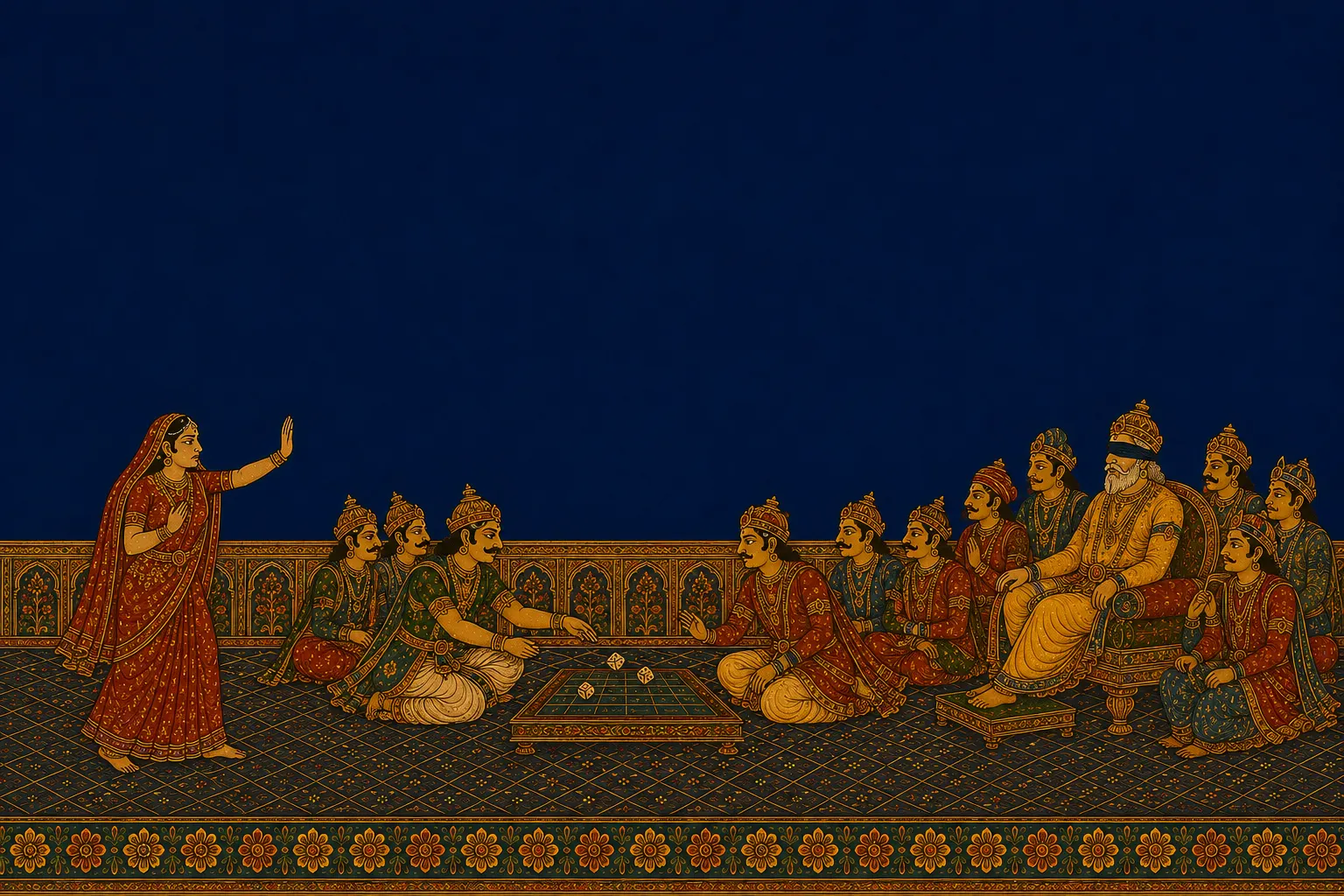
Yudhishthira was summoned to a game of dice. He knew it was not right, but refusing an invitation to dice was considered a disgrace in those days, and the code of a kshatriya did not allow him to decline such a call. He came. Shakuni threw the dice. Yudhishthira kept losing, first pearls and gold, then chariots, then elephants, then male and female servants, then horses, then the entire army. Each time Shakuni picked up the dice and announced, I have won.
Vidura stepped in. He told Dhritarashtra that this was no game, that it should be stopped at once, that this boy would destroy their house. Duryodhana cut him off. Dhritarashtra said nothing.
Then the kingdom was lost. Then Yudhishthira staked his brothers, Nakula, Sahadeva, Arjuna, Bhima, and lost them one by one. Then he staked himself, and lost. And then he staked Draupadi.
Draupadi's question
Duhshasana dragged Draupadi into the assembly by her hair. She was wearing a single garment. She put a question to the hall, one that remains open to this day, had Yudhishthira lost himself before he staked her, and if he had already lost himself, what right remained to him to stake her at all. The hall fell silent. Bhishma, seated there, said the question of dharma was too subtle, and he could not answer it. Vidura objected. Duryodhana's own brother Vikarna said Draupadi could not be considered won, and some in the hall supported him. Karna silenced Vikarna.
Then Duhshasana began pulling at her garment. In the popular telling, this is where Krishna makes the cloth grow, Duhshasana pulls and pulls and it never runs out, until at last he sits down exhausted. In that same hall Bhima swore two vows, that he would tear open Duhshasana's chest, and that he would break Duryodhana's thigh. Both would be fulfilled later.
The second throw
Dhritarashtra grew afraid. He granted Draupadi a boon and returned everything, her husbands, the kingdom, all of it. The Pandavas went home. And on the road they were called back again. This time there was a single throw, and the terms were, whoever lost would live twelve years in the forest and a thirteenth in hiding, undetected, on pain of another twelve years if discovered. Yudhishthira played again, and lost again.
Note: Maya's hall, the killing of Jarasandha, the Rajasuya, the killing of Shishupala, the game of dice, Draupadi's question in the hall and the second game are all in the Sabha Parva of Vyasa's Mahabharata. But Krishna lengthening the cloth at the disrobing is not found in this form in the critical edition — the cloth growing is mentioned there, but Krishna is not named at that moment. It became famous in the later textual traditions, and today it is the most frequently depicted scene of all. Draupadi's "the blind man's son is blind" is not in the text either — the text says only that Duryodhana fell and was laughed at. Draupadi's question — whether Yudhishthira lost himself before he lost her — is in the text, and the text leaves it unanswered.
Source: Mahabharata (ascribed by tradition to Vyasa), Sabha Parva