Parva 10

Sauptika Parva

The war was won. That night, three men walked back toward the camp

Three in the forest

Only three men on the Kaurava side could still fight, Ashwatthama, Kripacharya, and Kritavarma. The three of them sat down together in a forest at night. Duryodhana was still alive, lying on the field with his shattered thigh.

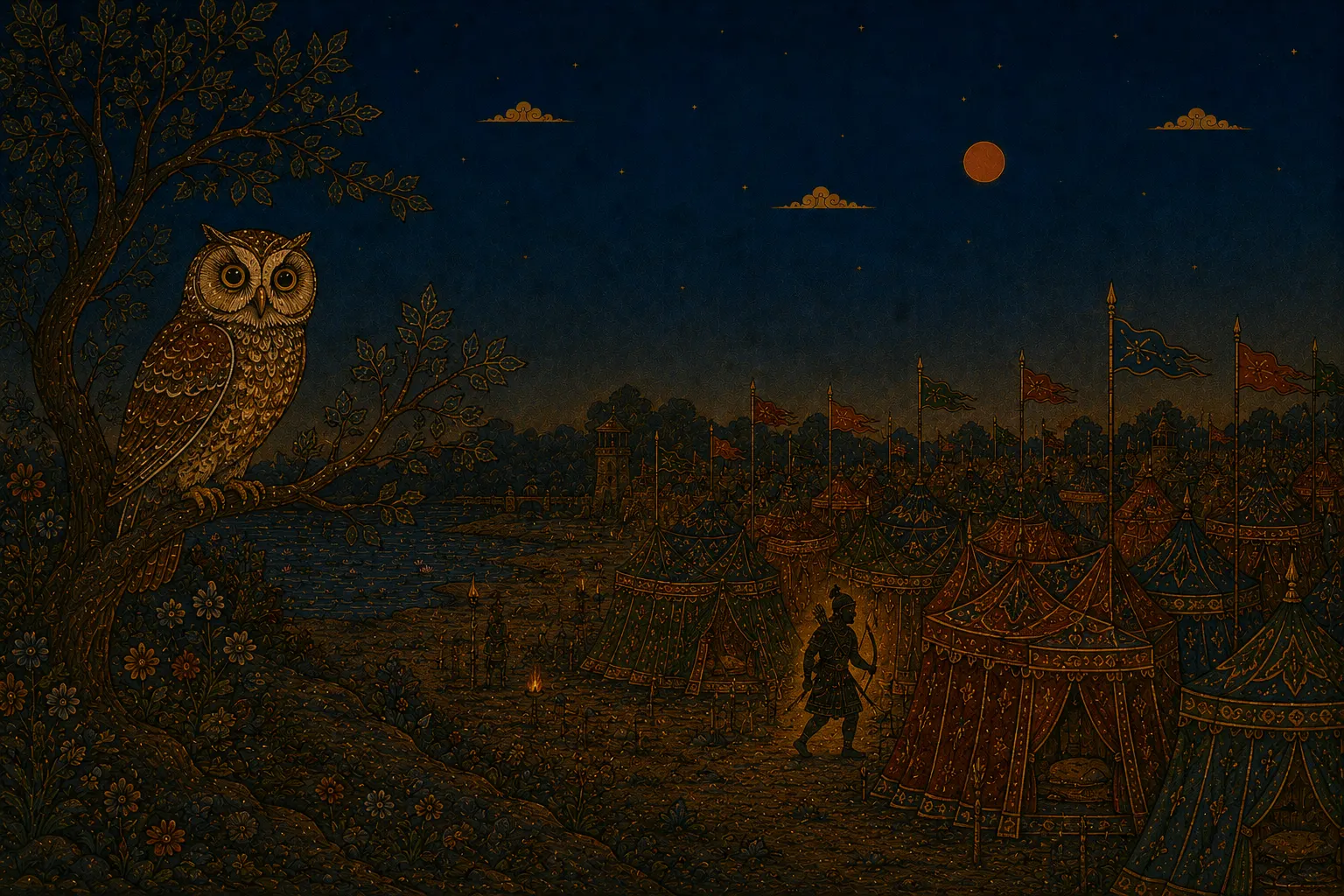
The owl and the crows

Ashwatthama could not sleep. He looked up. Crows were roosting in a tree. Then an owl arrived and killed the sleeping crows one by one. Ashwatthama watched. Then he woke his companions and said he had found a way.

Kripacharya's refusal

Kripacharya tried to stop him. He said killing sleeping men was not the work of a kshatriya, that it would bring no honor, and that night had already fallen, better to wait for morning. Ashwatthama would not listen. He said his own father had not been killed by the rules either. The three set out toward the camp.

The gate of the camp

At the gate of the camp stood a huge, terrifying figure that swallowed every weapon Ashwatthama threw at it. He understood the door would not open by force. He built an altar there, lit a fire, and offered himself as the sacrifice. Then Mahadeva appeared. He said the Panchalas had survived this long only because Krishna was protecting them, and that protection had now run out. He gave Ashwatthama a sword, and entered his body himself. The gate opened. The text tells it this way deliberately, that what happened that night was not Ashwatthama's alone.

The killing of Dhrishtadyumna

Inside, everyone was asleep. Ashwatthama first sought out Dhrishtadyumna, the man who had beheaded his father. He woke him, threw him to the ground, and beat him to death with his fists and feet. Dhrishtadyumna asked for a sword, to die like a warrior, Ashwatthama refused him one. Then he moved through the rest of the camp. Draupadi's five sons were killed that night, Shikhandi was killed, and everyone else still left. Outside, Kripacharya and Kritavarma stood at the gates, and killed anyone who fled past them, then set the camp on fire. An entire army was wiped out in one night. None of the five Pandavas were in the camp that night, they were staying outside with Krishna.

The jewel and the Brahmashira

When it was discovered in the morning, Draupadi sat down on the ground. She said she would not rise until she was brought the gem set in Ashwatthama's skull, which had been part of him since birth. The Pandavas went after him. Ashwatthama, surrounded, released the Brahmashira weapon. Arjuna released the same weapon in answer. Vyasa and Narada came between them and told both to withdraw the weapons, or nothing would remain. Arjuna withdrew his. Ashwatthama could not, he had never learned how. So instead he turned it toward the wombs of the Pandava women. The child in Uttara's womb was struck by that same weapon. Krishna made a vow on the spot, that the child would be born dead, but he himself would bring it back to life. The gem was pulled from Ashwatthama's head, and he was cursed, to wander for three thousand years, carrying his wounds, alone.

Note: The owl scene, Kripacharya's refusal, Shiva opening the gate, the killing of Dhrishtadyumna, the killing of Draupadi's five sons, the jewel, the Brahmashira and Krishna's word are all in the Sauptika Parva of Vyasa's Mahabharata. But Ashwatthama's immortality — that he still wanders today — comes from later religious tradition. In the text the curse is for three thousand years, not for immortality. This book is the darkest part of the whole story, and the text makes no attempt to soften it.

Source: Mahabharata (ascribed by tradition to Vyasa), Sauptika Parva

Now — how much stayed with you?

Why is that?

Ashwatthama attacked the sleeping camp at night. Where does the text say the idea came from?

  • Kritavarma suggested it
  • From watching an owl kill sleeping crows in a tree
  • Duryodhana said so as he died
  • Shiva ordered it
Read the whole story — The night animal

By day the crows will not let that owl sit on the branch. At night that same owl killed them one by one.

Ashwatthama drew no moral from it. He took it as a method — what cannot be beaten face to face can be killed asleep.

The Mahabharata puts the scene first, then shows what Ashwatthama concluded from it — and immediately after, Kripacharya's objection.

The centre of the Sauptika Parva is that one night's killing; the pursuit, the brahmashira and the punishment are in this parva too. It is one of the shortest and darkest in the Mahabharata.

Who said it?

Killing men asleep and unarmed is against a warrior's dharma — who told Ashwatthama this?

  • Kritavarma
  • Vyasa
  • Shiva
  • Kripacharya
Read the whole story — The man who tried to stop it, and then went along

Kripacharya is Ashwatthama's uncle, and had been on the Kaurava side throughout the war.

He called it against a warrior's dharma, and said wait until morning and ask Dhritarashtra and Vidura what the duty was.

Ashwatthama's answer was that the rules were already broken — with his father, with Abhimanyu, with Karna, with Duryodhana.

Kripacharya and Kritavarma went with him anyway, and stood at the gates killing those who ran. Refusing and then going along are both in the same night.

What happened?

Why were the Pandavas not killed in the camp that night?

  • Ashwatthama spared them deliberately
  • They were awake and fought
  • They were not in the camp that night; they were outside with Krishna
  • Shiva saved them
Read the whole story — A night spent outside

The five brothers and Krishna were away from the camp that night. The text does not tie it to any warning or prophecy.

The effect was that the winners lived and the people with them died — the commander Dhrishtadyumna, Shikhandi, Uttamaujas, Yudhamanyu.

Draupadi's five sons were killed that same night. They woke at the noise and came out.

So what is left in the morning is not a victory. Five brothers are alive and there is nobody in front of them.

Whose son?

There were five of us, and Draupadi was our mother. We were killed not in the war but in one night after it. Who are we?

  • Draupadi's five sons
  • Not the upapandavas but the Pandavas themselves
  • Ghatotkacha and his brothers
  • Abhimanyu and his brothers
Read the whole story — The line that did not survive

Draupadi had five sons, one by each Pandava. The text names them separately, but in the story they almost always come together.

They survived the eighteen days of the war. They were killed when the war was over.

With this the Pandavas' next generation is nearly finished. The only hope for the line is the child in Uttara's womb.

The throne of Hastinapura goes in the end to that Parikshit — Abhimanyu's son, so a grandson, not a son. And that same womb is attacked on this same night.

What happened?

Ashwatthama loosed the brahmashira and did not know how to withdraw it. What did he do at Vyasa's word?

  • He turned it to the sky
  • He turned it on himself
  • Arjuna stopped it
  • He turned it towards the wombs of the Pandava women
Read the whole story — A last blow that fell on no warrior

Arjuna withdrew his weapon, because he knew how. Ashwatthama only knew how to loose one.

Vyasa and Narada told him to turn it elsewhere. What he chose was the unborn.

Krishna said the child would live even so — and that is Parikshit, through whom the line continues.

Ashwatthama was cursed to wander alone for three thousand years, and the jewel was taken from his head. It was set before Draupadi, and she gave it to Yudhishthira.

Fact

What did Draupadi ask for from Ashwatthama?

  • His head
  • The jewel he had been born with in his head
  • That he be taken prisoner
  • Nothing
Read the whole story — What was not asked for

Draupadi said she would not eat until that jewel was placed in front of her.

But she did not ask for Ashwatthama's death. She said he was Dronacharya's son, and that his mother Kripi should not be given the grief she herself had been given.

This is the same woman who vowed in the Sabha Parva to leave her hair unbound, and kept it thirteen years.

The Mahabharata preaches nothing about it. It simply puts both things in the same person.

Vyasa or tradition?

"Ashwatthama is immortal and wanders to this day." — where is this from?

  • From later religious tradition; in this episode of the Mahabharata the curse is three thousand years, not immortality
  • It is stated plainly in the text
  • It is in the Gita
  • It is in the Shanti Parva
Read the whole story — Three thousand years

Krishna's curse is very concrete — three thousand years of wandering alone, with no company and no settlement.

So it is not an escape from death; it is something else undergone instead of death.

In later traditions Ashwatthama came to be counted among the chiranjivis, and stories of his being seen in various places accumulated.

The difference matters. A punishment of three thousand years ends; immortality does not, and it turns into a rank rather than a sentence.

Put it in order

Which is the right order of these events in the Sauptika Parva?

  • Seeing the owl → Shiva opening the gate → the brahmashira being loosed → Dhrishtadyumna's killing
  • Shiva opening the gate → seeing the owl → Dhrishtadyumna's killing → the brahmashira being loosed
  • Seeing the owl → Shiva opening the gate → Dhrishtadyumna's killing → the brahmashira being loosed
  • Dhrishtadyumna's killing → seeing the owl → Shiva opening the gate → the brahmashira being loosed
Read the whole story — The shortest and the heaviest

The Sauptika Parva is among the short parvas of the Mahabharata, and its central killing happens in a single night. Its consequence comes out the next day.

There is no army in it, no formation, no rule. After eighteen days of battle this is a room-by-room murder.

Victory and defeat both lose their meaning here. The winners survived, and there is nothing left to them.

The parva after this is not about fighting but about counting — who died, and who came to look at them.