Parva 12

Shanti Parva

The war was won, and the man who had won it did not want it

Yudhishthira refuses

The war was won. And Yudhishthira sat down. He said this kingdom had been gained by killing his own people, brothers, teachers, his grandfather. He would not take such a kingdom, he would go to the forest instead. The longest parva in the entire Mahabharata opens right here.

The brothers' answer

Bhima spoke first. He said that after thirteen years of hardship, to say this now was no different from throwing dice again, refusing what had already been won only made the loss worse. He also said that Yudhishthira always did the same thing, thinking when it was time to act, and making vows when it was time to think. Arjuna said something different, that giving up the kingdom was itself a search for comfort, and becoming an ascetic was no great deed in itself, a king's task was to rule. Draupadi said the sharpest thing of all, that she, whose five sons had been killed in a single night, had come now to hear that all of it had been for nothing.

Vyasa came, Narada came. In the end Yudhishthira agreed, and the coronation took place. But the question had not ended. Then Krishna said only one man could answer it, Bhishma, who still lay on his bed of arrows, his time not yet come.

To the bed of arrows

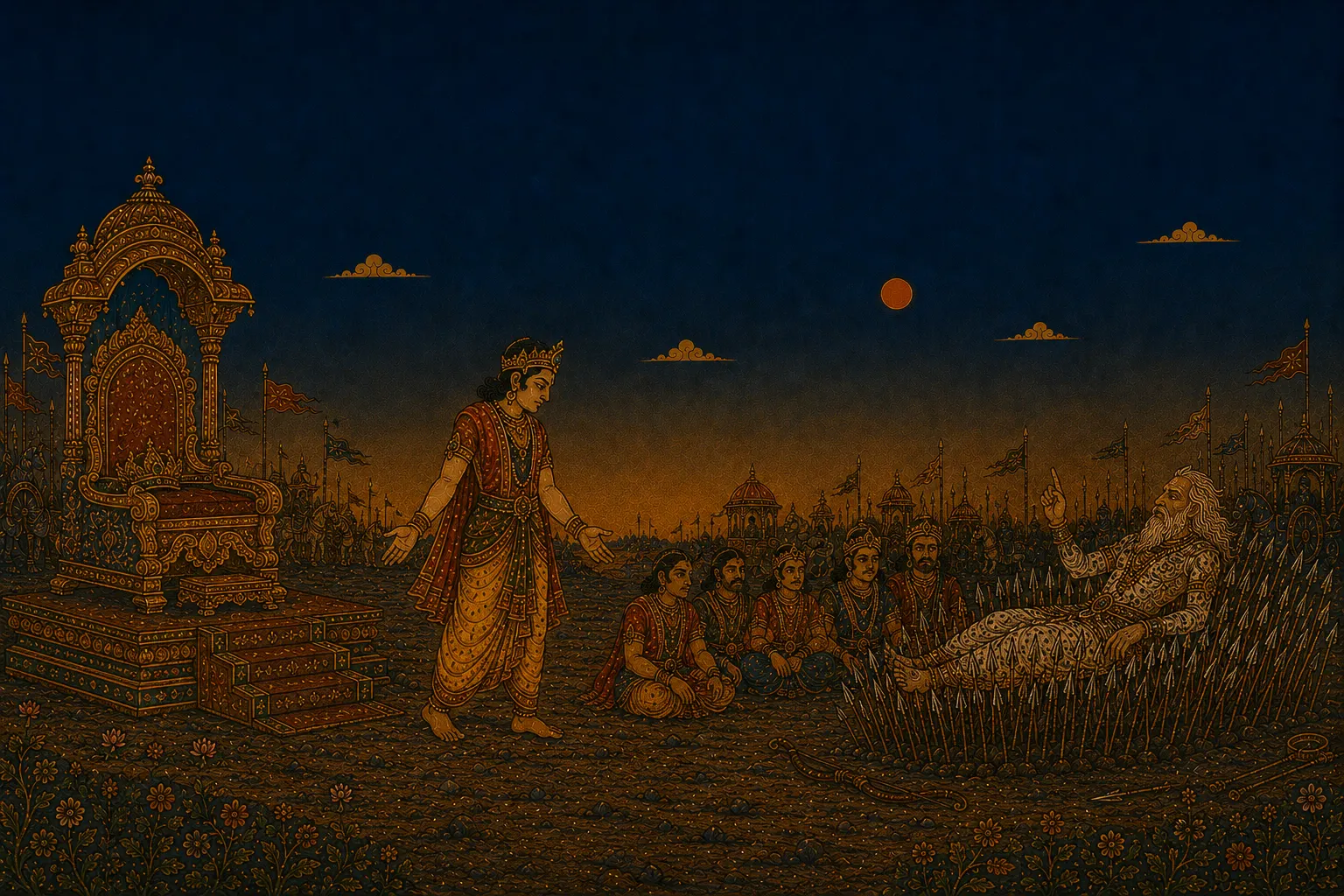
They all went to the field. Bhishma was still there, lying on the arrows where he had fallen on the tenth day. Yudhishthira sat beside him and began asking. What he received in answer forms the three parts of this parva.

Rajadharma

The first part concerns the duty of a king. Bhishma explained why kings became necessary at all. He said that in the beginning there was no king, and none was needed, people held to dharma and to their own rules on their own. Then that broke down, and punishment became necessary, and a king to administer it. In other words, in this telling, the king exists because society could not sustain the rules on its own, the king is not the starting point, he is an arrangement that came later.

Apaddharma

The second part is the hardest. Apaddharma means the dharma of times of crisis. It holds the questions where ordinary rules stop working, what to do when there is famine, when the kingdom is sinking, when telling the truth would get someone killed. The parva offers no easy answer here, it tells stories instead, and in every story the rule stands on one side and the circumstance on the other.

In this part comes the story of Vishvamitra, who during a famine, starving, resolved to take a dog's haunch from an outcaste's house, and argued the point with him. The outcaste said this was not for him, Vishvamitra answered that staying alive comes first, only the living can practice dharma later. The text does not simply call it wrong, it sets the rule and the circumstance side by side and leaves the question open.

Mokshadharma

The third part, Mokshadharma, is the longest. Here the subject moves away from kingship toward liberation, birth, death, the soul, and the question of what a man should do at all. Bhishma says that both joy and sorrow come and go, and a man who keeps chasing them never finds peace. He returns again and again to a single point, that nothing outside is truly one's own, not the kingdom, not the body, not anything won by conquest. But he does not say to abandon action, he says to act, and not cling to the fruit of the act. It is the very thing Krishna told Arjuna before the war, but here it is being told to a man who has already won the war and is grieving because of it.

In this part comes the story of Vyasa and his son Shuka. Shuka was renounced from birth, and Vyasa tries to hold him back, but the attempt fails, Shuka departs and Vyasa is left calling after him.

In the midst of this, Narada tells Yudhishthira the full story of Karna, from birth to death. Yudhishthira hears it whole for the first time, only after the war has ended. The reader has already read this story back in the first chapter, Yudhishthira is only hearing it now. Which means that all through the war there was one fact the reader knew and the fighter did not, and by the time it reached him, nothing could be changed anymore.

Note: Yudhishthira's refusal, Bhima's answer, the coronation, going to Bhishma, Rajadharma, Apaddharma and Mokshadharma are all in the Shanti Parva of Vyasa's Mahabharata. This is the longest book in the whole Mahabharata, and it has the least story in it. That account of the origin of the king — that there was no king at first, and the need arose when people no longer held to dharma on their own — is from this book, and it is counted among the oldest pieces of Indian political thought.

Source: Mahabharata (ascribed by tradition to Vyasa), Shanti Parva

Now — how much stayed with you?

Why is that?

After winning the war Yudhishthira refused the throne. What was his argument?

  • That this kingdom had come by killing his own people, so he would not take it and would go to the forest
  • That an heir of Duryodhana's was alive
  • That Bhima should be king
  • That he was ill
Read the whole story — Grief that turned into an argument

This was not simply sorrow. Yudhishthira put it as a whole argument.

His case was that a kshatriya's duty is killing, and there is one way out of that circle — renunciation.

Which is why the others could not quiet him with consolation. An argument had to be answered with an argument.

That refusal is what opens the long question the Shanti Parva goes on answering.

Who said it?

"A man who talks of renunciation after the time for fighting has passed is neither a warrior nor an ascetic." — who said this?

  • Arjuna
  • Krishna
  • Bhima
  • Vyasa
Read the whole story — The one who spoke most bitterly

Almost everyone speaks in this argument — Draupadi, Bhima, Arjuna, Nakula, Sahadeva, then Vyasa and Krishna.

Draupadi reminded him that the day they had cut through thirteen years for was today.

Bhima's argument was the plainest — the renunciation did not come at the right time, and is coming now.

Krishna at the end said the heaviest thing of all: giving up the kingdom gives the dead nothing, and the living need a king.

What happened?

What did Krishna advise Yudhishthira about his questions on running a kingdom?

  • That he would teach him himself
  • That Bhishma should be asked, who is still on the bed of arrows and whose time is not complete
  • That Vyasa should be asked
  • That Dhritarashtra should be asked
Read the whole story — The man still on the arrows

Bhishma fell on the tenth day and had lain there since, waiting for the sun's northward turn.

So he is alive even after the war is over, and that is what makes the whole Shanti Parva possible.

Yudhishthira sits beside him and asks, and Bhishma goes on answering.

So the largest teaching in the Mahabharata comes from a man who has stopped, having chosen the hour of his own death — and all of this is said in the interval.

Riddle

I am in three parts — the first on a king's work, the second on times of crisis, the third on letting go. What am I?

  • The Anushasana Parva
  • The Bhagavad Gita
  • The Sabha Parva
  • The Shanti Parva
Read the whole story — One parva divided into three names

Rajadharma — what a king should do. Apaddharma — what to do when the ordinary rules cannot run. Mokshadharma — how to be free of all of it.

The longest of the three is mokshadharma, and it is also the furthest from running a kingdom.

Which tells you the shape of this parva: the questions are a king's, but the answers move steadily away from kingship.

By verse count it is the largest parva in the Mahabharata — larger than the whole account of the war.

Who am I?

Starving in a famine, I decided to take a dog's haunch from a chandala's house and eat it, and argued with him about it. Who am I?

  • Vasishtha
  • Drona
  • Vishvamitra
  • Yudhishthira
Read the whole story — When a chandala stopped a brahmin

The force of this episode is that it runs backwards. The one holding to the rule is the chandala, and the one breaking it is the brahmin.

The chandala says this is not for you. Vishvamitra answers that staying alive comes first — whoever survives can keep dharma afterwards.

The text keeps this as an exception, not a permission. The whole apaddharma section rests on that discomfort.

And this is the same Vishvamitra who takes Rama away in the Ramayana. The two epics share some names between them.

Fact

According to Bhishma, why were there no king and no punishment in the beginning?

  • Because people kept dharma of themselves; when that broke, punishment and a king were needed
  • Because people were weak
  • Because the gods ruled
  • Because the population was small
Read the whole story — Who a king is for

Bhishma's rajadharma comes back to one place repeatedly — the king is not for the punishment, and the punishment is not for the king.

Both are for the people, and the text goes as far as removing a king who forgets it.

This is put in the mouth of a man who never took the throne himself, and spent everything he had defending it.

And the listener is the man who has just refused to take it.

Whose son?

I am Vyasa's son. I was detached from birth, and my father could not hold me in the world. Who am I?

  • Dhritarashtra
  • Vidura
  • Pandu
  • Shuka
Read the whole story — The one a father could not hold

Among Vyasa's sons, Dhritarashtra, Pandu and Vidura are counted — all three stayed inside the world.

Shuka is different. He was detached from birth, and Vyasa tries to hold him back.

The attempt fails. Shuka goes, and Vyasa is left calling after him.

The episode is placed where the subject is release — and the book telling it is held to be composed by that same Vyasa who could not hold his son.

What happened?

Yudhishthira's grief over Karna persisted. What happened about it in the Shanti Parva?

  • Krishna reasoned with him
  • Narada told him Karna's whole story
  • Bhishma told Karna's story
  • Kunti apologised
Read the whole story — The whole story, far too late

Yudhishthira had learned the truth about Karna in the Stri Parva, and the grief had not gone anywhere since.

Narada told it joined up — the birth, Parashurama's curse, the brahmin's curse, the armour to Indra, and the promise to kill none but Arjuna.

It does not lessen the grief. But one thing becomes clear — Karna's life was not the result of one mistake.

Here the Mahabharata sets out its most tangled character in full, once — and after he is dead.

Why is that?

Why is the apaddharma section in the text at all?

  • Because its subject is exactly the case where ordinary rules are tested against crisis
  • So that breaking the rules could be permitted
  • Because Yudhishthira asked
  • Because it is part of rajadharma
Read the whole story — An exception, not a permission

Apaddharma means the dharma of a time of crisis — famine, war, the situation in which no straight road is left.

The Vishvamitra episode comes here, and it is not told as any kind of victory.

The structure of the whole Mahabharata stands on this question — when do rules break, and what is left after they do.

The eighteen days of the war are the other form of it. The only difference is that there it happens, and here it is argued about.

Vyasa or tradition?

Where in the Mahabharata is Yudhishthira's coronation?

  • Right after the war, in the Shalya Parva
  • In the Stri Parva
  • In the Shanti Parva, after he is talked round
  • In the Anushasana Parva
Read the whole story — A throne filled late

In popular memory Yudhishthira becomes king as soon as the war ends. In the text a whole refusal lies in between.

The Stri Parva is mourning, and the Shanti Parva opens on the argument about whether he will take the throne at all.

The coronation happens when he is talked round by Krishna.

And immediately after it he goes and sits down beside Bhishma — so the first act of being king is to ask what a king is.

Fact

Which of the Shanti Parva's three parts is the longest?

  • Rajadharma
  • Mokshadharma
  • Apaddharma
  • All three are equal
Read the whole story — Where the subject leaves kingship behind

The questions are a king's, but the answers move steadily away from kingship.

The mokshadharma takes up creation, the self, samkhya and yoga, and stories like Shuka's.

Which is why this parva does not read like a story. It is a long conversation with stories passing through it.

And the whole conversation belongs to a man lying on arrows, waiting for the hour of his own death to arrive.

Put it in order

Which is the right order of these events in the Shanti Parva?

  • The coronation → Yudhishthira's refusal → going to Bhishma → the teaching on rajadharma
  • Yudhishthira's refusal → going to Bhishma → the coronation → the teaching on rajadharma
  • Going to Bhishma → Yudhishthira's refusal → the coronation → the teaching on rajadharma
  • Yudhishthira's refusal → the coronation → going to Bhishma → the teaching on rajadharma
Read the whole story — A parva in which the story stops

There is very little event in the Shanti Parva. What there is is finished in the first part — the refusal, the argument, the coronation.

After that the whole parva stays inside one scene: a man lying on arrows, a new king sitting beside him, and questions.

Which is why it is so often skipped, and why it holds the most clearly thought-out part of the book.

The next parva carries the same conversation on, and Bhishma's waiting ends in it.