
Parva 11
Stri Parva
No fighting in this book — only the women walking the field afterward
The iron figure
After the war the Pandavas went to Dhritarashtra. Dhritarashtra said he wished to embrace Bhima. Krishna knew what this meant, a hundred sons had been killed, and it was Bhima who had killed both Duhshasana and Duryodhana, and whatever strength remained in an old blind man's arms was enough to crush someone. He pulled Bhima back and put an iron statue in his place. Dhritarashtra wrapped his arms around it and crushed it. The statue shattered, its pieces scattering on the ground. Then he began to weep. He said he had killed Bhima. Krishna told him it had not been Bhima. Dhritarashtra fell silent, ashamed, and relieved at once.
Vidura's parable
Vidura told Dhritarashtra a parable. A man, fleeing through a forest, fell into a well. Halfway down he caught hold of a vine and hung there. Below him were snakes. Above, an elephant was shaking the vine. Two mice gnawed at the same vine, taking turns. And above it all, drops of honey fell from a hive. The man hung there with his mouth open for those drops, death below, death above, and in between he waited only for that one sweet drop. Vidura said this was the condition of every man, and this was why he could look straight at something and still not see it.
The field
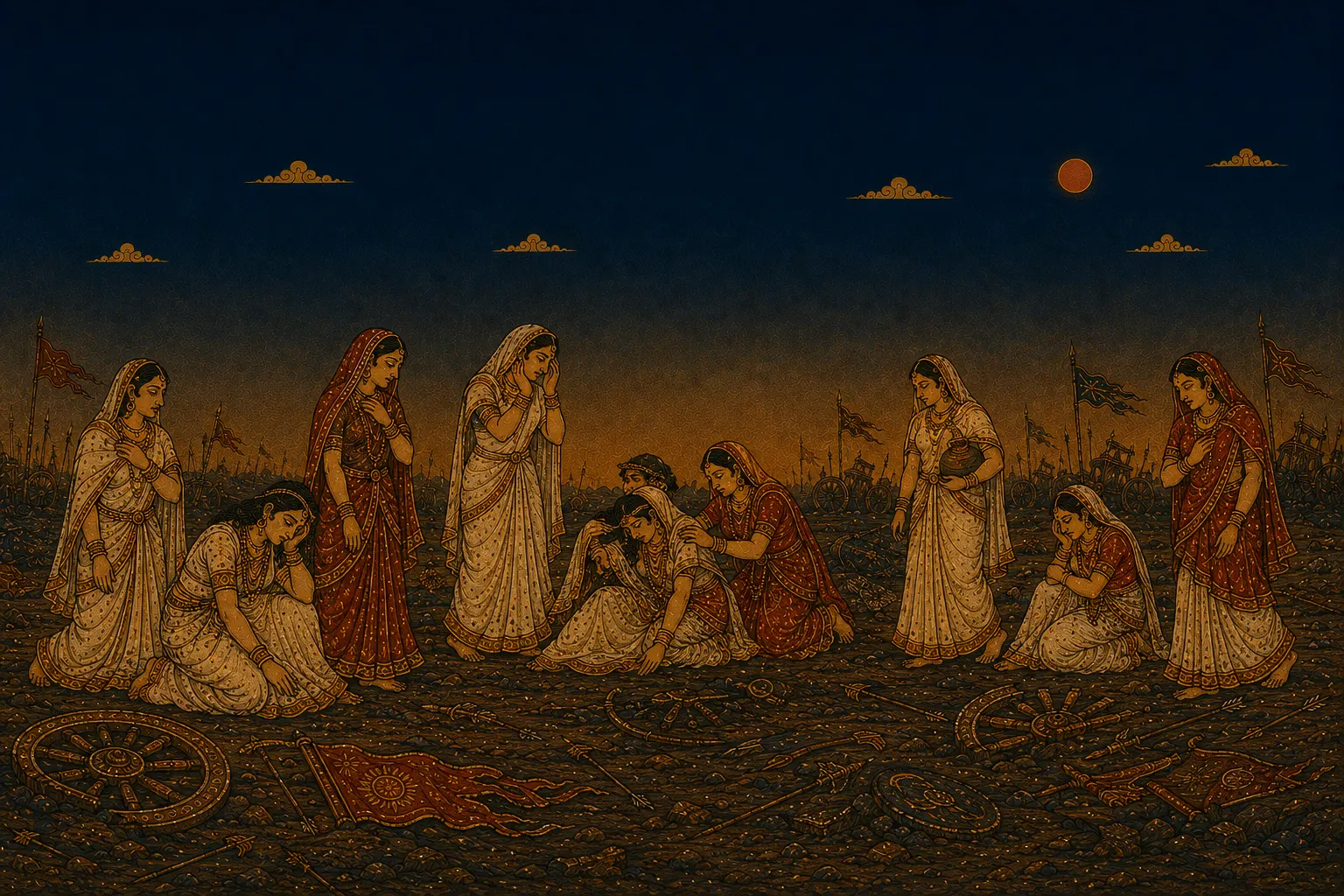
Then the women came onto the field. Much of this parva is exactly this, no battle, only mothers, wives, and sisters wandering the field trying to recognize their own among the bodies. One sits by her son. Another by her husband. Another simply stands, because there is nothing left to recognize. The text names them here, and leaves no one out.
Uttara sits beside Abhimanyu, the same girl married at the end of the Virata Parva, now a pregnant widow. Karna's wives are there. Duhshasana's. Jayadratha's. And it is not a hundred mothers, it is one mother, Gandhari, whose hundred sons lie on this same field. She had kept her eyes bound her whole life, because her husband could not see, and she did not want to see what he could not. Today she did not remove the blindfold. Vyasa granted her sight, and without lifting it she saw everything anyway, her hundred sons, one by one.
Gandhari's curse
Gandhari turned toward Krishna. She said he could have stopped this, he had the power, and he had not stopped it. Then she cursed him, that just as her own line had destroyed itself fighting among its own, Krishna's line too would destroy itself the same way, and he would die alone. Krishna accepted the curse without a word in his own defense. Thirty-six years later, it came to pass.
Kunti's truth
At the end, everyone offered water for the dead. Then Kunti told Yudhishthira to offer water for Karna too. Yudhishthira asked why, he had been the enemy. Then Kunti told him what she had hidden from her five sons until the war was over, that Karna had been her son, older than all five brothers. Yudhishthira listened, stunned. Then he cursed his own mother, that from that day no woman would ever again be able to keep a secret hidden.
It is the heaviest moment in the entire war, and it comes only after the war is over, when nothing remained that could still be changed.
Note: The iron figure, Vidura's parable of the well, Gandhari's curse, Kunti's truth and Yudhishthira's answer are all in the Stri Parva of Vyasa's Mahabharata. There is no fighting in this book — it is entirely on the grief of those left after the war, and the effect of it here is that a reader still hoping for a victory is brought up short.
Source: Mahabharata (ascribed by tradition to Vyasa), Stri Parva