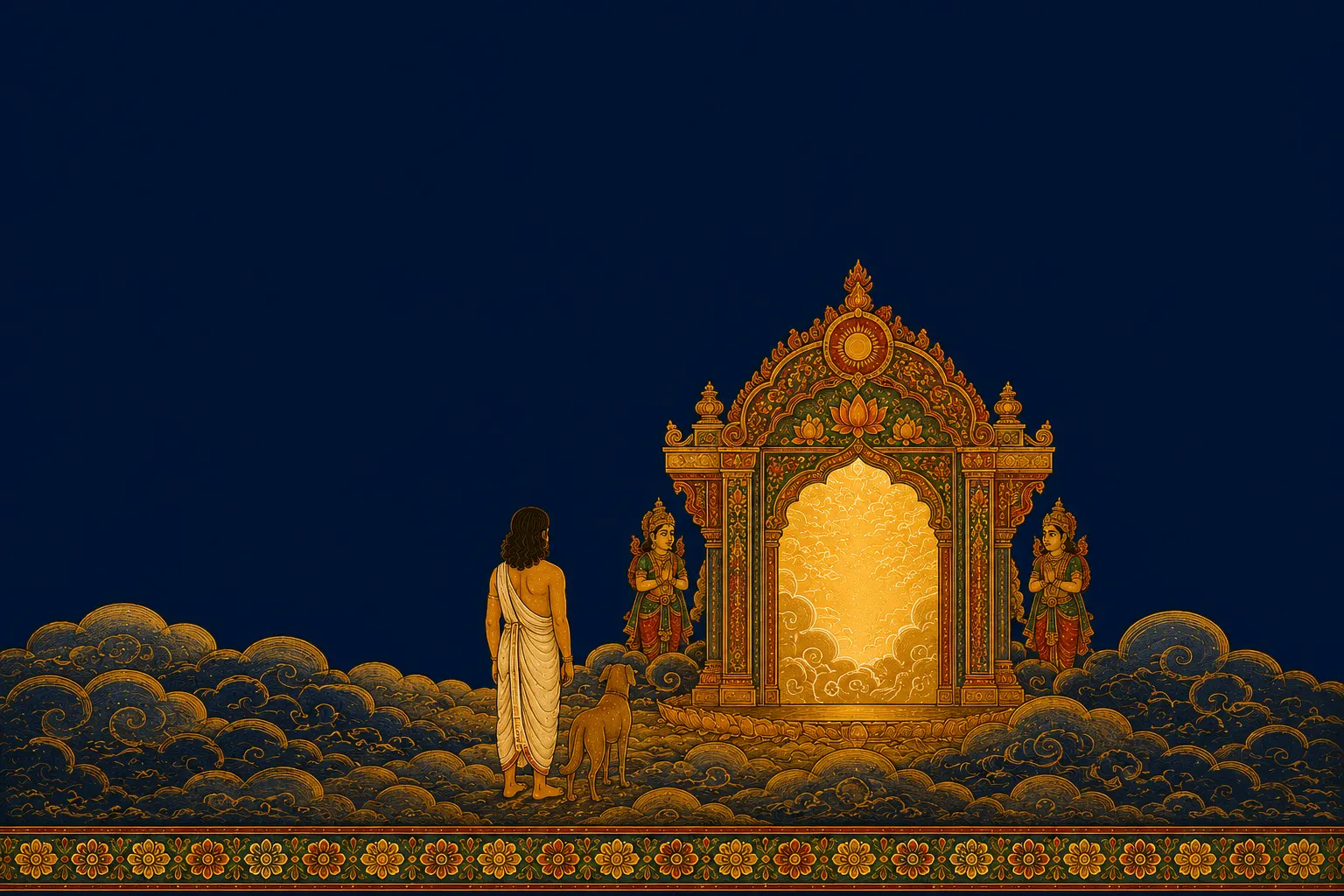
Parva 18

Svargarohana Parva

Heaven was not what Yudhishthira expected, and one test was left

Duryodhana in heaven

Yudhishthira arrived in heaven. And the first thing he saw there was Duryodhana, seated on a throne, honored. Yudhishthira asked how he came to be there. He was told that Duryodhana had died fighting on the field, and the heaven of heroes belongs to every kshatriya who falls in battle, whichever side he fought on. Yudhishthira said he did not want such a heaven. He asked where his brothers were, where Draupadi was.

The vision of hell

He was led away. The path went downward, and grew darker. A stench rose. Voices came from every side. The messenger said, enough, let us turn back now. Then voices called out of the darkness, wait, do not go, your presence gives us some relief. Yudhishthira asked who they were. The answer came, Bhima, Arjuna, Nakula, Sahadeva, Draupadi, Karna. Yudhishthira stood still. He told the messenger he would not go back. He said that if his staying here brought these people even a little relief, then this was his heaven.

The lifting of the dark

At that very instant the darkness lifted. The stench, the voices, the entire scene, all of it vanished. The gods stood before him. Indra explained that what he had just seen was divine illusion, a scene shown for a moment, and a final test. He said every king must witness hell once, whoever enjoys the fruit of his good deeds first must settle the rest of the account later, and whoever endures suffering first lives afterward in comfort. Yudhishthira had to see it also because, once during the war, he had spoken a half-truth, the words about Ashwatthama's death, which had made Drona lay down his weapons. It was the only lie of his entire life, and its account was settled here.

Everyone meets

Then they all met, in their true forms. The brothers returned each to the god from whom they had been born. Draupadi was there. Karna was with the Sun. Abhimanyu, Draupadi's five sons, Bhishma, Drona, all of them were there. Those who had stood facing each other on the battlefield did not stand facing each other here.

The end of the story

And the story returns to where it began. Janamejaya's sacrifice is still burning. The fire is still lit. Vaishampayana has finished the telling. Janamejaya listens on, knowing that what he has heard is the story of his own ancestors, and that Parikshit, his father, was born in the final part of this very tale. But there is one more circle around it. In the forest of Naimisha the sages sit, and Sauti is telling them all of this, Janamejaya's sacrifice, Vaishampayana's telling, and the whole story within it. It is there that he brings the story to a close. This is the very shape of the Mahabharata itself, someone telling it to someone, and the listener standing inside the same story.

Note: Duryodhana appearing in heaven, the vision of hell, Yudhishthira's decision to stay and the lifting of the dark are all in the Svargarohana Parva of Vyasa's Mahabharata. The hell he was shown was a divine illusion and a test — the text says so itself, and Indra explains the reason for it there. The story returns to the same snake sacrifice of Janamejaya where it began, and outside that lies one more frame: Sauti telling the same story to the sages in the Naimisha forest. A story inside a story, and the listener a descendant of the same story.

Source: Mahabharata (ascribed by tradition to Vyasa), Svargarohana Parva

Now — how much stayed with you?

What happened?

Whom did Yudhishthira see first on reaching heaven?

  • Duryodhana, sitting on a throne
  • His brothers
  • Krishna
  • Draupadi
Read the whole story — The first sight, and the bitterest

Yudhishthira's first question was why the man it all started with is here.

The answer was that Duryodhana died on the field, fighting as a kshatriya.

The Mahabharata shows him in heaven too, gives the reason, and moves on. Narada also tells Yudhishthira not to apply the measures of earth to the arrangements here.

Yudhishthira refused a heaven like that, and the real part of the parva begins there.

Why is that?

Hearing his brothers' voices in hell, why did Yudhishthira refuse to go back?

  • Because he did not know the way
  • Because the gods stopped him
  • Because his being there was giving those people some relief
  • Because he had forgotten the way to heaven
Read the whole story — The same choice, a third time

The voices were Bhima's, Arjuna's, Nakula's, Sahadeva's, Karna's and Draupadi's — all saying stay a little longer.

Yudhishthira told the messenger to go back, and said he would stay.

He had made this same choice in front of the yaksha at the lake, and at the gate of heaven for the dog.

Each time he chose against his own advantage. The text does not set these out as a counted series; it is a repetition the reader sees.

Fact

What was that vision of hell, in fact?

  • A permanent punishment
  • An illusion made by Duryodhana
  • A dream
  • A place shown for a short while, after which the darkness lifted
Read the whole story — A half-truth, an account settled

The gods said every king has to see this for a while.

What was on Yudhishthira's account was named too — the dice, and that half-truth told to Drona.

His brothers and Draupadi were not in any suffering. What he had seen was not a place anyone stays.

The Mahabharata does not hand out a plain reward here either. Even the man who kept most to dharma is taken on one round of hell.

Whose son?

The king this whole story was told to was Parikshit's son. Who is he?

  • Shuka
  • Janamejaya
  • Abhimanyu
  • Yuyutsu
Read the whole story — The circle closed

Janamejaya is Parikshit's son, and Parikshit is the child who died in the womb and was brought to life.

So the one hearing the story belongs to the very line the story is about — and that line survived through one child.

This is opened in the first parva itself, and comes back to it in the last.

That is the shape of the Mahabharata: a story inside a story, and a teller always connected to somebody.

Put it in order

Which is the right order of these events in the Svargarohana Parva?

  • The vision of hell → seeing Duryodhana → Yudhishthira deciding to stay → the darkness lifting
  • Seeing Duryodhana → the darkness lifting → the vision of hell → Yudhishthira deciding to stay
  • Yudhishthira deciding to stay → seeing Duryodhana → the vision of hell → the darkness lifting
  • Seeing Duryodhana → the vision of hell → Yudhishthira deciding to stay → the darkness lifting
Read the whole story — What is not in it is nowhere

The eighteenth parva is among the shortest, and it does not end on any great scene.

At the end the book says a thing about itself — what is in it may be found elsewhere too, but what is not in it will be found nowhere.

It is a large claim, and the Mahabharata sets it down without any defence of it.

The eighteen parvas are complete here — in the same assembly they began in, in front of the same listener.