
Parva 5
Udyoga Parva
Every attempt to stop the war, and the one man who would not be moved
Choosing Krishna
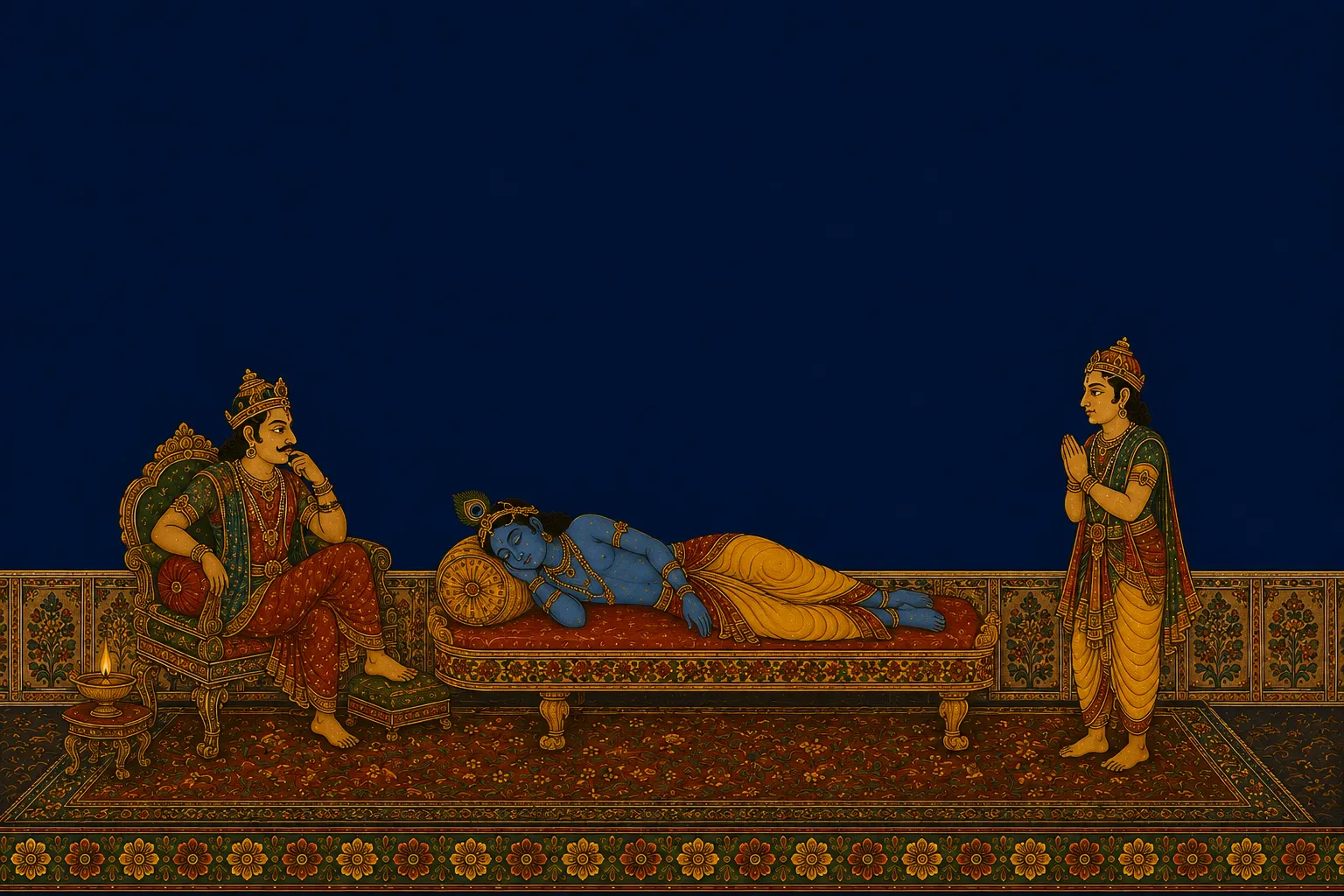
Both Duryodhana and Arjuna went to Krishna. Krishna was asleep. Duryodhana arrived first and sat by his head, Arjuna came later and stood at his feet. When Krishna's eyes opened, Arjuna was in front of him. Krishna said both had come, but he had seen Arjuna first, and Arjuna was also younger, so the first choice belonged to him. Then he laid out the terms. On one side, himself alone, unarmed, refusing to fight. On the other, his entire army, the Narayani Sena. Arjuna chose Krishna. Duryodhana thought this foolish, and went home pleased to have gained the army.
Vidura's counsel
Sanjaya went first. Dhritarashtra had sent him, and his task was to persuade the Pandavas that war would gain them nothing. Yudhishthira listened and said they too did not want war. But he also said that what was rightfully theirs, they wanted, and if it was not given, they would fight. Sanjaya returned.
That night Dhritarashtra could not sleep. He called for Vidura. What Vidura said that night is known as the Vidura Niti, what a king should do, whose counsel he should heed, and what kind of man burns down his own house. Dhritarashtra listened. At one point he said he knew what was right, but his son would not listen, and he could not stop him. It is the clearest line in the entire Mahabharata. The king knows, and still does not act.
Armies gathered on both sides. They were counted in akshauhinis, a great division with a fixed ratio of chariots, elephants, horses, and foot soldiers. The Pandavas raised seven akshauhinis, the Kauravas eleven. The Pandavas chose Dhrishtadyumna as commander, son of Drupada, brother of Draupadi. The Kauravas chose Bhishma.
Once made commander, Bhishma ranked the warriors on both sides, who was a ratha, who a maharatha. Of Karna he said he was an ardharathi, only half that rank. Karna, hearing this before the whole court, flared with anger. He announced then and there that as long as Bhishma led the army, he would not take up arms. So for the first ten days Karna sat out.
Krishna as envoy
Meanwhile efforts at peace continued. At last Krishna himself went as envoy to Hastinapura. He set the demand as low as it could go, not the whole kingdom, not half, only five villages. Duryodhana declared before the full court that he would not give even as much land as the point of a needle. He then tried to have Krishna seized. Krishna revealed his cosmic form in that very hall, so vast that those watching shut their eyes. He could not be captured. That ended the peace talks.
On his way back, Krishna took Karna aside and told him the truth, that he was Kunti's firstborn, older than all five brothers, and so the first claim to the kingdom was his. Karna refused. Then Kunti herself came and told him the same thing. Karna told her that Duryodhana had accepted him when no one knew his lineage, and to switch sides now would be ingratitude. But he made her a promise, he would kill no brother but Arjuna. Kunti's five sons would remain five, either way, Karna or Arjuna.
Note: Krishna's and Duryodhana's choice, the counting of the akshauhinis, the quarrel between Bhishma and Karna and Karna staying out of the first ten days, Krishna's embassy, the demand for five villages, the cosmic form, and Krishna's and Kunti's meetings with Karna are all in the Udyoga Parva of Vyasa's Mahabharata. Karna's promise is in the text too, and it is kept to the letter later in the Karna Parva — he defeats Yudhishthira, Bhima, Nakula and Sahadeva and spares them all.
Source: Mahabharata (ascribed by tradition to Vyasa), Udyoga Parva