Parva 3

Vana Parva

Twelve years in the forest, and the stories told to fill them

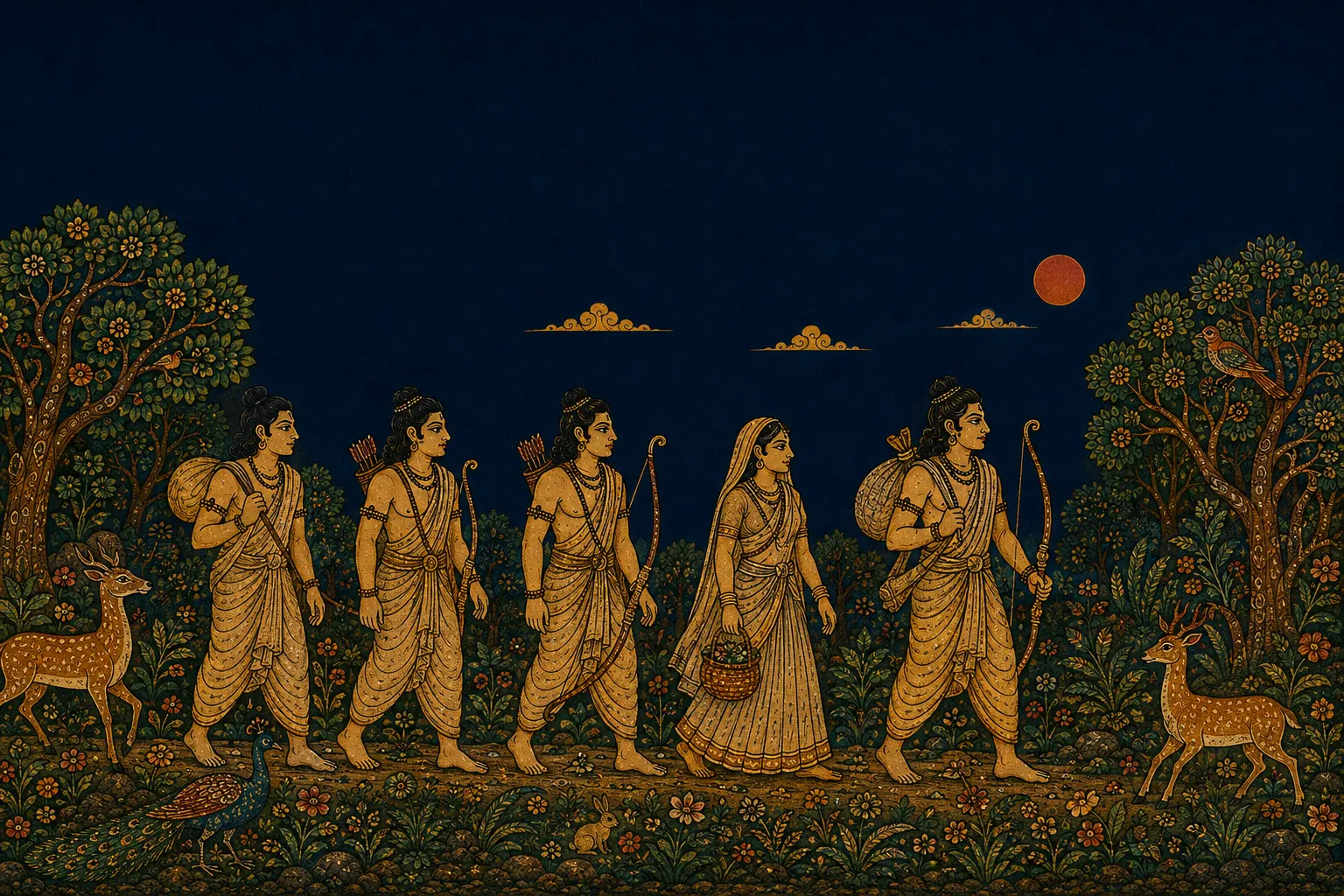
Into the forest

The Pandavas left the city. People walked with them for a while, then slowed, one by one, and turned back. Draupadi was with them, and she was not quiet, the sharpest words in this entire book are hers. At one point she told Yudhishthira that forgiveness is not always dharma, that a king who does not raise his hand against injustice is not practicing dharma, he is only enduring it. Yudhishthira answered, and his answer would remain the same throughout the book, a vow once given must be kept, whatever the cost. This argument runs on for the whole twelve years, returning again and again, sometimes settled, sometimes not.

Arjuna's penance

The Pandavas needed weapons. Arjuna went alone to the north to perform penance. One day during his austerities a wild boar charged toward him. Arjuna loosed an arrow, and at the same instant another arrow struck the same boar. Facing him stood a hunter dressed as a mountain tribesman. The two argued over whose kill it was, and the argument turned into a fight. Arjuna threw everything he had and could not even move the hunter. Finally, conceding defeat, he made a Shiva-linga out of clay and offered flowers on it. The flowers landed on the hunter's head. The hunter was Shiva. Shiva revealed himself and gave him the Pashupatastra, one of the most powerful weapons in the Mahabharata, one Arjuna would never fire again.

He then went to Indra's realm and spent years there learning celestial weapons. There the apsara Urvashi offered herself to him. Arjuna refused, saying that as an ancestress of his line she was like a mother to him. Insulted, Urvashi cursed him to live a year without manhood. Indra later said the curse would become a boon, and in the thirteenth year, it did.

Bhima and Hanuman

Meanwhile Bhima was walking a mountain path. In the middle of it lay an old monkey, its tail stretched across the way. Bhima told it to move the tail. The monkey said, I am old, move it yourself. Bhima touched it, the tail did not budge. He used all his strength, still nothing. He realized this was no ordinary monkey, and asked who he was. It was Hanuman, son of the wind, which made him Bhima's own brother, since Bhima too was born of the wind. Hanuman blessed him, and said that in the war he would sit on the flag of Arjuna's chariot. At Kurukshetra, that is exactly what happened.

The stories heard in the forest

This is one of the longest books in the Mahabharata, and the reason is not battle. It is that sages kept passing through the forest and telling stories, and those stories are recorded here in full. The tale of Nala and Damayanti is here, Nala too lost everything at dice, and his wife set him upright again, which is exactly why it was told to Yudhishthira. The tale of Savitri is here too, the woman who followed Yama and, through words alone, won her husband's life back. Even the story of Rama is told here in brief, meaning the Ramayana exists inside the Mahabharata, as a story within the story.

Karna gives away his armour

Karna had been born with armor and earrings, fused to his body, and as long as he wore them no one could kill him. Indra, Arjuna's father, knew this. One day he came to Karna disguised as a Brahmin, at the very moment Karna stood having just offered his oblation to the Sun, a time when he refused no one. The Sun had already warned Karna that this was Indra, and what he would ask for. Karna gave it anyway. He said that honor mattered more than the body, and that refusing now would undo the name he had earned. He cut the armor and earrings from his own body and gave them away. In return Indra gave him a weapon that could only be used once, one that would never be used on Arjuna.

The cattle raid

Duryodhana had the idea of going to the forest to show the Pandavas their reduced state. He set out to camp nearby with his army and his queens, on the pretext of inspecting cattle. There he clashed with some gandharvas, who seized him and began carrying him off bound. His companions fled to the Pandavas. Yudhishthira sent Bhima and Arjuna. Bhima said, good. Yudhishthira said, among ourselves we are five and they are a hundred, but before outsiders we are a hundred and five. The Pandavas went and freed Duryodhana themselves. Nothing worse could have happened to him, and he returned humiliated.

The yaksha's questions

The twelfth year was nearly over. One day, thirsty, the brothers came to a lake in search of water. Nakula went first, bent to drink, and collapsed. Then Sahadeva, then Arjuna, then Bhima, all four lay where they fell. Finally Yudhishthira arrived. A voice spoke, a Yaksha, saying, answer my questions first, then drink. Yudhishthira sat down. The Yaksha asked one question after another, all about dharma and life. The most famous of them was, what is the greatest wonder in the world. Yudhishthira answered, every day people die, everyone sees it, and yet every man lives as though he will never die at all.

The Yaksha was pleased. He said he would bring one brother back to life, choose. Yudhishthira chose Nakula. The Yaksha asked why not Bhima or Arjuna, who were of more use. Yudhishthira said, my father had two wives, one son of Kunti, myself, is alive, so one of Madri's sons should live too. The Yaksha raised all four. The Yaksha was Dharma himself, Yudhishthira's own father. The twelve years were complete. Now the thirteenth had to come, and it would be the hardest of all.

Note: Draupadi's argument, Arjuna's penance and the Pashupatastra from Shiva in the tribesman's form, Urvashi's curse, Bhima's meeting with Hanuman, the tales of Nala and Damayanti and of Savitri, Karna giving away his armour, the cattle raid and the yaksha's questions are all in the Vana Parva of Vyasa's Mahabharata. This is one of the longest books in the Mahabharata, and the reason is that it holds little plot and many inset stories, the Ramayana among them. Karna gives with his eyes open — the Sun has warned him beforehand, and in the text his motive is fame, not naivety.

Source: Mahabharata (ascribed by tradition to Vyasa), Vana Parva

Now — how much stayed with you?

Who said it?

"You kept walking in dharma, so why has all this happened?" — who asked Yudhishthira this in the forest?

  • Kunti
  • Draupadi
  • Arjuna
  • Vyasa
Read the whole story — The question that kept coming back

Draupadi's argument was plain: Yudhishthira had never done wrong, and everything was gone anyway. So what is dharma worth?

Yudhishthira's answer was plainer still — he does not keep dharma for a return. Anyone who bargains before doing right is a trader.

Bhima was with Draupadi in this argument. He says again and again to stop waiting and fight now.

The Mahabharata does not settle the argument. All three positions look sound in their place, and that is the real material of this parva.

Who am I?

I came dressed as a hunter and fought Arjuna. After he lost he recognised me, and I gave him my weapon. Who am I?

  • Indra
  • Yama
  • Shiva
  • Agni
Read the whole story — Where the flowers fell

The quarrel was over whose arrow had hit the boar. Both claimed it.

The fight went long and every one of Arjuna's weapons failed. That was new to him.

Worn out, he made a shivalinga of clay and offered flowers. Then he saw that the flowers were on the head of the kirata standing in front of him.

Arjuna understood and fell down. Shiva gave him the pashupatastra, which he never used in the war.

What happened?

Arjuna refused Urvashi's advance in Indra's world. What happened after?

  • Indra was angry
  • Arjuna was sent back
  • Urvashi cursed him to be impotent for a year
  • Nothing happened
Read the whole story — A curse that turned into a gift

Arjuna had refused Urvashi by calling her mother, because she had been the wife of his ancestor Pururavas.

Urvashi took it as an insult and cursed him — you will live as one who dances and sings among women.

Indra intervened and cut the curse to a year, and to a year of Arjuna's own choosing.

In the year of hiding that curse became the disguise of Brihannala, and it is the only reason Arjuna could stay hidden a whole year.

Who am I?

I was lying in the road and refused to move my tail. Bhima put his whole strength into it and could not shift it. Who am I?

  • Hanuman
  • Jatayu
  • Sugriva
  • Jambavan
Read the whole story — Two epics, one meeting

This is among the very few moments where the Ramayana and the Mahabharata meet directly.

Hanuman showed his vast form, and Bhima could not see the end of it.

Before going he promised that in the war he would be on the banner of Arjuna's chariot, and would break the enemy's courage with his roar.

That is why Arjuna is called kapidhwaja — the one with a monkey on his banner.

Fact

Which king's story was told to console Yudhishthira in the forest — a king who had lost everything at dice?

  • Harishchandra
  • Shibi
  • Nala
  • Yayati
Read the whole story — Nala and Damayanti

Nala was king of Nishadha, and married Damayanti at a swayamvara where she picked him out even from among the gods.

Then Kali entered Nala and he lost his kingdom at dice. In the forest he even left Damayanti while she slept.

After years of wandering the two found each other again, and Nala won his lost kingdom back — at dice.

The real work of the story is exactly that: to show Yudhishthira that what is gone can also come back.

Who am I?

I argued with Yama, and brought my husband's life back. My story was told to Yudhishthira in the forest. Who am I?

  • Damayanti
  • Kunti
  • Savitri
  • Gandhari
Read the whole story — The one who won by argument

Savitri chose Satyavan after being told he had a year left to live.

On the appointed day Yama took Satyavan's life and set off, and Savitri walked after him.

Yama told her to turn back and gave her boons in exchange. Savitri took each boon and kept walking.

At the end she asked for children — and since she would have none by anyone but Satyavan, Yama had to give the life back. She won by argument, not by force.

Vyasa or tradition?

The whole story of Rama is also told in the Mahabharata's Vana Parva. This statement is —

  • wrong, the two epics never meet
  • right
  • right, but it is in the Uttara Kanda
  • right, but it is held to be a later addition
Read the whole story — An epic inside an epic

Yudhishthira asks whether anyone has been more wretched than he is — anyone whose wife was humiliated in open assembly.

The sage Markandeya tells him the story of Rama: a prince sent to the forest, whose wife was taken, and who won her back by war.

It is not the whole Ramayana — it is a condensed form, and in places it differs from Valmiki.

Both epics are on this site, which makes the passage doubly interesting: one story inside another, told as consolation.

Why is that?

Karna gave away the armour and earrings even after the sun warned him. What reason does the text give?

  • He did not see the danger
  • He was afraid of Indra
  • He said fame outlives the body, and that after his offering he refused nobody
  • He wanted the shakti in return
Read the whole story — The man who could not refuse

Karna's vow was that after making his offering to the sun, he would refuse nobody who asked. It was known everywhere.

Indra chose exactly that hour, and dressed as a brahmin.

The sun had already warned him in a dream. Karna said he would not lose his name in order to save his life.

Indra gave him the Vasavi shakti in return, usable once. Karna will save it for Arjuna — and in the war will have to spend it on Ghatotkacha.

What happened?

Duryodhana was taken prisoner by gandharvas on the cattle expedition. What happened then?

  • He got free by his own strength
  • Karna freed him
  • The Pandavas went and freed him
  • The gandharvas let him go
Read the whole story — Worse than losing

Bhima's first reaction was that this was good news — the gandharvas had done the job for them.

Yudhishthira stopped him and said the line that makes this episode worth remembering: among ourselves we are five and a hundred, but before outsiders we are a hundred and five.

Arjuna fought the gandharva king Chitrasena and freed Duryodhana. Chitrasena was the same one Arjuna had learned dance from in Indra's world.

For Duryodhana it was unbearable. The text says he made up his mind to end his life there, and Karna and Shakuni stopped him.

Riddle

I brought down four brothers, but did not fight the fifth. I only asked questions. Who am I?

  • Indra
  • Chitrasena the gandharva king
  • The kirata
  • The yaksha
Read the whole story — The yaksha's questions

All four brothers ignored the warning and drank, and fell where they stood.

Yudhishthira answered first and drank after. The questions were about dharma, the world and human beings.

The most famous is what the greatest wonder in the world is. Yudhishthira's answer: people die every day, and everyone else goes on living as though they will not.

The whole passage is among the most quoted in the Mahabharata, and it comes just before the war — where living and dying is about to become real.

Why is that?

The yaksha offered to restore one brother. Why did Yudhishthira choose Nakula over Bhima or Arjuna?

  • Because one son of Kunti's was alive, so one of Madri's should be too
  • Nakula was the youngest
  • Nakula was his favourite
  • Because Nakula was the finest warrior
Read the whole story — The man who chose justice before a war

The yaksha made the choice hard on purpose. Winning the war without Bhima and Arjuna was close to impossible.

Yudhishthira said his father had two wives, and he wanted one son of each mother alive.

The yaksha said: you chose fairness over advantage — and restored all four.

That answer also leaves a question mark over the whole war to come: what will a man who does not choose advantage here do at Kurukshetra?

Whose son?

I am a son of the wind, and by that a brother of Bhima. Who am I?

  • Sugriva
  • Hanuman
  • Ghatotkacha
  • Nakula
Read the whole story — Who belongs to whom

In the Mahabharata the Pandavas' fathers are gods, and that lineage keeps mattering.

Yudhishthira from Yama, Bhima from the wind, Arjuna from Indra — and Nakula and Sahadeva from the Ashvins.

Which is why the yaksha at the lake turns out to be Yudhishthira's father, and why Indra comes to Karna for the armour.

And why the old monkey met in the forest turns out to be Bhima's brother.

Fact

Which weapon did Arjuna receive from Shiva?

  • The pashupatastra
  • The brahmastra
  • The Vasavi shakti
  • The narayanastra
Read the whole story — The one never used

The pashupatastra is counted among the most terrible weapons in the Mahabharata, and Shiva gave a warning with it.

The condition was that it not be used on an ordinary enemy, because it cannot stop what it starts.

Arjuna never used it at Kurukshetra.

That is worth noticing — across all eighteen days, the greatest weapon stayed in its sheath.

Who said it?

"People die every day, and everyone else goes on living as though they will not." — who said this, and to whom?

  • Krishna, to Arjuna
  • Bhishma, to Yudhishthira
  • Vidura, to Dhritarashtra
  • Yudhishthira, to the yaksha
Read the whole story — The greatest wonder

It is the most famous of the yaksha's questions, and the answer is so plain that people do not forget it.

The others were of the same kind — who is truly a brahmin, what is the greatest wealth, what is happiness.

Yudhishthira answered every question without hesitating, and the yaksha never once caught him out.

The placing is deliberate too. It comes at exactly the turn where they go into hiding, and after that into war.

What happened?

Jayadratha carried Draupadi off in the forest. What happened then?

  • He got away
  • Bhima and Arjuna chased him down, and spared him at Yudhishthira's word
  • He was killed on the spot
  • Draupadi got free herself
Read the whole story — The one who was let go

Jayadratha was king of Sindhu and husband of Dhritarashtra's daughter Duhshala — so a brother-in-law to the Kauravas.

Bhima wanted to kill him. Yudhishthira stopped him, saying Duhshala should not be widowed.

As punishment his head was shaved, leaving five tufts, and he was released.

This same Jayadratha will be the cause of Abhimanyu's death at Kurukshetra. The mercy shown in the forest is paid for there.

Put it in order

Which is the right order of these events?

  • The yaksha's questions → Arjuna's austerities → Karna's gift → the cattle expedition
  • Karna's gift → Arjuna's austerities → the yaksha's questions → the cattle expedition
  • The cattle expedition → the yaksha's questions → Arjuna's austerities → Karna's gift
  • Arjuna's austerities → Karna's gift → the cattle expedition → the yaksha's questions
Read the whole story — Twelve years, one preparation

From outside, the Vana Parva looks like drift — stories, pilgrimages, arguments.

But underneath it a straight line runs: both sides are preparing for a war.

Arjuna brings back divine weapons. Indra takes away Karna's armour. One side gets stronger, the other weaker.

And at the end Yudhishthira is tested by the yaksha's questions, after which the brothers get their lives back and the boon that nobody will recognise them. The term was set by the wager; the boon makes it possible to keep. The twelve years were not time spent doing nothing — they were the years of preparation.